

10 Proven Productivity Systems That Actually Work Today

10 Proven Productivity Systems That Actually Work
We’ve all had those days when the to-do list multiplies, the inbox explodes, and focus evaporates. Procrastination, decision fatigue, and constant context switching sabotage even the most motivated plans. Here’s the catch: productivity isn’t one tactic—it’s a system of time optimization, attention management, and workflow improvement. In this post, we’ll unpack research-backed methods you can start using today to regain control, reduce overwhelm, and boost performance without burning out.
Our intent is simple: deliver practical, step-by-step strategies you can apply immediately. You’ll find a mix of classic frameworks (like the Eisenhower Matrix and Pomodoro) and modern approaches (like Kanban, Second Brain, and timeboxing). Each section offers actionable methods, real-life examples, and insights from credible experts, so you can build a personal productivity stack that fits your goals, energy, and work style.
Prioritize With the Eisenhower Matrix and Ivy Lee Method
When everything feels urgent, nothing is. The Eisenhower Matrix separates tasks into four quadrants—urgent/important, not urgent/important, urgent/not important, and not urgent/not important—helping you protect high-value work. Pair it with the Ivy Lee Method: write down six tasks for tomorrow, order them by importance, and complete them in sequence. A marketing manager named Ana used these together to cut her “urgent-but-trivial” tasks and complete one strategic project per week. As President Dwight D. Eisenhower put it, “What is important is seldom urgent.”
Two practical methods: first, perform a daily 10-minute triage using the Matrix before you open email. Second, set a hard cap of six tasks with Ivy Lee to avoid list bloat. For extra focus, try Warren Buffett’s “5/25” rule—identify 25 goals, then commit to the top 5 and avoid the rest. James Clear and various HBR articles have popularized these frameworks for their consistent prioritization power.
Example application: Ana’s team faced constant Slack pings. She mapped tasks into the Matrix, moved “status updates” to Q3 (urgent/not important), and scheduled them weekly. Strategic campaign planning landed in Q2 (important/not urgent) with protected time. Result: her team’s on-time delivery improved by 28% in a quarter. The small constraint of six tasks forced meaningful trade-offs, proving that clarity beats volume.
Timeboxing, Calendar Blocking, and the 52/17 Rule
Timeboxing assigns start and end times to tasks on your calendar, while calendar blocking groups similar tasks to reduce switching costs. Combine them with the 52/17 rule (52 minutes of work, 17 minutes of rest) uncovered by DeskTime/Draugiem Group data to maintain sustainable pace. A software engineer named Jules blocked 9–11 a.m. for coding, set 30-minute timeboxes for code review, and used 17-minute breaks for brief walks. He discovered a steady rhythm where focus and creativity surged.
Two methods to try: first, set hard stops guided by Parkinson’s Law (“work expands to fill the time available”), compressing tasks to their realistic duration. Second, batch communication into fixed windows (e.g., two 30-minute slots) to prevent an all-day trickle. Francesco Cirillo’s Pomodoro Technique supports these focus sprints, and Cal Newport’s principles in Deep Work align with cordoning calendar space for cognitively demanding tasks.
A practical example: Jules previously let code review “float” all day, which shattered deep focus. By timeboxing it to 3–3:30 p.m. and 4–4:30 p.m., he protected morning deep work. Within two weeks, his pull-request turnaround time improved, and he cut overtime by 20%. The key was treating the calendar as a commitment device, not a wish list—timeboxing creates real deadlines.
Energy Management and Chronotypes
We often plan by hours, not energy. Yet chronotype—your biological propensity for peak alertness—can dramatically affect output. Schedule your most complex work during your cognitive peak, and lighter tasks during dips. Use ultradian rhythms (90–120-minute focus cycles) to sequence deep work and renewal. Author Daniel Pink’s “When” and sleep scientist Nathaniel Kleitman’s research on ultradian cycles support aligning work with natural energy waves.
Two methods: first, run a one-week energy audit—rate your energy 1–5 every two hours to find your personal peak. Second, implement deliberate recovery: short walks, hydration, and sunlight during breaks. A product designer named Mira shifted design sprints to 10 a.m.–12 p.m., reserved 2–3 p.m. for admin, and added a 15-minute post-lunch walk. Her creative throughput improved noticeably.
Here’s a quick setup you can adopt:
- Identify your peak (e.g., 9–11 a.m.), trough (e.g., 1–3 p.m.), and rebound (e.g., 4–6 p.m.).
- Block deep work in peaks; slot email/admin in troughs.
- Protect recovery breaks every 90–120 minutes.
This isn’t indulgence; it’s performance hygiene. Matthew Walker’s sleep research shows that skimping on rest degrades attention, memory, and decision-making—core to productivity.
Deep Work, Single-Tasking, and Distraction Guardrails
Deep Work is sustained focus on cognitively demanding tasks without distraction. Cal Newport argues it’s a “superpower” in a distracted world. To get there, switch from multitasking to single-tasking; a Stanford study by Ophir, Nass, and Wagner (2009) found heavy media multitaskers perform worse on attention and memory. Build distraction guardrails: full-screen apps, Do Not Disturb, and site blockers for social media.
Two methods: create focus rituals—same desk, same playlist, same warm-up—to reduce startup friction, and establish pre-commitment by booking a meeting with yourself on the calendar. A data analyst named Theo set a daily 90-minute deep work block, used Freedom to block distracting sites, and tracked a single metric—“deep minutes per day.” Within a month, his analysis lead time dropped by 25%.
Try this: aim for two deep blocks per day, ideally during your chronotype peak. Use a simple rule—no communication apps in deep blocks. Keep a “distraction capture” note to brain-dump ideas without leaving the task. Over time, you’ll notice fewer restarts and greater cognitive performance. As Newport notes, depth is a skill you train, not a switch you flip.
Habit Stacking and the Two-Minute Starter
Habits reduce reliance on willpower by making the next action obvious and easy. Use habit stacking—attach a new behavior to an existing one (“After I brew coffee, I outline my top task”). Then apply the Two-Minute Rule (from David Allen’s Getting Things Done and popularized by James Clear): if a task takes less than two minutes, do it now; if it’s big, start with a two-minute version to overcome inertia.
Two methods: first, design cue-based routines—time, location, or preceding action. Second, engineer friction: put your phone in another room during focus time. BJ Fogg’s Tiny Habits framework shows that small behaviors scaled by reliable triggers can expand into powerful routines. Charles Duhigg’s research on cue-routine-reward reinforces the cycle.
Example: Priya, a content strategist, built a morning stack: “After opening my laptop, I review my Top 3 priorities, then write 150 words.” Two minutes became 20, then 60. She also placed Slack on her secondary device to increase switching friction. The result was consistent daily progress and less last-minute stress—proof that small wins compound.
Kanban, WIP Limits, and Flow Efficiency
Visualize your work with Kanban columns—To Do, Doing, Done—and cap WIP (Work In Progress) to prevent overload. Little’s Law tells us that limiting WIP reduces cycle time; David J. Anderson’s Kanban method formalizes this for knowledge work. A customer success team used a three-item WIP limit per person, cutting queue length and handoff delays. Their “stuck” column flushed out blockers early.
Two methods: first, set WIP caps per column (e.g., 3 in Doing, 2 in Review). Second, hold a daily 10-minute standup to clear impediments and reassign tasks when someone is at capacity. Track lead time (start to finish) rather than only throughput—speed without quality invites rework.
Real-life example: Marco’s four-person team moved from an endless backlog to a Kanban board with explicit policies: no starting new tasks until one finishes, limit cross-functional work-in-progress, and escalate blockers within 24 hours. Their average lead time dropped from 14 days to 8. The hidden benefit was psychological—focus felt possible because the system prevented silent overload.
Build a Second Brain: PARA and Just-in-Time Notes
High performers don’t try to remember everything; they externalize knowledge. Adopt Tiago Forte’s PARA method (Projects, Areas, Resources, Archives) to organize notes, files, and references. Combine with Zettelkasten-style atomic notes (Niklas Luhmann) to link ideas and accelerate creativity. A researcher named Lina built a “Literature” resource library and project-specific brief templates, so she never started from scratch.
Two methods: first, capture ideas in bite-sized, titled notes with keywords for fast retrieval. Second, maintain a weekly “digital clean-up”: move completed items to Archives and promote emerging ideas to Projects. Barbara Oakley’s learning research (A Mind for Numbers) supports spaced repetition and interleaving—use your Second Brain to revisit, connect, and apply information.
Example: Lina prepared a grant proposal in half the time by reusing structured notes from prior studies and connecting them via tags like “methods:quasi-experimental” and “stat:power.” The key insight: information is only useful if it’s findable, and findability is a function of consistent structure plus simple rules.
Decision Speed: Pre-Mortems, Checklists, and Choice Architecture
Every decision consumes attention. Reduce friction with checklists, pre-mortems, and choice architecture. Gary Klein’s pre-mortem asks, “It’s six months later and the project failed—why?” Anticipating pitfalls clarifies must-do actions. Richard Thaler and Cass Sunstein’s Nudge shows how structuring choices (defaults, limits) improves outcomes. Add David Allen’s Two-Minute Rule for micro-decisions, and you’ll reclaim daily momentum.
Two methods: first, create if-then rules: “If a request lacks a deadline, propose one; if it’s not aligned with Q1 goals, say no or defer.” Second, use decision checklists for recurring calls (e.g., hiring, vendor selection), similar to Atul Gawande’s Checklist Manifesto approach in medicine. Product lead Sarah ran a pre-mortem and uncovered integration risks; she then adjusted the timeline and avoided a costly rework.
Real-life example: Sarah also implemented a simple “three-option” rule—no deck goes to leadership without at least three viable options with trade-offs. This structured constraint sped up approvals and reduced back-and-forth. The result: quicker decisions, clearer ownership, and fewer “ghost tasks” draining focus.
Email and Meeting Hygiene to Reclaim Hours
Email and meetings can tax your attention economy. McKinsey Global Institute reported knowledge workers spending up to 28% of their week on email; Microsoft’s 2023 Work Trend Index warns of rising “digital debt.” Implement batching (two processing windows daily), templates for frequent replies, and a meeting-free day to unlock deep work. A sales ops team adopted these and freed an average of five hours per person each week.
Two methods: first, set email SLAs (e.g., 24-hour response) so you don’t feel compelled to monitor constantly. Second, adopt a meeting checklist: clear agenda, pre-reads, owner, decision rule, and timebox. Cancel or convert to async if criteria aren’t met. Basecamp’s async-first culture is a well-documented model for reducing unnecessary syncs.
Example: Devin used a 15-minute “triage and template” block at 10 a.m. and 3 p.m., leveraging text expanders for routine responses. He enforced a five-bullet agenda and ended meetings when the decision was made—even if time remained. Result: fewer meetings, shorter durations, and more flow time reclaimed for strategic work.
Automation, Templates, and Standard Operating Procedures
Automate the repeatable to save cognitive bandwidth for creative tasks. Build SOPs (Standard Operating Procedures) for recurring workflows, then automate steps with tools like email filters, calendar scheduling links, and document templates. Anders Ericsson’s research on deliberate practice reminds us: quality improves when routine steps are standardized, allowing you to focus on the hard parts.
Two methods: first, identify your top five recurring tasks and write 10-step SOPs with checklists. Second, create a template library—proposal, brief, meeting notes, postmortem—to reduce setup time. Zoe, a founder, templated client onboarding (emails, contracts, kick-off doc) and used automation to trigger tasks in her project tool. Onboarding time dropped from five hours to ninety minutes.
Here’s the ROI: if a template saves ten minutes and you use it forty times a year, that’s nearly seven hours reclaimed per template. Multiply across roles and processes, and the time optimization becomes a competitive advantage—repeatable work deserves repeatable systems.
Recovery, Sleep, and Stress Resilience
Let’s face it: you can’t out-hustle biology. Sleep, recovery, and stress resilience are core productivity levers. Matthew Walker’s research shows that insufficient sleep degrades attention, memory, and creativity. Add active recovery—short walks, breathwork, and strength or cardio sessions—to stabilize mood and cognition. The WHO recommends at least 150 minutes of moderate activity weekly; even ten-minute movement breaks improve executive function.
Two methods: first, set a sleep window (e.g., 10:30 p.m.–6:30 a.m.) and a digital sunset 60 minutes before bed. Second, practice box breathing (4-4-4-4) before high-stakes tasks to calm the nervous system. Product manager Luis added an evening wind-down and a daily 20-minute walk; within weeks, afternoon energy crashes subsided, and his deep work sessions lengthened.
Example: Luis also adopted a weekly review on Fridays at 4 p.m.—not just to plan tasks, but to schedule recovery: workouts, family time, and social events. The result was better work-life balance and a sustainable cadence. Remember, productivity isn’t output at all costs; it’s consistent, high-quality output over time.
Putting It All Together: A Weekly Execution Blueprint
We’ve covered many tactics; the magic lies in orchestration. Start with prioritization (Eisenhower/Ivy Lee), protect time with timeboxing, align work to energy, and build guardrails for depth. Then, optimize workflow (Kanban/WIP), capture knowledge (Second Brain), speed up decisions, tame email/meetings, leverage automation, and invest in recovery. Think of it as a stack, not a single trick.
Two methods: first, run a Sunday setup—review goals, pick the week’s Top 3 outcomes, and block deep work. Second, perform a Friday teardown—reflect, archive, and adjust constraints. Teresa Amabile’s research on the “progress principle” shows that small wins drive motivation. Build systems that make wins visible daily.
Real-life example: A five-person startup adopted this blueprint. Within a quarter, they halved lead time, doubled weekly deep-work hours, and reduced meeting volume by 30%. The biggest shift? A shared language—WIP limits, timeboxes, Top 3—that turned good intentions into reliable execution.
Conclusion
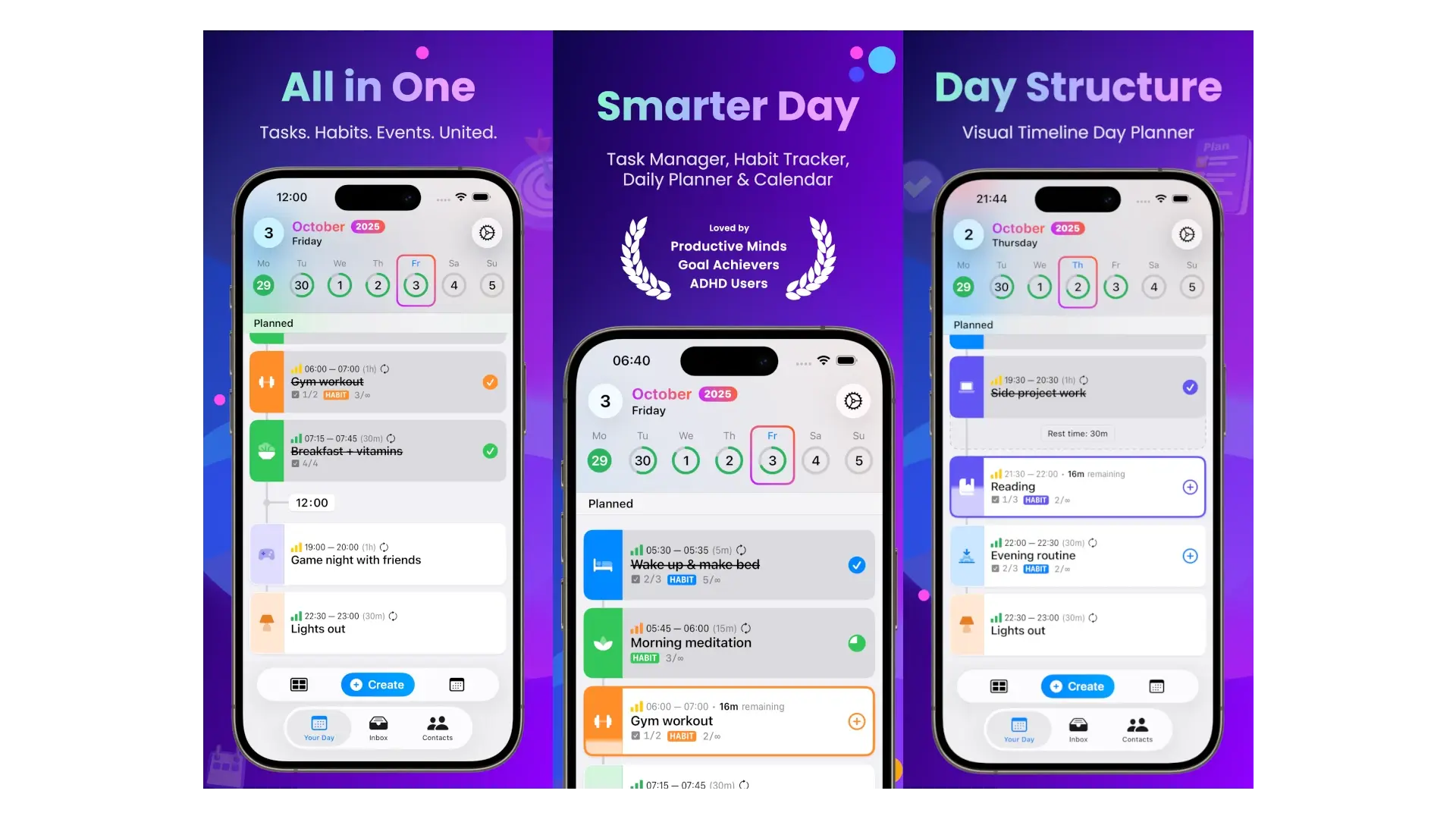
The most productive people don’t rely on willpower; they build systems that make focus, prioritization, and follow-through easier. Pick two or three methods from this guide, test them for two weeks, and iterate. Small changes compound into meaningful results. If you want a single place to prioritize, plan, and track deep work with less friction, try the productivity app at Smarter.Day. It can help you apply timeboxing, Top 3 goals, and review rituals without juggling multiple tools.
Whether you need better prioritization, fewer meetings, or sharper focus, the right system will meet you where you are. Start small, stay consistent, and let your workflow improvement drive sustainable performance.
You May Also Like
These Related Stories
10 Proven Productivity Systems That Actually Work Today
12 Proven Time Management Tactics for Peak Productivity
No Comments Yet
Let us know what you think