

10 Proven Time Optimization Tactics for Busy People

Style: Conversational and evidence-driven
Category: Time Management & Prioritization
Title: 10 Proven Time Optimization Tactics for Busy People
Description: Boost productivity with science-backed time optimization tactics. Get practical steps, real examples, and expert tips to improve focus and workflow.
H1: 10 Proven Time Optimization Tactics for Busy People
Introduction
Let’s face it—your to-do list multiplies while your attention shrinks. Procrastination sneaks in, email pings multiply, and by mid-afternoon you’re juggling tasks with dwindling energy. If you’ve felt overwhelmed, distracted, or stuck in reactive mode, you’re not alone. The good news? There are reliable, science-backed methods to optimize your time, sharpen your focus, and improve workflow without burning out. With a few smart shifts, you can change how your day feels—and what you accomplish.
This post delivers practical, research-backed strategies you can start using today. From timeboxing and deep work to habit design and energy management, you’ll learn how to prioritize effectively, reduce cognitive overload, and build momentum. We’ll share real-world examples and expert references so you can select the methods that fit your schedule, goals, and work style. Ready to reclaim your day? Let’s get to it.
H2: Timeboxing Your Day to Beat Parkinson’s Law
Timeboxing allocates fixed blocks on your calendar for specific tasks, forcing clarity and boundaries. Pair it with Parkinson’s Law—the idea that “work expands to fill the time available for its completion” (C. N. Parkinson)—to tighten timelines and speed up delivery. Method one: assign shorter, focused boxes for complex tasks to avoid overthinking. Method two: add a five-minute buffer between boxes to reset. A software engineer, Nina, shifted from open-ended coding to two-hour timeboxes and shipped features faster while reducing late-night spills.
To apply it, schedule your highest-value task first and protect it like a meeting with your future self. Use a visible timer and mark the box complete even if the task isn’t perfect; iterate later. Research on temporal landmarks and goal pursuit suggests structured time cues increase follow-through (Milkman et al.). The first week may feel rigid, but by week two, your decision fatigue drops, and your workflow improvement becomes obvious.
For deeper accountability, layer in a hard stop: share your end time with a teammate or set your room lights to change color at the end of a block. If interruptions hit, log them on a sticky note rather than switching contexts, then resolve them in a designated “catch-up” box. This aligns with Cal Newport’s advice in Deep Work to create time boundaries that protect cognitively demanding tasks and limit shallow work creep.
H2: Prioritize with the Eisenhower Matrix and the Ivy Lee Method
When everything feels urgent, nothing is. Use the Eisenhower Matrix to categorize tasks by urgency and importance, then combine it with the Ivy Lee Method: write the six most important tasks for tomorrow, prioritize them, and tackle them in order. Method one: identify one “must move the needle” task (important, not urgent). Method two: defer or delete items that are urgent but low-impact. Maya, a marketing lead, trimmed her day from 18 tasks to six and cut reactive churn by half.
Stephen Covey popularized this prioritization technique in The 7 Habits of Highly Effective People, emphasizing that important but not urgent work (like planning and risk mitigation) drives long-term performance. Write your six-item list before you stop work; your brain will “work the problem” overnight. The next morning, start at item one—no inbox, no Slack—until it’s complete. This single constraint builds momentum and reduces anxiety.
For clarity, add quick labels:
- I = Important
- U = Urgent
- D = Delegate
- X = Delete
By midweek, you’ll notice fewer context switches, a calmer mind, and more meaningful output. The discipline may feel strict, but the payoff is compounding focus.
H2: Schedule Deep Work and Manage Attention Drift
High-value work needs distraction-free blocks. Cal Newport’s Deep Work shows that intense, uninterrupted concentration produces outsized results. Method one: set 60–120 minute deep work windows with devices on Do Not Disturb and a clear success metric. Method two: use attention cues—a physical sign or a specific playlist that signals “focus mode.” A product manager, Alex, scheduled two daily deep blocks and saw proposal quality soar while meeting time shrank.
Gloria Mark’s research on attention shows it can take over 20 minutes to fully re-focus after an interruption. Build a recovery ritual: when interrupted, jot a one-sentence summary of your current thought, then return using that cue. Keep a “parking lot” notepad for random thoughts to prevent mental tab-switching. If distraction persists, shift to a single-tab browser policy during deep sessions.
If you must be reachable, set a compromise: one communication check at the half-way mark. “Make it easy to start and hard to stop” by prepping inputs beforehand—open the doc, load datasets, and close side apps. Over time, your cognitive performance sharpens, and the quality of insights compounds.
H2: Batch Similar Tasks and Tame Email with Protocols
Every context switch taxes your brain. Reduce switching costs by batching similar tasks: group all writing, all reviews, or all admin. Method one: create theme blocks (e.g., “reviews” at 3–4 pm). Method two: set email protocols—process email at fixed windows (e.g., 11:30 am, 4:30 pm) with rules like “two-minute replies, otherwise schedule.” McKinsey estimates knowledge workers spend about 28% of their week on email; batching can reclaim hours.
Use a simple triage flow:
- Reply in two minutes or less.
- Defer with a scheduled timebox.
- Delegate with clear next steps.
- Archive aggressively.
Sam, a customer success lead, moved from always-on email to two windows a day. Response quality improved, stress declined, and clients received clearer guidance. Pair this with templates for common replies to accelerate throughput and maintain tone. Research on implementation intentions (Gollwitzer) supports pre-deciding your “if-then” rules to reduce decision fatigue and increase consistency.
For maximum benefit, set your inbox to zero only weekly. Daily, aim for clarity, not perfection. Your workflow optimization comes from fewer interruptions and more deliberate processing.
H2: Build Momentum with Tiny Habits and Habit Stacking
Big goals often stall because the first step is too big. BJ Fogg’s Tiny Habits emphasizes starting ridiculously small—30 seconds of action—then scaling. Method one: pick a starter habit (open your planning doc) and attach it to a stable anchor (after coffee, start your plan). Method two: use habit stacking (James Clear, Atomic Habits) to chain behaviors: after you write the first sentence, set a 25-minute timer. Liam, a data analyst, began with “run code for five minutes after lunch” and soon built a 45-minute daily analysis block.
Two practical cues:
- Anchor to existing routines (“After I sit at my desk…”).
- Celebrate with a micro “yes” to reinforce identity (“I’m someone who starts quickly.”)
Fogg’s research shows that emotion wires habits faster than repetition. Keep friction low—preload files, pins, and templates—so starting is effortless. Over weeks, these micro-beginnings create consistent output and a noticeable performance lift.
If you slip, shrink the habit, don’t skip it. The goal is consistency over intensity, which sustains productivity under pressure.
H2: Manage Energy with Ultradian Rhythms and Movement Snacks
Time management fails without energy management. Humans operate in 90–120 minute ultradian cycles (Kleitman), with natural peaks and dips. Method one: schedule thinking-heavy work during your personal peaks; reserve admin for lows. Method two: insert movement snacks—60–120 seconds of walking, mobility, or breathwork—every 60–90 minutes. Neuroscientist Andrew Huberman emphasizes light exposure and movement for alertness; morning daylight plus brief walks can boost focus.
Try this three-part routine:
- Morning: bright light, hydration, and a 90-minute focus block.
- Midday: 10–15 minute outdoor walk to reset.
- Afternoon: shorter 50-minute work sprints with brief breaks.
Priya, a consultant, shifted her proposals to 9–11 am and batched calls later. Her accuracy improved, revisions dropped, and she ended days with energy to spare. Track your peaks for a week and align tasks accordingly. You’ll notice time optimization is easier when biology and schedule cooperate.
H2: Set Outcomes with OKRs and WOOP to Avoid Busywork
To avoid mistaking motion for progress, anchor your time to clear outcomes. Method one: use OKRs (Objectives and Key Results), popularized by Andy Grove and John Doerr, to define measurable results. Method two: apply WOOP (Wish, Outcome, Obstacle, Plan) by Gabriele Oettingen to anticipate friction and pre-plan responses. Diego, a team lead, set an objective to “Reduce onboarding time by 20%” with key results tied to cycle time and NPS; daily work became easier to prioritize.
Draft your plan like this:
- Objective: meaningful, directional, time-bound.
- Key Results: numeric and verifiable.
- WOOP: identify the most likely obstacle and a specific “if-then” plan.
Studies on mental contrasting show that pairing positive visualization with obstacle planning improves follow-through. Review OKRs weekly and prune any to-do that doesn’t advance a key result. This creates a positive pressure that kills busywork and channels effort toward workflow improvement that matters.
H2: Offload Memory with a Second Brain and Smart Templates
Your brain is for ideas, not storage. Use a second brain—a trusted system for notes, tasks, and references—to reduce cognitive load. Method one: capture insights in atomic notes with keywords and sources (Tiago Forte’s Building a Second Brain). Method two: build templates for recurring tasks—meeting notes, briefs, code review checklists—so you start at 60% complete. Rita, a project manager, templated her kickoff docs and cut prep time by 40%.
Keep it simple:
- A central capture inbox (app or notebook).
- A weekly sorting ritual into projects, areas, and archives.
- A small set of evergreen templates.
Cognitive offloading research shows externalizing information frees attention for problem-solving. The win is twofold: fewer errors and faster starts. Over time, your repository becomes a compounding asset—a searchable knowledge base that accelerates every project, boosting both speed and quality.
H2: Make Meetings Productive with Agendas, Roles, and Silent Starts
Meetings should be a multiplier, not a tax. Method one: require written agendas and desired outcomes; cancel meetings that don’t have them. Method two: use defined roles (owner, decision-maker, timekeeper) and consider a silent reading start, inspired by Amazon’s narrative memo practice, to level-set context. Ethan, a product lead, trimmed his weekly sync from 60 to 35 minutes by enforcing agendas and a 5-minute silent read.
Add these mechanics:
- 25/50-minute defaults to preserve buffer time.
- Record decisions and owners live.
- End with next steps and deadlines.
The RACI framework can clarify accountability and reduce follow-up chaos. Research on team effectiveness (Google’s Project Aristotle) highlights psychological safety and clarity as key drivers; clear processes produce better outcomes and fewer meetings. With structure, you reclaim hours for focused work, improving time optimization without sacrificing collaboration.
H2: Use Micro-deadlines and the Pomodoro Technique to Finish Faster
Speed comes from structure. Method one: set micro-deadlines—intermediate checkpoints with visible timers—to avoid last-minute rushes. Method two: use the Pomodoro Technique (Francesco Cirillo): 25 minutes on, 5 off, after four cycles take a longer break. A designer, Hana, broke a complex deliverable into six Pomodoros; she finished earlier and with fewer revisions because feedback arrived sooner.
Tips to amplify results:
- Define “done” for each micro-deadline before you start.
- Use a physical timer to create urgency and reduce app toggling.
- Log one improvement insight after each cycle to refine your process.
Studies on temporal construal suggest nearer deadlines feel more concrete, increasing action. Tuning interval length to task complexity (e.g., 40/10 for creative work) can maintain flow. The aim is consistent shipping, not perfection in one go.
H2: Review Weekly and Leverage the Progress Principle
Without review, improvement stalls. Method one: run a weekly review—clear inboxes, audit your calendar, realign tasks with goals, and plan your top six for next week. Method two: apply the Progress Principle (Teresa Amabile): track small wins daily to boost motivation and momentum. Omar, a startup founder, added a Friday review and a “wins” log; his team reported higher clarity and better morale within a month.
Your review checklist:
- What worked? What didn’t? Why?
- What to stop, start, continue?
- Which commitments will I renegotiate or decline?
Research shows that recognizing progress—even tiny wins—elevates intrinsic motivation and persistence. Pair your review with a short retrospective: one process tweak to test next week. Over time, this loop turns improvement into habit, amplifying performance while preventing burnout.
Conclusion
You don’t need more hours—you need smarter time optimization. By combining prioritization, deep work, batching, habit design, energy management, and structured reviews, you can cut noise, preserve attention, and consistently deliver meaningful results. Start small, stack wins, and let systems do the heavy lifting.
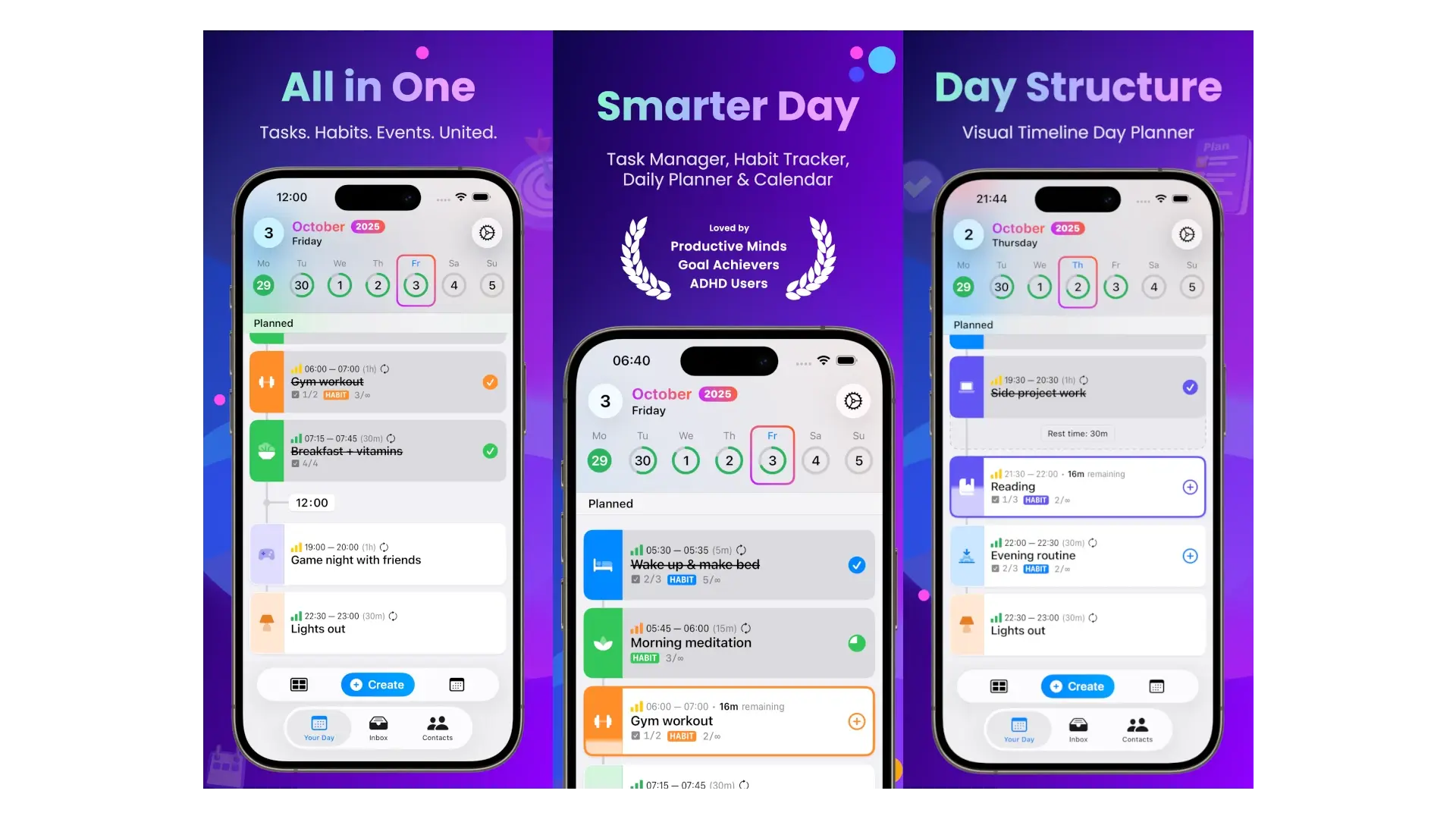
If you want an effortless way to plan, focus, and track progress, try the productivity app at Smarter.Day. It blends planning, focus timers, and review prompts so your best work happens on schedule—without the overwhelm.
You May Also Like
These Related Stories
10 Proven Time Optimization Tactics for Busy People
10 Proven Time Optimization Tactics for Busy People
No Comments Yet
Let us know what you think