

Advanced Time Management: 10 Proven Productivity Wins

Advanced Time Management: 10 Proven Productivity Wins
Introduction
Let’s face it—our calendars look full, but our progress often feels thin. Between pings, meetings, and context switching, your attention gets sliced into confetti. Here’s the catch: time isn’t your only bottleneck—attention and energy are, too. This post gives you a focused playbook to solve procrastination, overwhelm, and distraction with actionable time optimization strategies you can apply today. Expect research-backed tactics, relatable examples, and practical workflows designed for busy professionals who want sustainable performance.
We’ll walk through ten advanced methods that improve workflow efficiency, focus management, and planning discipline without adding friction. You’ll learn how to block time, build habits that stick, and use data to refine your routines. Whether you’re a founder, manager, or maker, these techniques will help you reclaim hours, protect deep work, and drive meaningful output—not just busyness.
1) Time Blocking That Actually Works (Not Just Boxes on a Calendar)
Most people “time block” by dragging rectangles on a calendar. The upgrade is structured time blocking—designing a weekly template calibrated to your energy and priorities. Method one: create a fixed weekly scaffold with 2–3 deep work blocks (60–120 minutes) on high-energy mornings and batch admin in low-energy zones. Method two: add buffer blocks (15–20 minutes) before and after meetings to prevent overrun and task bleed. Sara, a marketing manager, cut her daily spillover by 40% using buffers and a Tuesday/Thursday deep work cadence.
Cal Newport, author of Deep Work, emphasizes that “attention is the new IQ in the knowledge economy.” His approach supports reserving focus time for cognitively demanding tasks and relegating shallow work to predefined windows. For added control, implement calendar guardrails: color-code deep work, lock no-meeting mornings, and set default meeting lengths to 25 or 50 minutes. You’ll improve throughput and reduce fatigue from context switching.
Finally, leverage Parkinson’s Law—work expands to fill the time available—by setting hard stops. A simple trick: schedule something you care about immediately after a deep work block (like lunch or a walk). This forces a natural constraint and strengthens your completion muscle. When Sara began pairing a noon workout with her morning deep block, she shipped presentations earlier and with fewer revisions.
2) Prioritization Beyond To-Do Lists: MITs, Eisenhower, and Scoring
If everything is a priority, nothing is. Start with the Most Important Task (MIT): choose one high-impact task to complete before noon. Pair this with the Eisenhower Matrix to separate urgent from important. Method one: assign MITs to “Important/Not Urgent” and schedule them first. Method two: ruthlessly delegate or delete items in “Not Important” quadrants. Devin, a product lead, moved status updates to async and cleared 3 hours weekly for roadmap work.
For complex backlogs, add light-weight scoring. Use ICE or RICE scoring (Impact, Confidence, Effort; Reach, Impact, Confidence, Effort) to triage competing initiatives. This quantifies trade-offs and improves stakeholder alignment. Gary Keller’s The One Thing reinforces focusing on the one task that makes everything else easier or unnecessary—an elegant complement to scoring and MITs.
To prevent “priority creep,” implement a daily lock: after choosing your MITs and 2–3 supporting tasks, don’t add new work until the afternoon. Devin used a simple personal policy—no new tasks before 1 p.m.—and reported fewer partial starts and more completed deliverables. The result: consistent momentum and less decision fatigue.
3) Beat Context Switching with Batching and Single-Task Sprints
Multitasking feels efficient but erodes performance. Stanford research by Clifford Nass found heavy multitaskers perform worse at filtering irrelevant information and switching tasks. Strategy one: task batching—group similar tasks (emails, approvals, analytics) and process them in dedicated windows. Strategy two: single-task sprints—work in 25–50 minute intervals on one task, then break. Maria, a customer success leader, batched ticket reviews to 11:30 a.m. and 4 p.m., cutting reactive checking by 60%.
Use rules of engagement to stop leakage: mute notifications during sprints, open only essential tabs, and keep a “parking lot” note for intrusive thoughts. Pair this with the Pomodoro Technique (Francesco Cirillo) or 50/10 cycles to balance intensity and recovery. You’ll sharpen focus and reduce re-entry time.
To further curb switching costs, apply context crates—project-specific folders with briefs, assets, and checklists. When Maria opens her “Renewals” crate, everything she needs is ready. No scavenger hunts, no browser rabbit holes. Over a quarter, her team reduced average resolution time by 18%—a tangible workflow improvement from better cognitive ergonomics.
4) Align Work with Energy: Chronotypes and Ultradian Rhythm
You don’t run software on low battery; don’t run your brain that way either. Method one: schedule deep work in your chronotype’s peak. Early larks block mornings; night owls reserve late afternoons. Method two: work in 90–120 minute ultradian cycles with short breaks—research by sleep scientist Nathaniel Kleitman suggests natural performance rhythms. Jamal, a data analyst, shifted modeling to 9–11 a.m. and slotted meetings post-lunch; his error rate dropped and output rose.
Daniel Pink’s book When synthesizes research showing most people peak in the morning, slump midday, and rebound late afternoon. Use this peak-trough-rebound model: creative or analytical work during peaks, admin during troughs, and collaborative tasks during rebounds. Protect your peaks with no-meeting blocks and do-not-disturb modes.
For recovery, adopt active breaks: a 5-minute walk, mobility drills, or a short breathing reset (box breathing 4-4-4-4). Jamal added two micro-walks per morning block and reported better clarity. The lesson: energy management beats time management alone. Optimize your schedule to your biology, and watch performance compound.
5) Procrastination Antidotes: Tiny Starts and Implementation Intentions
Procrastination isn’t laziness; it’s an emotion regulation problem. Method one: the 10-Minute Rule—commit to just ten minutes. Momentum often carries you forward. Method two: implementation intentions—pre-commit with if–then plans (“If it’s 9 a.m., then I open the brief and write the first paragraph”). Priya, a consultant, used the 10-minute start to overcome deck dread and routinely built 45-minute flows.
BJ Fogg’s Tiny Habits shows that small, easy starts reduce friction and build consistency. Pair that with temptation bundling (Katy Milkman): combine a task with a reward (listen to a favorite playlist only when working on invoices). Over time, the brain associates progress with pleasure, reducing avoidance.
For thorny tasks, try costly commitment: put a small stake on the line (e.g., donate $20 if you miss a block). Piers Steel’s The Procrastination Equation highlights how increasing immediacy and value raises motivation. Priya set a Slack check-in with her team by 10:30 a.m.; public accountability improved delivery quality and timeliness.
6) Distraction-Proof Focus: Digital Minimalism and Environment Design
Our environment silently shapes behavior. Method one: practice digital minimalism—unsubscribe, unfollow, and remove nonessential apps from your home screen. Method two: environment design—work with a clean desk, closed door, and single-tab policy during deep work. Luis, a software engineer, kept one IDE window, turned on full-screen mode, and hid the dock; his focus time increased immediately.
Cal Newport’s Digital Minimalism champions intentional tech use—choose tools that serve your values, not hijack them. Add website blockers (e.g., block social feeds 9–12) and use the two-device rule: one device for comms, one for creation, to separate contexts. Combine with noise-cancelling headphones and instrumental playlists if you’re in a noisy space.
To reduce cognitive residuals, implement shutdown rituals: review tomorrow’s top 3, tidy your workspace, and close all apps. “What gets measured gets managed,” said Peter Drucker—track your focus ratio (deep work hours/total work hours). Luis increased his weekly focus ratio from 22% to 38% by treating attention as a finite asset.
7) Meeting Hygiene and Async Culture: Reclaim Hours Every Week
Meetings aren’t free—they compound interrupt costs. Method one: enforce agenda-first invites with clear decision owners. No agenda, no meeting. Method two: shift status updates to async channels (written briefs, short Loom videos). According to Atlassian’s research, workers spend hours weekly in unnecessary meetings; Microsoft’s Work Trend Index shows async tools reduce meeting load and improve team performance.
Adopt meeting design principles: 25- or 50-minute defaults, roles (facilitator, scribe, decider), and decision logs. Tasha, a design director, replaced her 60-minute weekly with a 10-minute async roundup and a 25-minute decision huddle. The team regained 3–4 hours weekly and improved cycle time.
For recurring sessions, apply sunset clauses: renew only if value is proven. Use pre-reads with comment deadlines to move discussions forward. Track “cost of meeting” (attendees x time) alongside outcomes. When Tasha calculated costs, she cut a cross-team sync that burned $1,200/week with little impact—clean, data-led time optimization.
8) Automation and Delegation: Build Systems That Work While You Don’t
Automation is leverage. Method one: map your SOPs (Standard Operating Procedures) and convert repeatable steps into templates. Method two: use no-code automations (e.g., route form submissions to a spreadsheet and Slack, auto-tag tasks, auto-generate invoices). Diego, an operations lead, automated onboarding emails and file creation, saving 5 hours per week.
McKinsey estimates that a significant share of tasks across roles can be automated with current technology. Combine with smart delegation: apply the 70% rule—if someone can do it 70% as well, delegate and coach. Provide a success checklist, a sample output, and a short loom walkthrough to accelerate autonomy.
Review your stack quarterly: prune overlapping tools, consolidate workflows, and track automation ROI (hours saved x cost). Diego built an “automation backlog,” prioritizing by effort and impact. Within a month, his team eliminated manual copy-paste steps across CRMs and docs—less error, more speed, and better workflow improvement.
9) The Weekly Review: Close the Loop and Plan with Clarity
Without a review, tasks multiply and priorities blur. Method one: run a GTD-style weekly review (David Allen): collect, clarify, organize, reflect, and engage. Method two: set three wins for the week—clear, achievable outcomes aligned to goals. Nia, a project manager, blocked Friday afternoon for review and Monday morning for planning; fire drills dropped dramatically.
Structure your review:
- Clear your inboxes (email, tasks, notes)
- Reassess priorities using the Eisenhower Matrix
- Schedule MITs and deep work blocks
- Audit your calendar for conflicts and buffers
Allen’s Getting Things Done shows how externalizing commitments reduces mental load. Nia added a 5-minute end-of-day log to note progress and blockers. By Monday, she started with a clean plan and fewer surprises. Over a quarter, her team’s on-time delivery improved because planning was proactive, not reactive.
10) Data-Driven Productivity: Track, Test, and Iterate
“What gets measured gets improved” only if you measure the right things. Method one: track leading indicators—deep work hours, interruption count, and task completion rate. Method two: run A/B tests on your routine—try 90-minute vs 50-minute cycles, morning vs afternoon deep work, or different prioritization systems. Omar, a founder, discovered his best idea work happened 8–10 a.m.; he shifted customer calls to afternoons and raised output quality.
Teresa Amabile’s research on the progress principle shows that visible progress fuels motivation. Use simple dashboards to visualize trends and celebrate small wins. Add a weekly retrospective: what worked, what didn’t, what will change. Keep it to 10 minutes to sustain consistency.
For better accuracy, pair subjective ratings (energy 1–5, focus 1–5) with objective metrics (calendar blocks honored, tasks completed). Over a month, Omar increased his “focus adherence rate” from 50% to 78% by iterating on meeting placement and pre-block routines. Your time is a lab; experiment until your performance compounds.
Conclusion
You don’t need heroic willpower to work better. You need systems that respect your attention, energy, and priorities. From time blocking and MITs to automation and data-driven iteration, these strategies help you ship important work with less friction and more consistency. Start small—pick one section, apply two methods, and refine weekly. Progress compounds.
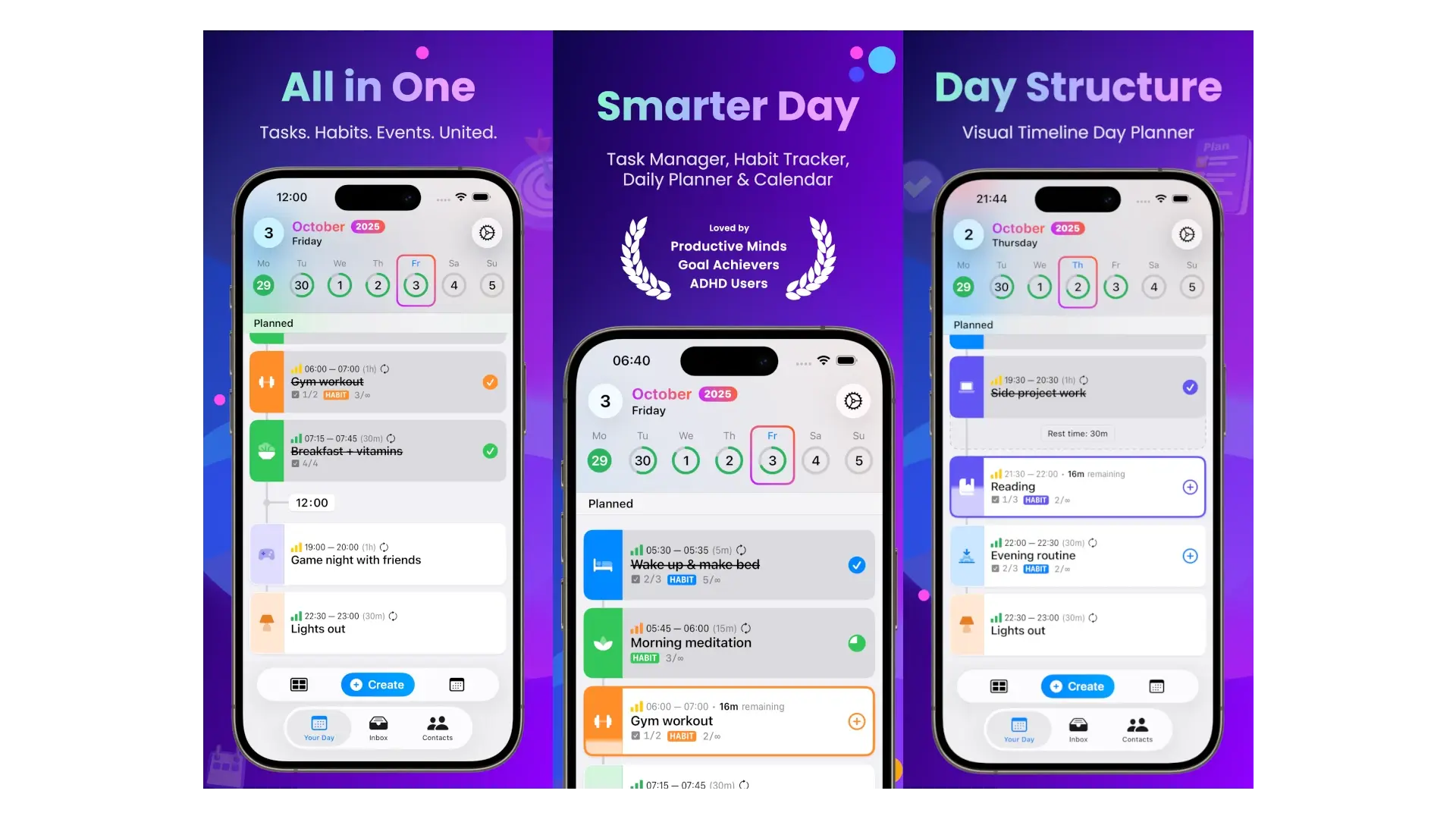
If you want a ready-made system that supports these workflows—deep work protection, habit tracking, and intelligent scheduling—try the productivity app at Smarter.Day. It’s designed to help you implement what you just learned without wrestling with tools.
You May Also Like
These Related Stories
13 Proven Productivity Strategies for Busy Professionals
13 Proven Productivity Strategies for Busy Professionals
No Comments Yet
Let us know what you think