
Master Your Time: 10 Evidence-Based Productivity Systems

Master Your Time: 10 Evidence-Based Productivity Systems
We’ve all sat through days where the to-do list grows faster than we can tick items off. The clock feels like it’s sprinting while our focus crawls. Here’s the catch: productivity isn’t just willpower—it’s a system problem. When you lack a reliable framework for prioritization, attention, and energy, the brain defaults to easy, not important. This post shows how to build time optimization habits that beat procrastination, tame distraction, and deliver workflow improvement you can feel by noon. We’ll lean on proven research and practical methods that you can apply today.
You’ll leave with a toolkit of evidence-based strategies: from timeboxing and Deep Work to OKRs, automation, and smarter email management. We’ll keep it real with examples from everyday knowledge workers and share sources from Cal Newport to McKinsey that validate what works. Think of this as your action plan to reclaim attention, reduce decision fatigue, and convert busy days into high-value output—without burning out.
1) Timeboxing and Calendar Blocking That Actually Stick
Let’s face it—if tasks aren’t on your calendar, they rarely get done. Timeboxing assigns a fixed slot to a task, turning intention into a commitment. Nir Eyal popularized this in “Indistractable,” while Parkinson’s Law reminds us that work expands to fill the time available. By shrinking the container, we force focus. Cal Newport’s calendar-blocking approach reinforces this, creating deliberate, uninterrupted stretches. Here’s the secret: the calendar becomes your to-do list, and each block reflects a prioritization decision you’ve already made. You spend less time deciding and more time doing.
Two practical methods: First, plan tomorrow today—in 15 minutes, block 2–3 high-impact “focus blocks,” then add 15-minute buffers. Second, use color-coding: deep work (blue), admin (gray), meetings (green). If a meeting appears, move—not delete—your focus block. Bonus: schedule a daily “no-meeting window” and guard it. This small fence around your attention pays off. As Eyal writes, “If you don’t plan your time, someone else will plan it for you.”
Real-life example: Maya, a product manager, set three 90-minute deep blocks weekly for roadmap work. She added 15-minute buffers for context switching and batched standup updates afterward. Within two weeks, she delivered a clear Q2 plan she’d delayed for a month. Using this cadenced calendar, her interruptions felt manageable because she’d pre-decided where her best energy goes—exactly what timeboxing optimizes for.
2) The Eisenhower Matrix Meets 80/20: Prioritize What Moves Needles
Dwight Eisenhower’s simple framework—urgent vs. important—helps you reduce noise. Stephen Covey’s “7 Habits” pushes us into Quadrant II: important but not urgent work. When combined with the Pareto Principle (80/20), you identify the few tasks that produce most results. Together, these tools enable ruthless focus on leverage. As Tim Ferriss notes, “Doing less is not being lazy. It’s smart.” The goal isn’t to do more—it’s to do more of what matters and less of what doesn’t.
Two practical methods: First, run a five-minute daily triage: divide your list into the Eisenhower Matrix, then star just three Most Important Tasks (MITs). Second, audit your week with an 80/20 review: list activities and ask, “Which 20% drove 80% of outcomes?” Eliminate or delegate the rest. Use a simple “Cancel, Delegate, Automate” rule for low-value tasks. Repeat weekly to stay aligned.
Real-life example: Leo, a startup founder, applied the Matrix plus 80/20. Ten initiatives were crowding his calendar; only two moved revenue. He cut four initiatives, delegated two, and automated reporting using a dashboard. Results: more time for sales conversations (important, not urgent), which doubled his pipeline in six weeks. Covey would approve: Leo shifted from firefighting to strategic progress.
3) Deep Work and Attention Management in a Distracted World
Cal Newport’s Deep Work argues that distraction-free concentration produces the best cognitive performance. Meanwhile, UC Irvine’s Gloria Mark shows frequent task switching introduces “attention residue,” lowering productivity even after interruptions stop. Translation: fragmented attention costs more than you think. Deep Work is not a luxury; it’s the engine of meaningful output. “Clarity about what matters provides clarity about what does not” (Newport). Your calendar is your shield.
Two practical methods: First, create a distraction-free environment with website blockers (e.g., Freedom) and phone in another room. Second, use commitment devices: book a Focusmate session or sit in a quiet library corner. Add a “shutdown ritual” (Newport) at day-end to list tomorrow’s first task; this cuts mental looping and reduces stress. Define “deep” tasks in advance to avoid busywork creep.
Real-life example: Ariel, a UX designer, scheduled two 120-minute deep sessions weekly for a redesign and used a blocker to silence social feeds. She wrote a two-line intent statement at the start: problem, criteria. Result: a clean prototype in eight days, where past attempts took three weeks. The difference wasn’t talent—it was attention management backed by clever constraints.
4) Manage Energy, Not Just Time: Ultradian Rhythms and Smarter Breaks
Productivity follows biology. Sleep researcher Nathaniel Kleitman documented ultradian rhythms—90-minute cycles of high and low alertness. The DeskTime/Draugiem Group analysis suggests a 52/17 work-to-break ratio correlates with top productivity. Breaks aren’t slacking; they’re maintenance for cognitive performance. The goal is to align deep work with peaks and schedule recovery during troughs. When we harmonize with natural cycles, we gain speed and sustainability—a win for both output and well-being.
Two practical methods: First, try 90/20 or 52/17: work intensely, then take a real break away from screens. Second, use movement snacks—a brisk walk, stretches, light exposure—to reset attention. Add water and a protein-rich snack in the afternoon to avoid crashes. Track peaks for a week and place your hardest work inside those windows. This is time optimization anchored in physiology.
Real-life example: Omar, a software engineer, noticed his sharpest hours were 9:30–11:30 a.m. and 2–3 p.m. He blocked code reviews for the afternoon trough and scheduled algorithm work during morning peaks. With 15-minute walking breaks, he reduced refactor errors and shaved a day off sprint estimates. It wasn’t more hours—it was better energy management.
5) Batching, Single-Tasking, and WIP Limits to Cut Context Switching
Every context switch taxes your brain. Kanban practices, championed by David J. Anderson, use WIP limits (work-in-progress) to reduce thrash and improve flow. The science of multitasking is clear: we don’t parallel process; we switch—and pay a toll each time. Limit concurrent tasks, and output becomes smoother and faster. In other words, workflow improvement is often a subtraction exercise.
Two practical methods: First, batch similar tasks—process email, make calls, and file expenses in dedicated windows. Second, set a WIP limit of 3: never actively juggle more than three projects. Use theme days (e.g., Tuesday = strategy, Thursday = operations) to concentrate effort. Visualize tasks on a Kanban board (To Do / Doing / Done) and keep “Doing” to three or fewer.
Real-life example: Priya, a content marketer, grouped all writing on Mondays and research on Wednesdays, capped her WIP at three pieces, and batched image sourcing after lunch. Turnaround times improved by 30%, and revisions dropped. The board made overcommitment obvious. By reducing cognitive load, she found more creative energy for headlines and structure—the real levers in her role.
6) Email and Notification Hygiene: Regain Hours Each Week
A 2015 study by Kostadin Kushlev and Elizabeth Dunn found that checking email less frequently reduces stress. Gloria Mark has also shown that email “vacations” lower measured stress and improve focus. Combine that with Microsoft’s Work Trend Index, which shows rising meeting and notification overload, and it’s clear: constant checking is the silent killer of focus. You don’t need fewer messages—you need better rules for when and how you interact with them.
Two practical methods: First, set three email windows (e.g., 11 a.m., 2 p.m., 4:30 p.m.) and turn off push alerts. Second, create VIP filters and route newsletters to a “Later” folder. Try an Inbox Zero Lite: archive aggressively and rely on search. For chat apps, switch to mentions-only notifications and establish team norms for response times (e.g., async by default, 24-hour SLA).
Real-life example: Elena, a CFO, had 2,000+ unread emails and constant pings. She set three windows, used rules to auto-tag vendors, and created templates for recurring requests. Within two weeks, her inbox dropped to 40 by day’s end, and her afternoon finance reviews felt calm. Less dopamine chasing, more deliberate decisions.
7) Habit Stacking and Tiny Habits to Make Consistency Easy
Behavior scientist BJ Fogg (Tiny Habits) argues that small, well-anchored behaviors drive lasting change. James Clear popularized habit stacking in “Atomic Habits”: pair a new action with an existing routine to reduce friction. The formula is simple: After I [existing habit], I will [new habit]. We’re designing defaults, not relying on motivation. Over time, these micro-commitments become automatic, compounding into reliable productivity gains.
Two practical methods: First, write three habit recipes: “After I open my laptop, I’ll plan the day for 3 minutes.” Second, add temptation bundling (Katy Milkman’s research): pair something you want (music, coffee) with a task you resist (inbox triage). Track streaks visibly to sustain momentum. Use environment design: keep cue and tools within reach to lower activation energy.
Real-life example: Nia, a grad student, stacked “write 100 words” after making coffee and bundled it with a favorite playlist. That small, repeatable action built a first-draft habit. In six weeks, her thesis intro was finished—a win that had eluded her for months. The lesson: tiny beats intense when it comes to sustainability.
8) OKRs and Weekly Reviews: Align Work with What Matters
OKRs—Objectives and Key Results—popularized by John Doerr in “Measure What Matters,” bring clarity and measurable outcomes to your quarter. The Progress Principle by Teresa Amabile shows that small wins are a primary driver of motivation. Pairing OKRs with a weekly review maintains line-of-sight between daily tasks and strategic goals. What gets measured gets managed; what gets reviewed gets done.
Two practical methods: First, set quarterly OKRs with 2–4 key results per objective—specific, time-bound metrics. Second, run a Friday review: check key results, log wins, and pick next week’s “Rule of 3” (credit to J.D. Meier’s “Getting Results the Agile Way”). Use a simple dashboard or spreadsheet for visibility. Keep scope tight; ambitious but achievable is the sweet spot.
Real-life example: A five-person nonprofit team adopted OKRs focused on donor retention and program outcomes. Weekly reviews exposed scope creep early and nudged conversations back to key results. In one quarter, retention rose 12%. The team’s morale improved because progress was visible—momentum drives motivation.
9) Lower Cognitive Load and Decision Fatigue with Smart Defaults
Nobel laureate Daniel Kahneman explains that deliberate thinking (System 2) is slow and tiring; your brain conserves it. The infamous study by Danziger et al. (2011) on judges’ rulings suggests decision quality can deteriorate as cognitive resources wane; while debated, the concept of decision fatigue remains useful for designing better workflows. Reduce choices, and you free energy for hard problems. Decision-light mornings create decision-rich afternoons.
Two practical methods: First, adopt standard operating procedures (SOPs) for recurring tasks—checklists turn decisions into steps. Second, pre-decide default calendars (e.g., deep work before noon) and menus (lunch rotation, wardrobe basics). Use templates for proposals and reports. Each default eliminates micro-decisions that chip away at mental energy.
Real-life example: Devin, a remote engineer, simplified mornings: same breakfast, pre-packed gym bag, and a prewritten daily start checklist. He moved sprint planning to 10 a.m. and code reviews to 3 p.m. Cognitive load dropped, and his afternoon debugging sessions became smoother. Fewer trivial choices, more brainpower for real work.
10) Automation, Templates, and Shortcuts: Compounding Minutes into Hours
The McKinsey Global Institute estimates that about 45% of work activities can be automated with current technology. Translation: there’s hidden time in your routine. No-code tools (Zapier, Make), text expansion, and keyboard shortcuts turn seconds into hours. Compounded over a quarter, that’s a project delivered earlier—or a Friday you reclaim. Automation is the quiet ally of workflow improvement.
Two practical methods: First, implement text expanders (e.g., aabg = “Best regards, …”), email templates, and snippet libraries for FAQs. Second, build Zaps: when a form is submitted, auto-create a task, send a Slack note, and file attachments. Learn five high-impact keyboard shortcuts per app and post a cheat sheet near your desk. Audit quarterly for new automation candidates.
Real-life example: Raya, a recruiter, automated interview scheduling with Calendly, used Gmail templates for candidate updates, and added a Zap to log responses in her ATS. She saved roughly five hours per week. More importantly, she spent that time prepping candidates—boosting offer acceptance, not inbox time.
Conclusion
The most productive people don’t rely on heroic willpower; they rely on systems that protect focus, align priorities, and respect energy. You’ve now seen ten research-backed ways to design your day: timeboxing, Deep Work, OKRs, habit stacking, automation, and more. Start with one or two, keep them small, and iterate weekly. Progress compounds faster than perfection.
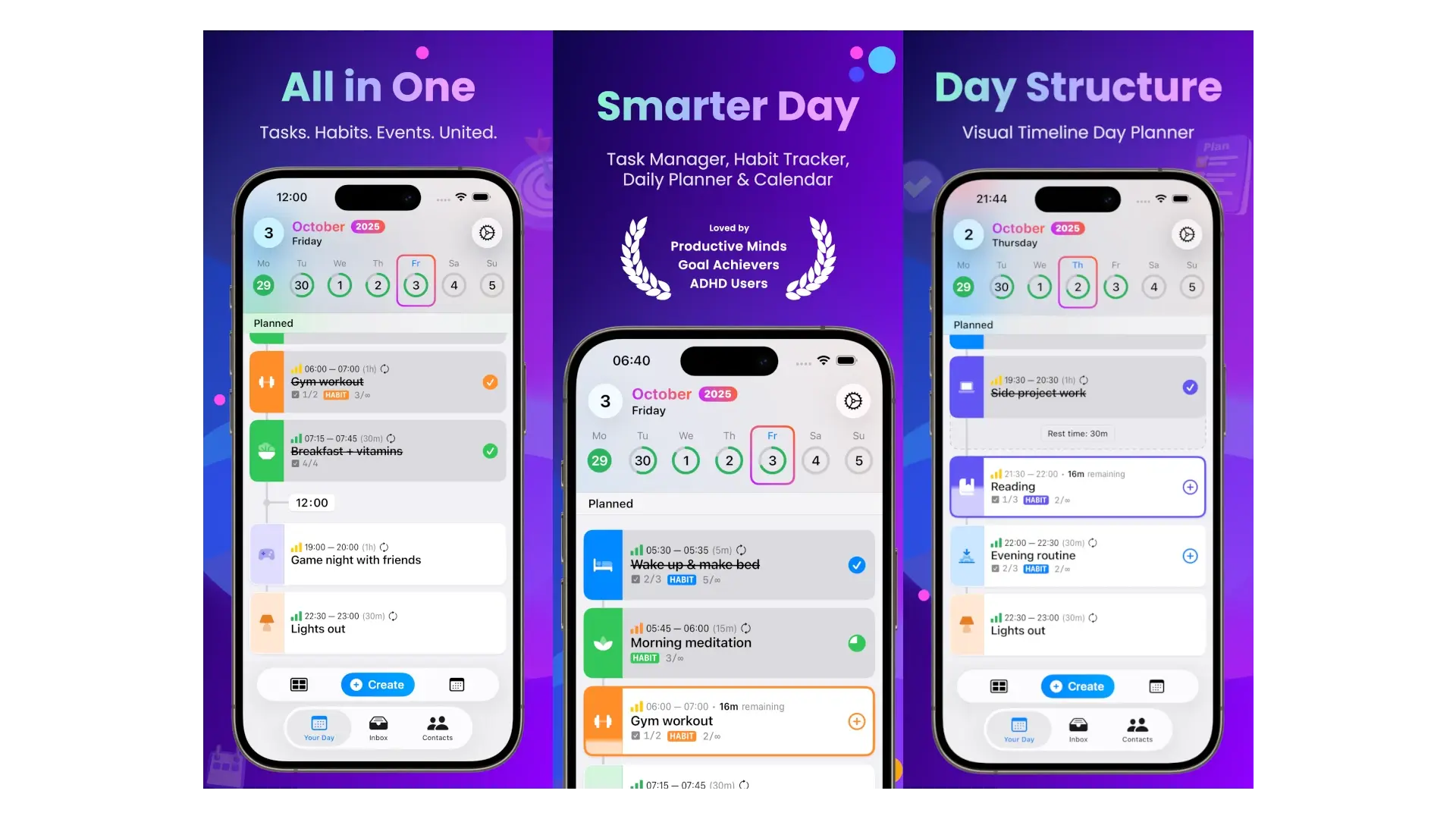
If you want a head start, try a tool that pulls these ideas together—calendar blocking, task batching, reviews, and automation triggers—in one place. The productivity app at Smarter.Day can help you implement these methods without wrestling with multiple tools or losing momentum when life gets busy.
You May Also Like
These Related Stories
12 Proven Productivity Methods for High-Impact Work
12 Proven Productivity Methods for High-Impact Work
No Comments Yet
Let us know what you think