

Time Management Mastery: 12 Proven Productivity Tactics

Time Management Mastery: 12 Proven Productivity Tactics
Introduction
Let’s face it—our days often dissolve into a blur of emails, meetings, and micro-fires. You plan to focus, but pings pile up, tasks expand, and energy drains fast. Here’s the catch: productivity isn’t about stuffing more into your calendar; it’s about time optimization, workflow improvement, and aligning work with your cognitive performance. In this post, we’ll cut through noise and deliver research-backed strategies that actually fit modern work.
You’ll learn 12 proven tactics to reduce overwhelm, reclaim attention, and finish high-impact work without burning out. We’ll blend real examples, expert guidance, and clear steps you can implement today. Whether you’re a manager, creator, or student, these approaches will help you streamline operations, sharpen focus, and build reliable momentum—no hustle theater required. Ready to work with your brain, not against it?
1) Timeboxing and Calendar-First Planning
Timeboxing is the art of allocating fixed blocks for tasks on your calendar. Instead of a bloated to-do list, you commit time to priorities and protect it. Two practices help: 1) Calendar-first planning—schedule your top 3 outcomes before anything else; 2) Buffer zones—add 10–15 minutes between time blocks for notes and resets. As Nir Eyal explains in Indistractable, timeboxing transforms intentions into agreements with yourself, reducing decision fatigue and procrastination.
How to apply it
- Reserve a daily focus block (90–120 minutes) for deep work.
- Batch admin (email, approvals) into two short clusters.
- Color-code themes—e.g., green for client work, blue for strategy.
Cal Newport underscores that time blocking forces trade-offs and improves attention management; it’s deliberate prioritization, not wishful thinking.
Real example: Jamal, a product lead, scheduled 9:00–11:00 a.m. for roadmap work and 3:30–4:00 p.m. for Slack/email. Within two weeks, he reported fewer context switches and shipped spec drafts days earlier, echoing Parkinson’s Law: work expands to fill the time allotted, so box it.
2) The 80/20 Rule and Ruthless Prioritization
The Pareto Principle (80/20) says a small fraction of inputs drive the majority of results. Apply it weekly: 1) Identify the top 20% of tasks that create 80% of value; 2) Eliminate, automate, or defer the rest. Tim Ferriss popularized this in The 4-Hour Workweek, but the origin traces to economist Vilfredo Pareto. The point isn’t perfection—it’s leverage: fewer, bigger levers, pulled consistently.
How to apply it
- Use the Eisenhower Matrix: label tasks as urgent/important; schedule important, decline or delegate the rest.
- Set a “Stop-Doing List.” If a task doesn’t tie to goals, cut or cap it.
A Harvard Business Review piece on “ruthless prioritization” aligns: leaders who limit work-in-progress deliver more strategic outcomes.
Real example: Priya, a marketing manager, realized three campaigns produced 75% of qualified leads. She reallocated time to those channels, paused low-yield experiments, and improved pipeline velocity by 22% in a quarter. Fewer bets, bigger gains.
3) Deep Work Sprints and Attention Management
Deep Work, coined by Cal Newport, is sustained focus on cognitively demanding tasks. Two methods: 1) 90-minute sprints for complex thinking; 2) Distraction fences—disable notifications and use site blockers. Research by Sophie Leroy on attention residue shows that when we switch tasks, part of our attention stays stuck on the prior task, degrading performance.
How to apply it
- Designate 1–2 mornings a week as meeting-free.
- Use website blockers (e.g., Freedom or Cold Turkey) and set your phone to Do Not Disturb.
- Prep “entry cues” (open docs, outline steps) before the sprint.
McKinsey once reported executives felt up to five times more productive in “flow” states; while subjective, the signal is clear: fewer interruptions, better output.
Real example: Lena, a researcher, ran two deep work blocks weekly for literature reviews. By prepping citations and questions in advance, she cut drafting time by 30% and improved clarity, citing Newport’s “focus as a skill to be trained.”
4) The 2-Minute Rule and Quick Capture
When a task takes under two minutes, do it now—that’s David Allen’s famous rule from Getting Things Done (GTD). Pair it with quick capture: jot tasks the moment they occur so your brain stops juggling them. Psychologist Bluma Zeigarnik found incomplete tasks occupy mental space; capturing them reduces cognitive load and anxiety.
How to apply it
- Keep a universal inbox (notes app or paper) for ideas and requests.
- Process your inbox twice daily: 2-minute tasks now, longer tasks scheduled.
- Use keyboard shortcuts or voice capture to speed intake.
Daniel Levitin, in The Organized Mind, explains that externalizing information frees up working memory for higher-order thinking.
Real example: Marco, a customer success rep, captured follow-ups immediately during calls. He cleared sub-2-minute actions between sessions and calendared the rest, reducing missed commitments and improving client satisfaction scores.
5) Single-Tasking and Context Switching Control
Multitasking feels efficient but typically tanks performance. Stanford research led by Clifford Nass found heavy multitaskers perform worse on attention and task-switching tests. Two methods tame this: 1) Single-tasking—one tab, one task; 2) Context windows—batch similar tasks (e.g., all approvals) to reduce setup costs, a principle borrowed from lean manufacturing.
How to apply it
- Use a “One-Tab Rule” during focus sessions.
- Group work by context: writing, reviewing, coding, collaborating.
- Turn off badge counts to curb visual triggers.
Professor Sophie Leroy’s “attention residue” underscores why: switching leaves residue that lowers quality and increases time to re-engage.
Real example: Aisha, a designer, limited Slack checks to the top of each hour. She finished mockups faster and with fewer revisions because her attention wasn’t fragmented by constant status pings.
6) Energy Management: Ultradian Rhythms
Productivity isn’t just time; it’s energy management. Sleep researcher Nathaniel Kleitman identified ultradian rhythms—90–120-minute cycles of peak and dip. Two methods: 1) Work in peak windows (often mid-morning); 2) Take renewal breaks—standing, hydration, a short walk. Matthew Walker’s Why We Sleep reinforces that sleep quality is the bedrock of sustained performance.
How to apply it
- Map your energy across a week; schedule hard tasks in peak zones.
- Practice active breaks: stretch, breathe, or take a daylight lap.
- Protect sleep with consistent bedtimes and dark, cool rooms.
As John Ratey notes in Spark, brief exercise boosts neurochemistry, improving mood and cognition—perfect for break slots.
Real example: Omar, a developer, shifted code reviews to his 2 p.m. slump and reserved 10–11:30 a.m. for architecture work. Short walking breaks between sprints kept his cognitive performance sharper through late afternoon.
7) Meeting Minimalism and Asynchronous Collaboration
Meetings quietly cannibalize focus time. Two methods curb the creep: 1) Apply Jeff Bezos’ “two-pizza rule”—keep meetings small; 2) Default to asynchronous updates (recorded Looms, documented decisions). Harvard Business School’s Leslie Perlow found that “predictable time off” and meeting norms can reduce burnout and improve team performance.
How to apply it
- Require an agenda, decision owner, and pre-reads—or cancel.
- Replace status meetings with a shared doc or async video.
- Set “maker hours” when meetings are off-limits.
Paul Graham’s maker vs. manager-schedule essay highlights the cost of splitting focus-heavy work across micro-slots.
Real example: The Vertex team cut weekly meetings by 40% using a decision log and async standups. Result: more deep work, faster approvals, and happier calendars.
8) Email Batching and Inbox Zero (Lightweight)
Email isn’t your job; it’s a tool. Two practices help: 1) Batch email 1–3 times daily; 2) Use a three-way triage—delete/delegate, respond in two minutes, schedule and label. Research by Gloria Mark (UC Irvine) shows interruptions increase stress and prolong task completion. “Inbox Zero,” coined by Merlin Mann, isn’t about zero emails; it’s about zero anxiety.
How to apply it
- Turn off push email; pull on your terms.
- Create rules/filters for newsletters and receipts.
- Use canned responses and templates for FAQs.
The APA notes that task switching costs time; batching reduces those losses and improves workflow efficiency.
Real example: Ravi checked email at 11:30 a.m. and 4:30 p.m., using templates for 80% of repeated replies. His average response time stayed under four business hours, but his morning focus was no longer shredded.
9) Task Batching and WIP Limits (Kanban)
Borrow from Kanban: batch similar tasks and set Work-In-Progress (WIP) limits so you finish more by starting less. Two methods: 1) Create columns (To Do, Doing, Done) and cap “Doing” at 2–3; 2) Batch repetitive tasks (invoices, code reviews) into dedicated windows. Little’s Law (John Little) shows that limiting WIP reduces cycle time—work flows faster when queues are shorter.
How to apply it
- Use a visual board (digital or whiteboard) to expose bottlenecks.
- Group small tasks and slay them in a power hour.
- Track throughput weekly; adjust WIP limits accordingly.
David J. Anderson’s Kanban explains how constraining WIP raises quality and predictability—a core of workflow improvement.
Real example: Mei, a freelancer, capped concurrent projects at two. She batched client updates on Tuesdays and production on Wednesdays, reducing context switching and shaving days off delivery timelines.
10) Implementation Intentions and Habit Stacking
A powerful way to beat procrastination is implementation intentions: “If situation X, then I will do Y.” Psychologist Peter Gollwitzer found this boosts follow-through by pre-deciding actions. Combine with habit stacking from James Clear’s Atomic Habits: tie a new behavior to an existing one to make it automatic.
How to apply it
- Write “If it’s 9:00 a.m., then I start my focus block with a five-minute outline.”
- Stack habits: “After I make coffee, I plan my top 3 outcomes.”
- Keep triggers visible—open the doc, lay out tools the night before.
BJ Fogg’s behavior model reminds us: make desired actions easier, not harder; reduce friction and your habits will stick.
Real example: Sara, a sales rep, stacked “pipeline review” after lunch. Her if–then plan kicked off an immediate 30-minute review, driving consistent follow-ups and a measurable increase in meetings booked.
11) Review Rituals: Daily Shutdown and Weekly Reset
Winning weeks are designed, not hoped for. Two rituals make it real: 1) Daily shutdown—last 15 minutes to log progress, schedule next steps, and clear the desk; 2) Weekly review—reflect on wins, reset priorities, and timebox your calendar. David Allen calls the weekly review “the master key” of GTD, and Teresa Amabile’s Progress Principle shows even small wins fuel motivation.
How to apply it
- Daily: capture loose ends, update task status, pick tomorrow’s top 3.
- Weekly: audit your calendar, prune commitments, and timebox priorities.
- Track a “win log” to reinforce momentum.
A short review reduces planning fallacy risk (Kahneman/Tversky), helping you estimate realistically and allocate effort intelligently.
Real example: Diego, an engineer, set a Friday review and a five-minute daily shutdown. He noticed fewer surprises on Mondays and a steady improvement in sprint predictability.
12) Automation, Templates, and AI for Workflow Improvement
Automate the busywork so you can do the brainwork. Two methods: 1) Automation—use tools (e.g., Zapier/Make) to move data, route approvals, and set reminders; 2) Templates—standardize recurring docs, agendas, and emails. The McKinsey Global Institute estimates that about 60% of occupations have at least 30% of tasks that could be automated, unlocking time for higher-value work.
How to apply it
- Create reusable checklists for launches, onboarding, and reporting.
- Automate calendar scheduling and follow-up sequences.
- Use AI to draft outlines, summarize meetings, and extract action items.
Research on standard work in lean systems shows templates reduce variability and errors, lifting both speed and quality.
Real example: Noor automated lead capture to CRM and built email templates for common replies. She saved roughly four hours a week and redirected that time to proposal strategy—direct performance gains without extra hours.
Conclusion
Productivity isn’t a single hack; it’s a system that aligns your time, energy, and attention with your most important outcomes. You’ve now got 12 proven tactics—from timeboxing to automation—grounded in research and field-tested by real people. Start with one or two methods, measure your results, and layer from there.
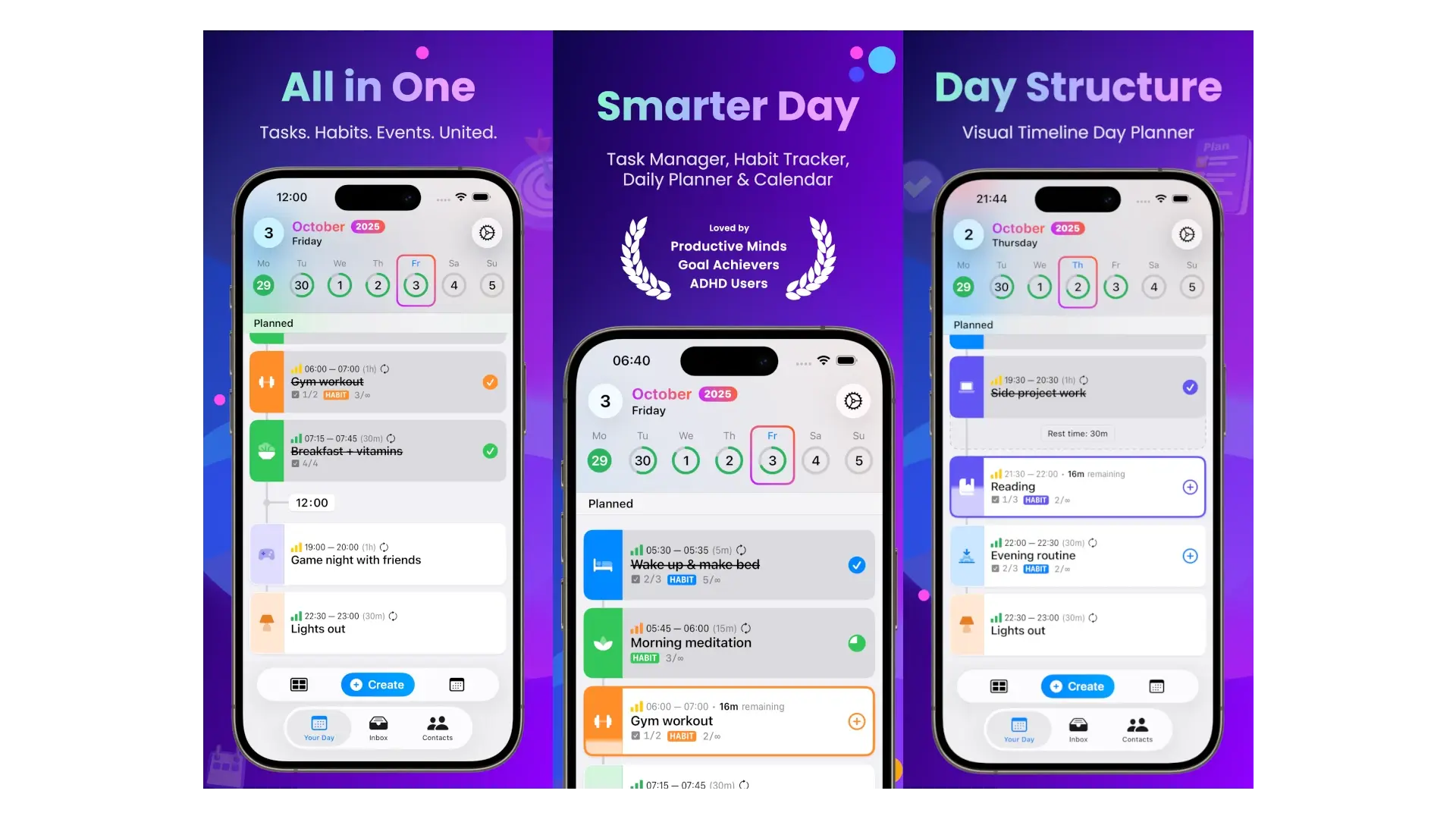
If you want a single place to plan, focus, and track momentum, try the productivity app at Smarter.Day. It can help you timebox priorities, batch work, and reflect on progress without juggling multiple tools.
You May Also Like
These Related Stories
Time Management Mastery: 12 Proven Productivity Tactics
Master Time Management: 12 Proven Productivity Moves
No Comments Yet
Let us know what you think