

10 Proven Productivity Strategies That Actually Deliver

10 Proven Productivity Strategies That Actually Deliver
As we all know, starting a laptop with the intention of good use and letting it run for the day with just pings, pings, and more pings is like a daydream. Loss of control sets in, to-do lists expand, and concentration appears only to be an illusion. The tricky part is that productivity is not something that you have; it is a system. We will present a simplified way to do this, without interference from other factors. You will learn these time management strategies: first, how to organize your tasks; then, how to improve your state of mind; and finally, how to adopt better habits. If you have been struggling with priorities or feel like you are in a reactive mode, these approaches will declutter your day and enhance productivity without getting exhausted.
These are methods that you can apply from today, no clichés. We will discuss the most effective, such as time blocking, deep work sprints, habit stacking, and Objectives and Key Results. They are based on the works of well-known figures like Cal Newport, Teresa Amabile, BJ Fogg, and Gloria Mark. So expect that the examples you follow will be real, the guidance will be clear, and the approach will be friendly, but you will still be expected to give it a try, test it, and adapt. Would you like to win back your interests and consequently your results?
Architect Your Day with Time Blocking and Theme Days
The first step is to plan your calendar using the concept of time blocking. This is a technique where you divide your schedule into different blocks of focused work, administrative tasks, and recovery time. In "Deep Work," Cal Newport, the author, talks about how the most crucial thing to produce high-quality work is protecting long, uninterrupted periods. You can mix this with theme days, which means assigning specific days of the week to high-level categories (e.g., Monday for strategy, Tuesday for meetings). As a result, you reduce decision fatigue and know what your week looks like. The outcome? Fewer spontaneous decisions, more steady growth, and a lighter mental load.
Think about Maya, a freelance designer who spent her days talking to clients, invoicing, and doing mockups at the same time. By blocking mornings for design and grouping admin into a single afternoon block, she gained two extra hours of focused creation per day. Jake Knapp and John Zeratsky, in their book "Make Time," highlight the importance of creating a daily "highlight"—your most significant task for that day. Time blocking secures the space for that highlight so that it does not get squeezed by email.
Here’s how to implement this: select tomorrow’s top outcome and schedule it into a 90–120-minute focus block. In addition, stack 15-minute buffer blocks to manage the transitions, so you can avoid being late to the next task. After that, add a weekly theme plan (e.g., "Wednesday: deep work only"). This combo both protects your attention and makes it easier to plan the workflow. It is a straightforward yet powerful way of optimizing time and enhancing performance.
Prioritize with the Eisenhower Matrix and the Pareto Principle
There is a vast discrepancy among tasks. The Eisenhower Matrix assigns tasks into one of four quadrants: Urgent-Important, Important-Not Urgent, Urgent-Not Important, and Not Urgent-Not Important. It was Dwight Eisenhower who famously used this method of making choices in a bid to devote more of his time and energy to the vital things. In conjunction with this, the Pareto Principle (80/20 rule) demonstrates that only 20% of the tasks are actually responsible for 80% of the outcomes. Richard Koch is the author who made this view well accepted; however, in "The ONE Thing," Gary Keller suggests a different approach: ask, "What’s the one task that makes everything else easier or unnecessary?"
Luis, the sales manager, took advantage of the matrix on his weekly to-do list and was astonished to find that writing three strategic proposals (Important-Not Urgent) was far more fruitful than 40 minor tasks he had on his list. Thereby, after ruthlessly prioritizing those proposals, he increased his closing rate in just one quarter. At the same time, he gave away Urgent-Not Important tasks such as data entry. The matrix also discloses "busywork," which means tasks you might be able to completely wipe off.
How to do it: Compile a list of everything that you think should be done. Group each task into one of the quadrants. Next, circle the top 20% of tasks that likely generate 80% of your desired outcomes—those are your priority blocks. Everything else? Defer, delegate, or delete. This approach not only enhances the management of workflow but also creates mental space for strategic thinking, a fact that has been proven by many years of decision science and goal-setting research (see Locke & Latham).
Protect Focus with Deep Work Sprints and Pomodoro Intervals
If you find yourself surrounded by distractions, you can utilize deep work sprints, which consist of periods alone during which you focus on cognitively demanding tasks. Cal Newport's research proves that minimizing interruptions is a direct precursor to high-quality output. You can support this idea with the Pomodoro Technique (Francesco Cirillo) in which you work in specific time intervals (for example, 50 minutes on and 10 minutes off). DeskTime research made popular the 52/17 rhythm among top performers, showing that by intentionally taking breaks one can achieve high performance throughout the working day.
Priya, a data analyst, was barely managing to finish her models because Slack interruptions piled up and left her work unfinished. She arranged the morning with two deep work sprints, during which she disabled the Slack notifications and set them to "notifications off." Adding a 10-minute break with movement, she saw fewer errors and faster iterations. Pomodoros helped her to "begin" when the work felt daunting, as it is an applied anti-procrastination technique that has a clear endpoint.
Create your pre-sprint ritual: silence notifications, close unused browser tabs, and put your phone in another room (advice from Nir Eyal's "Indistractable"). Set a timer and dedicate yourself to finishing a specific task. After each sprint, take the time to revert to a normal state—stretch, hydrate, or briefly journal about the accomplishment. This tactic not only builds momentum but also facilitates brain power and has proven to be significantly effective.
Slash Context Switching with Batching and Single-Task Mode
Frequent task-switching causes us to lose a lot of our cognitive energy. Psychologist David Meyer, Jeffrey Evans, and Joshua Rubinstein found that task-switching damages our timing noticeably and reduces both our speed and accuracy, resulting in the problem often being solved more slowly and incorrectly. Gloria Mark from UC Irvine also found that after a disturbance, it could take more than 20 minutes to restore complete attention. The opposite of that is batch processing and single-tasking. Group similar tasks (for instance, emailing, small approvals, calendar changes) into designated times and maintain undisturbed work as your sanctum.
Jonah, a product manager, was an all-day-inbox keeper. He transitioned to two email batches (11:30 a.m. and 4:30 p.m.) and added a "quick approval hour" for team asks. Also, he utilized a single-task mode, which is a full-screen window, Do Not Disturb on, and a purpose of "Focus—back at 2:30" that is visible to others. Over a two-week span, he was shipping specs at a faster rate, and in the end, he had energy left over for the day.
To give it a shot: identify two to three batch windows for doing low-priority tasks. Shut or postpone everything else outside those windows. For deep tasks, cut "open loops" by just writing a small introductory note (the Zeigarnik effect helps your brain in resuming where you stopped). You will observe cleaner concentration, uninterrupted work, and less mental residue while going through your day.
Manage Energy, Not Just Time: Ultradian Rhythms and Movement Snacks
Time management is only a part of productivity—energy is the main thing. Research conducted by K. Anders Ericsson, the mastermind behind elite performers, has documented that the most effective work schedule is 90-minute ultradian cycles with planned breaks for reshuffling. The outcome of the book "The Power of Full Engagement" by Jim Loehr and Tony Schwartz is basically that the highest efficiency is reached by oscillating—that is, going from concentrated effort to deliberate recovery, and vice versa. This can be further complemented by the addition of movement snacks—these are short intervals of activity that increase blood circulation and concentration.
Alicia, a teacher, made a new grading schedule out of 90-minute blocks that incorporate a 15-minute walk/stretch break. This action resulted in her seeing a significant decrease in mistakes as well as a quicker turnaround. During tough weeks, she tagged a mid-afternoon power nap (10–20 minutes), a trick mentioned by sleep researcher Matthew Walker, that it is possible to regain alertness without any grogginess if you get the timing right. Additionally, tiny movement breaks can counteract the lunchtime decline in productivity.
Concrete plan: utilize your peak energy to carry out the hardest tasks (record your energy levels for a week). Integrate 10–15 minutes recovery breaks with walking, deep breathing, hydration, or just being outside. Ensure your sleep with a regular wind-down without digital screen time in the evening. You will feel your time turn into better performance and longer-lasting productivity by optimizing energy in cycles.
Build Strong Habits with Tiny Habits and Habit Stacking
Massive targets have a high tendency of collapsing due to the fact that the habits that are focused on are too large. The starting point of BJ Fogg’s Tiny Habits method is small—flossing one tooth, writing one sentence—and it simply progresses from there. Then James Clear’s habit stacking associates the new habit with an already existing routine: "After I make coffee, I’ll review my top three priorities." The combination reduces friction and makes the regularity happen by itself, which is the real power of productivity.
Sam, a software engineer, wanted to enhance the speed of code reviews. He began with a tiny habit: "After standup, open the review queue." As soon as that was done without even thinking about it, he added "open queue" with a 25-minute review block and a short note to the team about any blockers. In just a month, the turnaround time improved and the backlog shrank. As Clear presents in "Atomic Habits," small, consistent victories added together create a substantial difference.
To put it into action: figure out one micro-behavior that corresponds most with your key outcome. Make it an addition to a stable anchor (for instance, after breakfast, after a meeting). Celebrate the benefits immediately; even though, yes, it is cheesy, Fogg’s experimental findings have it that tiny positive emotions link to new habits. Step by step you will increase the intensity of the habit, but the cues and the environment must stay the same for reliability.
Set Goals That Stick with OKRs, SMART, and WOOP
Flexibility in the goals set by the followers might be viewed as profit without cost. John Doerr, in his book "Measure What Matters," explains how big corporations such as Google align their efforts with clarity through the use of OKRs (Objectives and Key Results). The combination of OKRs and the use of SMART goals (Specific, Measurable, Achievable, Relevant, Time-bound) will guarantee you proper timing and specificity. Furthermore, you should utilize the WOOP (Wish, Outcome, Obstacle, Plan), Gabriele Oettingen’s method of mental contrasting, to predict the obstacles you will face and create the if-then plans that work.
A startup head, Lina, established an OKR: "Increase qualified leads by 30% this quarter." Key results included "Launch two landing pages" and "Ship three partner webinars." Applying the WOOP framework, she named her major hurdle—getting stuck on content drafts—and came up with the plan: "If I haven't written by 10 a.m., I will draft for 30 minutes before opening Slack." The plan was able to deal directly with the obstacles, which caused a surge of progress.
For the quarterly OKR cycle, adopt a weekly review of SMART sub-goals. Prepare a minimal WOOP for each key result in advance to pre-commit your answer to common blockers. The combination of the two elements—ambition and specificity—can make wishful thinking turn into automated workflow enhancement and substantial performance improvements.
Tame Your Tech with Notification Detox and Intentional Apps
Do you know that "just checking" can become 20 minutes? You can instead do a notification detox: turn off non-essential alerts, create a single bundle for the rest, and use device focus modes for deep work. Nir Eyal's "Indistractable" and Cal Newport's "Digital Minimalism" both present the necessity of the environment being arranged in a way that encourages specific behaviors. Use website blockers or app timers to low-value scrolling while keeping only necessary tools available.
Ben, a university student, made an interesting discovery! By only blocking social notifications and using a news feed blocker during study times, he was able to cut down his "just a sec" diversions considerably. He left SMS and calendar alerts on for inter-team coordination. Just a few weeks later he had shorter but more effective study periods and less laden with homework evenings. You would never guess the best thing: not every minute of willpower was needed—his environment did all the heavy lifting.
You can begin by observing a 24-hour alert audit: which ones can actually help you in your work? Turn off the rest, or batch them into digest summaries. Create a "Focus" profile that hides badges and restricts distracting apps. These little things lessen attention residue, as well as protect the mental clarity needed for deep, creative work.
Speed Decisions with Checklists, Templates, and Automation
Momentum is eliminated by decision fatigue. In other words, the efficient way to deal with it is through the use of checklists, templates, and automation. According to Atul Gawande's "The Checklist Manifesto," a checklist increases efficiency in many different fields such as surgery and aviation. For recurring tasks, build reusable templates (emails, briefs, meeting agendas) to accelerate workflow. Afterward, explore automation tools (e.g., Zapier, native integrations) to eliminate manual handoffs or reduce errors.
Tasha, who is an HR lead, turned her hiring pipeline into a checklist- and email-driven process with templates for every stage and automated reminders. Time-to-hire was reduced, candidate experience was enhanced, and her team was able to free up a few hours each week. By taking out the minutiae decisions, she was able to concentrate on making quality decisions in guaranteeing high-value interviews and culture assessments.
Write down a process you have recently performed that you can repeat at least three times. Make it a checklist where you include the steps one at a time. Create templates for any step with repeatable phrases. Finally, set up notifications or data transfers to be automated wherever it is possible. This method turns tribal knowledge into technological performance which is more scalable and focuses your mind on the work that you are capable of only doing.
Reflect and Iterate with a Weekly Review and Progress Principle
Pursuing busyness without due consideration and critically analyzing the positive effects is not seen as progress. Weekly review is an essential part of David Allen's "Getting Things Done" program that helps you organize your commitments, restructure priorities, and sift out what is irrelevant. Combine it with the Progress Principle by Teresa Amabile and Steven Kramer which demonstrates small victories that act as stimulators to inspiration. Record your progress notes daily and get used to it; this habit has huge effects on your motivation and mental clarity.
Omar, a project lead, chose Friday afternoons as the time for 45-minute reviews: clearing inboxes, updating project boards, and selecting three priorities for the next week. He also wrote a "win journal" made of three sentences each day. What was the result? Fewer dropped balls and a more vibrant sense of traction. When Monday came along, he had sharp goals, not a cloud of speculations.
Your flow: look back to your calendars and project lists weekly, prune or delegate unneeded items, and then come to the most crucial decision. Write down one win and one lesson for each day. Wrap up by suggesting next week's "big three" and a first step for each. This reflections loop practices your system as being adaptive, making both performance and resilience better over time.
Conclusion
Productivity is the resulting factor of small and deliberate choices, namely, the protection of your attention, energy management, making decisions simple, and regular reflection. With the use of such methods as time blocking, prioritization frameworks, deep work sprints, and habit scaffolding, you can change good principles into trustworthy performance—and experience tranquility while doing so. Initiate with small steps, iterate weekly, and observe how compounding advantages lead to your days being reformed.
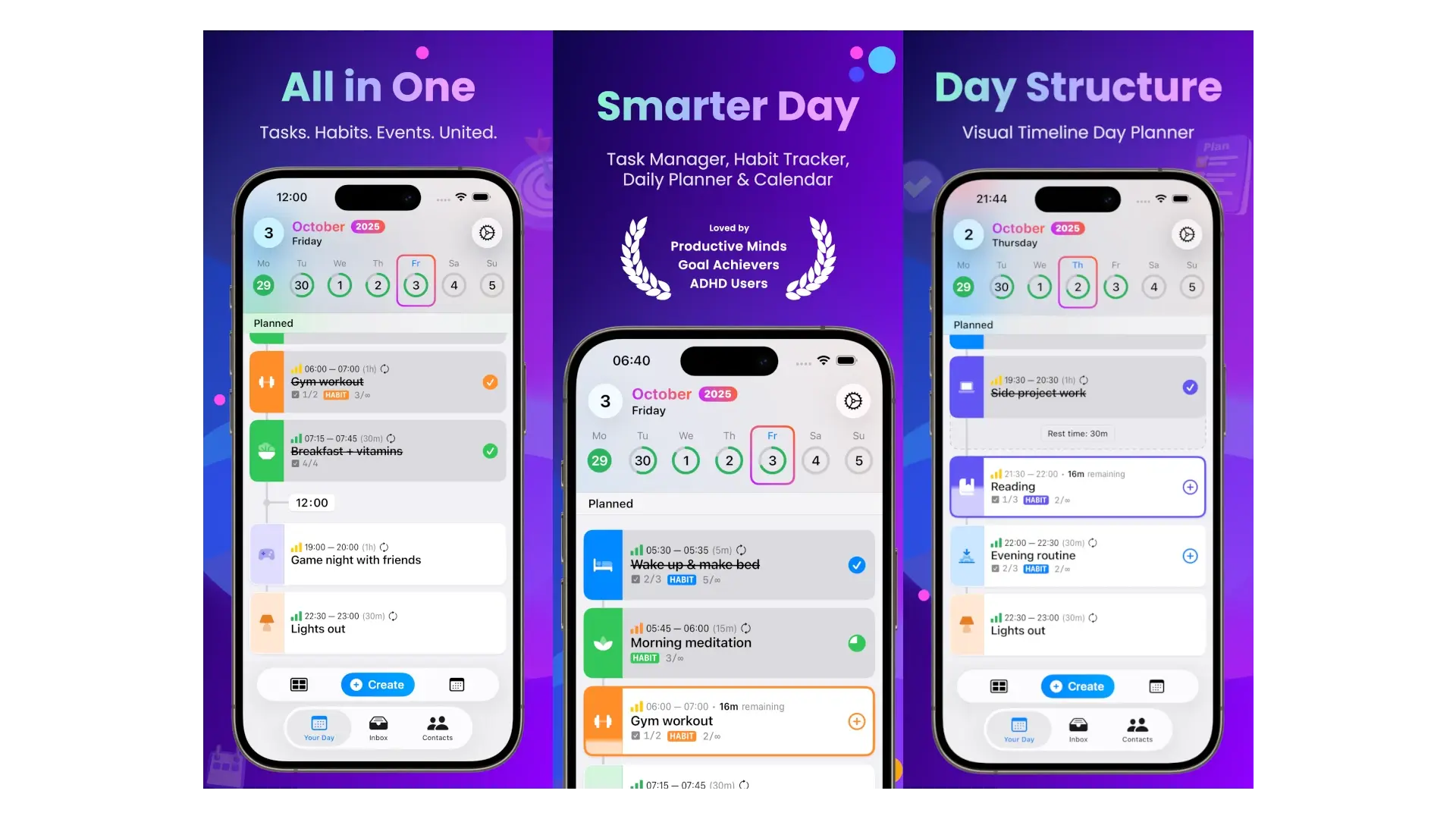
Once you are prepared to put these strategies into action, take advantage of a utility that integrates focus blocks, habit tracking, and review prompts into one. The productivity app at Smarter.Day can help you efficiently plan, execute, and reflect—even without annoying friction in your workflow.
You May Also Like
These Related Stories
Master Time and Focus: 10 Proven Productivity Systems
Master Time and Focus: 10 Proven Productivity Systems
No Comments Yet
Let us know what you think