
10 Proven Time Management Tactics for Peak Output Now

From Overwhelm to Output: 10 Research-Backed Time Management Strategies
Have you ever flipped open your laptop, taken a glance at your to-do list, and felt as if your brain was spinning? With the tricks of the trade of procrastination, constant notifications, and meeting overload, it is not difficult to fall into reactive work. Here’s the twist: productivity is not about doing more but rather doing what is important with less friction. In this article, we will work together to help you eliminate anxiety, overcome distractions, and design efficient routines for optimal performance. You will discover effective strategies for time optimization, workflow improvement, and maintained focus—all based on science and real-life stories.
At the end of the session, you will have a toolkit that has been tried and tested in battle: time boxing, deep work, prioritization frameworks, and habit stacking that you can put into practice immediately. We will alternate between strategies backed by experts and straightforward techniques that produce results even when schedules get haywire. The course you will attend will not just be about the theory (whether you are dealing with stakeholders or working on a side project); you will get a clear map that shows the way to regular progress and measurable outcomes.
1) Time Boxing + Theme Days: Outsmart Parkinson’s Law
According to Parkinson’s Law, work will take all the time available. Time boxing is the opposite of this: split tasks into strictly limited time blocks and let them go at the end of the timer. Couple it with theme days (e.g., Monday: planning; Tuesday: deep work; Wednesday: calls), which will help you eliminate context switching. The research of Cal Newport on time blocking showed that scheduling your day hour by hour will help you boost your concentration and efficiency. Two popular methods to start organizing your time: allocate a 25–55-minute block for each task, and group related work by theme. “What gets scheduled gets done.”
Imagine Harper, a product manager who is losing the fight with Slack. She made two communication boxes at 11 a.m. and 4 p.m., then protected two morning deep work blocks for roadmap tasks. In two weeks, she cut after-hours work by 30% through these actions. Begin with the least: select a single theme day (such as “Maker Monday”) and one non-negotiable focus block daily.
Cues are the best help. Name your calendar labels Focus, Admin, Collab accordingly. Give the boxes purpose with vision. A study investigating multitasking at the University of London indicated that task switching can temporarily bring down IQ performance. Time boxing minimizes those switches, which is why your brain now has more bandwidth for what is significant.
2) The Eisenhower Matrix + Pareto Principle: Prioritize Like a Pro
The Eisenhower Matrix sorts tasks according to urgency and importance so that you no longer mistake the loudest requests for the most useful ones. In addition, you can combine it with the Pareto Principle (80/20)—20% of tasks result in 80% of outcomes—to learn to prioritize high-leverage actions. For example, you can use the following two methods: your daily Top 3 that are selected from the Important/Not Urgent quadrant and a weekly Kill List where you wipe out or delegate low-impact items. As Dwight Eisenhower wisely said, “Often, the important things are not urgent at all.”
Let’s talk about Miguel, a freelance designer. After he mapped his week and eliminated quick Slack replies that did not contribute to revenue, he put his own pitch decks, portfolio updates, and high-value client outreach as his Top 3—his 80/20. An 18% revenue growth within a month with fewer hours was a great outcome. In other words, it was workflow improvement thanks to clearer filters.
For more supportive evidence, you might consider reading the book by Greg McKeown, Essentialism, which emphasizes that disciplined prioritization really is the key to clarity and momentum. You might also want to use the Impact x Effort test. Each task is assigned a score from 1 to 5 in both categories, and then you pick the tasks that have the most impact and require less effort to accomplish first. This is a very simple process of time optimization that you will realize by Friday.
3) Deep Work Routines: Build a Distraction-Resistant Brain
Deep work is the kind of work that is totally focused, eliminates distractions, and leads to a very high output of results. Cal Newport’s book, Deep Work, notes that even 60–90 minutes per day can lead to a significant increase in results. Two techniques: develop a pre-focus ritual (clean the desk, set intention, and silence notifications) and apply focus sprints (90 minutes on, 10–15 minutes off). The neuroscientist Daniel Levitin mentions that our brains expend energy when we are changing tasks; ritual actions cut down this cognitive cost.
Consider Riya, a marketer tasked with writing long-form copy. She initiated the process with a 10-minute warm-up outline and then a 75-minute sprint by using a site blocker. One quote to remember: “Clarity before typing.” In the course of a month, her first-draft quality was better, and the amount of revision dropped. By just not allowing decision noise up front, she got back her creative energy.
Make progress visible. A paper tally of daily deep work minutes can be a motivator—3 focus blocks today beats 1 yesterday. McKinsey Global Institute states that reducing fragmentation could lead to knowledge workers being 20–30% more productive. Deep work, which is the remedy for this, is characterized by less task switching and more tasks being completed.
4) Beat Procrastination with Implementation Intentions + Temptation Bundling
Procrastination isn’t merely a sign of laziness; it is more often a product of friction or uncertain next steps. A psychologist named Peter Gollwitzer provided implementation intentions like this: (“If it’s 8 a.m., then I open the draft and write 100 words”) that lessened ambiguity and improved follow-through. Pair it with temptation bundling (Katy Milkman): this is when you link an activity you need to do with something that you like (for example, listening to your favorite playlist exclusively during data cleanup).
Jules is a graduate student who consistently procrastinated her literature reviews. She had a simple plan: “If it’s 9 a.m. in the library, then I review three abstracts with a lo-fi playlist.” After that, she used the 2-minute starter to overcome inertia. In a matter of weeks, her citations had doubled, and her anxiety levels were lower. It was only a matter of small cues resulting in big outcomes.
Add pre-commitment: either keep your phone in a different room or use a website blocker for a specified period of time. Research indicates that the formation of precise “if-then” plans leads to a surge in the accomplishment of goals. Keep in mind that start lines far outweigh finish lines in importance. Once your momentum is in motion, the work gets done.
5) Energy Management: Align Work with Your Chronotype
It is clear that without energy management, time management is merely a fruitless battle. The book by Daniel Pink, When, and research on chronobiology by Satchin Panda provide evidence for pairing deep work with your peak cognitive windows (morning larks vs. night owls). Two strategies: conduct a 7-day energy audit (rate your energy every 90 minutes) and schedule brain-heavy tasks during peaks while batching emails and admin during dips.
Alex, an engineer, found his brain peak period from 9–11 a.m. He shifted code reviews there and left status updates for the late afternoon. He also added ultradian breaks after every 90 minutes to reset. As a result, he made fewer errors and merged faster. Performance is not just the number of hours worked, but also the time those hours are worked.
Fuel is important too. Drinking enough water, high-protein lunches, and taking breaks in the sun can help to keep your focus stable. The APA found that chronic stress is associated with mental fog, but short movement snacks help to work against it. Guard your best hours like gold. You will realize that you need fewer of them to deliver more.
6) Reduce Cognitive Load: Chunking, Checklists, and Single-Tasking
Cognitive Load Theory (John Sweller) proves the fact that our ability to hold information in mind is limited. Overloading leads to mistakes and detachment. Chunking is a weapon that can break complicated tasks into 3–5 steps, and checklists refers to the use of them in regular processes. Atul Gawande’s The Checklist Manifesto shows terrific error reduction with common lists by even a high-stakes doctor.
Nina, a customer success lead, was facing a problem in the onboarding process and thus was not able to do it smoothly. She made a three-stage checklist: Discovery, Setup, Success Plan—each with sub-steps ranging from 4–6. The onboarding time reduced by 25%, and at the same time, there was an increase in client satisfaction. Nina also did single-tasking by shutting off additional tabs at every stage. Less chaos, more completion.
Two methods you may try out:
- Chunk + Label: Label each chunk (e.g., “Outline,” “Draft,” “Polish”), which reduces confusion.
- Definition of Done: Write 3–5 criteria for each task.
Having fewer mental loops results in better workflow improvement and a lighter workday.
7) Control Interruptions: Design a Low-Noise Environment
Professor Gloria Mark’s findings suggest that it could take more than 20 minutes to revert to a previous task after a break. Create communication windows and notification tiers: for urgent issues, use phone calls only; for important issues, use email only; and everything else, batched. Two methods: first, specify office hours (e.g., 11:00–12:00 and 4:00–4:30 for messages) and second, use status signals like “Focus—back at 12:00” on Slack.
Omar, a team leader, introduced focus blocks across the team from 9:30–11:00. He came up with a shared policy: no DMs unless it’s a blocker. This was enough to see successful sprint periods, and cycle time and paging problems dropped too. “Urgent” was no longer overused in pings. The majority of messages can await a better system, it appears.
Apply a tech reset weekly: unsubscribe from unwanted newsletters, mute channels that do not have needed information, and set app-specific Do Not Disturb. Daniel Kahneman reminds us about the fact that attention can be consumed. Protect it by all means necessary. The most valuable ideas have to be expressed freely in silence.
8) Habit Stacking + Environment Design: Make the Right Action the Easy Action
Cues trigger habits. BJ Fogg’s method of Tiny Habits commences with actions so minimal that they seem impossible to refuse (“Once I turn on my laptop, I analyze the Top 3”). James Clear’s Atomic Habits brought into the spotlight habit stacking and environment design: simply place the cue in your way and the friction out of it. This is a case of solution: set a visual trigger (Top 3 sticky note on the keyboard) and a friction remover (open the doc you’ll work on before bed).
Priya, a developer, was having a hard time initiating code reviews. She used stacking: “After my morning coffee, I do one 10-minute review.” She always kept GitHub open since the night before. Once she began, she frequently did three. The initial step was like a key to that door.
Design to win is better than self-control. Keep social applications on an entirely different device. Place your focus tools—noise-canceling headphones or a paper planner—just within reach. “You don’t get to the level of your goals, you go down to the level of your systems.” Implement systems like a net that will catch you.
9) Plan with SMART + WOOP + Premortems
Ambiguous objectives bring about ambiguous destinies. One should employ the SMART (Specific, Measurable, Achievable, Relevant, Time-bound) to bring about clarity. Incorporate the WOOP (Wish, Outcome, Obstacle, Plan) from Gabriele Oettingen in order to predict the obstacles. These two approaches can help: a Friday 30-minute weekly review for SMART goals and a premortem (Gary Klein) to visualize failure beforehand and mitigate the risks now.
Diego, the sales lead, determined: “Book 8 qualified demos by Thursday.” His WOOP stated that the biggest obstacle was late responses, so he scheduled two follow-up blocks. A brief premortem shut out any calendar conflicts he may have faced; he had already reserved the time. With the newly added demos, he had a total of nine, this time without stressful work.
Be sure to keep your goals conspicuous. A good way to go about it is to use a one-page plan with only five active goals at most. Progress alone is enough—research by Teresa Amabile confirms the progress principle: small, daily wins increase both motivation and the continuation of momentum.
10) Make Meetings Productive: Fewer, Shorter, Sharper
Without proper control, meetings can become a real-time killer. A recent survey by Harvard Business Review found that executives spend nearly 23 hours a week in meetings, most of which do not lead to any clear conclusions. Two tricks: each meeting must have an agenda and an owner, and the default duration should be 25- or 50-minute slots to generate natural buffers. In the absence of an agenda, you may propose async updates through docs or Loom.
Lena, the operations director, innovated the practice by introducing RACI tags in agendas (R=Responsible, A=Accountable, C=Consulted, I=Informed) and moved the status updates to a shared dashboard. The team saved six hours every week, which they redirected to process improvement. Her motto became “Short meetings, long impact.”
For collaboration hygiene:
- Start with the decision question.
- Next steps—assign owners and due dates—in the last five minutes.
Atlassian’s statistics suggest bad meetings cost us billions of dollars in lost productivity. Consequently, design them on purpose, or skip them.
11) Automate Repetition: Templates, Shortcuts, and Bots
The McKinsey report states that almost 30% of tasks in many professions can be done by machines. The first step is creating templates for emails, briefs, and reports. The second step is to use text expanders for repeated phrases and keyboard shortcuts to speed up navigation. The two methods are to build a template library in your note system and create 10 snippets for your most common replies.
Ari, a customer support rep, used templates for ticket triage and a text expander for policy explanations. The resolution times went down by 20%, and the CSAT level increased. He also installed a simple Zap that logs the ticket metadata on a spreadsheet. Less swivel-chair work, more value.
Evaluate your week: which tasks are performed multiple times? Batch these and automate them wherever you can. You’re not getting rid of the human—you’re getting rid of the grind so that the human can do the high-value thinking.
12) Sustain Motivation: Progress Tracking and Commitment Devices
Incentives vary. Structured methods provide stability. Progress bars (Kanban, streak trackers) and commitment devices (public deadlines, accountability partners) are the means to power up the momentum. Teresa Amabile’s findings highlight that even small visible progress creates a constructive feedback loop. For example, a daily check mark to tally deep work minutes and a weekly demo to a buddy or team.
Sam, a founder of a startup company, concluded every day with a Done List and took a screenshot of it as proof for his accountability partner. He also laid down a rule: “No social media on weekends unless I hit three deep work blocks.” The limitation was more helpful than motivational speeches. Structure is what motivates.
Add a bit of game mechanics. Celebrate “clean sprints” with a bonus free time activity that is not work-related. If you miss one day, then don’t miss two. Momentum grows, and so does drift—so make it easier to regain your momentum than to lose it.
Conclusion
We discussed a hands-on, science-based stack: time boxing, deep work, prioritization, energy alignment, automation, and designing habits. The commonality among them is that they work on the principle of less friction, scheduling what is important, and keeping attention safe as an asset. You can start with one or two of these tactics this week, track the results, and make the necessary changes. Little, constant improvements can lead to great performance.
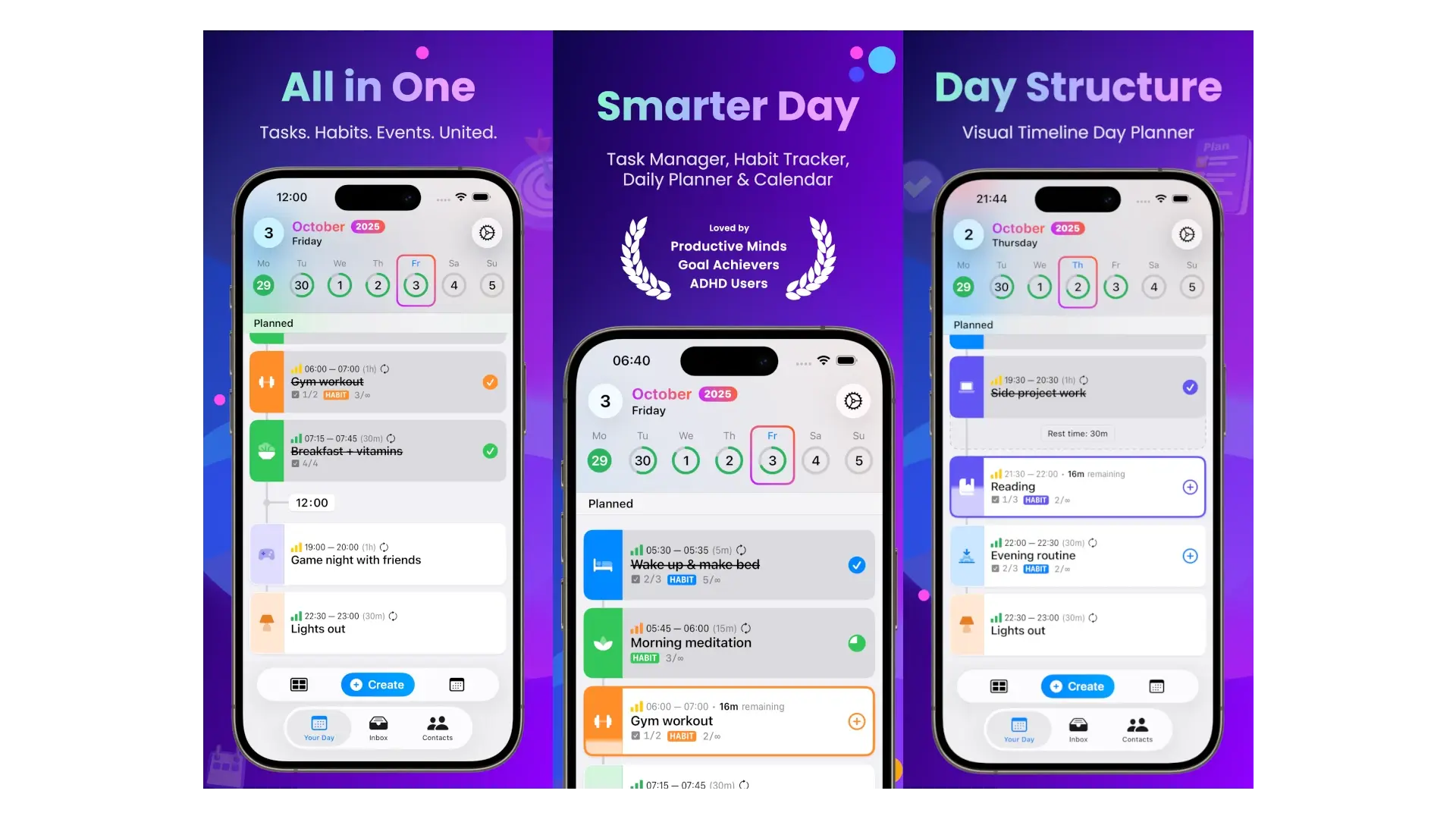
If you desire to see those strategies established for you, get the tool that offers time blocking, habit stacking, and progress tracking in one place. With the productivity app at Smarter.Day, planning focus blocks, templatizing routines, and visualizing progress to stay accountable without the overhead has never been this effortless.
You May Also Like
These Related Stories
Advanced Time Management: 12 Proven Productivity Tactics
Advanced Time Management: 12 Proven Productivity Tactics
No Comments Yet
Let us know what you think