

12 Proven Productivity Strategies for Busy Professionals

12 Proven Productivity Strategies for Busy Professionals
Have you ever noticed how a single notification can derail your entire morning? Or how a packed calendar still leaves your most important projects untouched? Let’s face it—modern work can feel like a relentless stream of urgent-but-not-important requests. The good news: you don’t need more hours; you need smarter systems. In this post, we’ll unpack practical, science-backed strategies that reduce overwhelm, sharpen focus, and improve time optimization, so you can consistently do your best work without burning out.
Here’s the catch: productivity isn’t one-size-fits-all. What works during a high-focus sprint won’t fix noisy meeting culture. That’s why we’ll blend methods from time management, habit formation, workflow improvement, and cognitive performance. Expect actionable steps, real examples, and a few expert-backed surprises. By the end, you’ll have a toolkit to reduce friction, execute with clarity, and sustain momentum—even on chaotic days.
1) Run a Personal Time Audit to Find Hidden Hours
Start with a time audit. For one week, track your day in 15–30 minute blocks using a spreadsheet or a time-tracking app. Tag each block as Deep Work, Shallow Work, Admin, or Personal. Then, calculate percentages and identify high-value vs. low-value activities. You’ll often discover that meetings and context switching consume disproportionate time. Research by Dr. Gloria Mark (UC Irvine) shows that after an interruption, it can take roughly 23 minutes to refocus—making the audit a powerful lens on distraction costs.
Two practical methods:
- Use color-coded categories to see patterns at a glance.
- Apply value labeling: ROI High, Medium, Low to inform cuts and delegation.
Real-life example: A SaaS manager found 27% of their week was “misc meetings.” By consolidating to two fixed meeting blocks and declining low-ROI invites, they reclaimed 6 hours weekly.
Reference: Gloria Mark, “The Cost of Interrupted Work” (2008) and “Attention Span” (2023).
2) Prioritize with the Eisenhower Matrix and the 80/20 Rule
When everything feels urgent, nothing important gets finished. Use the Eisenhower Matrix to sort tasks by Urgent/Not Urgent and Important/Not Important. Then, combine it with the Pareto Principle (80/20) to identify the few activities that drive most of your outcomes. The synergy is simple: first eliminate or delegate low-importance tasks, then double down on the top 20% that create impact.
Two practical methods:
- Create a daily top-3 drawn exclusively from “Important/Not Urgent.”
- Pre-schedule 90–120 minutes daily for your most impactful 20% work.
Real-life example: A marketing lead reduced campaign scatter by focusing only on two channels responsible for 78% of leads—freeing resources to iterate faster.
Reference: Dwight D. Eisenhower’s decision method; Vilfredo Pareto’s 80/20 principle.
3) Time Blocking and Theme Days for Calendar Clarity
Calendars get crowded. Time blocking fixes that by assigning fixed windows to tasks, not just meetings. Add theme days (e.g., Monday: Planning, Tue–Thu: Deep Work, Friday: Reviews/1:1s) to reduce context switching. Cal Newport’s work on Deep Work shows that uninterrupted blocks dramatically improve output and quality—especially for cognitively demanding tasks.
Two practical methods:
- Use 90-minute deep blocks followed by a 10–15 minute reset.
- Create meeting corridors (e.g., 1–3 p.m. only) to protect mornings.
Real-life example: A product designer shifted user research and syncs to Wednesdays, leaving Tues/Thu for design sprints. Throughput improved, and design revisions dropped by 25%.
Reference: Cal Newport, “Deep Work” (2016).
4) Master Attention with Focus Sprints and Context Shields
Attention is your most finite resource. Combine focus sprints (e.g., 50/10 or 45/15) with context shields—rules that block unnecessary inputs. Avoid task-switching; Nobel laureate Daniel Kahneman explains that System 2 thinking (deep reasoning) is effortful and fragile. Protect it. Also tap the flow state concept by Mihaly Csikszentmihalyi: match task difficulty to skill and set clear goals.
Two practical methods:
- Use website blockers and full-screen single-task windows.
- Try a 50/10 protocol: 50 minutes focus, 10 minutes active rest.
Real-life example: An engineer used 3 morning sprints with Do Not Disturb on. A feature that used to take 3 days shipped in 1.5—fewer bugs, clearer logic.
Reference: Daniel Kahneman, “Thinking, Fast and Slow” (2011); Mihaly Csikszentmihalyi, “Flow” (1990).
5) Cut Digital Noise: Notification Hygiene and Single-Task Interfaces
Let’s declutter your digital world. Implement a notification audit: disable non-critical pings, digest the rest, and leave only VIP alerts. Research suggests chronic multitaskers perform worse on attention tests; Stanford’s Ophir et al. (2009) found that heavy media multitaskers struggle to filter distractions. Also, the Microsoft Work Trend Index highlights the rising cognitive load of constant communication.
Two practical methods:
- Set batching windows for email and chat (e.g., 10:30 a.m., 2:30 p.m., 4:30 p.m.).
- Use single-task modes (e.g., separate browser profiles per project).
Real-life example: A sales rep muted Slack channels and relied on scheduled check-ins. Response times remained healthy, and weekly qualified meetings increased by 18%.
Reference: Ophir, Nass & Wagner (2009); Microsoft Work Trend Index (recent editions).
6) Manage Energy: Ultradian Rhythms and Smart Breaks
Productivity isn’t just time; it’s energy. Work in alignment with ultradian rhythms—cycles of roughly 90–120 minutes—then take brief, high-quality breaks. Studies popularized by Tony Schwartz suggest that strategic rests boost output and resilience. The DeskTime study famously found that top performers often follow a 52/17 work-break ratio, echoing the value of deliberate recovery.
Two practical methods:
- Schedule movement breaks (walk, stretch) and visual resets (20–20–20 rule).
- Use micro-fuels: water, protein, and daylight exposure to stabilize alertness.
Real-life example: A teacher alternated 50-minute lesson blocks with 10-minute hallway walks and hydration. Afternoon fatigue dropped, and grading accuracy improved.
Reference: Tony Schwartz/The Energy Project; DeskTime productivity analysis (widely cited).
7) Build Consistency: Tiny Habits and Habit Stacking
Consistency beats intensity. BJ Fogg’s Tiny Habits method starts with a behavior so small it’s hard to skip—then scales. James Clear’s Habit Stacking links new routines to existing ones (“After I make coffee, I’ll outline three bullets”). Add implementation intentions—if-then plans shown by Peter Gollwitzer to increase goal attainment—to combat ambiguity.
Two practical methods:
- Start with a 2-minute rule: do the smallest version of the habit.
- Use a habit recipe: After [current habit], I will [new habit].
Real-life example: A writer attached a 5-minute outline ritual to morning coffee. Within 6 weeks, rough drafts doubled, then tripled as the habit scaled.
Reference: BJ Fogg, “Tiny Habits” (2019); James Clear, “Atomic Habits” (2018); Peter Gollwitzer on implementation intentions.
8) Design Work for Momentum: Chunking, Checklists, and a Clear DoD
Overwhelm often signals poor task design. Use chunking to break large projects into atomic units that you can complete in one sitting. Create checklists to reduce cognitive load (surgeon Atul Gawande showed that checklists cut errors dramatically). Define a Definition of Done (DoD) so you stop perfectly-on-paper but practically vague tasks.
Two practical methods:
- Write tasks as verbs + deliverables + constraints (e.g., “Draft 600-word intro, 2 sources, tone: friendly”).
- Use “start anywhere” micro-steps to bypass procrastination.
Real-life example: A healthcare admin reduced onboarding errors by 40% after implementing a 14-step checklist and a clear DoD for each file.
Reference: Atul Gawande, “The Checklist Manifesto” (2009); Zeigarnik Effect literature on incomplete tasks and tension.
9) Streamline Workflow: Kanban and Work-in-Progress (WIP) Limits
If work items pile up, throughput collapses. Visualize your pipeline with a Kanban board: To Do, Doing, Review, Done. Enforce WIP limits to stop starting and start finishing. David J. Anderson’s Kanban guidance—and Little’s Law from queuing theory—show that fewer concurrent tasks reduce cycle time and variability.
Two practical methods:
- Use WIP caps (e.g., no more than 2 tasks per person in “Doing”).
- Add explicit policies for “Review” to avoid hidden queues.
Real-life example: A creative agency cut average turnaround from 14 to 8 days by limiting active tasks to three per designer and adding a daily Review Standup.
Reference: David J. Anderson, “Kanban” (2010); Little’s Law (John D. C. Little).
10) Fix Meeting Overload: Async-First and Tight Meeting Hygiene
Meetings are expensive. Shift updates to asynchronous memos and reserve live time for decisions. For necessary meetings, use a tight agenda, cap attendees (Amazon’s “two-pizza rule”), and end with clear owners and next steps. HBR and Atlassian research consistently show that many meetings lack clarity and could be replaced with async communication.
Two practical methods:
- Require pre-reads 24 hours ahead; cancel if not read.
- Adopt “no-meeting mornings” twice a week to protect focus.
Real-life example: A startup moved sprint updates to a 5-minute video and a template. Weekly meeting time dropped by 35%, while on-time delivery improved.
Reference: Harvard Business Review on meeting overload; Atlassian meeting research; Amazon/Bezos “two-pizza rule.”
11) Decide Faster: Pre-Mortems and If–Then Decision Rules
Indecision drags teams. Use pre-mortems (Gary Klein): imagine the project failed, then list reasons. You’ll surface risks without politics. Add if–then decision rules to speed routine choices and constrain Parkinson’s Law (“work expands to fill the time available”).
Two practical methods:
- Create default choices with opt-out (e.g., “Ship at 5 p.m. Friday unless blocker X occurs”).
- Timebox evaluation with clarity thresholds (e.g., 70% data rule popularized by Jeff Bezos).
Real-life example: A product team timeboxed pricing analysis to 48 hours with clear criteria; they launched earlier and A/B tested into a higher LTV plan.
Reference: Gary Klein on pre-mortems; Parkinson’s Law (C. Northcote Parkinson).
12) Review Weekly: GTD + The Progress Principle
Execution without reflection stalls. Run a Weekly Review to clear inboxes, update projects, and plan next actions—core to David Allen’s Getting Things Done (GTD). Then harness Teresa Amabile’s Progress Principle: even small wins boost motivation and creativity. Track daily progress in a short log to keep morale high and focus aimed.
Two practical methods:
- Use a five-part checklist: capture, clarify, organize, reflect, plan.
- Keep a “wins” list to reinforce momentum and resilience.
Real-life example: A freelancer’s 30-minute Sunday review cut missed deadlines to zero and made Monday starts calmer and faster.
Reference: David Allen, “Getting Things Done” (2001); Teresa Amabile & Steven Kramer, “The Progress Principle” (2011).
Conclusion
We’ve covered a full-stack approach to productivity: diagnose your time, prioritize with intention, protect attention, design smarter workflows, and review consistently. The thread through it all is deliberate focus paired with realistic systems. You don’t need to overhaul your life—just apply a few of these strategies this week and measure what moves the needle for your performance and workflow improvement.
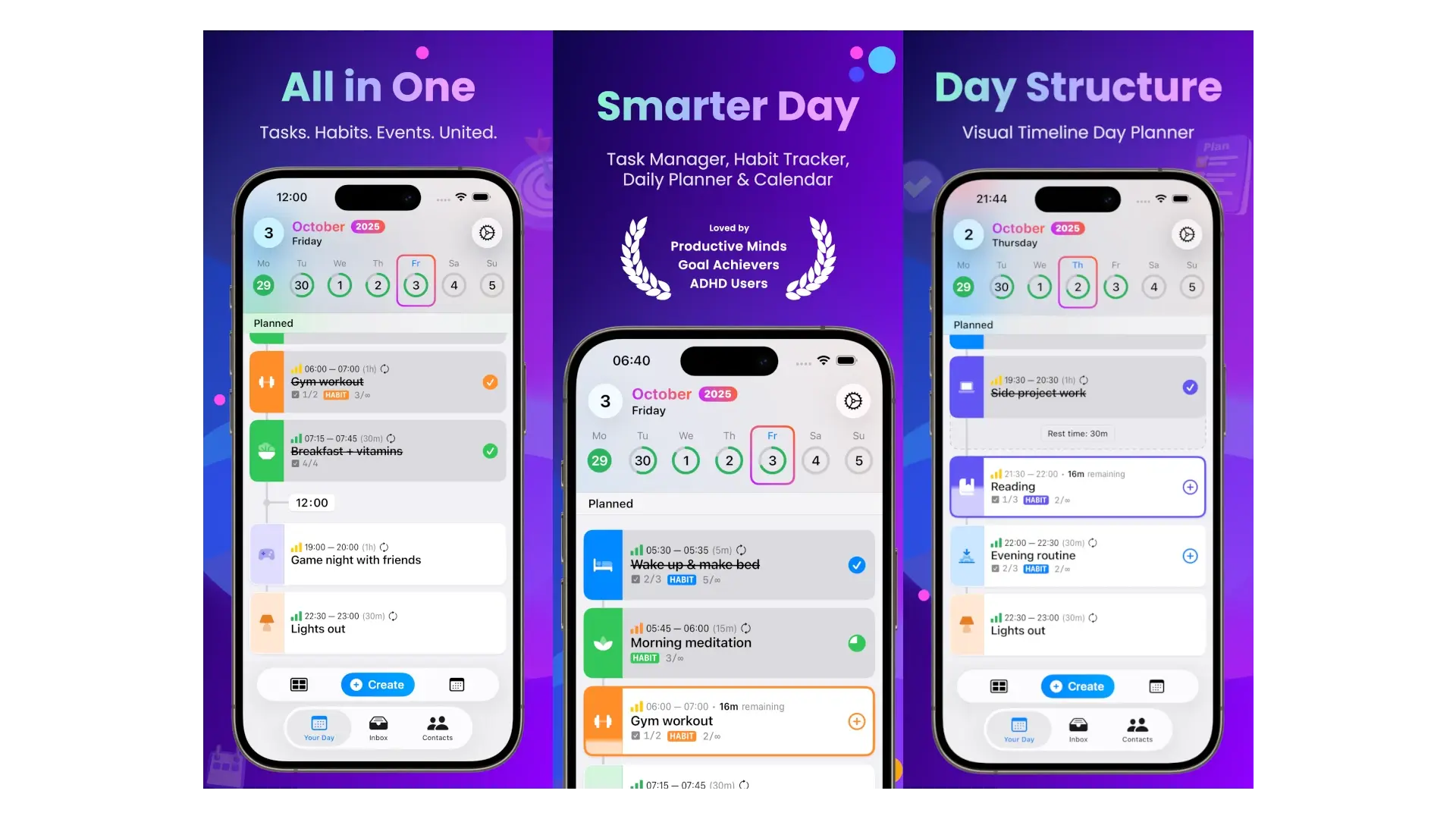
If you want a simple way to put these tactics into practice, try the productivity app at Smarter.Day. Use it to time-block, track habits, run weekly reviews, and tame your meeting load in one place—so your system supports you, not the other way around.
Ready to work smarter with less stress? Explore Smarter.Day and build a personal system that turns ideas into consistent, meaningful results.
You May Also Like
These Related Stories
12 Proven Productivity Strategies for Busy Professionals
Advanced Time Management: 12 Proven Productivity Tactics
No Comments Yet
Let us know what you think