

Advanced Time Management: 10 Proven Strategies That Work

Advanced Time Management: 10 Proven Strategies That Work
Introduction
Have you ever opened your laptop, stared at your calendar, and felt your stomach drop? We juggle emails, meetings, and never-ending to-do lists, yet real progress slips through the cracks. Here’s the catch: productivity isn’t about cramming more into the day—it’s about making better choices with limited energy and attention. In this guide, we’ll unpack practical, research-backed strategies to eliminate overwhelm, reduce procrastination, and reclaim control of your schedule with time optimization techniques you can implement today.
We’ll dive into workflow improvement ideas like time blocking, task batching, weighted prioritization, and deep work—plus the underrated power of energy management. Expect concrete methods, examples you’ll relate to, and a clear way to integrate everything into your daily routine. By the end, you’ll have a smarter system for focus, performance, and sustainable momentum—not just a longer checklist.
1) Start With Outcomes: OKRs and a North Star
Let’s face it: without clarity, we say yes to everything. The antidote is outcome-first planning. Use OKRs (Objectives and Key Results) to define what matters and how you’ll measure it. John Doerr’s “Measure What Matters” popularized OKRs to align teams and individuals on results, not busywork. Pair that with a single North Star metric—the one result that, if improved, signals meaningful progress. This keeps your weekly priorities honest and your calendar focused.
Two practical methods:
- Define one quarterly Objective with 3 quantifiable Key Results.
- Review tasks against your North Star; if a task doesn’t move the needle, schedule it later or remove it. Example: A product manager chooses “increase active weekly users by 15%” and declines non-essential meetings that don’t influence activation or retention.
Here’s a real-life scenario: Maya, a solo consultant, set an Objective to “double inbound leads.” Her Key Results were “publish 8 SEO articles,” “launch 2 lead magnets,” and “secure 10 podcast guest spots.” With this lens, she replaced ad-hoc networking with content sprints and outreach blocks. As Doerr puts it, “Ideas are easy—execution is everything.” The clarity transformed how Maya filtered tasks and protected her time.
2) Time Blocking and Theme Days
Time blocking—allocating calendar slots for specific work—reduces decision fatigue and keeps tasks from sprawling. Cal Newport, author of “Deep Work,” champions block scheduling to pre-commit to focus sessions and defend them like meetings. Create theme days (e.g., Monday: strategy, Tuesday: management) to batch related tasks and reduce mental switching. This tightens workflow improvement and makes your week more predictable.
Two practical methods:
- Plan tomorrow’s blocks in 15-minute increments before you end today.
- Assign theme days (or half-days) to batch similar work—e.g., all calls on Wednesdays.
Real-life example: A marketing lead blocks 9–11 a.m. for campaign strategy and 2–4 p.m. for approvals, leaving fewer fragmented hours.
If you’re worried time blocking is too rigid, add buffer blocks between deep sessions. Schedule “overflow” blocks every afternoon to mop up stragglers. Newport suggests a daily shutdown ritual to reconcile slips and re-plan. Result? Less anxiety when surprises hit. One client said, “I finally know where my time goes—and where it should go.” That confidence fuels consistent performance without working longer hours.
3) Prioritize With the Eisenhower Matrix + Weighted Scoring
The Eisenhower Matrix (popularized by Stephen Covey) separates tasks into four quadrants: Important/Urgent, Important/Not Urgent, Not Important/Urgent, Not Important/Not Urgent. The magic is spending most of your day in the Important/Not Urgent quadrant—preventing fires instead of fighting them. To refine decisions, layer on a weighted scoring model to quantify priority.
Two practical methods:
- Use a simple 1–5 score for Impact, Effort, and Alignment; prioritize by highest Impact/lowest Effort.
- Limit daily tasks to the top 3 quadratic priorities.
Example: A designer chooses a high-impact onboarding redesign (score 14/15) over responding to low-impact Slack threads (score 5/15).
“Most of us spend too much time on what is urgent and not enough time on what is important.” That Covey insight still holds. Research on opportunity cost neglect suggests we undervalue alternatives; weighted scoring forces trade-offs explicit. A real-life case: Tarek, an ops lead, reviewed his to-do list weekly with the matrix and halved time in Q3 and Q4. The result was a clearer pipeline and fewer weekend catch-ups.
4) Batch Tasks and Single-Task to Kill Attention Residue
Switching between tasks creates attention residue, a cognitive lag that hurts focus. Professor Sophie Leroy’s research shows that unfinished tasks leave residue, slowing performance on the next one. The fix is task batching (grouping similar tasks) and single-tasking (one mode at a time). You’ll feel your brain “click” into gear when you keep contexts consistent.
Two practical methods:
- Batch email, chat, and admin into two 25–40 minute windows per day.
- Use do-not-disturb and schedule notifications checks; don’t let apps set your agenda.
Real-life example: A remote developer batches code reviews at 1 p.m. and 4 p.m., cutting context switches from 18 to 6 per day.
Add communication contracts with your team: define response windows (e.g., “I check email at 11 a.m. and 4 p.m.”). This respects deep work. Cal Newport’s framework reinforces that fewer switches amplify depth and speed. Within weeks, you’ll notice smoother workflow improvement, fewer errors, and more consistent delivery. Think of batching as a 2x focus multiplier—free and immediate.
5) Align Work With Energy: Chronotypes and Ultradian Cycles
Peak productivity isn’t just scheduling—it’s energy management. Nathaniel Kleitman’s research on ultradian rhythms suggests we operate best in 90–120 minute cycles with a restorative break. Daniel Pink’s “When” and chronotype research show that larks, third birds, and owls hit different daily peaks. Work with your biology, not against it.
Two practical methods:
- Map your peak, trough, and rebound periods for a week; assign deep work to your peak.
- Work in 90-minute cycles with a 10–15 minute break; protect your peak with no-meeting blocks.
Real-life example: An analyst moved model-building to 9–11 a.m. and emails to 2:30 p.m., doubling throughput.
Add a movement micro-break: a five-minute walk or stretch resets alertness better than doom-scrolling. As Pink notes, timing is a strategic edge. You’ll notice fewer dips and more consistent performance by aligning tasks with energy. If your team spans time zones, use shared calendars to flag individual peaks—small coordination tweaks yield big gains in output and morale.
6) The 2-Minute Rule + Friction Design
David Allen’s 2-minute rule from “Getting Things Done” is deceptively powerful: if a task takes under two minutes, do it now. Pair it with BJ Fogg’s behavior design: make desired actions easier and undesired actions harder. This combo clears micro-backlogs and reduces procrastination triggers that derail focus.
Two practical methods:
- Sweep your inbox and task list for sub-2-minute items twice daily.
- Reduce friction: keep your project file open at day’s end; place your running shoes by the door; uninstall one distracting app.
Example: A sales rep processes quick follow-ups immediately and keeps CRM tabs pinned, slashing “I’ll do it later” delays.
“Make it easy” is Fogg’s mantra. Tiny wins create momentum that compounds. When you engineer low-friction starts—like a template for weekly reports—you bypass the heaviest lift: starting. Over a month, these micro-optimizations reclaim hours and lower mental load. The result is a cleaner runway for deep work and faster cycles on routine tasks.
7) Deep Work Sprints and Distraction-Proofing
According to Cal Newport, Deep Work is the act of focusing without distraction on cognitively demanding tasks. It’s the rare air where high-value results happen. Protect this time with focus sprints and a shutdown ritual. Clifford Nass’s Stanford research on multitasking found heavy multitaskers “are suckers for irrelevancy”—so build a fortress around your attention.
Two practical methods:
- Run 50/10 or 75/15 sprints with a visible timer; escalate to 90-minute cycles as stamina grows.
- Distraction-proof: full-screen mode, site blockers, phone in another room, and noise-cancelling or brown noise.
Real-life example: An engineer codes in two morning sprints and schedules code reviews post-lunch, doubling feature velocity.
End each day with a shutdown ritual: review progress, set top three tasks for tomorrow, and write a short plan. Newport argues this offloads worry and primes your subconscious for solutions. You’ll sleep better and start faster. In one month, teams that adopt sprints and rituals report tighter time optimization, fewer bugs, and calmer handoffs.
8) Kanban and WIP Limits: Flow Over Flood
Kanban, born at Toyota and common in Agile, visualizes work on a board: To Do, Doing, Done. The secret sauce is WIP (Work-In-Progress) limits, preventing too many concurrent tasks. By Little’s Law, limiting WIP shortens cycle times. It’s not just for engineers—freelancers and managers benefit from finishing more and juggling less.
Two practical methods:
- Set a WIP limit of 3 for “Doing”; you cannot start a fourth task before finishing one.
- Add a “Blocked” column with next actions; review daily to unblock fast.
Real-life example: A freelancer caps projects-in-progress at three, finishes work faster, invoices sooner, and reduces weekend spillover.
Use weekly throughput reviews: count cards finished, not started. This shifts focus from busyness to completion. Lean principles (Womack & Jones) validate that reducing flow interruptions amplifies performance and predictability. Within weeks, you’ll see smoother delivery, fewer stalled tasks, and reduced stress. The visual nature of Kanban makes bottlenecks painfully obvious—and solvable.
9) Review Loops: Daily and Weekly Check-Ins
Sustained productivity lives or dies by review loops. David Allen’s GTD Weekly Review consolidates loose ends, clarifies priorities, and refreshes commitments. Teresa Amabile’s “progress principle” shows that seeing progress—even small wins—boosts motivation and creativity. Reviews turn your system from reactive to proactive.
Two practical methods:
- Daily: end with a 10-minute “closeout”—log wins, capture loose tasks, schedule tomorrow’s top three.
- Weekly: scan projects, prune backlogs, and re-align with your OKRs and North Star.
Example: A teacher’s Friday review aligns lesson planning with learning objectives and reduces Sunday-night prep.
Add a Done list next to your To-Do list. Seeing finished items counters the “treadmill effect” and fuels momentum. Reviews also catch scope creep early. As Allen says, “Your mind is for having ideas, not holding them.” Regular check-ins ensure your calendar reflects your real goals, not everyone else’s.
10) Delegate, Automate, and Set Intelligent Constraints
To scale your output, you must stop doing everything. Tim Ferriss’s “4-Hour Workweek” popularized delegation and automation for leverage. Pair that with Parkinson’s Law—work expands to fill the time available—and set timeboxing constraints to finish faster with focus.
Two practical methods:
- Create simple SOPs (screen recordings + checklists) and delegate repeated tasks.
- Automate with no-code tools: auto-save attachments, route leads, post summaries, and calendar scheduling links.
Real-life example: A small-business owner hands off invoicing and customer FAQs, saving five hours weekly and focusing on sales.
Use timeboxes to force decision speed: 45 minutes to draft, 15 to refine. Constraints sharpen attention and curb perfectionism. As economist Vilfredo Pareto observed, 80/20 often holds—identify the 20% effort that yields 80% of results, and cut the rest. Over time, you’ll build a system where your calendar reflects your highest leverage—not your loudest requests.
Conclusion
Productivity isn’t magic—it’s a series of smart choices that respect your attention, energy, and goals. From OKRs and time blocking to deep work, WIP limits, and review loops, you now have a toolkit to drive consistent, meaningful results. Start small: pick two strategies, apply them for a week, and iterate.
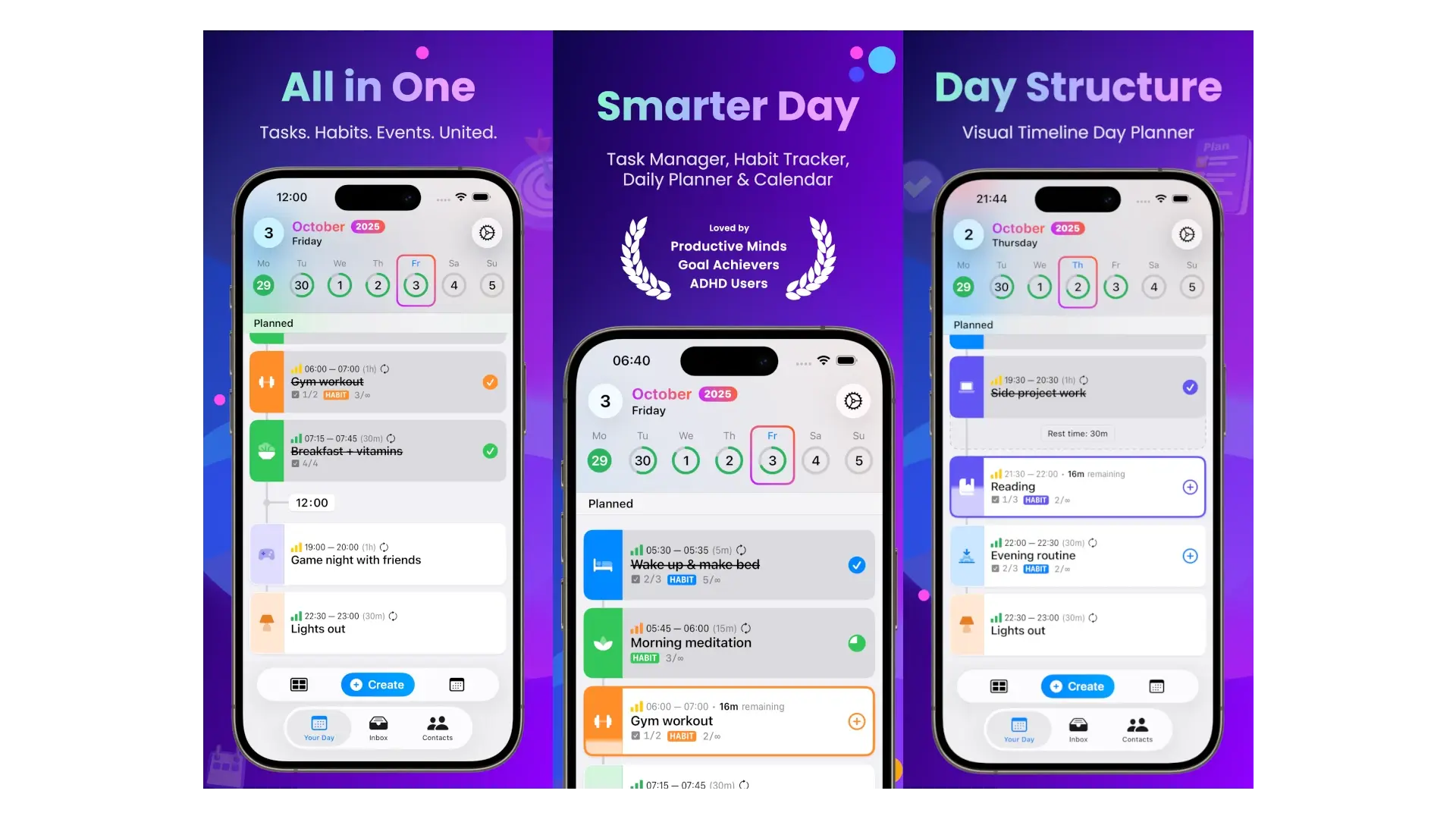
If you want help operationalizing these methods—planning blocks, tracking progress, and staying accountable—try the productivity app at Smarter.Day. It’s a simple way to align daily actions with your North Star, automate routines, and sustain momentum without adding complexity.
You May Also Like
These Related Stories
12 Proven Time Management Tactics That Actually Work
10 Proven Time Management Strategies That Actually Work
No Comments Yet
Let us know what you think