
12 Proven Strategies to Boost Focus and Productivity

12 Proven Strategies to Boost Focus and Productivity
We all know the feeling: you sit down to work, and your mind jumps between Slack pings, inbox alerts, and half-finished tasks. Hours later, you’ve moved a lot—but finished little. Here’s the catch: most productivity advice ignores the brain’s limits and the rhythms that drive cognitive performance. In this guide, we go beyond surface-level tips. You’ll learn how to reduce context switching, build deep work blocks, and tune your energy for consistent, sustainable results.
Our goal is simple: equip you with actionable, science-backed strategies that you can deploy today for immediate workflow improvement. We’ll blend proven methods like timeboxing, habit stacking, and energy management with modern tactics for time optimization. Expect real-life stories, expert insights, and practical scripts you can apply in minutes. Whether you’re a creator, manager, or founder, we’ll help you cut through noise and turn effort into outcomes that actually matter.
1) Timeboxing Your Day for Predictable Progress
Time expands to fill the time available—a reminder from Parkinson’s Law that undermines many calendars. With timeboxing, you assign a fixed window to a task and protect it like a meeting. Start by blocking two 90-minute focus blocks daily for your most meaningful work. Then, add 15-minute buffers between boxes to reset and prevent spillover. As Cal Newport explains in “Deep Work,” protecting focused time is the fastest way to amplify output without extending hours. “Work expands,” yes—but with hard edges, it stops expanding into your evening.
Two practical methods keep timeboxing sticky. First, use color-coded calendars: green for deep work, blue for collaboration, red for admin, and gray for buffers. Second, add a “shutdown ritual” at day’s end to review wins, move loose ends, and plan tomorrow’s first block—Newport calls it a “cognitive off-ramp.” Andre, a product manager, reclaimed two hours daily by front-loading a green block at 9 a.m. and shifting email to 11:30 a.m. As a result, his weekly “done” list finally matched his goals, not just his meetings.
When you start, your estimates will be off. That’s normal. Track the estimate vs. actual for recurring tasks for two weeks and adjust your boxes. Use a “parking lot” note to capture ideas that surface mid-block without breaking focus. Research shows that externalizing pending thoughts reduces mental load, a core idea in David Allen’s “Getting Things Done.” The lesson: timeboxing works when it’s alive—planned, measured, and refined—rather than a rigid plan that crumbles at the first interruption.
2) Eliminate Context Switching to Recover Your Focus
Every switch costs you. In a well-cited study, Gloria Mark (UC Irvine) found it can take over 20 minutes to return to the original task after an interruption. That cognitive “switch tax” is why scattered days feel exhausting and unproductive. To fight it, you need single-task windows and a distraction-proof environment. Start by batching similar tasks—email, approvals, scheduling—into one or two windows daily, and use full-screen mode during deep work. You’ll feel your brain quietly exhale as distractions shrink.
Two methods can help. First, use site blockers (e.g., Freedom or Cold Turkey) with pre-set “focus scenes” that mute social and news sites for 90 minutes. Second, create notification menus: turn off badges globally, keep only VIP calls on, and move Slack to manual refresh. Maria, a customer success lead, moved her metrics reviews and feedback writing to two morning blocks with Slack on “mentions-only.” Her weekly escalations dropped because the quality of her feedback increased—a win for both speed and accuracy.
As a backup, practice a “rescue question”: “Is this the best use of my brain for the next 30 minutes?” This mental checkpoint aligns your choice with your performance goals. If distractions are internal (e.g., worry, ideas), write a quick capture note to revisit later. Calming the “urgent-but-trivial” loop improves attention control, which Daniel Kahneman highlights as both limited and trainable. The big shift? Make context sacred. When you reduce switching, momentum becomes your new default.
3) Upgrade the Pomodoro: Active Breaks, Better Results
The Pomodoro Technique by Francesco Cirillo works because it sets clear start and stop boundaries that sidestep perfectionism. But here’s a high-leverage upgrade: keep the 25/5 cadence (or 50/10), but make breaks active. Use movement breaks (stairs, stretches) and visual resets (looking 20 feet away to relax eye muscles). Combine that with a post-it “next action” note before each break so you re-enter without decision fatigue. This simple tweak turns micro-pauses into a recovery protocol.
Two methods to amplify results. First, use “stair-step” sets: 25/5 x 3, then a 15-minute restorative break with water + breathing. Second, try 90/20 intervals when working on complex mental models—closer to ultradian rhythms (more on that later). Ravi, a data scientist, shifted from back-to-back 25s to a 50/10 model with quick kettlebell swings and outdoor light. He reported less afternoon dip and better code review quality, aligning with Cirillo’s emphasis on rhythm and sustainable pacing.
A 2011 study by Hölzel et al. on mindfulness found structural brain changes related to attention after consistent practice; think of active breaks as micro-mindfulness reps. For “brain-off” breaks, try box breathing (4-4-4-4) or a short body scan. Keep breaks screen-free when possible—your eyes and prefrontal cortex will thank you. The aim isn’t to grind harder. It’s to alternate bouts of concentration with micro-recovery so you sustain high performance throughout the day.
4) Align Work with Energy: Ultradian and Circadian Cycles
Let’s face it: time management without energy management is wishful thinking. Bodies run on circadian rhythms (24-hour) and ultradian rhythms (90–120 minutes), affecting alertness, creativity, and willpower. According to research popularized by Nathaniel Kleitman and later operationalized by Tony Schwartz in “The Power of Full Engagement,” performance peaks when we honor cycles of intense effort followed by recovery. Map your chronotype (morning lark, hummingbird, or night owl) and schedule deep work when your brain naturally fires.
Two methods to try. First, protect a daily peak block: if you’re a morning person, put analytical work between 9–11 a.m.; if you’re an evening peak performer, slot it after 6 p.m. Second, use a 90/20 cadence for cognitively heavy tasks and insert recovery: hydration, light movement, and sunlight. Kira, a designer, moved ideation into her late-morning peak and pushed admin to mid-afternoon. Her creative throughput rose, and revisions dropped—quality follows energy.
Track energy data for two weeks. Each hour, rate energy 1–5 and note task type. Patterns emerge fast. Then, stack high-cognitive-load work into your top two daily energy slots and push low-stakes admin into the trough. Protect sleep like a deliverable; as Matthew Walker summarizes in “Why We Sleep,” sleep deprivation impairs memory, decision-making, and emotional regulation—all critical for workflow improvement. Optimize time by respecting biology, not fighting it.
5) Prioritize with Impact: Eisenhower and Value Scoring
Not all tasks are equal. The Eisenhower Matrix popularized by Stephen Covey separates work into urgent vs. important, revealing what truly drives results. Build a simple Impact x Effort scoring: 1–5 for impact and effort; prioritize high-impact, low-effort “quick wins,” schedule high-impact, high-effort projects, and eliminate low-impact tasks. Do this weekly so your plan reflects strategic goals, not just current fires. “The key is not to prioritize what’s on your schedule, but to schedule your priorities,” Covey reminds us.
Two practical methods. First, implement a “Friday filter”: list your top 10 tasks, score them (Impact x Effort), and keep only the top five for the following week. Second, use time caps for low-impact tasks so they don’t balloon. Jamal, an engineering manager, cut his backlog by 30% by culling low-impact tickets and fast-tracking code improvements with high customer-visible impact. His team’s velocity improved without longer hours, reflecting time optimization done right.
To avoid decision fatigue, convert priorities into a North Star metric (e.g., “customer activation rate” or “weekly commits merged”) and map tasks against it. Adam Grant’s work on “Originals” emphasizes thoughtful risk-taking and outcome focus—choose fewer, bigger bets. Revisit your priorities during a weekly review and after product launches. Clarity beats chaos when you measure impact, not motion, and your performance will show it.
6) Build Habits That Stick: Tiny Actions, Stacked Cues
Big goals fail when they rely on motivation alone. BJ Fogg’s “Tiny Habits” shows that small behaviors, anchored to existing routines, build automaticity. Pair that with James Clear’s “Atomic Habits,” and you have a playbook: make the habit obvious, attractive, easy, and satisfying. Start with two-minute versions of big behaviors—write one bullet point, open the design file, or draft a single test. Then habit stack: “After I make coffee, I open my daily plan” or “After lunch, I review key metrics.”
Two methods to lock it in. First, use implementation intentions: “If it’s 9 a.m., then I start my focus block.” Second, make it visible: a physical checklist, a desk tent with your “one thing,” or a widget with your daily target. Sofia, a marketer, struggled with content consistency. She stacked “outline two bullets” to her morning coffee and added a visual cue on her laptop. Within a month, she published twice as many posts with less friction—proof that tiny beats tricky.
Celebrate small wins to reinforce identity—“I’m the kind of person who starts on time.” The Progress Principle by Teresa Amabile and Steven Kramer shows that recognizing daily progress boosts motivation and creative output. Keep a win log at day’s end; it trains your brain to notice traction, not just gaps. When you design your environment for the habit you want, motivation becomes optional and workflow improvement becomes default.
7) Tame Email and Notifications: Treat Inbox Like a Tool
Email is a to-do list that anyone can write on. In a study by Kostadin Kushlev and Elizabeth Dunn (2015), limiting email checks to three times per day reduced stress significantly. The fix: batch email into scheduled windows and remove real-time visibility (badges, previews). Set inbox rules: VIP senders get a daily check at noon; everything else waits until the afternoon. Keep your prefrontal cortex for creation, not constant triage. This single shift often returns an hour or more per day.
Two methods. First, craft a communication charter with your team: what to use email for vs. chat, expected response times, and escalation paths. Second, write short, structured emails with clear asks, deadlines, and bullet points to cut reply chains. Nia, a sales lead, moved to 11:30 a.m. and 4:30 p.m. email windows and added a “Need by EOD Friday?” line to outbound messages. Response quality improved, and the frantic back-and-forth dropped—order replaced always-on anxiety.
For notifications, apply a “default off” policy: no badges, vibration only for VIPs, and “Do Not Disturb” during deep work. Gloria Mark’s interruption research shows how external pings fragment attention; reducing them is a lever for cognitive performance. If you worry about missing something important, set a failsafe: a colleague can call you twice to break through DND for urgent issues. The outcome: fewer dopamine spikes, more deliberate output.
8) Offload Your Brain: Capture, Clarify, and Close Loops
Your brain is for having ideas, not storing them. David Allen’s “Getting Things Done” advocates a trusted capture system to externalize tasks and reduce cognitive load. Start with a single capture inbox (not five). Throughout the day, jot quick notes—one line each. Then, clarify: what’s the next physical action? If under two minutes, do it. If not, assign it to a project list and schedule it. This keeps your mental RAM clear and your execution crisp.
Two methods that accelerate clarity. First, use the Zeigarnik effect: when unfinished tasks nag at you, write down the next step and a when/where. Your brain relaxes knowing the loop is parked. Second, set context lists—Calls, Errands, Deep Work—so you can batch work by environment. Luis, a founder, stopped waking up at 3 a.m. thinking about investor follow-ups after he started capturing and clarifying nightly. His morning focus blocks felt lighter and faster.
For creative work, keep a “seed bank”: a note where you store fragments—great lines, questions, data points—with tags. As Anders Ericsson’s research on deliberate practice suggests, structured reps beat random effort. Closing loops—by capturing, clarifying, and completing—reduces anxiety and boosts workflow improvement. The payoff is a calm mind that can enter deep focus on demand.
9) Design Your Environment: Make Focus the Default
Have you ever noticed how your surroundings dictate your attention? Studies by Ethan Bernstein and Stephen Turban (Harvard Business School) found that open offices can reduce face-to-face interaction and increase digital messaging, often hurting focus. The fix: environment by intention. Create a focus zone with a clean desk, front-facing monitor, and minimal visual clutter. Add noise control: noise-canceling headphones or brown noise at low volume. Make it easy to focus—and hard to drift.
Two methods. First, set a “startup sequence” for your desk: water bottle, phone on DND, one tab group, notebook open to “Today.” Second, use light and plants. Access to natural light and greenery is associated with better mood and productivity; biophilic design research consistently points to cognitive benefits. Omar, a developer, moved his desk near a window, added a plant, and switched to a standing desk in the afternoons. Afternoon slump? Largely gone.
Make distractions physically inconvenient. Put snacks, social apps, and extra gadgets out of reach. Keep visual cues for your goal—your North Star metric or today’s “one thing.” As James Clear notes, environment is the “invisible hand” shaping behavior. When performance matters, don’t rely on willpower. Design your space so the easiest action is the right one, and watch your time optimization improve without extra effort.
10) Plan Fast, Review Weekly: Progress over Perfection
Big plans often die in planning. Instead, adopt a Rapid Planning Ritual: five minutes each morning to identify your top outcome, three critical tasks, and your first action. Then, run a Weekly Review—30 to 45 minutes to reflect, refocus, and re-commit. The Progress Principle (Amabile & Kramer) shows that seeing progress fuels motivation and creativity. Make the review a celebration of what moved, not a guilt session about what didn’t.
Two methods to keep reviews effective. First, use a simple checklist: wins, blockers, priorities, calendar alignment, next experiments. Second, add a mini-retro borrowed from Agile: what to start, stop, continue. Priya, a team lead, started Friday reviews and Monday five-minute plans. Within two sprints, the team’s carryover dropped and on-time delivery rose. The secret? Short feedback loops that keep reality close and plans flexible.
Track a few leading indicators (e.g., sessions in deep work, PRs merged, qualified demos) rather than drowning in lag metrics. As Peter Drucker taught, “What gets measured gets managed”—but choose carefully. The outcome of consistent reviews is clarity: you’ll know what works, what to adjust, and where to double down. That’s workflow improvement you can feel.
11) Train Attention: Mindfulness for Meta-Focus
Mindfulness isn’t just calm; it’s attention training. Research led by Richard Davidson and clinical programs like Jon Kabat-Zinn’s MBSR show improved attention regulation and reduced stress with consistent practice. Start with 10 minutes a day of breath-focused meditation. When the mind wanders, gently return. That rep is the workout. Pair it with one-minute resets before deep work and after meetings to clear residue and re-center on your next intention.
Two practical methods. First, use “noting”—label thoughts as “planning,” “worry,” or “remembering.” Second, try visualization: rehearse your next focus block starting smoothly. Hana, a product designer, used a pre-work one-minute breathing ritual and a 10-minute afternoon sit. She reported fewer false starts and better flow entry. A 2011 study by Hölzel et al. found gray matter changes in regions associated with learning and memory after eight weeks—attention is trainable.
Make it easy to stick with: tie mindfulness to anchors you already do—after coffee, post-lunch, pre-shutdown. Keep it non-judgmental: the goal is returning, not never getting distracted. Over time, you’ll develop meta-awareness—the ability to notice distraction sooner and choose your response. That choice is a superpower for cognitive performance in a noisy world.
12) Engineer Flow: Challenge, Clarity, and Constraints
Flow isn’t luck; it’s designed. Mihaly Csikszentmihalyi showed that flow emerges when challenge matches skill, goals are clear, and feedback is immediate. To increase flow time, set crystal-clear objectives for each session (“Write draft intro and outline three sections”) and tighten constraints (time cap, tool limits, offline mode). Then, create immediate feedback loops—checklists, tests, or quick peer reviews—to keep engagement high and attention anchored.
Two methods. First, aim for 4% challenge above comfort, a practical rule drawn from skill acquisition research: hard enough to engage, not so hard that it overwhelms. Second, use single-task sprints with visible progress bars or checkboxes. Theo, a software engineer, started setting “one-commit goals” for focus blocks and kept tests running for instant feedback. Result: more days with sustained flow and fewer frustrating plateaus.
Cal Newport’s “Deep Work” reinforces that distraction-free concentration produces outsized returns in a distraction-rich world. Stack your flow triggers: a clear goal, a countdown timer, a quiet environment, and a post-session review. Over time, you’ll spend more minutes in that sweet spot where time disappears and output soars. It’s time optimization at its most satisfying.
Conclusion
Productivity isn’t about squeezing more into your day; it’s about aligning your attention, energy, and environment so important work happens reliably. You’ve learned how to timebox, reduce context switching, leverage ultradian rhythms, and design habits and spaces that make focus natural. Pick two strategies, implement them this week, and review your progress. Momentum beats perfection.
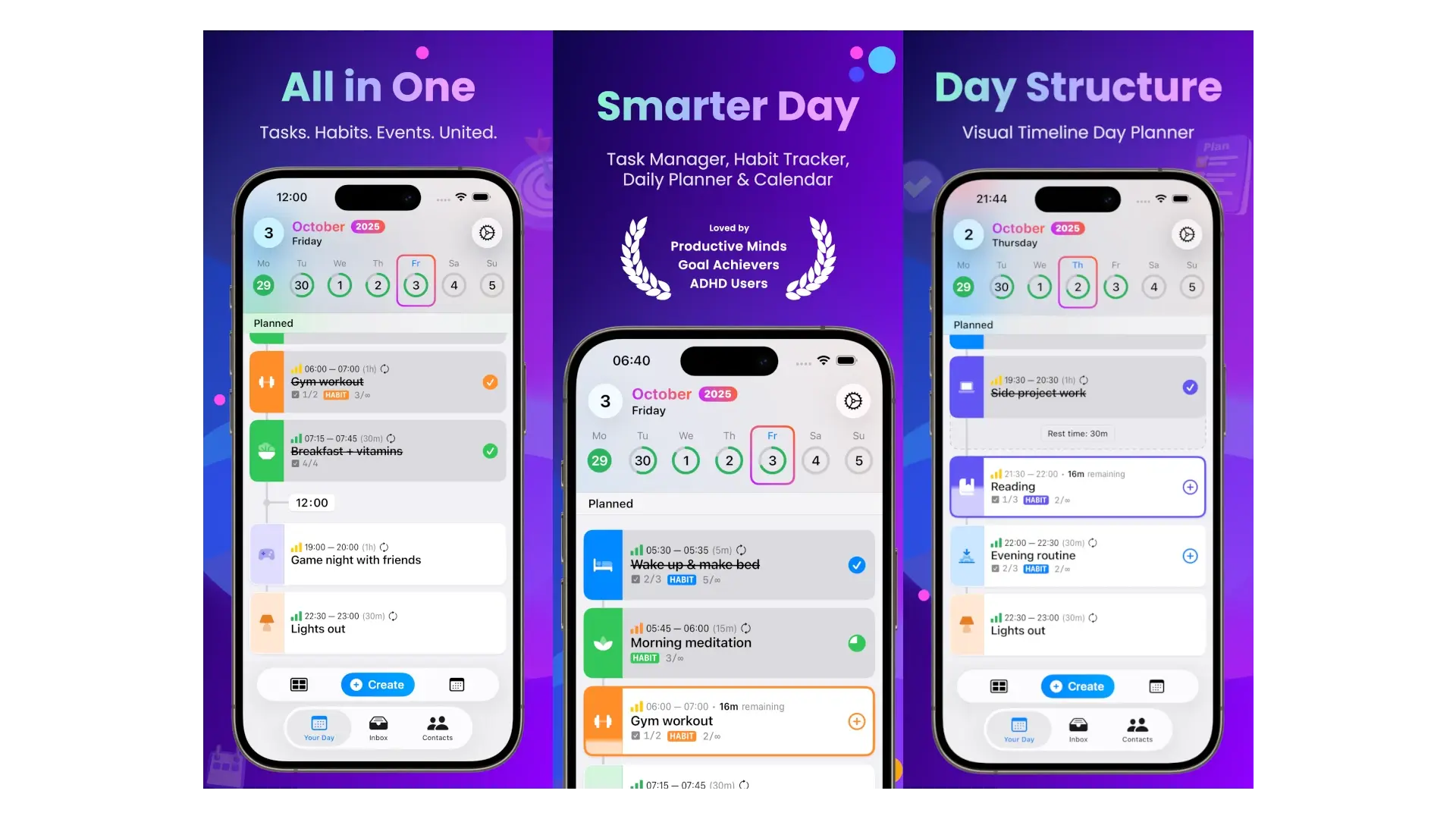
If you want a simple way to coordinate these strategies—blocking time, tracking energy, and reviewing wins—try the productivity app at Smarter.Day. It centralizes your plans, captures ideas, and helps you enter deep work with fewer clicks and less friction. Start small, iterate weekly, and let your results compound.
Ready to turn busy days into meaningful progress? Explore Smarter.Day to plan smarter, focus deeper, and finish what matters most.
You May Also Like
These Related Stories
12 Proven Strategies to Boost Focus and Productivity
12 Proven Strategies to Boost Focus and Productivity
No Comments Yet
Let us know what you think