

12 Proven Time Management Strategies That Truly Work

12 Proven Time Management Strategies That Truly Work
Totally, we’ve all gone through those situations where the to-do list increases exponentially and no focus is left. A multimodalistic app transitioning together with a “just one more” message popping up on your screen is the same as having a long day that is suddenly over. This is the irony: productivity does not refer to doing more; rather, it is about doing the right things on purpose. Our objective is to practice actionable time optimization techniques to help you deal with challenges like noise, managing priorities, and cognitive performance improvement without burnout, etc. If doing busywork and not getting results is your issue, just stay with us there.
The goal set for you is to provide you with excellent, sensible techniques grounded in research that can be put into practice immediately. You are going to learn to effectively use timeboxing, the Eisenhower Matrix, Deep Work, habit design, and smart planning rituals to upgrade your workflow. We’ll include practical and relatable sample solutions, tried-and-true tools, insights from top-selling books, and several scientific studies. At the end of the meeting, you will be equipped with a detailed plan for workflow improvement, increased focus, and consistent execution—no filler, just vital parts.
Timeboxing and Fixed-Schedule Productivity
Work expands so as to avail the totality of the time which is available—Parkinson’s Law in action. You can counter that by timeboxing; this is the process of assigning tasks to fixed calendar blocks so that work will fit your schedule, not the other way around. Method one: schedule 30–90 minute blocks for deep tasks and protect them as if they were meetings. Method two: use fixed-schedule productivity (Cal Newport, “Deep Work”) to select a time when your workday is ended and formulate your day after it. Maya, a product manager, reclaimed evenings by bulking deep design work from 8:30–10:00 a.m., shoving meetings and Slack to later blocks.
With two practical tweaks, results can be magnified. First, set scope constraints within each block (for example, “write 600 words,” “ship draft v1”) to avoid just filling time without a purpose. Second, integrate a 10-minute buffer for journaling what worked and what was missed; this debrief sharpens estimates, needing less time in the future. According to Newport, shortening time accompanies the increase in focus: “Work expands to the time allowed.” Within a week you will find that your estimates become better, and your time management gets on course to becoming proactive, not reactive.
For repetitive tasks, make templates with pre-set durations: “weekly planning—25 minutes,” “inbox zero—30 minutes,” “report review—45 minutes.” Maya added templates to her calendar every Monday, getting rid of the decision-making fatigue in a minute. When critical requests appeared, she swapped the blocks instead of removing them. The result was fewer overruns and a new rhythm. Studies on implementation intentions witness that people who plan concretely and within set time frames have a much higher rate of achieving follow-through.
The Eisenhower Matrix + Ivy Lee Method
When all things look to be urgent, we are just left with extinguishing flames. Here comes the Eisenhower Matrix: divide tasks into urgency and importance. Method 1: Distribute items into four quadrants; “important but not urgent” is first on the list along with your quadrant tasks. Method 2: The Ivy Lee Method—tomorrow, list the top six tasks and order them by priority before you take action one by one. Alex, a freelance designer, applied this procedure to be free from stuffing their mornings with trivial things and able to focus on more productive work, like concepting.
A fast track to implement this method is as follows. Start off with your three core Most Important Tasks (MITs) having explicit outcomes (for instance, “finalize storyboard v2”). Arrange the other tasks using the Eisenhower technique: delegate or defer “urgent but not important,” and schedule “not urgent but important” for review. The Ivy Lee anecdote—consultant Ivy Lee advising Charles Schwab—brings out the simple prioritization routine that can produce high rewards. The six items paradigm cuts down cognitive overload while keeping the momentum.
To not lose your path, utilize time limits per quadrant. For instance, you could put a 30-minute triage block every day on “urgent but not important.” Alex took a 10-minute evening pass to write down the six tasks for the next day, which alleviated indecision in the morning. Joining priority frameworks with the proper blocks is a force multiplier. As Dwight Eisenhower once said, “What is important is seldom urgent and what is urgent is seldom important.” It’s up to you to make the difference in your calendar.
Energy Management: Ultradian Rhythms and Peak Windows
Let’s be honest: you aren’t a robot. The very best time optimization is the one that follows the rules of Mother Nature. Method one: align deep work with your chronotype—the times when you are the most productive. By working in ultradian cycles (90 minutes on, 15–20 minutes off), you will be following the physiological rhythms explained by Nathaniel Kleitman. Priya, a software engineer, transferred the complex debugging task to the mental peak hours of 9–11 a.m. (her brain at its best). She ran meetings after lunch and took 15-minute breaks outdoors, thus achieving her target to drop error rate and increase throughput.
Implement a 1-week plan of energy audit. Once every two hours of work, log your energy levels from 1–5 and note the task type. After seven days, you will find out that the highest-cognition tasks can be arranged in your two preferred time windows. Tony Schwartz (The Energy Project) spread the idea that energy management is more important than just time, and it is the fuel that promotes sustained performance. Build micro-breaks: just 20-second eye rests, 5-minute walks, or short stretches to reset attention are small but highly productive investments.
Include two supporting strategies. The first approach is to front-load protein and hydration in the morning to reach a state of stable focus. The second one is overlapping recovery rituals: breathwork (box breathing) for 5 minutes after deep blocks and a “shutdown routine” for 10 minutes at the end of the day to reduce cognitive residue. At the end of her routine, Priya wrote a to-do list for tomorrow by hand and added the phrase “workday closed.” The outcome? Less ruminating, improved sleeping, and easier next-day deep work carrying on.
Task Batching and Reducing Context Switching
Running between tasks creates an invisible cost. Dr. Gloria Mark of UC Irvine has found that it often takes more than 23 minutes to return to focus after an interruption. The first method is task batching—combining related tasks (such as email, analytics, and design) and then running them through in isolated time blocks. The second method is theme days or half-days (i.e., Tuesday mornings for client reviews). Luis, an agency owner, was able to combine proposals for Wednesday afternoons and thus cut the turnaround time by 30%.
Be specific with the batches. Formulate three to five context buckets where every bucket has its own toolkits: Email/Comms, Creation, Admin, Learning. Prepare checklists for every bucket—and ensure less thinking and more doing is the order of the day. After that, set your notification preferences in accordance with each batch. For instance, during Creation, turn off everything, while during Comms, turn on Slack and email. The combination of batching and Do Not Disturb windows is a win-win for productivity. They not only keep the flow going, but also baby-step away from the mindless “just a quick check.”
Two more tricks will wrap it up. Use a single-tab browser rule for serious work accompanied by a parking lot note for any ideas popping up anytime mid-task—just capture them and don't chase. Besides, Luis had also set a slot at 3:30 p.m. for open loops to be covered by small items collected through the day. This way he feels less cluttered yet maintains high-quality focus in the morning. As Cal Newport, an author of productivity, said, attention residue diminishes quality; batching averts it from getting medieval.
Deep Work + Pomodoro Pairing
“Deep Work,” as Cal Newport defines it, is the ability to focus fully on complex tasks without being distracted by anything. Method one: block 60–90 minutes of deep work on a single goal and use a visible progress metric. Method two: use the Pomodoro Technique (Francesco Cirillo) in conjunction with a focus time of 25–50 minutes followed by a break of 5–10 minutes. Jenna, a content strategist, used 50/10 cycles for two rounds and then paused for a 20-minute reset. Her draft speed increased and the number of edits decreased.
Try this hybrid protocol. For idea generation, use shorter 25-minute Pomodoros to keep momentum; for execution and synthesis, run 75-minute deep blocks. Hide your phone somewhere else, out of sight to reduce checking. Measure the results with a count metric (words written, tests passed, slides produced) so that your brain stays engaged. Newport’s research states that high-intensity, distraction-free periods can be trained like a muscle.
Confront drag using these two strategies. Begin with a focus warm-up: 3 minutes to review your outcome, 2 minutes to organize tabs, 30 seconds of breathwork. Second, end each block with a status note for the future-you: what’s done, what’s next, where to resume. Jenna’s status notes cut ramp-up time in half. In conjunction with a weekly tally of deep hours, these tools will ensure consistent progress. What gets measured, indeed, improves.
Habit Anchors and Implementation Intentions
As intensity is secondary to consistency. The first method is to utilize habit anchors—associating a new behavior with an already established routine (“after I make coffee, I plan my day”). The second method is implementation intentions, for example: if-then statements “If it is 8:30 a.m., then I will start my design block.” Peter Gollwitzer’s experiment found that if-then planning notably enhances follow-through. Tom, a QA engineer, linked his daily test-plan review to the first log-in that he did and achieved nearly perfect consistency.
Introduce habit shaping based on James Clear’s “Atomic Habits.” Make it obvious (visual cue on desk), attractive (pair with your favorite playlist), easy (open the doc template ahead of time), and satisfying (check off a box). Add a habit contract—a simple commitment with a peer and a small consequence if skipped. The social nudge increases adherence without heavy policing.
For a particularly challenging day, use two guardrails. First, follow the never miss twice rule—if you miss a habit once, give priority to the next rep directly. Second, shorten the habit to a gateway version: 5 minutes of planning rather than 25, one paragraph rather than a whole page. Tom’s rule of “minimum viable habit” was what helped him maintain his record during the product launches by preserving the momentum until the regular workload returned.
Build a Second Brain: Capture, Clarify, Organize
Multiply Your Ideas Instead of Keeping Them. The first one is the use of the PARA method (Projects, Areas, Resources, Archives) from Tiago Forte’s “Building a Second Brain.” The second way is to implement the GTD workflow (David Allen): capture, clarify, organize, reflect, engage. A group of consultants used the PARA in their shared drive: projects benefited from active deliverables, areas with ongoing responsibilities, resources with curated references, and archived completed work.
Universal capture is your starting point. Use a single inbox for notes—app or notebook—and empty it on a daily basis. Clarify every item: is it actionable? If yes, define the next action; if no, file it as reference or trash. Create project dashboards that include outcomes, scope, stakeholders, and next steps. The transparency in information reduces the resistance that comes with the initiation of a task and fosters a faster time to productivity. The essence of David Allen’s idea is that: “Mind like water” comes to life when the promises are made visible and well-organized.
Incorporate two high-leverage practices. Firstly, a weekly maintenance sweep to prune, tag, and link notes—10–20 minutes is sufficient. Secondly, create maps of content (MOCs) for the topics you frequently discuss—sales scenarios, design blueprints, research overviews. The consulting team’s MOC workshop was incredibly useful for creating agendas in less time. As you progress, the second brain method develops, transforming the previously unstructured data into well-organized and easily applicable resources.
Meeting and Communication Hygiene
Conducting meetings has the potential to be both useful and wasteful. The first approach: designating no-meeting blocks to spend time on deep work (i.e., 9–12 a.m. Mon–Thu). The second method: use the async-first strategy for updates—briefs, demos, and decision logs that are recorded. Atlassian indicates that employees typically waste hours each week in unproductive meetings; eliminating unnecessary syncs brings back time for quality work. An advertising group’s workflow was transformed from the status meetings to a shared dashboard and, as a result, they won an additional deep block each week to utilize.
Essential meetings should be structured with tight agendas: purpose, decision needed, prep materials, owner, and timebox. Adhere to the two-pizza rule (small groups), and finish with brief but clear DRIs (Directly Responsible Individuals). Keep a decision log so that the choices cannot be lost in the chat history. According to Microsoft’s Work Trend Index, digital debt has escalated; written clarity avoids the need for rework and extended explanations.
There are two more methods to boost productivity. First, schedule office hours to deal with ad-hoc questions, which makes sense of the random pings. Second, launch a communication ladder: begin async (doc), climb to comments, then short call only if necessary. The team added zero internal meetings on a Wednesday “maker day,” and, creatively, they outputted much more. Bear in mind that each calendar invitation constitutes a decision on resource allocation—and it should be treated as such.
Email and Notification Control
Email and alerts frantically churning at unregulated speed are productivity kryptonite. A McKinsey review found that knowledge workers waste nearly 28% of the workweek on email. Method one: batch email three times a day for 25–30 minute periods. Method two: create VIP filters so the only messages coming in are the urgent ones. Sofia, the operations lead, proactively slipped her inbox checks to 11:30 a.m. and 4:00 p.m. by using filters that let the finance and vendor messages appear right away.
Apply the 4D principle: Do (under two minutes), Delegate, Defer (timebox), Delete. Use shortcuts and templates for frequent replies to reduce repetitive keystrokes. Disable non-negotiable badges, banners, and alarms; keep just calendar and VIPs visible. A study from the University of British Columbia (Kushlev et al., 2015) found that reducing email checking decreased stress and improved overall well-being—your nervous system will be overjoyed.
Last two improvements. First, create a waiting for label to track the items you delegated, which should be reviewed every afternoon. Second, establish email guardrails in your signature (“I check email at 11:30 a.m. and 4:00 p.m.”) to manipulate expectations. Sofia’s group aligned to that schedule; fewer “I am just checking” messages, more collective updates. Remember that your inbox should only be a tool and not a source of stress—view it this way.
Planning Rituals: Weekly Reviews, Daily Targets, and OKRs
Monstrous weeks are not spontaneous; they are designed in reverse. Method one: a weekly review—process inboxes, check whether you are on the right track with the projects, select 3–5 important tasks, and schedule time. Method two: daily target setting—define one to three outcomes and schedule them first. Marcus, the remote team lead, kicked off Friday reviews and Monday morning timeboxing; his on-time delivery improved without working longer hours.
To ensure the company is headed in the right direction, OKRs (Objectives and Key Results) should be used. These are the methods popularized by John Doerr in “Measure What Matters.” Set one to three objectives quarterly and list quantitative key results, and therefore the weekly actions will be cascaded. Your daily targets will be based on relative OKRs—this will prevent local optimization that does not affect the company’s objectives. During the weekly review, give a score to progress and modify the plan. This feedback loop is maintaining performance that is attached to goals, not just activity.
Two practices achieve this. One is a 10-minute morning kickoff where three things are done: top three of the day are confirmed; blockers are checked; and the first block is committed. The other key practice is a 5-minute shutdown checklist which involves three things: gains are logged, open loops captured, and the first next action for tomorrow is noted. Marcus’s team has used a shared review template which clarifies the cross-team priorities. Planning is raising leverage; it multiplies all hours you do.
Environment and Digital Ergonomics for Frictionless Focus
Your environment has a bigger impact on your behavior than the force of will. Strategy one: create a focus-friendly workspace—neat desk, essential tools visible, distractions out of sight. Strategy two: use digital ergonomics—single-monitor deep work, minimal dock icons, and site blockers (e.g., Freedom, Cold Turkey) during focus hours. Jenna relocated her phone to a different room and significantly reduced her mindless checks.
The default effect can be your best friend. Make being productive the easy option: auto-open your daily plan on startup, set your browser’s home to your project dashboard, and log out of distracting sites. Additionally, noise-canceling headphones or brown noise can help in lessening auditory distractions; research indicates that even a momentary background speech could impair cognitive performance. Strike back with simplicity—one app, one decision, one speed-up.
This is strengthened by two simple habits. Firstly, a 2-minute reset ritual after every deep block to clean your desk and close stray tabs. Secondly, a visual cue—sticky note with your single current goal—front and center. These tiny changes, accumulated over time, lead to a fortified attention. Picture your environment as a colleague: construct it in a way that makes it easier for you to work.
Rest, Micro-Breaks, and Sustainable Performance
The relationship is direct: the highest output necessitates the highest quality of recovery. Sleep—7–9 hours, and a consistent schedule. Matthew Walker’s “Why We Sleep” brings together a lot of studies showing sleep’s extensive impact on memory, creativity, and decision-making. The second method is to schedule micro-breaks—standing, stretching, or 60-second eye rests every hour. A randomized study on brief breaks reveals that these can improve vigilance and task accuracy.
Add two other ingredients. Firstly, include movement snacks—quick walks or mobility drills—especially after meetings. Secondly, you may power nap (10–20 minutes) for a cognitive recharge without feeling groggy. Priya created a 10-minute break in the outdoor area after lunch; she no longer had afternoon energy slump, and her code review quality increased. Progressive workflow improvement is the proper ratio of stress to renewal.
Finish the day with a shutdown procedure: capture the pending tasks that linger in your mind, schedule the first deep block for tomorrow, and finish with jotting a gratitude note. This would thus eliminate the cognitive residue—those sticky thoughts that plague the evening hours and sleep time. Attend to these with your weekly planning, and you would see your potential break forth without any heroic effort. Productivity is a way of living, not a quick race.
Conclusion
You do not need to apply several hacks; you are only in need of a system that you have faith in. The antidote to distraction is, for instance, the combination of timeboxing, priority frameworks, Deep Work, habit anchors, and unchanging planning. Select two of them, put them into practice this week, and then evaluate the results. Barely organize your tools before you start planning.
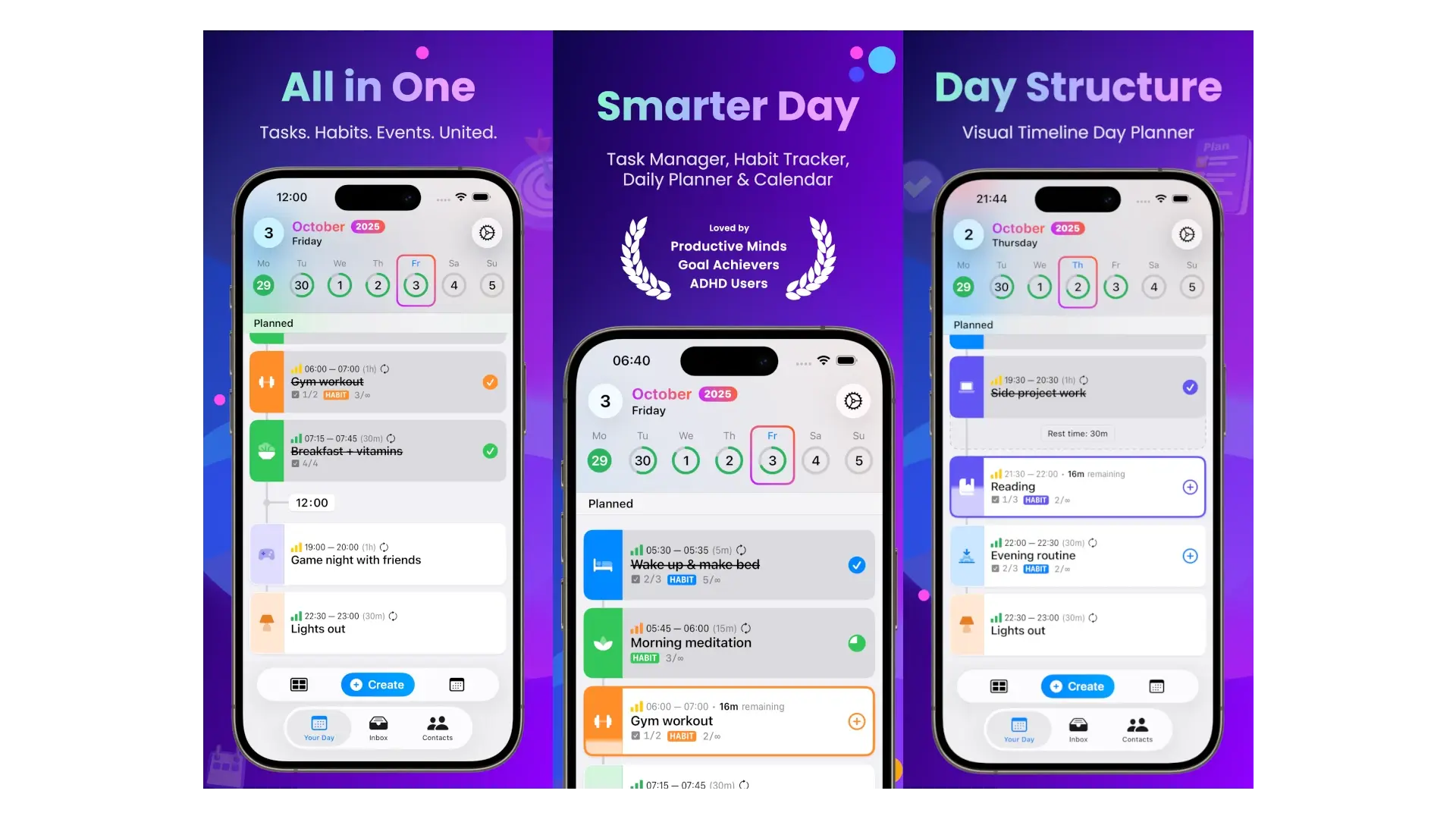
If you want an integrated way to plan deep work blocks, batch tasks, and run weekly reviews without juggling six apps, the productivity app at Smarter.Day is a smart next step. Use it to timebox, track MITs, and maintain your second brain—all in one place.
You May Also Like
These Related Stories
Win Your Day: Advanced Time Management Tactics That Work
Win Your Day: Advanced Time Management Tactics That Work
No Comments Yet
Let us know what you think