
Win Your Day: Advanced Time Management Tactics That Work

Win Your Day: Advanced Time Management Tactics That Work
Have you ever opened your laptop, shuffled a few tabs, and somehow felt busier but not better? Let’s face it—procrastination, endless pings, and messy priorities hijack our best hours. Here’s the catch: productivity isn’t about working more; it’s about working intentionally. In this guide, we’ll show you how to outsmart distraction, make smarter choices faster, and deliver results without burning out. If you want practical time optimization and workflow improvement techniques that actually fit real life, you’re in the right place.
Our aim is simple: give you battle-tested tactics you can use today. You’ll get advanced prioritization frameworks, deep work strategies, cognitive performance boosters, and automation moves that compound over time. We’ll lean on credible research and real examples so you can build a sustainable system. By the end, you’ll have a flexible playbook—rooted in focus, performance, and time management—to win your day, week, and beyond.
Design Your Day Around Energy, Not the Clock
Most of us plan our day by the hour instead of our energy peaks. Yet research on ultradian rhythms suggests we’re wired for 90–120 minute cycles of intense focus followed by recovery (first described by sleep researcher Nathaniel Kleitman). Two methods: first, run a one-week energy audit—every two hours, note your alertness and task ease. Second, take a quick chronotype quiz (Daniel Pink’s book “When” summarizes this science) to learn whether you’re a lark, third-bird, or owl. Map your deep work to peak times; place admin and meetings in troughs.
Next, design ultradian sprints. Block 90 minutes for concentrated work, followed by a 10–15 minute break. Use cues like a “no meetings” calendar block and a phone in another room. Pair peak blocks with your highest-impact tasks to maximize performance. Example: Sofia, a product manager, shifted roadmapping to 9–11 a.m. (her peak), moved email to 2 p.m., and reclaimed two hours of focused progress daily.
Finally, guard your energy with buffered transitions. Schedule 5–10 minutes after intense sprints to stand, hydrate, or take a brief walk. This reduces mental residue and preserves cognitive bandwidth (see Cal Newport’s “Deep Work” for why attention residue matters). Over time, your schedule becomes a custom-fitted system—anchored to biology, not just blocks on a calendar.
Prioritization Frameworks That Beat the To-Do Pile
Staring at a crowded list is paralyzing. Start with MITs (Most Important Tasks)—choose 1–3 domino tasks that move the needle. Pair this with a Kill–Snooze–Do sweep: kill non-essentials, snooze low-impact items to a future list, and do what’s left. This forces clarity. Malik, a customer success lead, adopted MITs each morning and cut daily carryover tasks by half in two weeks.
For bigger planning, use the Impact/Effort matrix to find quick wins and strategic bets. Or apply RICE scoring—Reach, Impact, Confidence, Effort—to prioritize projects with more rigor (popularized by Intercom and adaptable for individuals). Score your options quickly, then timebox the top two. This reduces decision fatigue and puts value first.
Remember, focus is a choice. Greg McKeown’s “Essentialism” argues that “if you don’t prioritize your life, someone else will.” Combine Essentialism with the Pareto Principle (80/20) to find the small set of tasks that create disproportionate outcomes. One founder used RICE for her roadmap and found two features that drove 70% of customer retention—freeing time and mental space for growth.
Slash Context Switching with Batching and Mode Days
Every switch drains attention. Gloria Mark’s research at UC Irvine found interruptions can take over 20 minutes to fully recover from—meaning context switching quietly destroys productivity. Two methods: batch similar tasks (write all proposals together, process all invoices together) and create mode days—e.g., Monday = strategy, Tuesday = team, Wednesday = maker time. This reduces cognitive gear shifts and strengthens workflow momentum.
Next, implement communication windows. Set two 30–45 minute blocks to process email and chat. Use “Do Not Disturb” status and clear expectations like “I respond within 24 hours.” Pair this with templates—email snippets, proposal outlines, and meeting agendas—to speed up repeated work. The goal is fewer transitions, more time optimization.
Example: Priya, an HR lead, moved to mode days (recruiting on Tuesdays, onboarding Thursdays) and cut her Slack checks to three windows. The result? More predictable focus time and fewer after-hours catch-ups. For more on the cost of interruptions and attention fragmentation, see Mark’s “Attention Span: A Groundbreaking Way to Restore Balance, Happiness and Productivity.”
Timeboxing and Weekly Sprints You’ll Actually Keep
Timeboxing puts a deadline on effort, not just tasks. Instead of “work on report,” try “Draft section A, 10:00–10:50.” Two methods: block deep work in 50–90 minute boxes and add buffer zones before/after meetings for notes and recovery. Then finish with a five-minute “definition of done” check. This aligns effort with outcome, taming Parkinson’s Law—the idea that work expands to fill the time available.
Run weekly sprints to connect goals with time. On Friday or Monday, review your backlog, pick one or two sprint goals, and pre-load your calendar with timeboxes. Midweek, do a 15-minute recalibration. This agile-lite approach is portable and keeps priorities live.
Cal Newport champions time-block planning to manage attention intentionally. Pair it with Francesco Cirillo’s Pomodoro principles to gain rhythm. Example: a marketer pre-boxed campaign work 9–11 a.m. and content edits 3–4 p.m., with 15-minute buffers. The tangible gains: fewer overruns and a steady cadence that improved both quality and speed.
Pomodoro 2.0: Rhythm Variations for Real Life
Classic Pomodoro isn’t one-size-fits-all. Try the 52/17 rule—52 minutes on, 17 minutes off—popularized by the DeskTime analysis of high performers (Draugiem Group). Set a timer for the on-block, then use off-time for non-screen recovery: stretch, walk, hydrate. This balances effort with restoration for better focus and performance.
Experiment with Flowtime: work until your concentration dips, then log the duration and break accordingly. Over a week, you’ll learn your natural focus span and tailor blocks accordingly. It’s flexible and honors the day’s reality—especially useful for creative or analytical tasks that resist tight boundaries.
Finally, add deliberate breaks. Research on deliberate practice (Anders Ericsson) shows peak performance relies on cycles of intense focus and recovery. Use the 20-20-20 rule to rest your eyes (every 20 minutes, look 20 feet away for 20 seconds) and mix in short “movement snacks.” Example: Leo, a developer, shifted to Flowtime and gained an extra hour of quality coding daily without feeling drained.
Engineer Focus: Environment, Attention, and Tech Guards
Your environment quietly sets your attention ceiling. Start an attention diet: remove unused icons, log out of distracting apps, and use a one-screen rule during deep work. Keep your phone in another room when possible. A simple practice: keep a “capture pad” for intrusive thoughts so you can offload and return to the task. You’ll curb mental tab-switching.
Optimize lighting, noise, and temperature. Aim for 20–22°C (68–72°F), add a desk lamp for task lighting, and test brown noise or instrumental playlists to mask chatter. Studies show moderate background noise can impair complex cognition, while controlled soundscapes can help some workers re-enter flow. Over-ear noise-canceling headphones are a strong upgrade for sustained deep work.
Deploy digital guards: site blockers (e.g., block social feeds), app limits, and email triage with a three-folder system—Action, Awaiting, Archive. Cal Newport’s “Deep Work” outlines why these barriers are essential for meaningful output. Example: Ana, a designer, does 90-minute design blocks with Freedom enabled, Slack paused, and a short checklist at the start and end. Her review cycles shrank by 30%.
Boost Cognitive Performance with Sleep, Movement, and Fuel
No time system beats bad sleep. Aim for 7–9 hours with a consistent wake time. Two methods: a 90-minute wind-down routine (dim lights, hot shower, no heavy food) and a digital sunset 60 minutes before bed. Matthew Walker’s “Why We Sleep” consolidates evidence that sleep quality drives memory, focus, and emotion regulation—key for sustainable productivity.
Add movement micro-doses. Take a two-minute walking break every hour or do a 60-second mobility flow to refresh blood flow and attention. A Stanford study (Oppezzo & Schwartz, 2014) found walking boosts creative output substantially—perfect for problem-solving blocks. Don’t forget hydration; even mild dehydration can reduce cognitive performance and mood. Keep water visible and reachable.
Fuel wisely. Choose low-glycemic meals to prevent energy crashes, eat a protein-forward breakfast, and time caffeine 60–90 minutes after waking to avoid cortisol spikes. Johns Hopkins research links caffeine to enhanced memory consolidation—used strategically, it’s a tool, not a crutch. Example: Dana swapped pastries for eggs and greens, added hourly water sips, and stopped late-day caffeine—her afternoon slump disappeared.
Automate, Template, and Delegate Like a Pro
Look for repetitive steps and build SOPs (standard operating procedures). Two methods: create a checklist for recurring workflows (onboarding, reporting) and draft templates for emails, briefs, and proposals. Pair with text expanders to insert boilerplate in seconds. Your “swipe file” becomes a force multiplier that boosts workflow efficiency and consistency.
Automate the glue work. Use tools like Zapier or native integrations to move data between apps, trigger reminders, and update spreadsheets. Set robust email filters and route calendar bookings with scheduling links. McKinsey research estimates roughly 30% of activities in many occupations can be automated, freeing high-value time for strategic work.
Then delegate using outcomes, not tasks. Borrow from “Who Not How” (Dan Sullivan) and assign the goal, constraints, and definition of done—then let the owner design the path. Example: a freelancer set SOPs for client onboarding and automated invoicing. With templated proposals and delegated design tweaks, she reclaimed five hours weekly and scaled without late nights.
Meeting and Communication Hygiene That Saves Hours
Meetings need a reason or a retirement. Use a clear purpose, agenda, and decision owner. Two methods: default to async updates (memos, Loom videos) for status and run decision-focused meetings for alignment. Steven Rogelberg’s “The Surprising Science of Meetings” shows that smaller, purpose-led sessions dramatically lift effectiveness and reduce fatigue.
Shorten defaults to 25/50 minutes to leave transition space. Keep groups small (“two-pizza rule”) and use a parking lot for off-topic items. Maintain a lightweight decision log so outcomes don’t get lost and debates don’t repeat. This streamlines collaboration and preserves flow for actual work.
Set inbox and chat boundaries. Establish response windows, state your DND hours, and use priority channels for true urgencies. Doodle’s 2019 “State of Meetings” report estimated hundreds of billions lost to ineffective meetings—time that should fuel deep work. Example: a sales team moved pipeline updates to a shared doc and cut weekly meetings by 40%, with no hit to performance.
Build Resilience with Tactical Recovery, Not Just Rest
Productivity thrives on variable intensity—think intervals, not marathons. Two methods: schedule a daily white space block for overflow or thinking time and practice micro-recovery (breathing drills, quick stretches) between sprints. This reduces stress load and keeps attention sharp when it matters most.
Adopt psychological detachment after work. Create a shutdown ritual: log wins, list tomorrow’s MITs, and close your laptop with a phrase like “workday complete.” Research in occupational health psychology shows detaching from work enhances well-being and next-day performance. Off-hours are an investment, not a luxury.
Example: Jorge, a team lead, added a 10-minute shutdown and a 15-minute midday walk. He reported calmer evenings and better morning focus within a week. For more structure, check Cal Newport’s shutdown routine and the REST literature summarized by Alex Soojung-Kim Pang in “Rest: Why You Get More Done When You Work Less.”
Review, Metrics, and Continuous Improvement
Consistency beats intensity. Run a weekly review using Deming’s PDCA (Plan–Do–Check–Act). Two methods: every Friday, scan your calendar and tasks to spot wins, misses, and bottlenecks; then plan the top two priorities and timeboxes for next week. Use a simple journal: What moved the needle? What will I cut or change?
Track a few leading indicators: deep work hours, task completion rate, average cycle time per task. Keep a lightweight scoreboard visible. If you’re overloaded, apply WIP (work-in-progress) limits—cap simultaneous tasks to reduce thrash and raise throughput. You’ll see smoother flow and better time optimization.
James Clear’s “Atomic Habits” reminds us that identity and systems drive results. Identify as a person who protects focus, reviews weekly, and iterates relentlessly. Example: Nina measured deep work hours (target: 12/week) and reduced open tasks to three at a time. Her output rose, and stress dropped because her system—not adrenaline—did the heavy lifting.
Conclusion
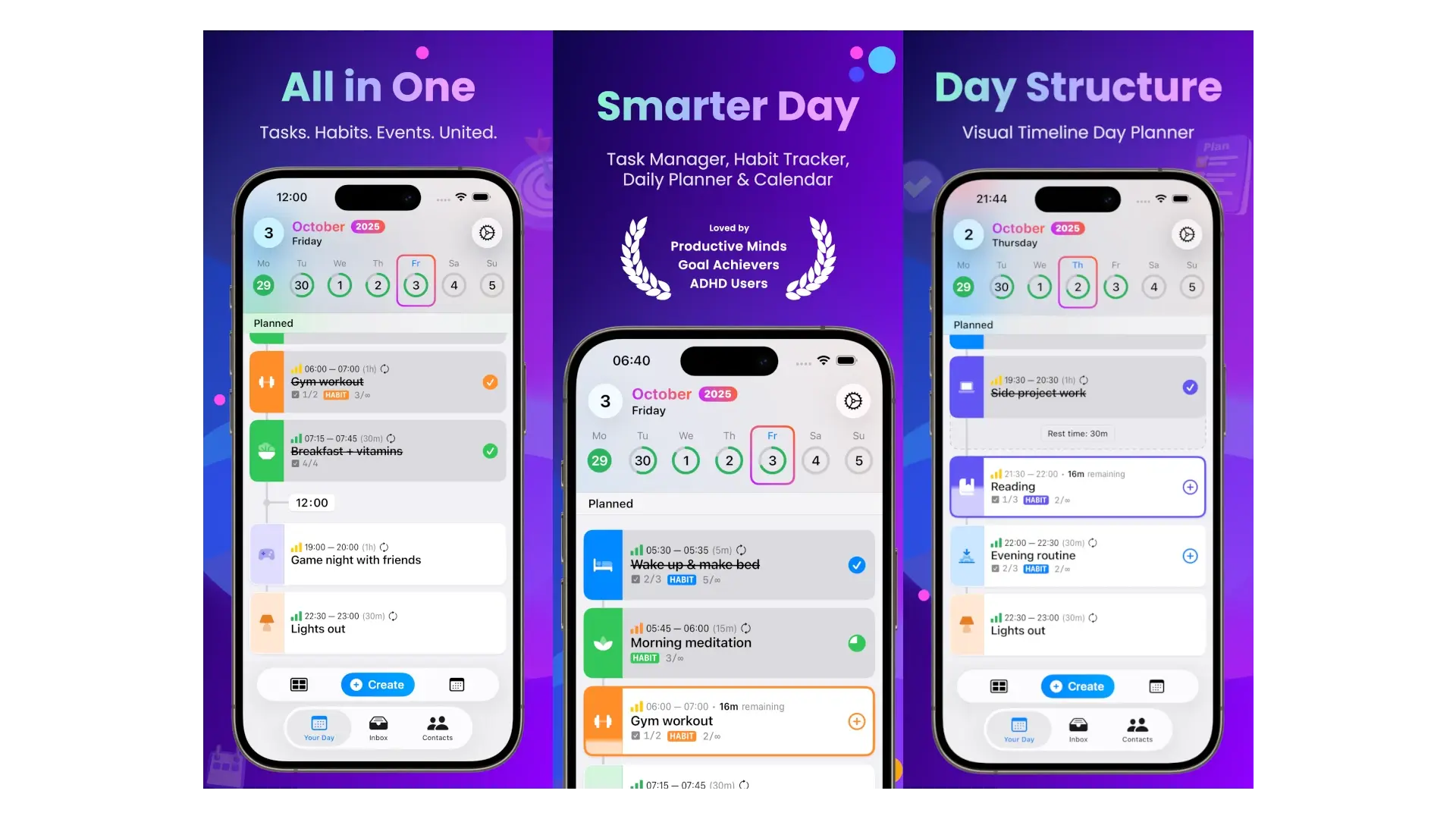
When we align time with energy, protect attention, and prioritize ruthlessly, productivity turns from a grind into a rhythm. The methods above—timeboxing, batching, deliberate breaks, and continuous improvement—create a flexible system for sustainable performance. To make it simpler, centralize your schedules, reviews, and focus blocks in one place. The productivity app at Smarter.Day helps you plan sprints, track deep work, and automate routine steps so you can stay on what matters.
Test a few tactics this week, then stack them. With a system that honors your biology and goals, you’ll build momentum day after day—and keep it.
You May Also Like
These Related Stories
Win Your Day: Advanced Time Management Tactics That Work
10 Advanced Time Management Strategies That Truly Work
No Comments Yet
Let us know what you think