

12 Proven Time Optimization Tactics for Peak Productivity

12 Proven Time Optimization Tactics for Peak Productivity
We all know the feeling: a calendar packed with meetings, a to-do list that multiplies overnight, and a nagging sense you’re busy but not moving the needle. Here’s the catch—productivity isn’t about doing more; it’s about doing what matters, better. In this guide, we’ll cut through noise and distraction to share practical, evidence-backed strategies that help you optimize time, sharpen focus, and streamline your workflow. Have you ever noticed how a clear plan makes even tough tasks feel manageable? That’s the power of deliberate design.
Our goal is simple: give you a playbook of actionable methods you can implement today. You’ll learn how to run a quick time audit, create high-impact priorities, enter deep work states, reduce communication clutter, automate repetitive tasks, and design habits that last. We’ll reference credible studies and experts—think Cal Newport, Stephen Covey, Teresa Amabile—to ensure you’re building a system grounded in research, not fads. Ready to turn overwhelm into momentum? Let’s dive in.
1) Run a Time Audit and Map Your Energy Peaks
Start with a time audit to see where hours really go. Track work in 15–30 minute increments for a week using a spreadsheet or a lightweight tracker. Label entries by category: focus, admin, meetings, and breaks. Second, log energy levels (1–5) to discover your personal chronotype—your natural peaks and troughs. Daniel Pink’s work in “When” highlights how aligning tasks with biological rhythm improves performance. Pair high-energy hours with deep work and reserve low-energy time for admin.
Two simple methods work well: use calendar colors to tag task types and set daily “focus windows” where notifications are off. A marketing lead I coached realized she spent her best hours in Slack. By shifting creative drafting to 9–11 a.m. and moving chat to afternoons, she doubled output in two weeks. Cornell’s time-use research shows awareness alone can drive measurable workflow improvement.
2) Prioritize with the Eisenhower Matrix and MITs
Clarity beats hustle. Use the Eisenhower Matrix to differentiate urgent vs. important work. Tackle “Important-Not Urgent” tasks proactively; delegate or eliminate “Not Important” items. Next, pick 3 MITs (Most Important Tasks) each day that ladder up to quarterly goals. Stephen Covey’s “First Things First” reinforces that what’s scheduled gets done. Schedule MITs first; everything else is extra.
Another method: apply RICE/ICE scoring (Reach, Impact, Confidence, Effort) to weigh projects objectively. A startup founder I advised used ICE weekly, and it ended debate-driven prioritization. Within a month, the team refocused on high-impact features, cutting cycle time by 25%. Dwight D. Eisenhower famously said, “What is important is seldom urgent,” and that mindset preserves time optimization.
3) Protect Deep Work with Timeboxing and Focus Sprints
Cal Newport’s “Deep Work” shows that undistracted concentration creates outsized value. Block 60–120 minute timeboxes for cognitively demanding work and protect them like meetings. Then run focus sprints: 25–50 minutes on, 5–10 off (Pomodoro by Francesco Cirillo). During sprints, turn off notifications, close extra tabs, and establish a “no interruption” signal for teammates.
Two refinements amplify results: write a 3-line intention (Outcome, Scope, End state) before each session, and end with a “next step” note to reduce friction later (leveraging the Zeigarnik effect). A developer I worked with adopted two morning timeboxes and finished his weekly planning tool in three days instead of two weeks. Mihaly Csikszentmihalyi’s research on flow confirms why this focus and cognitive performance routine works.
4) Stop Procrastination with Precommitments and Bundles
Procrastination thrives on ambiguity and infinite choice. Use commitment devices—public accountability, tools like StickK/Beeminder, or calendar-locked blocks—to reduce escape routes. Pair tasks with enjoyable activities using temptation bundling (Katherine Milkman’s research): only listen to your favorite podcast while doing admin or chores. BJ Fogg’s “Tiny Habits” suggests starting small—consistency trumps intensity.
Two quick methods: the 2-minute rule (David Allen) to start instantly, and the “just the first ugly draft” rule to beat perfectionism. A grad student I coached posted weekly progress screenshots to a private Discord and wrote 300 words during a daily coffee ritual. Three months later, the thesis was done. As Piers Steel’s procrastination research shows, commitment plus momentum beats willpower alone.
5) Chunk Work with Micro-Goals and the First Domino
Big tasks intimidate; small wins catalyze momentum. Break projects into micro-goals you can finish in 20–40 minutes. Use a first domino approach: identify the tiniest action that unlocks the rest—open the doc, outline three bullets, draft one paragraph. Teresa Amabile’s “progress principle” shows that visible progress fuels motivation and creativity.
Two tactics help: create a definition of done for each chunk (clear, observable) and end each work session with a bridge note: the very next step. A freelance writer started structuring articles as 10 micro-sections with a checklist. The clarity sped drafting by 40%. The Zeigarnik effect explains why partially completed tasks hold attention—use it intentionally for workflow optimization.
6) Tame Email and Chat: Batching, Triage, and Protocols
McKinsey estimates knowledge workers spend about 28% of the workweek on email. That’s a full day lost. Reclaim it with batching—three fixed email windows—and use a triage system: 1) reply in under two minutes, 2) schedule, 3) delegate, 4) archive. Adopt a three-sentence rule for clarity and speed. In Slack/Teams, set channel norms: tags for urgency, daily summaries, and “office hours.”
Two practical moves: use scheduled send to avoid after-hours creep and create response templates for FAQs. Cal Newport’s “A World Without Email” argues for asynchronous, structured communication to curb overload. A customer success manager I coached moved to twice-daily email checks and added a customer FAQ macro; response times improved while stress fell. That’s time optimization in action.
7) Fix Meetings: Fewer, Shorter, and Decision-Oriented
Let’s face it—meeting overload kills momentum. Borrow Amazon’s two-pizza rule and require a clear agenda and pre-read for every meeting. Shift status updates to a shared doc; reserve synchronous time for decisions. Cap meetings at 25 or 50 minutes to preserve buffer. Shopify’s experiment cutting recurring meetings showed meaningful time savings across teams.
Two methods stand out: use a Decision Log tracking owner and deadline, and test a No-Meeting Day weekly for deep work. MIT Sloan research highlights how written briefings improve decisions by reducing groupthink. A product team I advised cut recurring meetings by 40% and instituted a Wednesday deep-work day; shipping velocity rose the same quarter. “Meet less, decide more” should be your mantra for workflow improvement.
8) Boost Cognitive Performance: Sleep, Cycles, and Smart Breaks
Peak performance is a biology game. Prioritize sleep—Matthew Walker’s research shows impaired cognition after even mild sleep loss. Work with ultradian rhythms: 90-minute focus blocks followed by 10–15 minute breaks. NASA found that strategic 26-minute naps improved alertness by 54% and performance by 34%. That’s not laziness; it’s smart focus management.
Two practical methods: schedule movement breaks (short walks, mobility) and use a break menu (stretching, sunlight, water, quick journaling) to avoid doom-scrolling. A designer I coached added a 10 a.m. walk and a 3 p.m. stretch + hydration routine; afternoon crashes disappeared, and creative output improved. Stanford research also links light exercise to cognitive gains—small habits, big returns on performance.
9) Automate and Template Everything Repetitive
Anything you do 3+ times deserves a template or automation. Build SOPs for recurring tasks with checklists inspired by Atul Gawande’s “The Checklist Manifesto.” Use text expanders for common replies, spreadsheet templates for reports, and tools like Zapier or Make to connect apps. Automate data entry, reminders, and handoffs to reduce errors and mental load.
Two quick wins: create a weekly planning template (goals, MITs, meetings, risks) and a project kickoff template (scope, stakeholders, milestones). A sales pro I worked with automated CRM updates from form submissions and used email snippets for proposals, saving 5 hours weekly. Harvard Business Review frequently reports on the compounding benefits of standardization for workflow optimization and reliability.
10) Cut Context Switching with Single-Tasking and WIP Limits
Frequent task-switching causes attention residue, as Sophie Leroy’s research shows. Protect focus with single-tasking: one tab, one document, one outcome. Implement WIP limits (work-in-progress caps) on a Kanban board—no more than 2–3 tasks per stage. Stanford studies on multitasking indicate performance drops when switching, especially for complex tasks.
Two methods to try: define a Daily Theme (e.g., Strategy Tuesday) to cluster similar tasks, and set “switch checkpoints” at natural breaks (every 50 minutes) to change context intentionally. A product manager I advised moved feature reviews to a single block and limited concurrent projects to three. Cycle time fell, bugs dropped, and focus improved. “Slow is smooth, and smooth is fast” applies to knowledge work.
11) Review Weekly: Kaizen, After-Action, and OKR Check-ins
Improvement is a habit. Run a weekly review: assess wins, challenges, and priorities. Use Kaizen thinking (small, continuous improvements) and conduct quick After-Action Reviews: What did we intend? What happened? What will we try next? Check progress against OKRs or clear metrics to align tasks with outcomes. James Clear emphasizes systems over goals; reviews maintain the system.
Two methods: keep a metrics dashboard (lead/lag indicators) and a Stop/Start/Continue list. A remote team I coached used a 30-minute Friday review with a shared doc; next-week readiness improved markedly. Harvard Business School research (Francesca Gino) shows reflection boosts learning and performance. These light-touch rituals compound into serious time management gains.
12) Build a Resilient Mindset: If-Then Plans and Identity Habits
Sustainable productivity rests on mindset. Use implementation intentions—“If X happens, then I will Y”—from Peter Gollwitzer to pre-decide responses to obstacles. Pair this with identity-based habits (James Clear): “I’m the kind of person who protects my focus.” Carol Dweck’s growth mindset research shows that viewing abilities as developable increases persistence and adaptability.
Two methods to anchor mindset: celebrate small wins (Teresa Amabile) daily and journal a one-sentence reflection on progress. A freelance designer adopted “If Slack pings during deep work, then I’ll mute and return at 1 p.m.” and “I’m a craft-first creator.” Within weeks, they reported calmer days and more consistent output. Motivation follows action; productivity mindset shapes behavior, and behavior shapes results.
Conclusion
You don’t need heroic willpower; you need a reliable system. Start with a time audit, protect a few deep work blocks, and prune meetings and messages. Layer in automation, weekly reviews, and mindset cues, and your days become lighter, faster, and more meaningful. When the plan matches your energy and priorities, performance naturally rises.
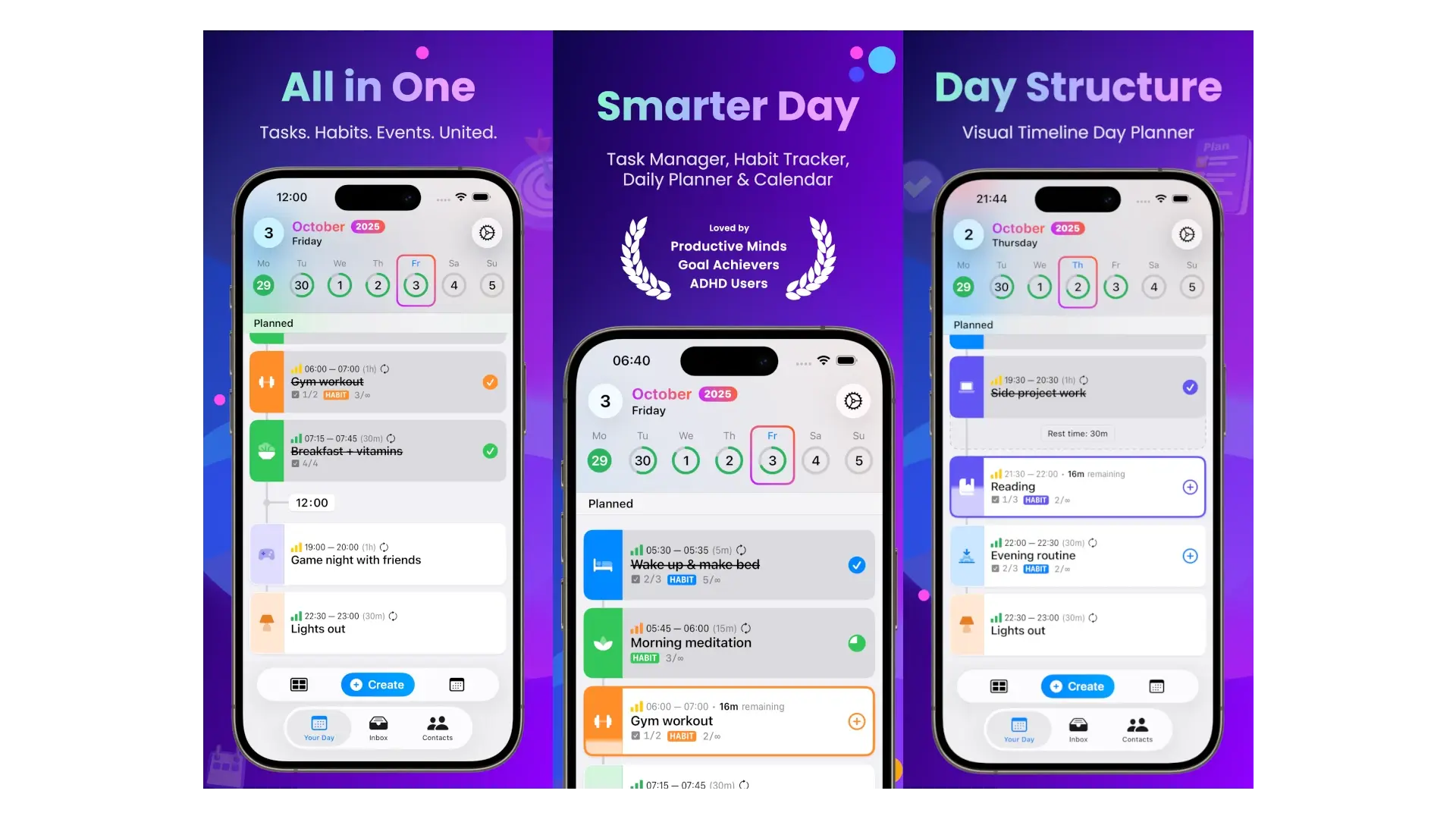
If you want help stitching these tactics into one cohesive flow, try the productivity app at Smarter.Day. It centralizes your focus blocks, templates, reviews, and communication boundaries so you can execute without friction. No fluff—just the right nudges at the right time.
You May Also Like
These Related Stories
12 Proven Time Optimization Tactics for Peak Productivity
Advanced Time Optimization: 12 Proven Productivity Wins
No Comments Yet
Let us know what you think