

Advanced Time Optimization: 12 Proven Productivity Wins

Advanced Time Optimization: 12 Proven Productivity Wins
We all know the feeling: a calendar stuffed with meetings, a to-do list that multiplies overnight, and a brain pinged by notifications every 30 seconds. Here’s the catch—busy doesn’t equal productive. The real advantage is time optimization that compounds into better focus, stronger performance, and meaningful wins. In this guide, you’ll learn actionable frameworks, routines, and tools backed by research and real-world examples. Whether you’re leading a team or managing your own day, these strategies help eliminate overwhelm and improve workflow efficiency—without burning out.
Our intent is simple: give you a system you can actually use. You’ll find methods for prioritization, deep work, and cognitive energy management; smart approaches for emails and meetings; and modern tactics like automation and templates. We’ll draw from authors like Cal Newport and BJ Fogg, studies on attention and switching costs, and field-tested practices from high performers. Ready to trade chaos for clarity? Let’s get you a leaner, calmer, and more effective workday—one method at a time.
1) Timeboxing Your Day for Predictable Progress
What it is
The simplest path to predictable progress is timeboxing—assigning fixed blocks on your calendar for specific tasks. Cal Newport popularized time blocking in “Deep Work,” showing how structured time boosts attention and throughput. Nir Eyal echoes this in “Indistractable,” noting that “if you don’t plan your time, someone else will.” When you box your day, you pre-decide what “good” looks like, reducing decision fatigue and protecting focus from opportunistic distractions that creep in when your schedule is vague.
How to apply
Use two blocks daily: one for deep work (strategy, writing, coding) and one for shallow work (emails, admin). Add buffer margins—10 to 15 minutes between blocks—for transitions. If tasks run long, “budget” extra time tomorrow rather than squeezing everything today. Color-code your calendar so priority work is visually prominent. Review and re-plan at midday for agility. Over time, you’ll learn your true task durations, which is the secret to compounding accuracy and realistic planning.
Example & evidence
When Maya, a marketing manager, began timeboxing a 90-minute deep work block every morning, her campaign planning improved dramatically. She scheduled shallow work after lunch when her energy dipped, matching tasks to natural energy cycles. Drawing on Newport’s work, she protected her mornings, which boosted throughput and reduced overtime. The result? Campaigns went out earlier, with fewer last-minute edits, proving that constraining time can expand quality.
2) The Eisenhower Matrix Meets ICE Scoring
What it is
The Eisenhower Matrix helps you categorize tasks by urgency and importance: Do, Schedule, Delegate, or Delete. It’s a timeless prioritization lens popularized by Stephen Covey. Pair it with ICE scoring (Impact, Confidence, Ease) from product management to rank ideas numerically. Together, they let you triage chaos quickly and commit to what truly moves the needle. Greg McKeown’s “Essentialism” aligns with this: “If it isn’t a clear yes, it’s a clear no.”
How to apply
Each morning, list your top 10 tasks. Place them in the Eisenhower quadrants. Then, assign ICE scores (1–10 per dimension) to everything in Important/Not Urgent. Tackle items with the highest ICE total first. For low-ICE items that still matter, schedule small next steps to maintain momentum. The matrix prevents urgency traps; ICE prevents “big-project paralysis” by revealing high-leverage, doable wins.
Example & evidence
Arjun, a startup founder, was drowning in Slack pings and “urgent” asks. He used the matrix to delegate low-importance urgencies and ICE to prioritize a pricing experiment and onboarding tweaks—both high-impact, easy, and confidence-backed. The combo mirrors practices recommended in product roadmapping and aligns with Covey’s focus on Quadrant II. Within a quarter, churn dropped, underscoring the power of clarity-based prioritization.
3) Deep Work Sprints with a Pomodoro Upgrade
What it is
Deep work produces outsized results but demands protection. Cal Newport defines it as cognitively demanding tasks performed in distraction-free concentration. Pair it with a Pomodoro upgrade—45/10 cycles instead of classic 25/5—for longer immersion. Francesco Cirillo’s method is great; we tweak it for knowledge work that benefits from uninterrupted flow. Add an “open loop capture” notepad to park intrusive thoughts without breaking concentration.
How to apply
Commit to two 45-minute sprints daily. Before each sprint, define a specific output (e.g., “draft intro + outline”). Turn on a website blocker, silence notifications, and place your phone out of sight. During the 10-minute break, stand up, hydrate, and avoid screens to let your brain reset. Log one sentence about what worked to build a repeatable focus playbook. Over time, lengthen sprints if your cognitive stamina improves.
Example & evidence
Jenna, a product designer, struggled with fragmented attention. She applied two upgraded Pomodoro sprints in the morning, aligning with research suggesting longer focus intervals can benefit complex tasks. Citing Newport’s work and Cirillo’s framework, she used a notepad to capture “idea leaks.” After two weeks, she produced higher-quality wireframes with fewer iterations. Her takeaway: protecting attention multiplies output—not hours.
4) Manage Energy, Not Just Time
What it is
Let’s face it: your calendar’s not your biggest constraint—your energy is. “The Power of Full Engagement” by Jim Loehr and Tony Schwartz argues that performance rises when we manage energy across physical, emotional, mental, and spiritual domains. Align demanding work with peak energy and schedule rest as a non-negotiable productivity tool. This mirrors ultradian rhythm science, where humans cycle through 90–120-minute energy waves.
How to apply
Identify your peak hours by tracking alertness for a week. Place deep work there; save admin for low-energy slots. Insert micro-recovery: a 5–10-minute break every 90 minutes, ideally away from screens. Add movement snacks and hydration anchors. Protect sleep with consistent bed/wake times and a 30-minute pre-sleep wind-down. Energy rituals—morning sunlight, breathing exercises—compound into more sustainable performance than heroics.
Example & evidence
Diego, a data analyst, shifted model-building to his 9–11 a.m. peak and stacked meetings post-lunch. Inspired by Loehr and Schwartz, he added brief walks between blocks. His afternoons stopped crashing, and error rates dropped. The lesson: when you pair tasks to energy, you reduce rework, a subtle but massive win in time optimization.
5) Habit Stacking and Cue Design
What it is
Habits reduce friction by making good choices automatic. BJ Fogg’s “Tiny Habits” shows how to build sustainable behavior by anchoring a new habit to an existing one. James Clear’s “Atomic Habits” expands this with the cue–craving–response–reward loop. The fastest way to improve consistency is to stack micro-actions on reliable cues and engineer your environment so the right choice is the easy choice.
How to apply
Pick one high-leverage habit: daily planning. Stack it after a stable cue: “After I brew coffee, I’ll plan the day in five bullets.” Reduce friction: keep your planner and pen next to the machine. Add a tiny version for rough days: “one bullet only.” Reinforce with a visual streak tracker. This creates automatic momentum, turning intention into routine without willpower theater.
Example & evidence
Priya, a sales lead, struggled to plan consistently. She stacked a two-minute planning ritual onto her morning espresso. Drawing from Fogg’s tiny behaviors and Clear’s emphasis on identity (“I’m the kind of person who plans”), she never missed more than a day. Within a month, her team’s pipeline reviews got sharper, proving micro-habits drive macro clarity.
6) Batch Work and Beat Context Switching
What it is
Every switch between tasks taxes your brain. Research led by Gloria Mark has shown that interruption costs linger long after the ping. The antidote is batching: grouping similar tasks—like email, approvals, or code reviews—into designated blocks. This reduces switching costs and lets you exploit “same-context momentum,” a key enabler of workflow improvement.
How to apply
Create daily or weekly theme blocks: Monday morning for planning, afternoons for outreach, etc. Inside each block, set clear scope (e.g., “process 30 emails” vs. “inbox zero”). Use templates for repetitive replies and a decision tree for quick triage (delete, delegate, defer, do). Protect batch blocks with a simple status message: “Heads down 2–3 p.m.—will reply after.” Expect pushback; persist.
Example & evidence
Omar, an engineering lead, batched code reviews into a single late-afternoon window. Inspired by research on switching costs and lean principles, he stopped sprinkling reviews all day. Turnaround stayed fast, but his morning deep work improved. Within weeks, he shipped a complex refactor earlier than planned, illustrating how fewer swaps equal faster delivery.
7) Design a Distraction-Proof Environment
What it is
“Environment is the invisible hand that shapes human behavior,” James Clear writes. To protect cognitive performance, create a distraction-proof setup. Cal Newport’s “Digital Minimalism” advocates intentional tech use: remove the non-essential, automate guardrails, and cultivate high-quality leisure to reduce mindless scrolling. The goal isn’t zero tech; it’s purposeful attention.
How to apply
Start with a “clean desktop” rule and a single-tab policy during deep work. Install website blockers and app timers. Keep your phone in another room during focus blocks. Use noise controls: noise-canceling headphones or brown noise. Simplify tool sprawl—consolidate apps and mute non-critical channels. End each day with a two-minute reset ritual so you start tomorrow clear.
Example & evidence
Lea, a content strategist, used to juggle six apps while writing. After reading Newport, she set up one writing window, blocked social feeds, and moved her phone away. She reported calmer sessions, faster drafts, and fewer edits. The big lesson: you can’t out-will a noisy environment—you must change it.
8) OKRs and the Weekly Review
What it is
OKRs—Objectives and Key Results—popularized by John Doerr in “Measure What Matters,” align teams around quantifiable outcomes. Pair them with a weekly review, a GTD staple from David Allen, to keep outcomes front and center while adjusting tactics in real time. This duo creates a feedback loop that turns goals into trackable execution.
How to apply
Define one quarterly Objective with 2–4 measurable Key Results. Translate them into weekly commitments. Every Friday, run a 20-minute review: check KR progress, prune tasks, and schedule next week’s first deep block. Keep a living document with status notes and learnings. The KR scoreboard provides clarity, and the review provides course correction—a powerful pairing for consistency.
Example & evidence
Nina, a customer success manager, set an Objective to improve retention with KRs on onboarding completion and NPS. Inspired by Doerr and Allen, she used weekly reviews to surface bottlenecks and reassign resources. Within one quarter, both KRs advanced, and her team reported less whiplash. That’s the magic of goals plus reflection.
9) Email and Meeting Hygiene
What it is
Email and meetings are essential—and often wasteful. Merlin Mann’s “Inbox Zero” wasn’t about zero emails, but about rapid triage. 37signals’ “Rework” famously quips, “Meetings are toxic” when overused. The fix is hygiene: clear standards that give you back hours. The goal is to optimize communication flow, not punish collaboration.
How to apply
Process email in 2–3 scheduled batches. Use the 4D method: delete, delegate, defer, do. Turn long threads into short calls; turn recurring meetings into asynchronous updates. For meetings, insist on an agenda, desired outcome, and pre-reads. End five minutes early to capture decisions and next steps. Guard three meeting-free hours a day for focus.
Example & evidence
After implementing a “no-agenda, no-meeting” rule, Tasha’s team cut weekly meeting time by 30%. Borrowing from Mann’s triage and async-first practices seen at modern remote companies, they replaced status meetings with written updates. The outcome was fewer interruptions and faster decisions because prep became the norm, not the exception.
10) Reduce Cognitive Load with a Second Brain
What it is
Your memory isn’t a filing cabinet. Offload it. Tiago Forte’s “Building a Second Brain” advocates externalizing knowledge using systems like PARA (Projects, Areas, Resources, Archives). Niklas Luhmann’s Zettelkasten showed how linked notes spark insight. By reducing cognitive load, you free mental bandwidth for creative problem-solving and workflow improvement.
How to apply
Create a simple PARA structure in your notes app. Capture ideas in the moment, then progressively summarize: bold the essence, extract actions, link related notes. Tag by project and outcome. Run a 10-minute knowledge review twice a week to promote stale notes into active projects or archive them. The system becomes your context memory, not a junk drawer.
Example & evidence
Eli, a researcher, struggled to retrieve findings quickly. After adopting PARA and light Zettelkasten linking (ideas connect to ideas), he built a reusable knowledge base. Citing Forte’s methods, he summarized papers into actionable insights. His writing sped up because the thinking had been pre-done. The shift was clear: store to recall, summarize to act.
11) Beat Procrastination with Implementation Intentions
What it is
Procrastination isn’t laziness—it’s a friction mismatch. Psychologist Peter Gollwitzer’s implementation intentions (if–then plans) convert abstract goals into concrete triggers. Pair them with the 5-minute rule (just start for five minutes) and temptation bundling (Katy Milkman) to make starting easy and staying pleasant. The goal is action activation, not perfection.
How to apply
Write one if–then plan for your hardest task: “If it’s 9:00 a.m., then I open the brief and outline one section.” Add the 5-minute rule: once started, momentum carries you. Bundle a treat—your favorite playlist—only when working on that task. This trifecta lowers emotional resistance, giving you a reliable ignition switch for stalled work.
Example & evidence
Marco avoided a quarterly report for days. He set: “If it’s 9:30, then open the spreadsheet and fill the first column.” Five minutes in, he kept going. Anchored by Gollwitzer’s research and Milkman’s bundling, he reframed the start as small and rewarding. The report shipped on time. Lesson: start tiny, stay steady.
12) Automate, Template, and Document
What it is
Automation multiplies time. Atul Gawande’s “The Checklist Manifesto” shows how checklists reduce errors and speed execution. Combine templates, text expanders, and workflow automations to eliminate repetitive drudgery. Think in SOPs (standard operating procedures): document once, repeat forever. Modern tools make this accessible without code.
How to apply
Template everything repeated: proposals, outreach, briefs. Use a text expander for common paragraphs and a “starter checklist” for recurring projects. Automate handoffs: when a form is submitted, auto-create tasks and notify owners. Document your process as a one-page SOP with steps, owners, and quality checks. Revisit quarterly to remove steps and tighten flow.
Example & evidence
Shira, an operations manager, templatized onboarding and set automations for account setup. Inspired by Gawande’s checklist philosophy, she dropped errors and saved hours weekly. The compound return was huge: every hire started faster, and her team had clarity under pressure, not just speed. That’s how automation becomes a competitive advantage.
Conclusion
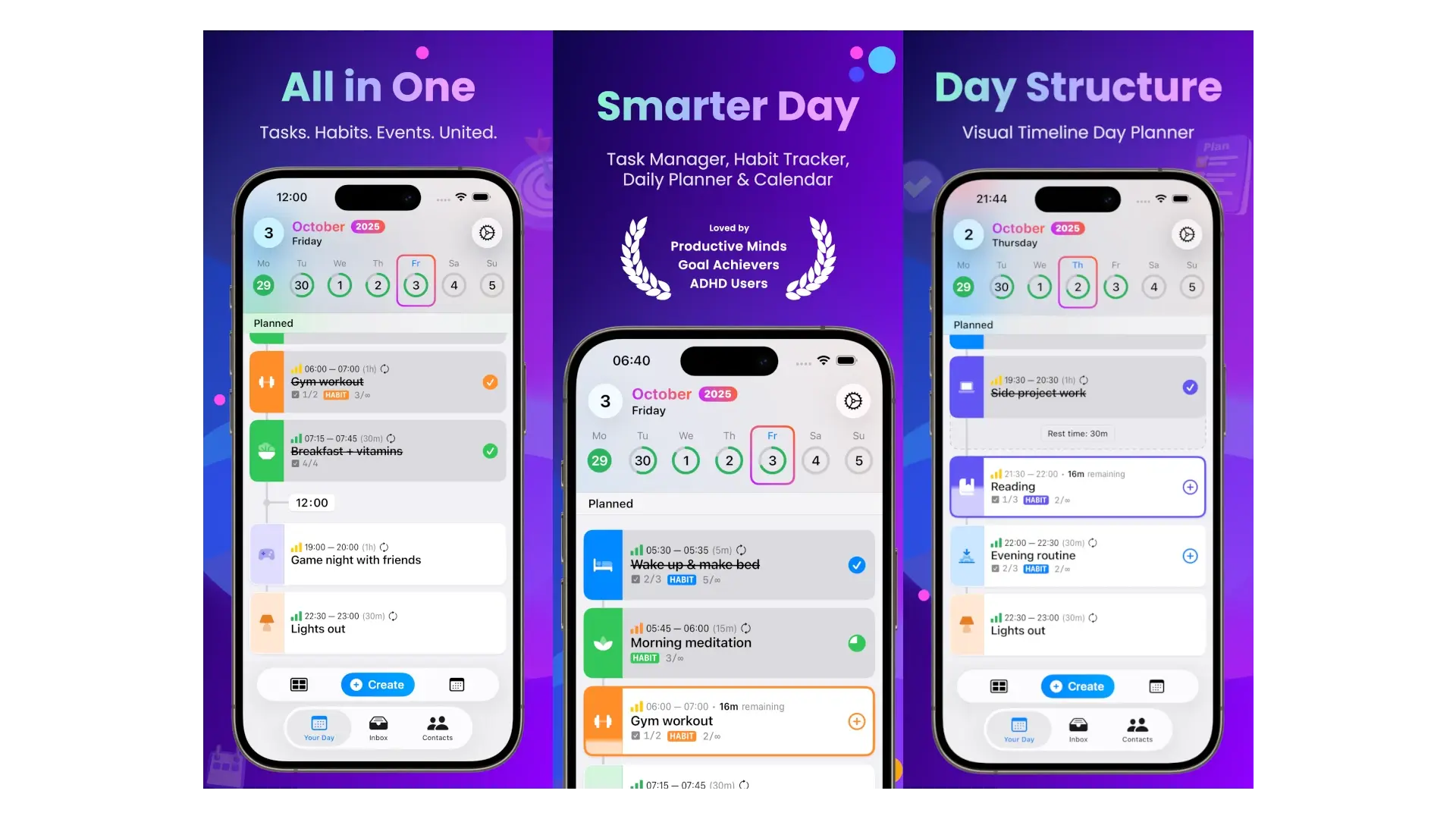
We’ve covered a full-stack system for time optimization: from timeboxing and deep work to energy management, habit design, and automation. The common thread is clarity—deciding what matters, when to do it, and how to protect your attention. Start with one practice this week, measure the win, and build from there. If you want a practical way to plan, focus, and track progress in one place, try the productivity app at Smarter.Day. It complements these strategies with structure you’ll actually use.
Great productivity isn’t about squeezing more; it’s about doing the right work with less friction. With these methods—and a supportive tool like Smarter.Day—you’ll turn busy days into purposeful progress.
You May Also Like
These Related Stories
Advanced Time Optimization: 12 Proven Productivity Wins
10 Proven Methods to Master Time and Get More Done
No Comments Yet
Let us know what you think