

12 Proven Ways to Turbocharge Focus and Productivity

12 Proven Ways to Turbocharge Focus and Productivity
Introduction
Have you ever opened your laptop, only to get swallowed by emails, pings, and “just a quick chat”—and suddenly the day is gone? We’re operating in a world engineered for distraction. Yet the organizations and individuals who win are the ones that master attention, time optimization, and workflow improvement. Here’s the catch: focus isn’t about working more hours. It’s about working with intention, constraints, and smart systems that protect your best cognitive energy.
In this in-depth guide, we’ll share actionable, science-backed productivity strategies you can apply today. From deep work sprints to implementation intentions, you’ll learn how to reduce context switching, design your calendar for performance, and build habits that make consistency inevitable. We’ll weave in real-life examples, expert insights, and practical methods you can test this week. Ready to stop “busy” and start effective?
1) Time Boxing and Calendar Blocking That Actually Stick
Time boxing is simple: give a task a fixed slot instead of an open-ended runway. Cal Newport’s Deep Work popularized this approach for focus, while Parkinson’s Law reminds us that work expands to fill the time available. By boxing your efforts, you shrink that expansion and craft a realistic, visual plan. The magic isn’t in the calendar—it’s in the constraint. When you pre-decide your day, you reduce decision fatigue and gain momentum.
To make it work, commit to two methods: first, theme your days (e.g., Monday = strategy, Tuesday = delivery) to reduce switching. Second, use buffer blocks—15-minute gaps every two hours—to absorb spillover. Protect high-energy hours (usually mornings) for deep tasks, and push admin to lower-energy windows. Anchor start times: “I begin writing at 9:00 a.m., not when I feel like it.” That simple anchor boosts compliance.
Example: Priya, a product lead, set 9:00–11:00 for roadmap work, 1:30–3:00 for stakeholder updates. Result? Fewer overruns and cleaner handoffs. A Stanford analysis by John Pencavel shows output plateaus past ~50–55 hours; cramming more doesn’t help. By boxing tasks, Priya delivered more value without working later—proof that time constraints drive clarity and performance.
2) Prioritize with Impact/Effort and the Eisenhower Lens
We all know urgency hijacks attention. The Eisenhower Matrix separates urgent from important, a principle echoed by Stephen Covey. Pair that with an Impact vs. Effort score to rank work by ROI: high-impact, low-effort tasks get prime time; low-impact, high-effort tasks get rethought or delegated. This dual lens cuts the noise and lifts strategic throughput.
Try two methods. First, score tasks 1–5 for impact and effort, then sort by the delta (impact minus effort). Second, ruthlessly apply “delete, delegate, defer, do” from the Eisenhower playbook. If a task is important but not urgent, schedule it; if urgent but low-value, renegotiate or route it. Reassess weekly to reflect changing priorities—your system must adapt with your reality.
Consider Elena, a marketing manager drowning in requests. By scoring tasks, she found a 30-minute pricing page update that boosted conversions more than a week-long minor rebrand. Citing McKinsey’s work on productivity and resource allocation, Elena focused on high-leverage work and trimmed busywork. Her mantra: optimize for leverage, not motion.
3) Deep Work Sprints and Attention Management
Cal Newport defines deep work as cognitively demanding, distraction-free tasks that create value. The obstacle? “Attention residue.” Gloria Mark’s research at UC Irvine shows frequent switches degrade focus and increase time to resume tasks. The fix is structured sprints that protect your attention from micro-interruptions.
Use two methods. First, set 90-minute deep work sprints with devices on Do Not Disturb and notifications off. Second, create a distraction capture list—when intrusive thoughts pop up, jot them down and keep going. End each sprint with a two-minute recap: “What moved? What’s next?” That quick closure reduces residue and primes the next session.
Real-life: Omar, a data scientist, blocked 8:30–10:00 for analysis, door closed, Slack silenced. He warned teammates with a status message: “Heads down—back at 10.” Output jumped, errors fell. As Newport notes in Deep Work, intensity beats length; the right environment turns 90 minutes into a powerhouse of progress.
4) Task Decomposition and Checklists That Save Hours
Big tasks intimidate; vague tasks stall. Atul Gawande’s The Checklist Manifesto shows how checklists reduce errors in complex environments. Break work into crisp, visible steps and you reduce anxiety, improve throughput, and embolden momentum. When the next action is obvious, you start faster and quit less.
Two methods help. First, rewrite tasks as visible verbs: “Outline slide deck,” “Draft three bullets,” “Send invite.” Second, create starter checklists for recurring work (launches, reports, 1:1s) and iterate them with each cycle. Add a “Definition of Done” to align expectations and avoid scope creep. Clear boundaries equal predictable finishes.
Example: Neil, a consultant, cut proposal time by 40% using a seven-step template and a pre-flight checklist (client goals, success metrics, risks). He credits Gawande’s insight: “Checklists are not a crutch; they’re a quality system.” With fewer errors and faster handoffs, Neil reclaimed hours every week for higher-impact work.
5) Energy Management and Ultradian Rhythm Planning
We schedule by clock, but our brains run on ultradian rhythms—90- to 120-minute cycles identified by sleep researcher Nathaniel Kleitman. Tony Schwartz, in The Power of Full Engagement, argues performance rises when we oscillate between intense effort and recovery. Sustained output isn’t about grinding; it’s about strategic renewal.
Two methods: align hardest work with peak energy (often morning for many) and pair it with intentional recovery—short walks, hydration, breathing drills. Second, use micro-refuels after sprints: 5–10 minutes of movement or sunlight. Avoid caffeine stacking late afternoon; protect sleep as the ultimate productivity tool. Track energy for a week to spot your personal rhythm.
Case: Marta, a software architect, moved code reviews to early afternoon and kept architecture design to 9:00–11:00 when her insight peaked. She added a brisk 7-minute walk between sprints. Result: better decisions, fewer rewrites. As Schwartz notes, manage energy, not time, to unlock sustainable performance.
6) Habit Stacking and Implementation Intentions
Habits remove the need for willpower. James Clear’s Atomic Habits popularized habit stacking—tacking a new behavior onto an existing one. Psychologist Peter Gollwitzer’s research on implementation intentions (“If situation X, then I will do Y”) shows they dramatically raise follow-through by pre-wiring cues and actions.
Two methods: define a stack like, “After I open my laptop, I plan my top 3 MITs.” Then add an implementation intention: “If a Slack ping arrives during my sprint, I’ll note it and stay heads down.” Make habits tiny and trigger-based; you can scale later. The identity shift—“I’m the kind of person who protects focus”—cements consistency.
Example: Jay, a sales lead, stacked a 60-second planning ritual onto his morning coffee and set an intention to start outreach immediately after. Within two weeks, outreach volume rose 25%—no extra hours, just automatic starts. Clear’s core idea is simple: environment and cues beat motivation.
7) Defeat Multitasking with Context Windows
The APA has long warned that multitasking is a myth; Rubinstein, Meyer, and Evans (2001) quantified the switching costs as tasks grow complex. Every switch incurs a cognitive tax, stealing time and spiking errors. The antidote is context windows—grouping similar tasks and minimizing mode changes.
Two methods: first, batch communication twice daily (late morning, late afternoon) instead of all-day grazing. Second, use single-tab, single-task rules during deep work—close unrelated tabs and tools. Define “context packs” for writing, analysis, and admin, each with its own tools and environment, to reduce setup friction and mental overhead.
Sofia, a customer success manager, moved tickets and email to two windows (11:30 and 4:00). She protected 9:00–11:00 for proactive success planning. Within a month, response SLAs still held, while her strategic accounts program finally shipped. The lesson is clear: switch less, finish more.
8) Async Collaboration and Meeting Hygiene
Harvard Business Review’s “Stop the Meeting Madness” highlights the productivity drain of excessive sync time. Microsoft’s Work Trend Index also shows meeting overload and fragmented attention. The fix is async-first collaboration and meeting hygiene—clear agendas, decisions, and outcomes—or no meeting at all.
Two methods: adopt agenda-then-accept policies (no agenda, no join) and use docs-before-discussion (write decisions asynchronously, meet only to resolve disagreements). Cap meetings at 25/50 minutes to preserve transition buffers. Assign a DRI (directly responsible individual) and log decisions in a shared note for transparency and continuity.
Example: Luis’s product team replaced status meetings with a daily async update template and kept one 30-minute weekly decision review. Shipping cadence improved, and stress dropped. As HBR notes, fewer, better meetings unlock sustained performance and give deep work the breathing room it needs.
9) Personal Knowledge Management: Make Ideas Findable
Information is only useful if it’s retrievable. Tiago Forte’s Building a Second Brain popularized PARA (Projects, Areas, Resources, Archives) to organize notes, while Sönke Ahrens’ How to Take Smart Notes demonstrates how Zettelkasten links ideas to spark insight. The goal: a knowledge system that reduces rework and accelerates creativity.
Two methods: first, progressive summarization—distill notes in layers (bold, highlights, executive summary) so future-you skims fast. Second, link notes by concept, not just by folder. Tag by problem, decision, or metric. Collect outputs (templates, checklists, drafts) in project folders to shorten the distance from idea to execution.
Real-life: Dana, a strategist, created a resource vault for case studies and a decision log for experiments. When a new project kicked off, she assembled a draft plan in under an hour using past assets. Forte’s premise holds: organized knowledge compounds your effectiveness over time.
10) Weekly Review and Micro-Retrospectives
David Allen’s Getting Things Done champions the weekly review to keep your system trusted. Without review, lists bloat, calendars decay, and attention leaks. Add micro-retrospectives—brief lookbacks after key sprints—to capture lessons while they’re fresh and to refine processes for the next cycle.
Two methods: schedule a Friday 60-minute review to clear inboxes, renegotiate commitments, and plan the top three outcomes for the next week. Then run 10-minute retros after major tasks: What worked? What will we change? Track one process tweak per week to maintain continuous improvement without overwhelm.
Case: A design duo closed each sprint with a quick retro and set one improvement: “Prototype on day one,” “Share WIP daily,” “Decide font before color.” Small changes produced smoother weeks. Allen’s insight stands: a trusted system reduces stress and frees cognitive bandwidth for real work.
11) OKRs and a Personal North Star
When everything is a priority, nothing is. OKRs (Objectives and Key Results), popularized by John Doerr in Measure What Matters and adopted by Google, align ambition with measurable outcomes. Adapt them personally: one objective per quarter, with 3–4 key results that quantify success. This simplifies choices and curbs shiny-object syndrome.
Two methods: write a compelling objective (“Elevate client onboarding to drive retention”) and pair it with measurable KRs (NPS +10, time-to-value −30%, churn −1 pt). Review KRs weekly; if progress stalls, change tactics, not goals. Limit concurrent objectives to avoid dilution. The focus you protect becomes the progress you see.
Example: Bri, a customer lead, set Q2 KRs around activation. By mid-quarter, a daily dashboard showed lagging TTV. She shifted resources to a guided tour and templates. Outcomes improved without overtime. Doerr’s core lesson: clarity creates velocity.
12) Automations, Templates, and the “Default to Done”
Automation preserves attention for high-value work. Forrester and Deloitte have both reported meaningful productivity gains from RPA and workflow automation in knowledge work. You don’t need a robot army—just smart defaults that shrink setup time and reduce manual steps.
Two methods: create templates for recurring outputs (meeting notes, briefs, outreach scripts) and wire up no-code automations (calendar scheduling, note routing, CRM updates). Bundle micro-automation like text expanders for common replies. Audit your week: where do you copy-paste or re-enter info? Automate that first.
Real-life: Tessa, a recruiter, created a candidate update template and automated interview scheduling. She reclaimed five hours a week, which she reinvested in sourcing. As the saying goes, “Automate the predictable so you can humanize the exceptional.” Your future self will thank you.
Conclusion
Let’s face it: the modern workday won’t simplify itself. But with time boxing, deep work sprints, habit stacks, OKRs, and automation, you can design a day that protects focus, boosts performance, and reduces stress. Start small—one sprint, one review ritual, one automation. Momentum compounds quickly when your system is aligned with how your brain works.
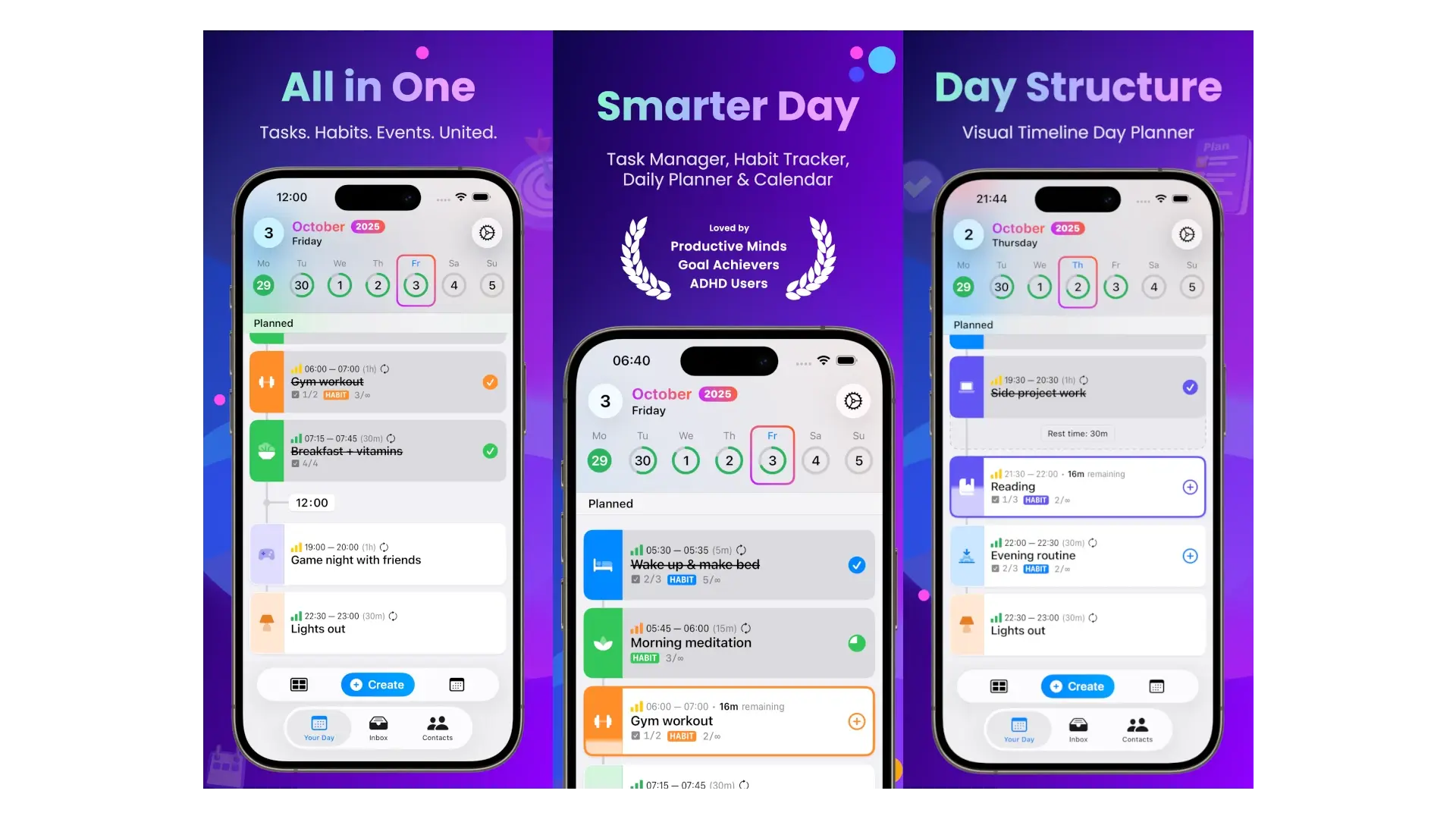
If you want an easy way to operationalize these strategies—calendar blocks, routines, reviews, and automations—try the productivity app at Smarter.Day. It elegantly supports workflow improvement and time optimization without the bloat, so you can stay focused on meaningful work.
You May Also Like
These Related Stories
12 Proven Ways to Turbocharge Focus and Productivity
12 Proven Strategies to Boost Focus and Productivity
No Comments Yet
Let us know what you think