
Advanced Time Management: 10 Proven Productivity Wins

10 Advanced Time Management Strategies That Actually Work
We’ve all felt the drag: tabs multiplying, Slack buzzing, and a to-do list that looks like a wall of sticky notes. Here’s the catch—busy isn’t the same as productive. If you’re juggling shifting priorities, context switching, and decision fatigue, you’re not alone. The good news? You can reclaim your time with a handful of evidence-backed time optimization strategies. From time blocking to task batching, you’ll learn how to focus deeper, finish faster, and design a workflow that supports peak performance.
In this guide, we’ll walk through 10 practical frameworks used by high performers and teams that scale. Each section offers clear methods, real-life examples, and citations from credible experts and research. Whether you want better workflow improvement, stronger focus, or fewer “Where did my day go?” moments, you’ll find step-by-step tactics you can apply today—and keep using for the long term.
1) Master Time Blocking with Reality-Based Estimates
Time blocking turns vague intentions into calendar commitments. Instead of hoping to “work on the report,” you schedule 90 minutes for “Draft section 1,” then 60 minutes for “Edit and charts.” Cal Newport popularized this in Deep Work, arguing that structured time is the antidote to distraction. To avoid self-delusion, account for Hofstadter’s Law—“It always takes longer than you expect.” Build estimates with a buffer and track your accuracy weekly. Over time, your blocks will mirror reality, not optimism.
Two practical methods: 1) Shape your day around three anchors—a morning deep-work block, a midday execution block, and an afternoon cleanup block. 2) Add a 15–25% buffer to each block for context transitions. If your tools allow, label blocks by cognitive demand (creative, analytical, administrative) to match energy to task. The aim is time optimization, not filling every minute. Leave white space to protect focus and flexibility.
Real-life example: Diego, a product manager, carved 9–11 a.m. for roadmap work and moved all “quick questions” to 3–4 p.m. With buffers and better estimates, he cut late-night catch-up by 70%. Referencing Parkinson’s Law—work expands to fill the time available—he constrained tasks to their block and found that hard stops drove crisper thinking and higher throughput.
2) The Eisenhower Matrix + Ivy Lee: Prioritize What Actually Moves the Needle
The Eisenhower Matrix separates tasks by urgency and importance so you stop mistaking noise for progress. “Important but not urgent” is where long-term leverage lives—strategy, relationship building, and skill development. Combine it with the Ivy Lee Method: at the end of each day, list the six most important tasks in priority order and start with the first. Harvard Business Review has long championed prioritization frameworks like these for leaders who must choose wisely under pressure.
Try two methods: 1) Place everything into the four quadrants, then schedule Quadrant II items first. 2) Use impact/effort scoring (1–5 scale) to rank Ivy Lee’s six, tackling high-impact, low-effort wins early for momentum. Keep your list short; constraint creates clarity and reduces decision fatigue. Add a weekly review to archive or delegate persistent low-value tasks.
Example: Anna, a marketing lead, used the matrix to stop firefighting and placed campaign analytics and copy refinement in Quadrant II for morning deep work. With the Ivy Lee six, she started days with the highest-leverage deliverable. Result: her team cut overtime by 40% and delivered a product launch two weeks early. Dwight D. Eisenhower’s prioritization lens turned strategy into a daily routine.
3) Beat Context Switching with Task Batching and Single-Task Windows
Research by Gloria Mark (Attention Span) shows that after an interruption, it can take over 20 minutes to fully resume focus, and “attention residue” lingers even after you switch back. The implication: to improve cognitive performance, minimize toggling. Task batching groups similar tasks—emails, approvals, or code reviews—into dedicated windows so your brain stays in one mode. Each switch is a tax; batching limits the tax to specific, planned times.
Two practical methods: 1) Create two communication windows (e.g., 11:30 a.m., 4:00 p.m.) and keep email closed outside them. 2) Stack meetings back-to-back in one or two clusters with short buffers to avoid fragmenting your maker time. Use “Do Not Disturb” and app blockers during deep-work windows. The American Psychological Association has documented the cognitive costs of multitasking; single-tasking is a competitive advantage.
Example: Priya, a senior engineer, batched code reviews for 30 minutes after lunch and kept mornings sacred for building. By cutting ad-hoc checks and channel surfing, she shipped a critical feature in half the time. Her stress dropped, and her pull requests were cleaner. Once she saw the gains, the switching tax became non-negotiable.
4) Focus Sprints: Pomodoro 2.0 and Ultradian Rhythm Cycles
The Pomodoro Technique (Francesco Cirillo) remains a simple way to tame procrastination: short, focused sprints with defined breaks. For knowledge work, “Pomodoro 2.0” adjusts intervals to your task type and energy—try 50/10 or 75/15 instead of 25/5. Layer in ultradian rhythms (Ernest Rossi): our brains naturally cycle through 90-minute peaks. Planning around these cycles boosts sustained focus and reduces burnout.
Two methods: 1) Run a 90/20 “deep sprint” for creative or analytical work; reserve 25/5 for shallow tasks. 2) Use a pre-commit checklist: close inbox, silence phone, set a single objective, and prepare reference materials. During breaks, avoid cognitive clutter—walk, breathe, or hydrate. The goal is not just time spent but quality of attention.
Example: Leo, a grad student, scheduled two 90/20 cycles for thesis writing and left admin for late afternoon. After a week, he reported fewer rewrites and higher clarity. By matching work to his peak cycle, he entered flow more often, echoing observations popularized by Mihaly Csikszentmihalyi on optimal experience and deep engagement.
5) Goals That Drive Action: OKRs and Weekly Reviews
Vague goals drain motivation. OKRs (Objectives and Key Results) make outcomes observable and measurable. John Doerr’s Measure What Matters shows how OKRs align teams and individuals around clarity and focus. Pair them with a weekly review to reflect, reprioritize, and plan—your system for continuous workflow improvement. Teresa Amabile’s Progress Principle notes that small wins are powerful motivators; reviews help you see and compound them.
Two methods: 1) Set 2–3 Objectives per quarter, each with 3–4 Key Results tied to metrics (e.g., “Reduce cycle time from 12 to 8 days”). 2) On Fridays, run a 30-minute review: capture wins, update KR progress, drop or delegate low-value tasks, and schedule next week’s priorities. Keep it consistent; rhythm beats intensity.
Example: Maya, a startup founder, set an Objective to improve onboarding. Key Results included “Cut first-value time from 10 to 3 days.” Weekly reviews revealed a recurring handoff gap. After solving it, activation increased 22%. OKRs turned “work hard” into “move what matters,” and the review ritual ensured direction, not just speed.
6) Build Durable Routines: Tiny Habits and Habit Stacking
When willpower fades, habits carry you. BJ Fogg’s Tiny Habits shows that starting ridiculously small (e.g., “Open the document”) reduces friction and builds consistency. Habit stacking (James Clear, Atomic Habits) links a new behavior to an existing routine—“After I brew coffee, I’ll plan my top three tasks.” Over time, these micro actions create macro results; consistency is compound interest for productivity.
Two methods: 1) Use anchor prompts: “After [current habit], I will [new habit].” 2) Apply the 2-minute rule: scale new habits to two minutes, then grow. Track streaks to visualize progress (but forgive misses—streak repair is part of the system). Celebrate small wins to wire the habit loop with positive emotion, a core Fogg principle.
Example: Sam, an analyst, struggled to start deep work. He stacked “open brief + outline one bullet” after his morning coffee. Two weeks later, he routinely logged a 60-minute focus block before meetings began. Tiny commitments created momentum his future self could trust, and his daily output increased without feeling forced.
7) Energy Management: Sleep, Light, Movement, and Caffeine Timing
Time management fails without energy management. Matthew Walker (Why We Sleep) underscores that 7–9 hours of quality sleep improves memory, creativity, and decision-making—pillars of cognitive performance. Consider the Yerkes-Dodson law: there’s an optimal arousal level for peak performance; too little or too much stress hurts output. Optimize inputs—sleep, light, and movement—to maximize output.
Two methods: 1) Delay caffeine 60–90 minutes after waking to avoid a crash as adenosine clears, and get morning daylight to anchor your circadian rhythm. 2) Insert movement microbreaks (2–3 minutes) every 60–90 minutes—walk, mobility drills, or breathing—supporting sustained focus. Schedule hardest work during your personal peak (often mid-morning) and protect it.
Example: Luis, a trial attorney, shifted to a strict 11 p.m.–6:30 a.m. sleep window, delayed coffee to 9 a.m., and added two walking breaks. Within a month, he reported calmer mornings and 20% faster case brief reviews. By aligning physiology with task load, his performance rose without longer hours.
8) Digital Minimalism for Focus: Notification Diet and Inbox Systems
Notifications are a slot machine in your pocket. Cal Newport argues in Digital Minimalism that intentional technology use is central to modern focus. The McKinsey Global Institute estimates knowledge workers spend about 28% of their week on email—powerful leverage if optimized, a sinkhole if not. A notification diet and a dependable inbox triage system put you back in control.
Two methods: 1) Turn off nonessential alerts and enable VIP/priority filters; schedule two inbox appointments. 2) Apply the 3Ds for triage: Do (under two minutes), Delegate, or Defer (schedule it). Use keyboard shortcuts and templates to speed responses. Keep your phone on grayscale during work blocks to reduce novelty seeking and reclaim attention.
Example: Fatima, an HR manager, disabled badges and bundled notifications into a 15-minute afternoon window. With triage rules and templates for common requests, she cleared her inbox daily and regained 90 minutes a week. The result: less mental clutter and more time for hiring strategy and employee development.
9) Automate and Template Your Workflow
Automation isn’t just for engineers—it’s for anyone who repeats steps. Small automation and template wins compound into major workflow improvement. Think text expansion for common phrases, rules that route files, or scripts that log tasks from emails. Industry surveys (e.g., Deloitte on RPA) consistently report meaningful productivity gains from automating routine work, freeing humans for higher-value thinking.
Two methods: 1) Use text expanders for FAQs, links, and signatures; build templates for briefs, agendas, and reports. 2) Automate handoffs: when a form is submitted, auto-create a task, assign an owner, and set a due date. Add scheduling links to eliminate back-and-forth. Document SOPs so improvements survive busy seasons and onboarding.
Example: Jonah, a freelance designer, created reusable proposal and feedback templates and set up automations to file assets and invoice on project completion. He saved 4–6 hours weekly, responded faster, and closed more deals. The kicker: less administrative drag meant more creative time and better client outcomes.
10) Meeting Hygiene and Asynchronous Communication
Meetings multiply by default unless constrained by design. Doodle’s “State of Meetings” report estimated hundreds of billions lost annually to ineffective meetings in the U.S. alone. Adopt a no-agenda, no-meeting policy and the two-pizza rule (popularized by Jeff Bezos): if two pizzas can’t feed the group, it’s too big. Strategic asynchronous communication preserves maker time and accelerates decisions.
Two methods: 1) Default to async updates with clear owners and due dates; reserve meetings for decisions, debates, or creative collaboration. 2) Cap meetings at 25 or 50 minutes, start with pre-read memos, and end with RACI-tagged action items. Record important sessions and summarize in writing so absent stakeholders can catch up without adding another meeting.
Example: A product team cut weekly meetings from 10 to 6 by moving status updates to async posts and requiring a one-page pre-read for strategy sessions. They reduced average decision time by three days and increased shipping velocity. With fewer, sharper meetings, the team protected deep work and shipped better features.
Conclusion
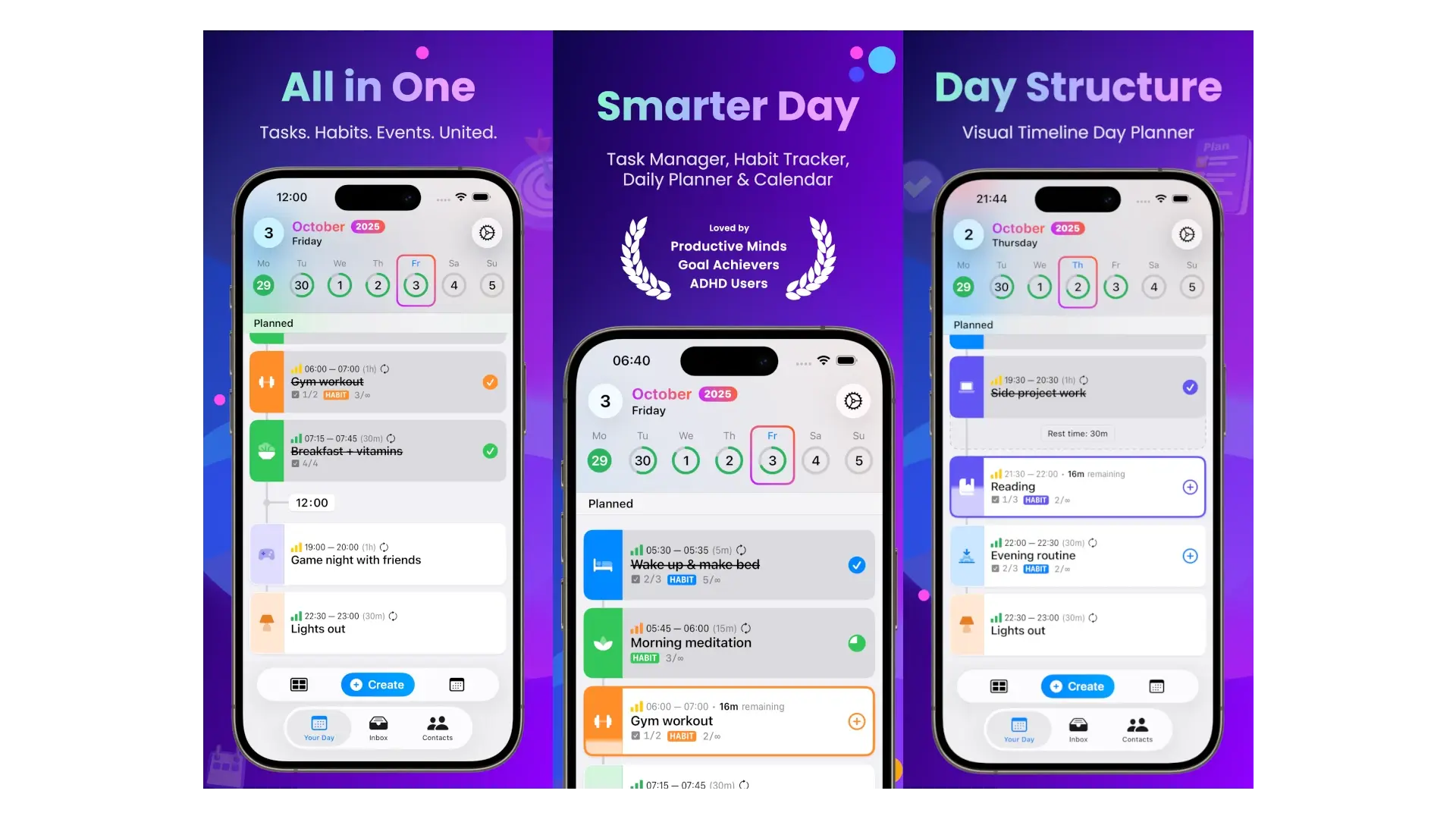
Let’s face it: there’s no single silver bullet. But when you combine time blocking, smart prioritization, task batching, OKRs, habit design, and energy management, you create a resilient productivity system. Start with one or two changes, observe results, and iterate weekly. If you want a simple way to put these methods into practice—calendar blocks, review rituals, and templates—try the productivity app at Smarter.Day. It centralizes planning, reduces friction, and helps you stay consistent.
Small improvements, repeated daily, become transformative. Build your system, protect your focus, and let your best work compound—starting today with Smarter.Day.
You May Also Like
These Related Stories
Advanced Time Management: 10 Proven Productivity Wins
Advanced Time Management: 10 Proven Productivity Wins
No Comments Yet
Let us know what you think