

Time Mastery: 12 Evidence-Backed Productivity Tactics

Style: Conversational and evidence-driven
Category: Time Management & Prioritization
Title: Time Mastery: 12 Evidence-Backed Productivity Tactics
Description: Boost focus with time blocking, prioritization, and cognitive strategies. Actionable tips, expert-backed methods, and real-world examples.
H1: Time Mastery: 12 Evidence-Backed Productivity Tactics
Introduction
Let’s face it: between pings, meetings, and ever-growing to-do lists, it’s easy to feel like your day is driving you—not the other way around. Have you ever noticed how a “quick check” of email turns into an hour, or how urgent tasks push meaningful work aside? Here’s the catch: it’s not a motivation problem; it’s a system problem. In this post, we’ll rebuild your system with evidence-backed time optimization strategies that tame chaos and boost performance without burning you out.
Our goal is simple: give you practical, proven tools you can put to work today. We’ll blend prioritization frameworks, focus sprints, and workflow improvement tactics—each supported by experts, studies, or classic productivity books. You’ll find actionable examples for real life: a marketing lead juggling campaigns, a developer drowning in tickets, a busy parent balancing responsibilities. By the end, you’ll have a reliable blueprint to master your time and get more done—calmly.
H2: Time Blocking and Theme Days for Calendar Clarity
When your calendar reflects your priorities, your day finally aligns with your goals. Time blocking—popularized by Cal Newport in Deep Work—means assigning focused blocks for deep tasks, admin, and breaks. Start by scheduling your top outcomes first, then add supporting tasks. Add theme days (e.g., Monday = strategy, Tuesday = meetings) to reduce decision fatigue. These two methods counter Parkinson’s Law—the idea that work expands to fill the time available—by giving tasks tight, realistic containers.
Practical methods:
- Block 90–120 minutes for your most important task early in the day.
- Assign one or two themes per day to group tasks and stabilize context.
A real-life example: A product manager dedicates mornings to strategy blocks and afternoons to stakeholder time, cutting context switching and improving output consistency in a week.
For focus integrity, protect blocks with calendar “busy” status and a short buffer between sessions to reset. Newport argues that “who you are is defined by what you do,” and scheduling is how you decide what you’ll actually do. Add “hard edges”—alarms and visual timers—to keep sessions honest. One founder we coached used Thursday “ops day” to tackle finance, hiring, and metrics; within a month, overdue admin shrank by 80% and their strategic time doubled.
H2: The Eisenhower Matrix + Pareto Principle for Ruthless Prioritization
The Eisenhower Matrix helps you decide what to do now, schedule, delegate, or delete by sorting tasks across urgent/important axes—echoing Stephen Covey’s classic framework. Pair it with the Pareto Principle (80/20 rule): identify the 20% of actions responsible for 80% of results. Together, they deliver a simple yet powerful filter for daily choices and time management.
Practical methods:
- Start the day by moving tasks into four quadrants; commit to Quadrant II (important, not urgent) first.
- Apply 80/20 to your backlog: trim or batch the low-impact 80%.
A sales lead used this duo to shift time from reactive email to pipeline-building activities and saw a 25% lift in qualified leads within a quarter.
Put it into practice with a quick ritual: list tasks, label impact (H/M/L), and assign a quadrant. Schedule important-not-urgent tasks immediately. Delegate low-skill, repeatable tasks and consider deleting nonessential ones. As Dwight Eisenhower put it, “What is important is seldom urgent,” and the matrix ensures you work on what matters most before the noise claims your day.
H2: Deep Work Sprints and Flow Triggers to Amplify Focus
Deep work sprints are uninterrupted sessions where you concentrate on complex, high-value tasks. Cal Newport’s research shows these sessions dramatically improve output and learning. Combine them with flow triggers from Mihaly Csikszentmihalyi’s Flow—clear goals, immediate feedback, and the right challenge level—to nudge your brain into heightened focus.
Practical methods:
- Define a specific outcome and success metric for each sprint (e.g., “draft 600 words, no editing”).
- Use a distraction audit (disable notifications, close tabs, phone in another room).
A UX designer set two 60-minute sprints daily with a “one-tab rule” and completed a redesign a week early.
Calibrate difficulty: if the task is too easy, add a constraint (e.g., time limit); if too hard, break it into smaller parts. Track your focus latency—how long it takes to settle in—and aim to reduce it by keeping a consistent ritual (same time, same playlist, same app layout). Over time, you’ll condition a “focus reflex” that makes deep work your default mode for complex problem-solving.
H2: Habit Stacking and Implementation Intentions for Consistency
Habits remove friction. James Clear’s Atomic Habits popularized habit stacking: “After I [current habit], I will [new habit].” Back it with implementation intentions (Peter Gollwitzer) which tie actions to specific cues: “If situation X, then I will do Y.” This pairing turns vague aspirations into clear, automatic routines that drive consistent execution.
Practical methods:
- Stack a quick planning ritual onto your morning coffee: “After I brew coffee, I’ll set my top 3 tasks.”
- Write an if-then plan: “If I finish a meeting early, then I’ll spend 5 minutes logging actions.”
A content creator stacked editing onto their lunch break walk—edit for 15 minutes after returning—and doubled weekly output in a month.
Keep stacks tiny at first to avoid friction and build streaks. Use visual cues: a sticky note on your laptop or a recurring reminder. Clear emphasizes identity-based habits—“I am the kind of person who plans my day”—because identity fuels persistence. To cement routines, track streaks and celebrate small wins; momentum often matters more than intensity when building reliable productivity systems.
H2: Manage Energy, Not Just Time: Chronotypes and Ultradian Rhythms
Timing matters. Tony Schwartz’s The Power of Full Engagement argues that energy management beats time management alone. Align work with your chronotype (morning lark or night owl) and your ultradian rhythms—90-minute cycles of peak and troughs studied by sleep researcher Nathaniel Kleitman. Complement that with Matthew Walker’s insights from Why We Sleep: consistent sleep schedules maintain cognitive performance.
Practical methods:
- Schedule deep work during your personal peak (track your best hours for a week).
- Use the 90/20 rule: 90 minutes of focus followed by 15–20 minutes of real recovery.
A data analyst noticed peak clarity from 9–11 a.m.; by reserving that slot for model-building, accuracy improved and rework dropped.
Experiment for two weeks and log results: When are you most focused? What kind of recovery helps (walk, stretch, snack, quick nap)? Avoid caffeine late in the day to protect sleep quality. “Work when your brain wants to work” may be the most underused productivity rule. You’ll find time optimization becomes natural when energy and task difficulty are aligned.
H2: Batch Work and Reduce Context Switching
Switching between tasks comes with a cognitive tax. Research by Rubinstein, Meyer, and Evans (2001) showed measurable switching costs when alternating among tasks—even more so when complexity rises. The cure? Task batching and WIP (work-in-progress) limits drawn from Kanban principles: group similar tasks and limit how many you tackle at once.
Practical methods:
- Batch shallow tasks (email, Slack replies, approvals) into two daily windows.
- Set a WIP limit of 1–2 for deep projects to avoid fragmentation.
A marketing coordinator batched campaign updates into a 45-minute window at 2 p.m., cutting daily Slack usage by 40% and reclaiming mornings for creative work.
To reinforce batching, create “mode-specific” spaces: one browser profile for admin, another for research and writing. Use site blockers to prevent accidental drift. As Gloria Mark notes in Attention Span, frequent interruptions extend recovery time; batching protects your cognitive performance and keeps progress visible. The result is smoother workflow improvement and steadier momentum.
H2: Quick Capture and the 2-Minute Rule to Kill Micro-Procrastination
David Allen’s Getting Things Done (GTD) popularized two game-changers: quick capture—collect everything in a trusted inbox—and the 2-minute rule—if it takes less than two minutes, do it now. These methods minimize the Zeigarnik effect, where unfinished tasks occupy mental space, by moving items quickly from your head into a system.
Practical methods:
- Keep one capture tool (notes app or notebook) and empty it daily.
- Process inboxes with a 2-minute triage: do, delegate, defer, or delete.
A customer support lead added a pocket notebook and processed it at 4:30 p.m.; small to-dos stopped falling through the cracks, improving team response times.
Set a maximum of three capture inboxes across your life (e.g., app, email, paper), and link them to a daily processing window. Combine this with a weekly sweep to clear lingering items. Allen’s mantra—“Your mind is for having ideas, not holding them”—is a reliable antidote to mental clutter and micro-procrastination.
H2: Weekly Review and the Ivy Lee Method to Stay Aligned
A weekly review aligns your projects with your goals and resets your plan for the week ahead, straight from GTD’s core practice. Pair it with the Ivy Lee Method, a century-old approach: list the six most important tasks for tomorrow, in order; do the first task until it’s done, then move to the next. The simplicity forces prioritization and follow-through.
Practical methods:
- Review projects every Friday: status, next actions, blockers, and calendar alignment.
- Each evening, write your top six tasks in rank order for the next day.
A software engineer used Friday reviews and nightly top-six lists; sprint spillover dropped by 30%, and stress over “unknowns” eased.
Use a checklist to ensure consistency: review calendar, projects, waiting-for items, and someday/maybe ideas. Keep the Ivy Lee list realistic—six is a cap, not a quota. This “reset ritual” prevents drift, helps you plan proactively, and ensures the next week starts with momentum rather than mystery.
H2: Outcome Goals with OKRs and WOOP to Bridge Strategy and Action
Goal setting is most effective when it connects ambition to execution. OKRs (Objectives and Key Results)—popularized by John Doerr in Measure What Matters—define where you’re going and how you’ll measure success. Complement them with WOOP (Wish, Outcome, Obstacle, Plan) by psychologist Gabriele Oettingen to anticipate obstacles and design implementation plans.
Practical methods:
- Write one quarterly Objective with 3–4 measurable Key Results.
- For each KR, run a WOOP: name the biggest obstacle and define an if-then plan.
A startup team set an Objective to “delight users,” with KRs on NPS and activation. WOOP flagged onboarding friction; a pre-planned fix boosted activation by 12%.
Keep OKRs visible and review weekly. Tie daily tasks to Key Results to ensure work maps to outcomes. Avoid “vanity KRs”—metric-rich but impact-poor. OKRs give direction and measurability; WOOP provides the psychological scaffolding to overcome friction in the real world. Together, they align strategy and daily execution.
H2: Automation, Shortcuts, and Templates to Eliminate Repetition
Repetition is a silent time thief. Use automation and templates to reclaim hours. Tools like no-code automations, text expanders, and email templates remove manual steps. The “State of Automation” reports from platforms like Zapier underscore how automating routine work compounds over time. For non-coders, Al Sweigart’s Automate the Boring Stuff with Python shows what’s possible, even for beginners.
Practical methods:
- Create templates for outreach emails, meeting notes, and briefs.
- Automate recurring workflows (e.g., form → spreadsheet → task creation).
A recruiter built a template pack and an automation to log candidates; screening time dropped by 25% and follow-ups became consistent.
Start small: identify top three recurring tasks and build one automation per week. Add keyboard shortcuts and text snippets for common phrases to reduce typing time. Document each automation so it’s easy to maintain. Think of automation as “compound interest” for your time—small investments that continuously pay you back.
H2: Meeting and Email Hygiene to Reclaim Focused Time
Meetings and email can unravel your day. McKinsey research has shown knowledge workers spend a significant chunk of time on email, and Microsoft’s Work Trend Index highlights meeting overload as a top drain. Adopt meeting hygiene—clear agendas, defined outcomes, fewer attendees—and email hygiene—batching, filters, and Inbox Zero principles popularized by Merlin Mann.
Practical methods:
- Institute “no-meeting mornings” or a weekly meeting-free block.
- Use filters and rules to auto-label newsletters and cc’s; batch email twice daily.
A project lead cut one recurring status meeting by switching to an async doc with comments; team velocity increased and interruptions fell.
Before scheduling, ask: “Can this be async?” Require agendas and decisions captured in writing. For email, keep messages short, use descriptive subject lines, and unsubscribe ruthlessly. These changes protect deep work windows, reduce cognitive load, and create a respectful team culture where attention is treated as a scarce resource.
H2: Environment Design and Digital Minimalism to Reduce Friction
Your environment is a quiet co-pilot. A Princeton Neuroscience Institute study (McMains & Kastner, 2011) found that visual clutter competes for attention. Reduce desk clutter, create a “focus zone,” and set up digital spaces that encourage monotasking. Cal Newport’s Digital Minimalism outlines how intentional tech use restores attention and clarity.
Practical methods:
- Remove visual distractions from your immediate field of view; keep one tool per task.
- Use website blockers and turn off nonessential notifications.
A freelance writer put the phone in another room and used a minimalist writing app; within days, daily word count rose and editing time shrank.
Design “defaults” that make the right action easy: open to your planning dashboard, pin only work-critical tabs, and hide the dock/taskbar during focus. Borrow a nudge from Thaler and Sunstein’s Nudge: change the choice architecture so your best behaviors become the path of least resistance. That’s workflow improvement by design.
H2: Parkinson’s Law and Timeboxing for Momentum and Finish Rates
Work often expands to the time you give it—Parkinson’s Law. The fix is timeboxing: assign a strict, short deadline to a clearly defined task to force decisions and progress. Timeboxing also leverages the goal-gradient effect—we speed up as we see the finish line—by making the finish line sooner and clearer.
Practical methods:
- Give complex tasks a first-pass timebox (e.g., 45 minutes to draft, not perfect).
- Use visible timers and a “good enough” exit condition to prevent endless polishing.
A product marketer timeboxed a website copy draft to 60 minutes, then scheduled a 30-minute edit later; the campaign launched a week earlier without quality loss.
Pair timeboxes with a checkpoint: at the end, log what’s done and what’s next. If you need more time, add another timebox later instead of letting the task sprawl. Over time, you’ll train an instinct to ship, not stall. This method is simple, humane, and shockingly effective for beating perfectionism.
H2: Strategic “No” and Essentialism to Protect Priorities
Every “yes” is a “no” to something else. Greg McKeown’s Essentialism argues that choosing less but better creates space for meaningful work. Practice strategic no’s and create decision rules that filter requests before they hit your calendar. This is prioritization in its purest form.
Practical methods:
- Use a polite no-template: “Thanks for thinking of me; I’m heads down on commitments through [date].”
- Apply a “hell yes or no” rule for nonessential invitations and projects.
A senior engineer declined ad hoc support requests during sprint focus windows and introduced an office-hours slot; ticket throughput improved and stress decreased.
Build guardrails: define your quarterly priorities and cap active projects. Route new requests to an intake form or a weekly review. Essentialism isn’t about being rigid; it’s about aligning your limited time with your highest contribution. By defending focus, you upgrade both output and well-being.
Conclusion
Productivity isn’t a single hack; it’s a system that blends prioritization, focus, energy, and environment. You’ve learned how to time block, batch, set OKRs, leverage habit stacking, and design an ecosystem that respects your attention. Start with one or two tactics, track your results, and iterate. Small, steady improvements compound into reliable performance.
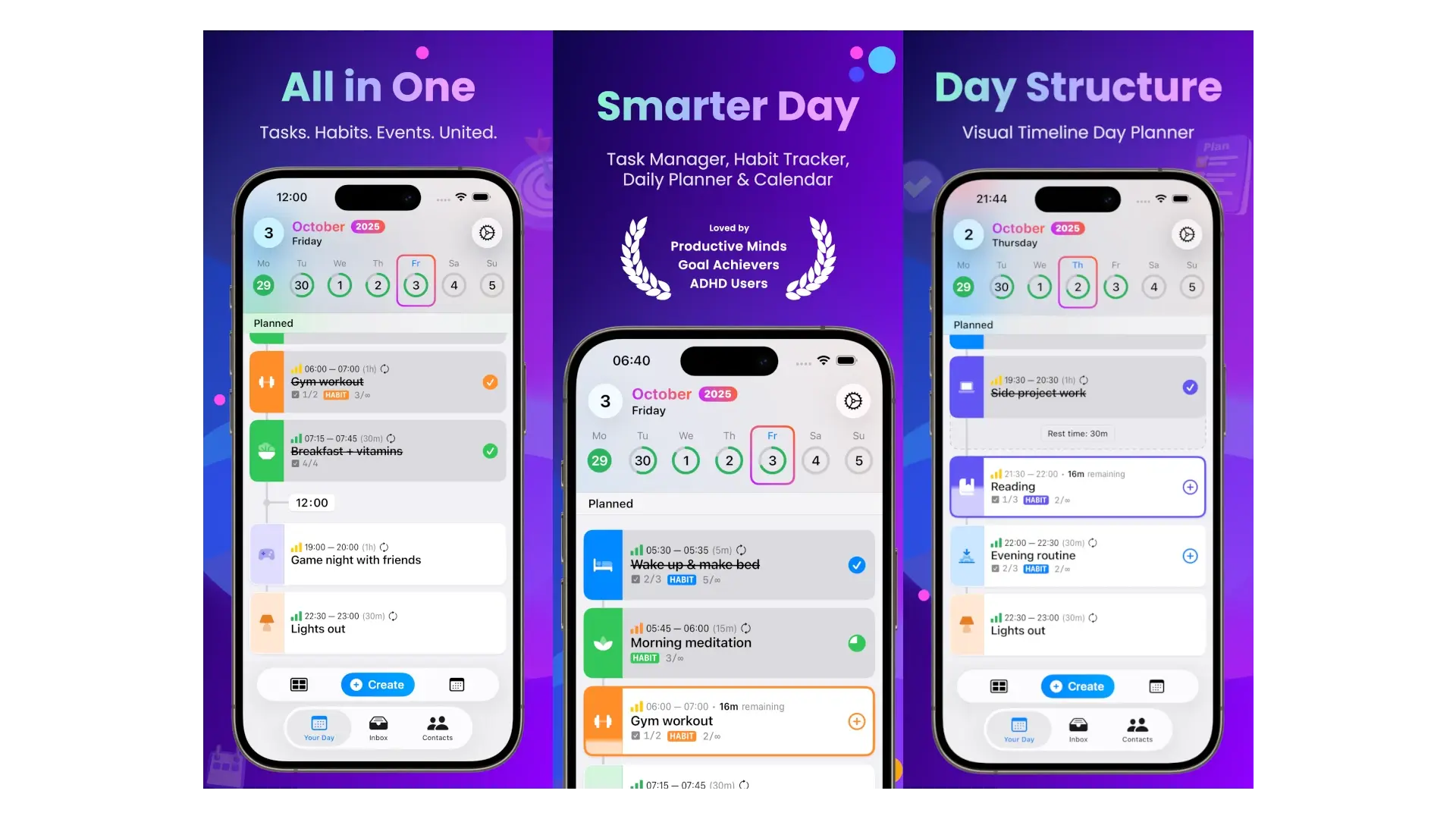
If you want a head start, try a productivity app that supports time blocking, quick capture, and review rituals in one place. The app at Smarter.Day aligns your calendar, tasks, and goals so your system runs smoothly—without extra busywork.
You May Also Like
These Related Stories
Time Mastery: 12 Evidence-Backed Productivity Tactics
Time Mastery: 12 Evidence-Backed Productivity Tactics
No Comments Yet
Let us know what you think