
Advanced Time Management: 12 Proven Ways to Focus Better

Advanced Time Management: 12 Proven Ways to Focus Better
Have you ever had the experience of looking at your to-do list, sensing the anxiety coming up, and then getting into the easiest task just to feel more “productive”? The twist is that busy is not the same as effective. In a life filled with constant notifications and meetings, the ability to concentrate your attention is what will give you the edge over your competitors. This article crystallizes the most actionable evidence-based strategies on time optimization, attention, and workflow improvement so that you can achieve essential work without overheating. We will combine proven frameworks with real examples and simple steps you can implement today.
The aim is straightforward: to support you in creating a lean and replicable system that transforms your confusion into forward motion. You’ll be acquiring the skill of precision prioritization, planning productively for weeks that actually work, and hanging on to deep focus. We will go through topics like habit development, tools, automation, and energy management—because productivity is not only about working harder, but it’s also about designing your cross-sectional day. Let’s turn those intentions into a regular application.
1) Layered Time Blocking That Survives Real Life
Traditional time blocking is effective until the unforeseen happens. With three layers, you will be able to increase its resistance: 1) give your days a theme (e.g., Strategy Tuesday), 2) color-code your tasks into deep vs. shallow work, and 3) after difficult tasks, schedule buffer zones to absorb any possible spillover. For instance, Maya, the marketing manager, transitioned from popping tasks all over the place to a content block on Monday, an analytics block on Tuesday, and 30-minute buffers after big campaigns. Parkinson's Law, which states that "work expands to fill the time available," is the reason we should act wisely and protect our focus by decreasing time.
Experiment with the "block + buffer + backup" plan. At first, block 90–120 minutes of deep work. Afterwards, put in a 15–30-minute buffer. Then, make a backup micro-task list (2–3 small wins) for times when your focus is disrupted by interruptions. Cal Newport's Deep Work provides evidence that the deliberate scheduling of focus periods is the most effective means of increasing cognitive performance. A practical touch: personalize each block with an "anchor verb," like "Draft" or "Decide," so you start off quickly.
To make sure blocks don't come crashing down, you can impose two limitations: hard meeting caps (e.g., no more than 2 hours daily) and one daily highlight, inspired by the book Make Time (Knapp & Zeratsky). Maya's highlight was to "Draft the Q3 campaign outline." Even though the afternoon went off the rails, that one thing made it possible to progress in reality instead of only in theory.
2) Precision Prioritization: From Overload to Clear Next Steps
When every single thing seems to be equally important, none is. First, apply the Eisenhower Matrix to identify the most important issues that are not urgent. After that, add the Rule of 3 (choose three must-wins per day). For instance, the product manager Jordan slashed his task list by 40% and achieved greater on-time deliveries with these two techniques only. Drawing from Stephen R. Covey’s Habit 3 (“Put First Things First”), the essential tasks in Quadrant II—important but not urgent—are the key to success in the long run.
Set the targets when risks are high. For quick task ranking, you don’t need to go for heavy tools like ICE score (Impact, Confidence, Ease). Instead, you can use simple frameworks like RICE (Reach, Impact, Confidence, Effort) when making roadmap decisions. A quick introduction to this flow: 1) brain-dump tasks, 2) sort into Eisenhower quadrants, 3) score top candidates, 4) commit to the Rule of 3. This enhances decision hygiene and diminishes cognitive overload.
On the ground, indeed, Jordan learned to begin his mornings by writing down his “3 Wins.” Then he devoted 90 minutes to the most important one and blocked it off. He delegated Quadrant III tasks and abolished Quadrant IV fully. In just three weeks’ time, his team complained about fewer fire drills and had better clarity on their goals. “What is your top priority should never suffer at the hands of what is your least priority,” Goethe’s famous utterance to that effect has significance that goes beyond time and can be renewed in our lives today.
3) Protect Deep Work and Slash Context Switching
The brain is overwhelmed by switching contexts. According to Gloria Mark's research, interruptions can take more than 20 minutes to recuperate from. It is a cost of attention that grows exponentially. Software developer Priya chose to arrange all her meetings in the morning before noon twice a week, and in addition, she reserved two blocks of time that were absolutely uninterrupted, two hours each block, only for coding. The outcomes were fewer overtime hours and fewer bugs.
Calendar defense is one of the recommended strategies: setting recurring deep work blocks, stacking meetings into meeting windows, and using "office hours" for on-the-spot queries. Introduce focus mode rituals—close tabs, silence notifications, and move your phone to another room. Cal Newport's research shows that long, uninterrupted concentration significantly raises the quality and speed of the produced output.
Additionally, Priya employed checkpointed deep work: she scheduled a 5-minute pre-brief (goal, constraints, definition of done) and a 5-minute debrief (what was finished, next step). This made the process of ramping up quicker and helped with proper delivery of the project. After completing three sprints, her velocity increased by 18%. The lesson: less switching, more finishing. Render your calendar a fortress around your highest levels of thought.
4) Focus Sprints: Pomodoro Meets Ultradian Rhythm
The Pomodoro Technique (Francesco Cirillo) uses time boundaries of 25-minute intervals and 5-minute breaks. Along with them, you may also use ultradian cycles—natural 90-minute energy waves—for the best cognitive performance. Luis, a data analyst, used one power block of 50 minutes and a 10-minute movement break, and after lunch, he had one 90-minute deep sprint followed by a 15-minute walk. The DeskTime/Draugiem Group report indicates that individuals with outstanding performances often work approximately 52 minutes on, 17 off.
Two practical methods: 1) to cut decision fatigue, use a physical timer; 2) pre-select one task per sprint, writing it on a sticky note to "lock your intention." Also, add a "friction budget" and remove one distraction per sprint (e.g., close Slack). It is true that "What gets scheduled gets done," but the task that is protected from interruption gets done faster.
Luis's major change, however, was due to the quality of breaks. He eliminated doomscrolling in favor of quick stretches, drinking water, and catching sun rays. After two weeks he noticed not only a decrease in the afternoon crash but also a stable throughput. Over time, booked sprints add up to tangible triumphs, replacing the stop-and-start disorder that messes with your progress.
5) Habit Stacking and Startup–Shutdown Routines
Just like the saying goes, small hinges swing big doors. Use habit stacking: “After I [current habit], I will [new habit].” BJ Fogg’s Tiny Habits shows that tiny, reliable actions beat grand intentions. Aisha adopted a 7-minute startup routine—review the calendar, set the daily highlight, and clear her desk—and a 10-minute shutdown routine—update tasks, plan tomorrow’s first block, and jot a quick wins list.
Put in effect implementation intentions (Peter Gollwitzer): “If it’s 3:00 p.m., then I’ll batch email for 20 minutes.” Also, use a commitment device that sends a calendar invite for the break reviews to help turn intention into behavior. James Clear’s Atomic Habits reiterates that environment design—like placing the task list in front of you—makes the right choices more straightforward.
Aisha realized that ending her day with a "last 5 minutes of order" facilitated her mornings. She was able to start focused work just 10 minutes after arriving. The result? Increased productivity, less stress, and a clearer mind. Customs aren't extras—they're systems for your willpower.
6) Weekly Review and Time Budgeting
Without a weekly review, tasks multiply in the shadows. David Allen's Getting Things Done suggests emptying inboxes and renegotiating commitments alongside reviewing projects. Ben would reserve 45 minutes every Friday: he would close open loops, set three key tasks for next week, and time-budget his calendar—40% deep work, 30% collaboration, 20% admin, and 10% learning were his targets.
Here are two tools that are very useful: 1) time audit your week to see where hours actually go; 2) pre-block next week’s deep work before meetings fill the grid. This will significantly decrease the planning fallacy (Buehler & Griffin) because it will distinguish ambition from actual capacity. Quick review will turn into a filter of accumulated ideas rather than a brainstorming session.
Ben's team saw that fewer people were drawn into last-minute emergencies. The review was the tool which made it possible to see potential risks in advance. He included a "what were we going to say no to this week?" step, which helped him free 4–6 hours a week. The weekly review is like a bump on the road that averts crashes; it keeps your system reliable and your priorities updated.
7) Single-Tasking and Task Batching to End Multitask Myths
Multitasking is a productivity myth. Stanford research findings done by Ophir, Nass, and Wagner (2009) noted that heavily media multitaskers have a poorer performance on attention and task switching. Moving from real-time juggling to batching, Elena, a recruiter, added sourcing candidates in a window, phone screens in another, and admin in a third. She capped work-in-progress (WIP) at a maximum of two tasks.
Try these methods: 1) batch similar tasks (e.g., email, approvals, scheduling) to minimize setup costs; 2) distraction list method—when a thought pops up, just write it down instead of switching. Add notification triage: turn off all the badges, set Do Not Disturb during focus, and schedule two communication blocks daily. Gloria Mark’s findings on interruption costs back up this design.
In one month, Elena achieved a 20% faster filling of roles. She attributed it to fewer context collisions and a clearer mental space. The mantra is easy: single-task to finish, batch to start faster. One clean lane is better than five chaotic ways.
8) Energy Management: Sleep, Fuel, and Movement
If you want to be honest with yourself, you have to admit that no method has a chance to succeed when you are low on energy. The CDC has stated that adults should have 7–9 hours of sleep every night while Matthew Walker's book Why We Sleep asserts that sleeping well is closely related to attention, memory, and decision-making. Omar was introduced to a wind-down routine: he eliminated the use of screens an hour before bed, reduced the light in his room, and followed a consistent bedtime. He also planned his most demanding work around his chronotype, which he tracked. He used it during his time of peak focus—late morning—and switched to lighter tasks at the time of natural dips.
Two of the most effective techniques: 1) pair movement microbreaks with water refills to improve blood flow and alertness; 2) use smart caffeine—consume it before 2 p.m., not as a remedy for boredom. In addition, consider morning light exposure and a protein-rich breakfast as a means of keeping energy at stable levels. Treat this as time optimization for your biology.
Omar managed to stabilize weekly performance by keeping track of his sleep and subsequently adjusting his work blocks. The heavy analysis that he initially had scheduled for 4 p.m. was cut in favor of collaboration. Now, with energy-first planning, they have turned "grind and crash" into smooth sailing. Don't forget: to protect the focus, you need to protect the energy.
9) Build a Second Brain: Cognitive Offloading That Scales
Your mind is meant to generate thoughts, not to hold on to them. Transfer ideas to a digital configuration known as a Second Brain by using the PARA system (Projects, Areas, Resources, Archives) made popular by Tiago Forte. Chloe is a digital master who made such a simple setup: a separate notes hub for each project, focused on the essentials including hyperlinks and next steps. She added daily notes where she listed decisions made and meeting summaries, thus clearing out the fog of memory.
Here are two new techniques to utilize: 1) employ atomic notes (Sönke Ahrens, How to Take Smart Notes), a system of single-idea note cards; 2) add progress markers—a checklist of what has been done so far to remove the annoyance of having to restart. The Zeigarnik effect (the fact that we remember what is unfinished) is relieved when the next actions are captured fully.
Chloe achieved a ramp-up time reduction of 30% as she no longer started from scratch, but from context. That was a long-term workflow improvement—a system where everything is organized, and you are always aware of the next minor thing to do. Memory is unpredictable; systems are constant.
10) Automate Repetition and Speed Up with Shortcuts
Automation is the unnoticed workhorse of efficiency. By 2025, McKinsey Global Institute believes that automation will be able to increase global productivity growth by 0.8 to 1.4% annually. Ravi has sketched out three practical, real-world automations: 1) text expanders for standard replies, 2) keyboard shortcuts for commands, and 3) no-code workflows (e.g., Zapier) for form submission to his CRM and Slack.
Two beneficial tips: 1) develop templates for proposals, agendas, and updates; 2) employ rules and filters to automate the tagging of files and emails. Adhere to the “5x rule”: if you announce something five times, automate or templatize it. Keep track of the saved clicks and minutes to emphasize the gains and maintain enthusiasm.
Ravi got back almost 4 hours a week by getting rid of manual status updates and repetitive typing. The matter is not about flashy tech; it's basically a pile of tiny, inconspicuous victories. Automate the predictable so you can human the exceptional.
11) Email and Communication Hygiene for Fewer Pings
Communication overload is a serious distraction. In his book, A World Without Email, Cal Newport explains that inundated inboxes form a never-ending state of “hyperactive hive mind.” Mei implemented inbox appointments—email checks at 11 a.m. and 4 p.m.—and she adopted templates for typical responses. Besides that, she reorganized the status updates, moving them to a shared document, which made reply-all threads so much less frequent.
Two immaculate techniques are: 1) set subject line contracts (like “[Action Required by Fri]”); 2) establish response SLAs (e.g., internal emails answered within 24 hours) in order to hold down urgency creep. "Stop the Meeting Madness" is a magazine article (Perlow, Hadley, Eun, 2017) that addresses how structured communication norms reduce unnecessary gatherings.
Mei mixed Slack Do Not Disturb with email windows and a team agreement: questions put in a channel; replies not to be expected instantly. Within a month, her team cut the number of meetings by 25% and discovered fewer messages after working hours. Clear channels make the work go well and fast.
12) Motivation, Measurement, and the Progress Principle
Motivation is not magic; it is just momentum. The Progress Principle by Teresa Amabile and Steven Kramer suggests that small wins fuel inner work life. Sam took the initiative to track daily accomplishments, no matter how small they were: such as a hard email sent, a page drafted, or a bug fixed. He set Outcome + Process goals for the report shipping (unless the time frame is too long) and 3 deep work blocks (committing to time spent on work).
Two methods for sticking: 1) apply a visible scoreboard (Kanban, habit tracker, or weekly review metrics); 2) install commitment devices (e.g., public promises, StickK) for high-stakes goals. According to the Goal-Setting Theory of Locke and Latham, specific, challenging goals and feedback lead to better performance than the use of vague intentions.
Sam had high morale and continued to perform better than usual because he could check his progress every day. Therefore, in this case, action led to motivation rather than the other way around. When you perceive it, you can keep it—this is the rule for long-term performance.
Conclusion
We examined the precise prioritization process, the techniques of protecting profound focus, building appropriate routines, the concept of energy management, and creating systems that scale. The main theme here is engineering: consciously arranging your calendar, space, and tools to make things easier and direct attention to the important things. Choose one or two techniques, evaluate your gains, and then add more for compounding effects.
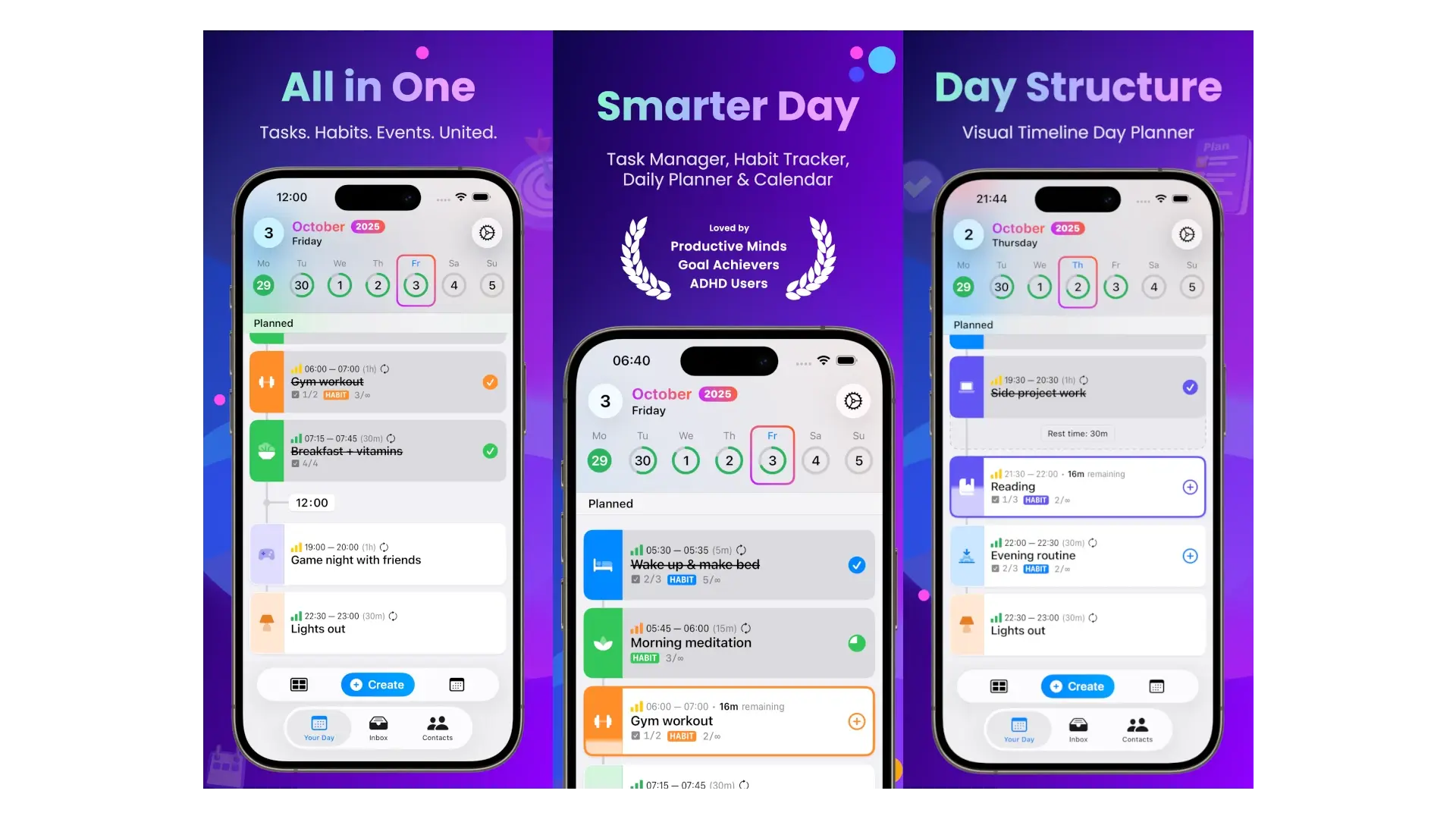
The productivity app at Smarter.Day could be a central space to plan, track, and automate your routines. With the app, you can do time-blocking, batch tasks, and run weekly reviews without having to manage multiple tools. Keep your system simple, visible, and repeatable—and watch your focus, throughput, and confidence rise.
Do you want to transform your plans into actions? Visit Smarter.Day and create your own personalized, high-performance workflow today. Your most focused week begins now.
You May Also Like
These Related Stories
Advanced Productivity Playbook for Peak Performance Today
Master Time Blocking: A Practical Guide to Peak Focus
No Comments Yet
Let us know what you think