

Master Time Management: 12 Proven Productivity Tactics

12 Time Management Tactics to Reclaim Your Day
Introduction
Let’s cut to the chase: busy doesn’t always equate to productive. With constant notifications from your phone, meetings that are not at all helpful, and the unpredictable nature of your daily schedule, you can easily feel run by your day. The uplifting part is—you can switch it back to normal with a few time optimization techniques that combine science, systems, and a smoother workflow. We will address the main issues: procrastination, distraction, and decision fatigue, and instead substitute them with strategies that hasten focus and workflow performance without leaving you with extra workload.
This guide will give you straightforward, replicable mechanisms as described by eminent personalities and certified by science. We will thoroughly examine practical suggestions like time blocking, WIP limits, automation, and weekly reviews, each transparently exemplified with real-life situations. You will find out how to link priorities with value, take care of energy (not just hours), and get tips for easy facilitation of deep work. Are you set to work smarter and retrieve your time? Do not hesitate to join us.
1) Time Blocking and Themed Days for Calendar Control
In a reactive calendar, your day becomes fragmented. The time blocking method effectively mitigates that by scheduling specific work durations, whereas themed days minimize context switching throughout the week. The phenomenon that creativity and efficiency greatly enhance with continuous working is famously attributed to Cal Newport’s “Deep Work.” However, there is a catch: blocks are futile when they are general. Connect blocks with tangible results (for instance, “Draft proposal v1”) and keep them away from interruptions by using Do Not Disturb. Parkinson’s Law applies: work expands to fill the time available; setting shorter but realistic block lengths creates positive pressure.
Apply the following tips: 1) Prepare a weekly template embedding regular focus blocks (90–120 minutes) and admin blocks (30–45 minutes). 2) Delegate themed days (e.g., Monday: strategy; Tuesday: content; Wednesday: meetings) to group similar tasks. 3) Include ten-minute buffer zones between blocks for reset and notes. The practice of wrapping blocks with a one-liner summary at the end will later help fast re-entry into the topic and provide a breadcrumb trail for the future.
Example: A marketing manager organizes her Monday for analytic processes and strategic planning, Tuesday for content creation, and Wednesday for review of campaigns. On Monday, she schedules two morning deep work sessions that include analysis and a short admin block for reporting. As a result, there is less juggling, fewer “just a sec” distractions, and clear milestones. Newport’s view on this resource allocation is: “Clarity of schedule breeds clarity of work.” Time blocking turns the will to do something into an already visible plan of action.
2) Priority Clarity with the Eisenhower Matrix and Value Metrics
The importance of time management is often mistaken for time anxiety. The Eisenhower Matrix divides what is urgent from what is actually the most impactful. In “The 7 Habits of Highly Effective People,” this framework was promoted by Stephen R. Covey, who proposed a life in Quad II: significant but not urgent. To start your day, do a 5-minute sort of all tasks: do it now (QI), schedule (QII), delegate (QIII), or delete (QIV). After that, use a value score—a very simple 1–5 rating to measure a task’s impact on your goals or revenue—to make sure that your time is allocated correctly.
There are two effective methods: 1) Go for a daily Top 3 list made only of the tasks under QI/QII. 2) Look at things from a value-per-hour view: if a task has a good score but takes little time, just do it first. Tag low-value tasks as friction; either batch them together or defer them indefinitely. This causes a shift from a reactive manner to a strategic way, which in turn leads to decision fatigue being less present throughout the day.
Example: A freelance designer organizes tasks on a daily basis. She discovers that a new client proposal (QII, high value) is more important than checking social DMs (QIV, low value). She schedules the proposal for after lunch, then a 4 p.m. batch of DMs, and finally, she gives file exports to an assistant. The results are quicker achievement of her goals. The thought of Covey is still valid today: “The key is not to prioritize what’s on your schedule, but to schedule your priorities.”
3) Pomodoro 2.0: Focus Sprints Without Burnout
The Pomodoro Technique is a classic approach to increasing focus: work in short, timed bursts with short, timed breaks. However, you can bring it into the modern world. Combine 25/5 sprints for tasks that require shallow depth and 50/10 or 52/17 cycles (made popular by the DeskTime/Draugiem Group findings) for deep work. The basic concept is ultradian rhythm-friendly: intense focus, then recovery. Make a “parking lot” note to capture intrusive thoughts; this cuts the mental load of resisting distraction while protecting the sprint.
Two down-to-earth practices: 1) Employ tiered sprints—kick off a 25/5 to heat up first, then boost to 50/10 for deep assignments. 2) After a cycle of four sprints, take a longer break (20–30 minutes) for genuine recovery—go for a walk, drink water, and have light snacks. Assess which sprint length yields your best output and consistency, and apply that as a standard pattern of work for similar tasks.
For instance, a programmer gets the job done by applying 50/10 cycles for coding while 25/5 is for code reviews. The switch assists the individual to have an intense mind along with difficult tasks to ensure higher stability throughout the day. Cirillo’s primary principle continues to be relevant: short and strictly planned work decreases procrastination. When it incorporates conscious breaks, Pomodoro 2.0 becomes an everlasting machine of attention.
4) Task Batching and Single-Tasking to Beat Multitasking Myths
Although multitasking brings the illusion of being busy, it carries the downside of reduced cognitive performance. A study done by Stanford’s Clifford Nass revealed that heavy media multitaskers had a poorer ability to filter out irrelevant information. The solutions to this issue are task batching and single-tasking. Batching groups similar tasks (e.g., emails, approvals) to minimize switching contexts, while single-tasking creates undisturbed lanes for meaningful work. We are optimizing workflow by cutting down on switch costs, which are micro-delays that add up throughout the day.
Use these methods: 1) Create two batch windows daily for communications (e.g., 11:30 a.m. and 4:30 p.m.) and make them short. 2) Allow system-wide Do Not Disturb, hide the dock/taskbar, and keep only one browser with essential tabs. You may also add a “later” tab group for research to prevent the instant context shift that takes your attention away. This helps you stabilize your attention and clean up your time.
Example: A customer support lead operates tickets in three 45-minute batches, with a separate 90-minute block for documentation. Performance metrics witness an improvement because the deep documentation no longer competes with incoming pings. In fact, as the APA notes, persistent interruption leads to a higher error rate; single-tasking makes it possible for quality and speed to be more predictable—and your stress to be less.
5) Habit Loops: Stacking and Implementation Intentions
If there is anything that easily converts a tactic to a transformation, consistency is what it is. Habit loops—cue, routine, reward—drive productivity with less effort. Small changes, repeated, compound into big wins. James Clear (“Atomic Habits”) and BJ Fogg (“Tiny Habits”) point out how really small alterations can effectively accumulate to major benefits. Build habit stacks by hanging a new behavior on an existing one (“After I make coffee, I plan my Top 3”). Incorporate implementation intentions (Peter Gollwitzer): if-then plans that tell your brain precisely when to act (“If it’s 9 a.m., then I start my focus block”).
The following are two techniques to consider using: 1) Create a 2-minute gateway—the small first action that leads to a whole new behavior (for example, open the doc, write the title). 2) Match a reward that you like with the established behavior (e.g., listen to a playlist, take a short walk). The visualization of tracking streaks gives a sense of success and reinforces the progress principle (Teresa Amabile): small victories increase motivation.
Example: A content writer stacks “outline one paragraph” with her morning coffee and sets the if-then for 9 a.m. deep work. The design of the 2-minute entry reduces friction, and the post-session stroll is the reward for that day. After weeks of application, the output level has risen as the routine has been maintained in autopilot mode. Small actions lead to big shifts.
6) Energy Management and Ultradian Rhythm Scheduling
Failing to manage time due to neglecting energy is a common scenario. The main function of energy management is to schedule tasks according to your natural energy peaks and troughs. According to the book “The Power of Full Engagement,” written by Tony Schwartz and Jim Loehr, it is energy that you should be managing, not time, which in turn increases your efficiency. Before anything else, determine your chronotype (a morning lark or a night owl) and plan your timeline with the most difficult assignments during your peaks. Use 90-minute cycles along with brief recovery to respect your ultradian rhythms (Kleitman): your brain needs oscillation, not an unbroken grind.
Try: 1) A simple energy audit—for a week, report your energy hourly and then allocate deep tasks into your top two hours each day. 2) Use microbreaks (1–3 minutes of movement or eye rest); research indicates microbreaks can counter vigilance decrements. Make it a habit to stay hydrated and have light protein after mid-morning to stabilize your focus.
Example: An analyst realizes that she has the best clarity from 9:30–11:00 a.m. She decides to shift model building to that time and leave email batching for early afternoon. She walks for 5 minutes after each 90-minute push. The outcome is a lower number of errors and a quicker throughput. When you align with energy cycles, time expands in your favor.
7) Reduce Decision Fatigue with Defaults and Checklists
All the choices regarding tasks impact willpower. Decision fatigue can make afternoons less productive and also affect quality of work. The solution brought forth by Barry Schwartz in his book “The Paradox of Choice” is that fewer and better defaults can lessen cognitive load. Create defaults for diets, clothes, tool stacks, and file structures. After that, utilize checklists—Atul Gawande’s “The Checklist Manifesto” illustrates that they minimize mistakes in complex settings and develop creativity by releasing working memory.
Two strategies you can try: 1) Create SOPs and checklists for recurring workflows. 2) Standardize your decision thresholds—for decisions with less than a certain impact, make them in less than 60 seconds or default them. This method provides high momentum and preserves mental bandwidth.
A startup founder automates their morning routines, calendar routing rules, and uses a launch checklist for campaigns. Despite it being only 2 p.m., they still have strategic capacity because this resource was not consumed by the trivial. Defaults are not immovable; they are friction reducers that allow your mind to function at its best when it really matters.
8) Communication Compression: Async First and Meeting Hygiene
Inadequate clarity increases meetings. Prioritize asynchronous updates: written briefs, recorded demos, or concise status posts. Harvard Business Review has been advocating for clear agendas and meeting hygiene to cut waste for a long time. Employ “no agenda, no meeting” rules and reduce default slots to 25 or 50 minutes to reclaim transition time. When a live sync is essential, focus on reaching decisions, not on providing updates.
Two practical techniques: 1) Embrace a one-pager template for proposals and status—problem, context, options, decision. 2) Introduce office hours for ad-hoc questions to protect deep work. Meeting notes must reflect decisions and owners within 24 hours for accountability and workflow improvement.
Example: A remote team transfers weekly updates to async memos and limits live calls to decisions and blockers. Engineers state that they focus on their work more and have quicker cycles with 30% fewer meetings. The Work Trend Index of Microsoft has recognized the phenomenon of overstated meetings; cutting back communication brings back time for actual work—and calmness.
9) Kanban Flow and WIP Limits to Finish Faster
Starting is uncomplicated; however, completing is exceptional. Kanban displays tasks and uses WIP (work-in-progress) limits to maintain smooth flow. Based on Toyota’s Lean system (by Taiichi Ohno) and David J. Anderson’s book “Kanban,” the methodology emphasizes continuous delivery and fewer bottlenecks. Implement Little’s Law: limiting WIP leads to shorter cycle time as tasks pass through the system more rapidly with decreased traffic.
Two options: 1) Specify a WIP limit in each column (e.g., “In Progress: 2”) and do not start new tasks until something is completed. 2) Incorporate a blocked lane to show dependencies directly and set off quick resolution. Daily 10-minute stand-ups dwell on the aging items rather than the new ones to maintain flow and throughput.
Example: A marketing crew sets “In Progress” limit per person at 3 and marks blocked tasks with red. Cycle times go down and the “almost done” tasks finally get shipped. As Anderson says, visualizing work alters behavior; you see the choke, you resolve the choke. Less churn, more output.
10) Automation and Templates to Eliminate Repetition
Repetition occurs when you have to do it, and therefore sequences of repeated tasks can be automated. Templates and automation are solutions that save time by a number of hours each week and counteract the possibility of human error. According to the McKinsey Global Institute, many knowledge work activities can be automated given that the tools and technology required for it are already available. To start this process of automation, look at things that you can templatize like emails, proposals, briefs, and reports. After that, connect tools with simple automation of calendar schedulers, form-to-doc workflows, and rules in email or project managers.
Two methods: 1) Make a snippet library for common replies along with a proposal template that you can fill in according to the recipient. 2) Apply simple automation (e.g., Zapier, native integrations) to re-route tasks, tag files, and log time automatically. Review the automation on a monthly basis to either cut back or expand the automation as needs arise.
Example: A salesperson develops a proposal template and a workflow with which signed documents are automatically turned into tasks with deadlines. Accordingly, he sends the proposals in 15 minutes instead of an hour, and he can easily track the follow-ups. Automation does not have to be robotic; it is about time reclamation, which you can then spend on strategy and relationships.
11) Daily Shutdown and Weekly Review for Continuous Clarity
Neglecting reviews can lead to a lapse of priorities. David Allen’s book “Getting Things Done” highlights the importance of the Weekly Review to reestablish commitments and give you faith in your system. Use it alongside a daily shutdown ritual to signal the end of your work and to prepare for recovery. Reviews are the mental loops that you open, sort, and close—or schedule—so your brain can relax. Teresa Amabile’s progress principle suggests assuring yourself that you are able to overcome smaller challenges; it is during the reviews that these wins are made visible.
Two methods: 1) Each night, for 10 minutes, check off what you have completed, write down the loops that are left hanging, and set a Top 3 for tomorrow. 2) Weekly, clear inboxes, review projects, update roadmaps, and decide on one next clear action for each priority. To avoid going off track, make your notes concise and actionable.
Example: A project manager conducts a brief 30-minute Friday review: they check the risks, update timelines, and mention one win per project. The week can begin faster because of the refreshed plan. The strong review practice is the glue that keeps the time management system in place—no need to question “Where was I?” anymore.
12) Environment Design and Digital Minimalism
Your surroundings speak louder than words. Environment design is all about making the right choice the easier one. Simply clear your desk of everything that isn't needed, keep only the tools necessary for the task at hand, and then create a “work scene” that takes not more than 60 seconds to reset. Cal Newport’s “Digital Minimalism” moves toward attention diet auditing where you cut out nonessential apps and mute notifications, and you can also use app blockers to protect your deep work windows.
Two techniques to apply: 1) Set up a single-task workspace consisting of just one monitor/project, physical notes out of view, and phone on airplane mode away from reach. 2) Employ website blockers and set summarized notifications twice a day. The 10-minute weekly reset keeps order intact and wards off the clutter creep that affects focus.
Example: A student builds a distraction-free desk, puts the phone outside the room, and uses an app blocker from 9–11 a.m. They notice that study sessions are of much better quality as the environment is nudging them to do the right thing. According to BJ Fogg’s principle, the change in behavior stems from prompt, ability, and motivation; the environment enhances the last two.
Conclusion
Your productivity doesn't depend on having more time on your hands but rather on your system being better. By using time blocking, value-focused prioritization, focus sprints, WIP limits, and automation you will set up a workflow that will protect your attention and also speed up results. Add in habit loops, energy management, and weekly reviews, and you'll be able to find a cadence that is sustainable, with progress feeling inevitable as opposed to accidental.
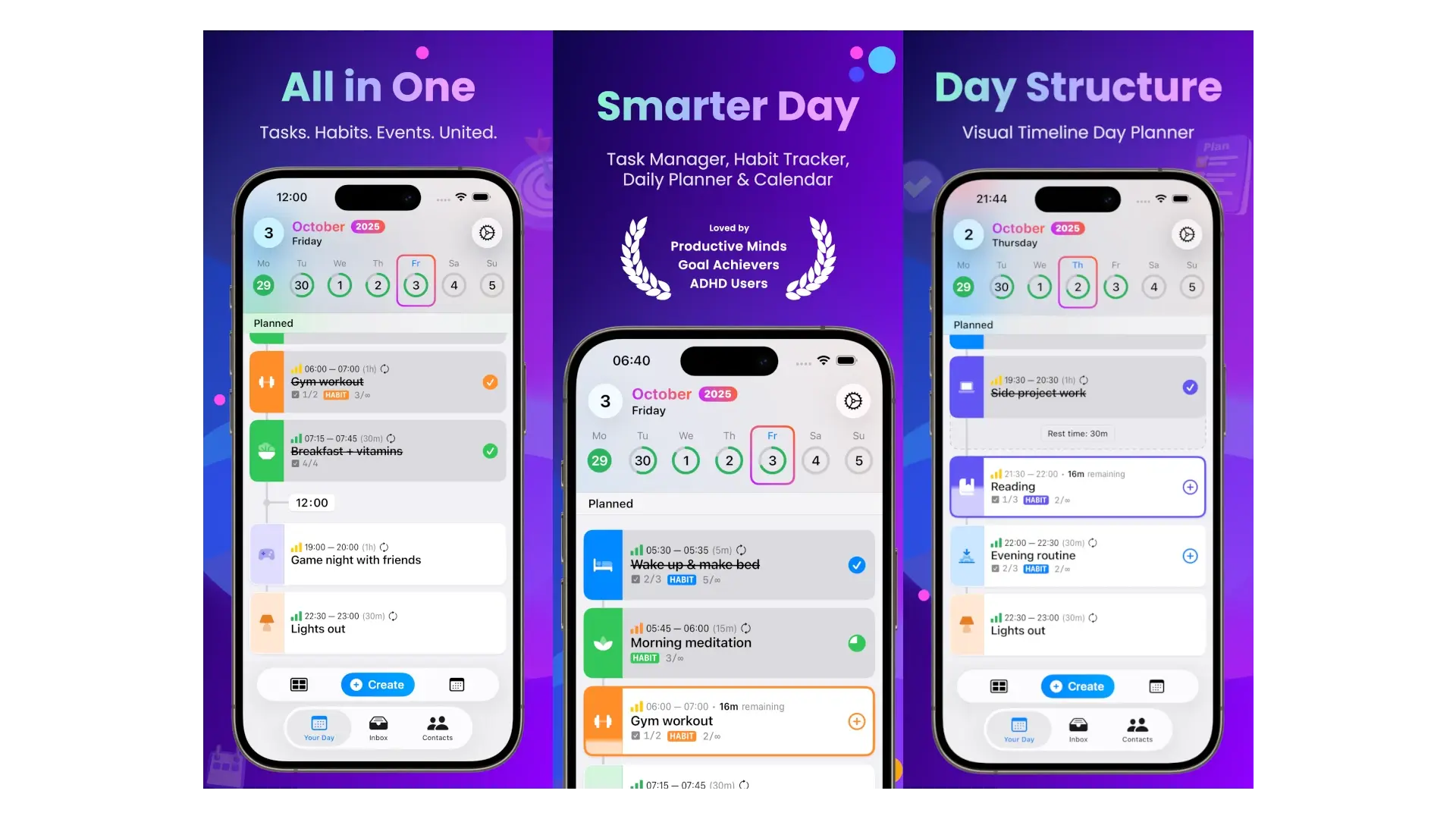
If you want a simple way to put this playbook into action, the best option is to download the productivity app at Smarter.Day. It will let you plan focus blocks, set WIP limits, capture your Top 3, and even automate routine logs and run end-of-day reviews—all in a single place that facilitates deep work and clarity.
You May Also Like
These Related Stories
Time Management Mastery: 12 Proven Productivity Tactics
Time Management Mastery: 12 Proven Productivity Tactics
No Comments Yet
Let us know what you think