

Time Optimization Blueprint: 10 Proven Productivity Tips

Time Optimization Blueprint: 10 Proven Productivity Strategies
Think of it as a performance—where modern-day working is juggling burning torches on a slim rope. Notifications ring, your tasks are growing, your mind flits between the signals: beeping urgent and half-done work. Are you conscious of the fact that simply sending a "quick email" slingshots your focus for one hour? The tricky part is that you are productive not just by doing more, but by doing the right things in the right way. In this guide, we will highlight how to lower the friction, shield your mind, and establish permanent workflow improvement habits.
We will hand over to you the often-proven methods—from time optimization frameworks and deep work sprints to energy management and review rituals—that were substantiated by credible research as well as lived experiences. Regardless of whether you're a manager, creator, or founder, the steps highlighted below will help you take back your calendar, direct focus, and gain momentum. Our aim is practical and not theoretical; therefore, you can test two or three methods even today and get results this week.
1) Clarify What Matters: Eisenhower + OKR Alignment
The first step is to distinguish the noise from the impact. Use the Eisenhower Matrix to categorize tasks into four quadrants: urgent/important, important/not urgent, urgent/not important, and neither. Then, take Quadrant 2 items (important, not urgent) and tie them to OKRs (Objectives and Key Results). By doing this, you will save the strategic work for such activities like research, learning, and system-building, which will yield long-term benefits. Dwight D. Eisenhower's prioritization technique, emphasized by John Doerr and the OKR model, is recognized in "Revise What Matters," which asserts that focus and alignment are key factors to achieve high performance.
Two easy-to-implement methods:
- First, label Eisenhower quadrants with the top 10 tasks you need to tackle each morning.
- Second, at least one weekly Key Result should be dedicated to a bigger overall Objective.
In the real world: Mia, a product manager, applied the matrix technique, cleared three “urgent” requests, and dedicated two hours to the Objective “Improve onboarding,” which led to a 7% increase in activation within a month.
The next step is to prioritize your Quadrant 2 tasks by scheduling them first—before meetings and Slack threads that might occupy your day. If a task does not link with an OKR, ask: “What if I didn't do this at all?” Often, the world wouldn't end this way. According to Harvard Business Review, the most crucial pointer for the realization of effectiveness in execution is the precision of priorities. The use of Eisenhower for triage combined with OKRs for direction limits decision fatigue and makes you act promptly.
A neat hack: Position your OKRs at eye level—which is to say at the top of your to-do list or calendar. That visual reminder fosters better suggestions right at the start. Besides, you should also integrate a weekly "Objective Check" block when you ask quickly: Did my time reflect my beliefs? If not, adjust. The mantra "what gets measured gets managed" is even more true when simple and visible measures are used.
2) Own Your Calendar: Time Blocking and Theme Days
Time blocking refers to the practice of reserving specific periods in your calendar for specific tasks or categories. Citing Cal Newport, it is "the act of assigning your time a job," while his study about deep work concludes that pre-planned changes drive not only the quantity but the quality of work. Combine time blocks with Theme Days—a full day dedicated to a category of work (Monday: strategy, Tuesday: content). This construct minimizes decision fatigue and goes against Parkinson’s Law—work expanding to the time allocated to it.
Concrete examples of these are:
- Set aside daily 90-minute slots for your most profitable tasks.
- Schedule Theme Days to group similar work tasks (content, client calls, admin).
A practical example would be Lila, a freelance designer, who introduced “Design Day” Wednesdays and “Admin & Invoicing” Fridays. Her productivity surged by 25% after a 4-week period.
Be strict on your blocks and maintain clear limits. Incorporate buffer zones of 10–15 minutes between blocks to be able to reset, record wins, and avoid spillover. In case a block is being taken over, just reschedule, not cancel. Small variations defeat the falling-off track. A University of Minnesota study on the planning fallacy shows that we often underestimate durations, so buffers help align reality with our desires. Write post-block notes in short form: What was OK? What is my adjustment? This tiny retrospective will put fast learning loops into place.
Lastly, the best way to visualize time investment is by color-coding your calendar. One shade should primarily indicate deep work, another for meetings, and yet another for administration. In a snap, you will recognize the distortion clearly. Aim at having at least 30–40% deep work in knowledge jobs; McKinsey has shown outstanding lift in productivity due to team meeting disruptions becoming less fragmented. These visual tools will prompt you to take care of the time that makes a difference.
3) Build Unbreakable Focus: Deep Work Sprints
The repetitious toggling between different tasks has become a part of our life and is on the expensive side. Stanford's Ophir et al. carried out a study that showed multitasking has a negative impact on cognitive performance, especially attention control. The solution would be deep work sprints: a period of time (60–120 minutes) which allows deep work without being distracted by anything. The book "Deep Work" by Cal Newport states that serious concentration is what makes you have a larger reward in your results. In addition to that, you can make a focus ritual—putting the phone in the other room, using a one-tab browser, or wearing headphones—to tell your brain that you should start now.
Two practical tricks:
- Make sure to book two periods in the day for deep work sprints of your most difficult tasks.
- Utilize a physical countdown clock; it creates urgency and restrains drifting.
Example: Aaron, who is a developer, went through two backlog items that he had been averting for weeks after pledging to complete two 90-minute sprints and turning off Slack for the duration of these windows.
To make the sprints livable, you should determine a “shallow landing strip” at the end: five minutes to capture disorganized thoughts and the next step. This will reduce attention residue, a concept analyzed by Dr. Gloria Mark that proves task-switching creates a mental trail that damages performance. You'll be able to continue faster in the next case. This should be paired with the Shut Door Rule—an actual or figurative barrier during the sprints. Inform your team, “When the door is shut, I’m on a sprint. Ping me after.”
Sprints will be documented by what is done per session: lines of code, pages drafted, decisions made. The goal is not to be about hours but about measuring the output that makes sense. Through time, you will find out what is the best length of the sprint, when is the best part of the day, and what the best environment is. Your customized performance rules are becoming a fruitful workflow improvement system.
4) Control the Inputs: Email, Notifications, and Context
Usually, the factor that obstructs our progress is not the to-do list but rather the inbox. You should try notification batching and email triage. You can also silence all the non-critical notifications and only check your email at set times, for example, 11:30 a.m. and 4:30 p.m. Use a three-bucket model to sort your email: Do (under two minutes), Delegate, Defer. According to what is said by Merlin Mann, "Inbox Zero" is more about decisive processing than being empty. Frequent interruptions are reported by the Work Trend Index of Microsoft to cause cognitive impairment and extended working hours.
Two easy ways:
- Arrange two email windows and turn off push notifications in between.
- Make filters and rules to auto-label messages that are low-priority.
For instance, Priya, a sales employee, made rules for newsletters and set a "Later" label. She implemented two batch windows, and she achieved a 40% rate of cutting her email time and hitting her quota long before the deadline since she was only focusing on the live calls that morning.
As for chat tools, you should embrace status signaling: "Heads-down until 1 p.m.—text for urgent." This will help reset team expectations and thereby minimize "Can I get you?" pings. The survey that was conducted by Dr. Gloria Mark discovered that 20+ minutes are needed to regain concentration after the distractions conclude. Treat your cognitive bandwidth like a resource that you need to conserve. As with communication blocks, first handle the most relevant messages; sometimes they take no time at all and also free your mind.
Lastly, you need to select your information diet carefully. You should unsubscribe from everything that is not useful. Use a read-it-later tool for low-urgency articles instead of having tab chaos. From being "just in case," they become "just in time," relating to the information you need at that moment. Your brain is not a content museum; it is an outcome production workshop.
5) Make Habits Do the Heavy Lifting: Tiny Habits + Stacking
Willpower is not dependable; systems, on the other hand, are constant. BJ Fogg's Tiny Habits and James Clear's habit stacking transform small actions into automated routines. Fogg's studies reveal that behavioral change is resilient only when it's simple, anchored, and acknowledged. Try "After I make coffee, I'll open my task list." Establish a 1% improvement loop—micro-changes that add up over weeks. In "Atomic Habits," Clear stresses the importance of identity-based habits: "I am the kind of person who prepares before I act."
Two straightforward techniques:
- Attach a 2-minute planning routine to your morning beverage consumption.
- Use "habit pairs": plan → start timer; finish block → log win.
For example, Noor, a content writer, included "plan three bullets after coffee" in her habit list. As a result, in just one month, she overcame blank-page anxiety and increased her publication frequency by 100%.
Make habits visible. You can implement a simple tracker or a calendar with X's for streaks; the brain prefers to see a continuous flow. When situations become overwhelming, you can rely on minimum viable habits: the smallest version that keeps the chain unbroken (for instance, 5-minute review). This will mitigate the all-or-nothing risk. Research conducted by Wendy Wood concludes that 40–50% of daily tasks are automatic; thus, you should move your high-priority tasks to this autopilot state.
Environment design can also be incorporated with the habits. You can place your notebook on the keyboard at night to trigger a morning plan. You can use a single-task desktop background with your focus word (e.g., "Ship"). Small friction leads to disrupted behaviors. And eventually, your process will turn into who you are.
6) Clear Mental Clutter: GTD, Capture, and the 2-Minute Rule
Energy is drained by unfinished tasks. According to the principle of David Allen's Getting Things Done (GTD), our brain is an instrument that aids in generating ideas but is not meant to be the repository of them. Develop a capture system—notepad, inbox, or paper—to bring together every open loop. Next, utilize the 2-Minute Rule: if it takes less than two minutes, do it now, to organize. The Zeigarnik effect stresses that unfinished tasks preoccupy attention; when capturing and clarifying is done, focus is restored.
Two hands-on strategies:
- Take a single trusted inbox; twice daily clear it into projects.
- Use contexts like @Home, @Laptop, @Errands for quick batching.
For example: Ops lead Jorge moved from 200 sticky notes to one digital inbox. Processing it twice daily, he was able to eliminate the moments of “Where is that?” and he could reach deadlines without fire drills.
During processing, apply the GTD questions: What is it? Is it actionable? What’s the next physical action? If it takes longer, schedule it or delegate. This thinking is simple but clears the mist. Allen's scientifically grounded method has a side benefit of stress reduction, which is gained by more control. Incorporate a weekly "mind sweep" to collect the stragglers—ideas, worries, possible risks. Sound sleep will be ensured as crucial items will not slip through the cracks.
Last but not least, link capture to review. The information without a return path becomes a source of digital clutter. Set project- and date-based tags or folders. With trust in your system, your cognitive performance will soar as you are not spending cycles on the memory processes of where everything is.
7) Manage Energy, Not Just Time: Sleep, Movement, Nutrition
Energy management is the other half of the bridge to time management. Sleep should be your first priority: Dr. Matthew Walker, in his book "Why We Sleep," presents evidence that even slight sleep deprivation can cause problems with memory, attention, and the immune system. Aim for 7–9 hours of sleep, regular bedtime/wake time, and a room that is dark and cool. Add movement snacks that you can do for 3–5 minutes every hour. Dr. John Ratey's "Spark" states that exercise increases brain-derived neurotrophic factor (BDNF), which, in turn, promotes better learning and happiness.
Two practical ways:
- Set an alarm for a bedtime that is non-negotiable.
- Include 5-minute mobility breaks after each focus block.
For example, Hana, a founder of a startup, has swapped her workout to lunchtime and she added a 10:30 p.m. wind-down to her schedule. Tiredness in the afternoon has disappeared and the improvement in her decision quality is significant.
Organize work according to ultradian rhythms—natural performance cycles of 90 to 120 minutes identified by Nathaniel Kleitman. During your peak, which is usually late morning, stack deep work and schedule admin during your valleys. Include smart fueling: eat a protein-rich breakfast, drink water steadily, and avoid afternoon caffeine to stay alert. Guidance from the Harvard nutrition department shows that balanced meals help stabilize energy and, thus, prevent focus dips. The game plan is straightforward: get enough sleep, be physically active, and eat smartly. Your productivity will be better.
An end-of-day "shutdown" to reduce overthinking: write down the 3 most important tasks for tomorrow, note loose ends, and close work applications. Your brain can take a break because it knows the system won't forget anything.
8) Use Better Breaks: Pomodoro, Microbreaks, and Reset Rituals
Breaks are not a luxury; they are a tool for increasing productivity. The Pomodoro Technique (Francesco Cirillo) allows you to work for 25 minutes and then take a 5-minute break; after four rounds, you can take a longer break. If the tasks you have are complicated, think of 50/10. Research on attention restoration (Berman, Jonides, and Kaplan) shows that short, deliberate breaks are more effective than mindless scrolling in restoring concentration.
Two practical methods:
- Use 50/10 for deep tasks; 25/5 for simple issues.
- Take microbreaks: stand, stretch, breathe, hydrate, look outside.
Example: Eva, a financial analyst, changed to 50/10 cycles for modeling work. Her accuracy improved, she finished reports faster, and she had to do fewer re-checks.
At the end of each day, run Park and Mark: “park” the task at a logical stopping point and “mark” the next step. This strategy reduces startup friction tomorrow and utilizes the Zeigarnik effect positively—whereby your brain simmers productively. Think of this quote on breaks: “Rest is not idleness,” as said by Bertrand Russell. Those who are excellent in their field do not continuously work intensely; they alternate between the two.
Try out various break activities. Light movement is more beneficial than checking email. Breathing techniques like the 4-7-8 method can be very effective in calming the nervous system. Over a week, write down which breaks you find most refreshing and standardize them.
9) Streamline the Flow: Kanban, WIP Limits, and Automation
Visualize work on a Kanban board (To Do → Doing → Done). Apply WIP (Work-In-Progress) limits to avoid jam; Little’s Law from queueing theory illustrates the fact that limiting WIP decreases cycle times, a basic perception of Lean and the Toyota Production System. Stick to the lightest automation—templates, text expanders, keyboard shortcuts, and tools such as Zapier—to wipe out repetitive steps and speed up decision flow.
Two fitting methods:
- Cap WIP at 2–3 items per person; finish before starting new work.
- Automate recurring tasks: calendar invites, file naming, reporting.
Example: A marketing team capped WIP at 3 per role and templatized briefs. Turnaround time dropped by 30%, and error rates fell as handoffs became cleaner.
Add definition of done checklists to reduce rework: file format, stakeholder review, final QA. Checklists, popularized by Atul Gawande in “The Checklist Manifesto,” diminish cognitive load and mistakes in complex work. Use batching for similar tasks—design variants, invoice runs, weekly reports—to gain from setup-time savings. Over time, log bottlenecks and fix one per week. Workflow improvement is a process, not a one-off project.
Conduct a quarterly review of your stack. Prune tools that overlap and add friction. Set standard folder structures and naming conventions. Uniformity is the silent accelerant of team performance.
10) Reflect, Measure, Improve: Weekly Reviews and WOOP
Think about the impact of not noticing your mistakes and repeating them. Execute a Weekly Review (GTD-aligned) to empty inboxes, refresh projects, and schedule your next week's top outcomes. Add a 15-minute retrospective: What worked best? What hindered me? What single thing will I try next week? Teresa Amabile's "Progress Principle" elucidates that identifying small wins propels motivation and sustained high performance.
Two practical methods:
- Have a 45–60-minute Friday review: calendar scan, project status, next week top 3.
- Conduct a time audit: categorize calendar entries such as deep, shallow, and meetings.
Example: Marco, a remote team lead, found out that only 18% of his time was deep work. To his relief, he removed two meetings that took place regularly and regained two focus blocks, thus enhancing throughput by 22%.
State implementation intentions (e.g., "If it’s 9 a.m., then I start the strategy block") along with the support of Peter Gollwitzer's research. For goals that stand in the way, practice WOOP (Wish, Outcome, Obstacle, Plan) from Gabriele Oettingen; mental contrasting increases activation. Track metrics—or lead indicators—like deep work hours, and ship output-lagging indicators. Weekly wins are a great way to affirm your identity: "We are the team that ships."
Create a “Stop/Start/Continue" list every three months. This rhythm is what keeps your system alive and transformative—shaping along with your role, workload, and goals.
Summation
Productivity is not merely a form of a single hack; rather, it is a mode of operation. Setting the right priorities channels the right effort, reserving time blocks ensures focus, developing proper habits minimizes resistance, and feedback engenders quality development. By mixing focus intervals with proper management of energy and smart workflow design, performance reaches predictability. Start with two methods that appeal to you—maybe two such as Eisenhower + OKRs and deep work sprints—and add to that.
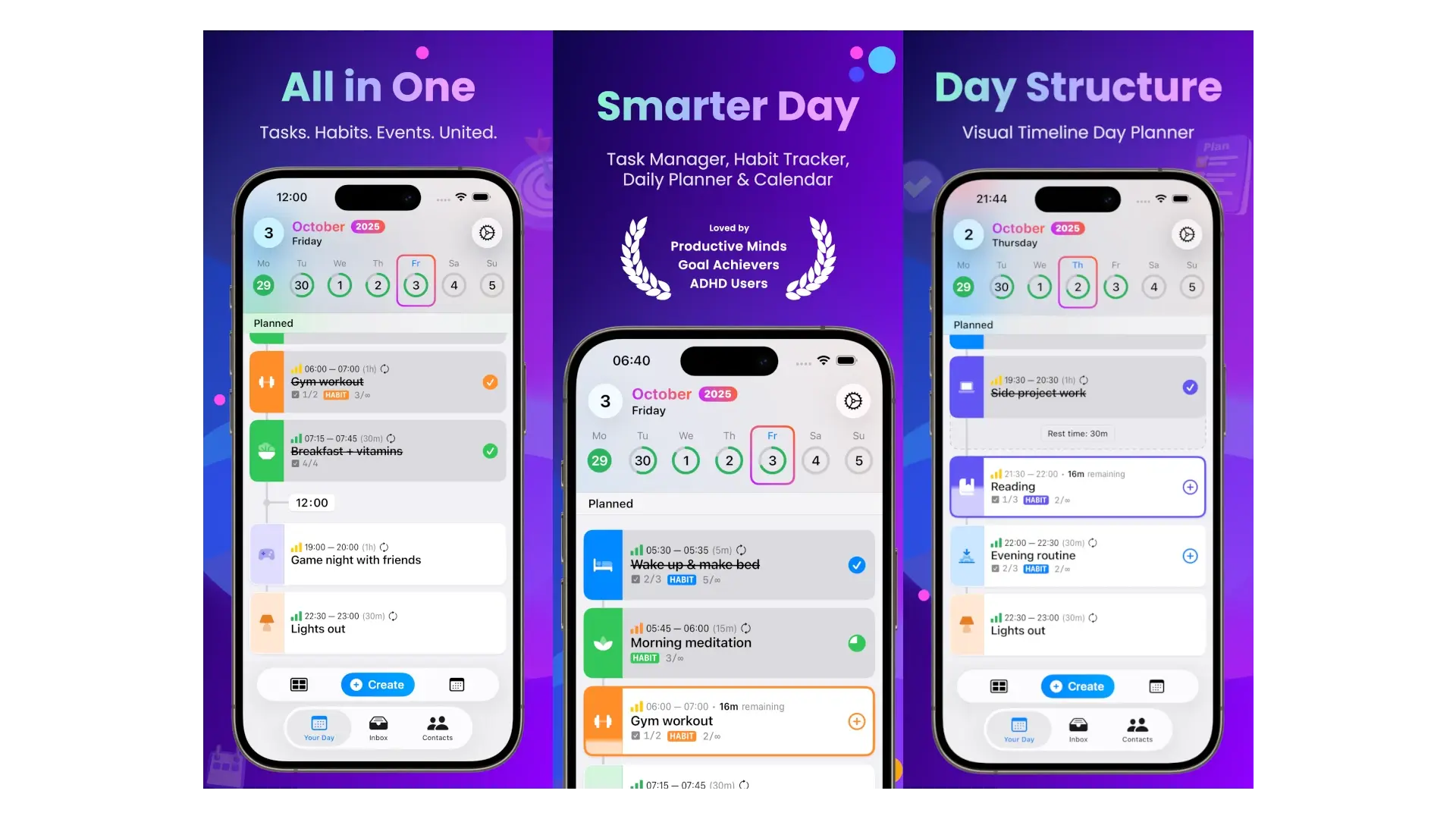
One of the simple ways to centralize tasks, protect focus blocks, and measure progress is to use the productivity app at Smarter.Day. It’s designed to support the methods outlined in this guide—while simplifying your day.
You May Also Like
These Related Stories
High-Impact Time Management: 12 Proven Strategies
10 Proven Time Optimization Tactics for Busy People
No Comments Yet
Let us know what you think