
Time Optimization Tactics for High-Impact Productivity

Time Optimization Tactics for High-Impact Productivity
Introduction
Let’s face it: procrastination, constant pings, and a never-ending to-do list can make even the best of us feel overwhelmed. You start the day with big goals, then noon arrives and your focus is scattered. Here’s the catch—most productivity problems aren’t about willpower. They’re about systems. In this guide, we’ll break down actionable, science-backed tactics for time optimization, focus, and workflow improvement. You’ll learn how to work with your brain, not against it, and build momentum without burning out.
Our goal is simple: give you practical methods you can apply today to increase performance and reduce stress. We’ll cover everything from prioritization and deep work to meeting hygiene and automation. Along the way, we’ll borrow from respected research—think Cal Newport, Daniel Kahneman, and Tiago Forte—and share relatable examples. By the end, you’ll have a toolkit tailored for modern work, whether you’re a leader, creator, or busy professional.
Build a Personal Operating System (POS) for Work
A Personal Operating System ties your tools, routines, and review cadence into a clear workflow. Start with two core methods: a single capture inbox and a weekly review. Capture everything (tasks, ideas, links) into one place—Notes, Notion, or a task app—so nothing lingers in your head. Then, during a weekly review, clarify, prioritize, and schedule your top outcomes. David Allen’s Getting Things Done popularized this approach, which reduces cognitive load and makes prioritization easier.
Next, use time blocking to assign focus, admin, and recharge blocks to your calendar. Cal Newport’s research in Deep Work shows that structured blocks significantly improve cognitive performance. For example, Sam, an agency owner, blocked 8–10 a.m. for strategy, 10–11 for email, and 2–4 for client deliverables. Within two weeks, turnaround times dropped 30%, and stress levels fell noticeably.
Add one more layer: a daily shutdown ritual to plan tomorrow. List 3 most important tasks and close the loop on loose ends. This protects your evening and primes your brain for the next day. Newport calls this a “closure” effect; it helps your subconscious process work in the background without anxiety. It’s a small step with outsized impact on time optimization and workflow improvement.
Prioritize with Clarity, Not Wishful Thinking
When everything feels important, nothing is. Use two methods to simplify: the Eisenhower Matrix (urgent vs. important) and the Impact/Effort Map. The first filters distractions; the second ranks tasks by payoff. Stephen Covey’s work reinforces that “quadrant two” tasks—important but not urgent—drive long-term results. In a quick 10-minute session, you’ll identify what truly moves the needle this week.
For product or project work, try RICE (Reach, Impact, Confidence, Effort) scoring to make objective trade-offs. A Harvard Business Review feature on prioritization frameworks highlights how simple scoring reduces bias and indecision. Mia, a designer, scored feature requests with her PM; they cut low-impact work by 40% and freed time for a high-value accessibility update.
Make prioritization visible. Write a Most Important Task (MIT) list with 1–3 outcomes per day. Keep it in your eye-line—sticky note, whiteboard, or app. By committing your MITs before checking email, you avoid reactive spirals. Over time, this single habit compounds productivity gains without adding complexity.
Protect Deep Work Windows from Digital Drift
Deep work thrives on uninterrupted focus. Two practical methods: schedule 90-minute focus windows and run distraction firewalls. In your focus window, disable notifications, close cycles (email/slack tabs), and use site blockers. Cal Newport’s Deep Work plus Microsoft’s Work Trend Index both show context fragmentation degrades performance and increases time to recover.
If 90 minutes feels heavy, use a 50/10 cadence—50 minutes focused, 10 minutes off—to maintain intensity. Gloria Mark’s research at UC Irvine finds it can take 20+ minutes to refocus after an interruption. Anand, a data analyst, used three 50/10 cycles each morning; he shipped a model update a week faster, simply by guarding attention.
Add a pre-commitment ritual: write your focus goal (“finish section 2 draft”) and a single metric (“500 words”). This anchors intent. For creative work, keep a “parking lot” note for incoming thoughts—capture, don’t context switch. Over a month, you’ll notice clearer thinking, faster completion, and better cognitive performance.
Manage Energy, Not Just Time
Your energy rhythms—not the clock—dictate your best work. Try two methods: ultradian sprints (work in 90-minute cycles, then rest 15) and movement microbreaks every 60–90 minutes. Tony Schwartz’s The Power of Full Engagement shows energy management outperforms raw time tracking for sustained performance. Julia, a developer, paired 90-minute sprints with a 10-minute walk. Bugs fixed faster; afternoon fatigue faded.
Sleep is non-negotiable. Prioritize a consistent sleep window and aim for 7–9 hours. NIH-backed research links sleep to improved memory consolidation and problem-solving. Time caffeine strategically: avoid it within 8–10 hours of bedtime and save your first cup for 60–90 minutes after waking to align with cortisol rhythms.
For a quick performance boost, experiment with NASA’s “power nap” insight—about 26 minutes increased alertness 54% and performance 34% in pilots. Combine with light exposure in the morning and hydration to stabilize energy. The goal isn’t hustle; it’s sustainable output without burnout.
Reduce Context Switching with Task Batching
Context switching is a silent productivity killer. Two methods help: task batching and communication windows. Batch similar tasks—design reviews, administrative tasks, analytics—into dedicated blocks. The American Psychological Association notes switching can cost up to 40% of productive time. Clifford Nass’s Stanford research also found heavy multitaskers performed worse on attention and memory tasks.
Create communication hours—for instance, 11:30–12 and 4–4:30—for Slack and email. Rosa, a recruiter, moved candidate sourcing to a single 2-hour block and limited chat checks. Her pipeline moved faster, and scheduling errors dropped by half. Batching reduces mental friction and speeds throughput.
Use checklists to accelerate repeated contexts: “handoff review,” “invoice send,” “QA checklist.” Checklists reduce cognitive load and error rates, popularized by Atul Gawande’s The Checklist Manifesto. Over time, this leads to measurable workflow improvement and more predictable delivery.
Run Meetings with Intention, Not Habit
Meetings should serve decisions, not calendars. Use two methods: agenda with decision rights and shorter defaults (25/50-minute slots). Require a clear purpose (“inform, discuss, decide”), pre-reads, and named owners. Atlassian’s meeting research estimates unnecessary meetings cost billions in lost productivity annually; trimming time and increasing clarity pays back immediately.
Second, apply No-Meeting Blocks—for example, Tuesdays and Thursday mornings. Omar, a PM, instituted 11–2 as decision-only windows and moved status updates async using a template. Project velocity climbed because stakeholders had more deep work time and fewer interruptions.
Adopt RACI (Responsible, Accountable, Consulted, Informed) for complex projects to avoid ambiguity. Harvard Business Review often highlights RACI’s role in faster decisions. Tie every meeting to a documented next step with owner and deadline. When meetings consistently propel outcomes, attendance drops, but impact rises.
Master Email and Chat Without Losing Focus
Email and chat can devour your day. Try batch processing 2–3 times daily and use triage rules: do (2-minute rule), defer, delegate, delete. McKinsey Global Institute reports knowledge workers spend about 28% of time on email—so even modest improvement is huge. Lena, a consultant, checked inbox at 10, 1, and 4; her response times stayed reasonable, and her morning deep work blossomed.
Build smart filters (VIP senders, clients, action-required) and templated replies for recurring messages. Text expanders for intros, follow-ups, and FAQs save minutes that add up. Gloria Mark’s interruption studies show fewer context shifts reduce stress and improve perceived productivity.
For chat, set status cues (“Heads down 9–11,” “Reviewing 2–3”) and move discussions to threads to prevent notification storms. Use asynchronous updates for status: a short daily standup in a shared doc can replace a meeting and limit reactive chatter. This is time optimization in action.
Set Outcomes with OKRs and Weekly Results
Goals should drive action, not clutter dashboards. Two methods: OKRs (Objectives and Key Results) and a Weekly Results Review. Define a bold objective and 3–5 measurable key results. John Doerr’s Measure What Matters documents how OKRs sharpen focus at Google and beyond. Ken, a sales lead, set KRs on qualified pipeline, conversion rate, and cycle time; his team aligned instantly.
During a weekly review, ask: What moved KRs? What’s blocked? What’s next? Teresa Amabile’s Progress Principle shows small wins fuel motivation and momentum. Translate KRs into leading indicators—the activities that predict results, like demos scheduled or articles published.
Keep goals visible. Use a one-page scoreboard with green/yellow/red status. Review it in five minutes daily. This simple ritual connects your day-to-day tasks with strategic outcomes, improves performance, and prevents drift into low-impact work.
Automate and Template Repetitive Work
Automation is leverage. Start with two methods: no-code automations (Zapier/Make) and text expansion (for boilerplate). McKinsey research suggests about 30% of tasks in many roles are automatable. Priya, an operations manager, linked form submissions to a CRM, triggered checklists, and sent onboarding emails automatically. Onboarding time fell from 3 hours to 30 minutes.
Create SOPs (Standard Operating Procedures) for recurring processes: how to publish content, run QA, or close a sprint. SOPs + templates mean consistency without reinventing the wheel. Store them where the team works—Docs, Notion, or Confluence—and keep them searchable.
Add keyboard shortcuts and snippets for everyday actions. Multiply small time savings across dozens of repetitions and you’ll reclaim hours monthly. Automation isn’t about replacing thinking; it’s about eliminating drudgery to free capacity for high-impact work.
Build a Second Brain for Faster Retrieval
Information is only useful if you can find it. Use PARA (Projects, Areas, Resources, Archives) to organize files and notes, as taught by Tiago Forte in Building a Second Brain. Two methods: save notes within Projects for active work and use Progressive Summarization to bold, highlight, and distill key insights over time. Marco, a researcher, found quotes and stats in seconds instead of hours.
Pair PARA with daily capture: a short note of ideas, decisions, and learnings. Sönke Ahrens’ How to Take Smart Notes explains how linked notes accelerate creativity and writing. Tag by topic and connect ideas with simple links for rapid retrieval.
Keep a knowledge index—a single page with links to your most-used resources, templates, and definitions. Over time, your second brain becomes a competitive advantage, improving workflow and reducing duplication of effort across projects.
Make Faster, Better Decisions Under Constraints
Speed matters, but so does rigor. Use two methods: premortems and decision deadlines. Gary Klein popularized the premortem—imagine the project failed, then list reasons why. You’ll surface risks early. Set a deadline and criteria for the decision to avoid endless analysis. Dana, a marketing lead, cut campaign planning from 3 weeks to 5 days with this combo.
Adopt a two-way vs. one-way decision model (Jeff Bezos). If it’s reversible, decide at ~70% information; if not, gather more. Daniel Kahneman’s work reminds us of cognitive biases; use checklists to mitigate them. For complex choices, run small experiments to test assumptions quickly.
Document decisions in a simple decision log: context, options, chosen path, and why. This creates institutional memory and prevents re-litigating the same questions. You get speed, clarity, and better performance over time.
Protect Recovery and Well-Being to Sustain Output
Sustained productivity requires recovery. Two methods: microbreaks (2–5 minutes every hour) and walking meetings for low-stakes conversations. Stanford research (Oppezzo & Schwartz, 2014) found walking boosts creative output dramatically. Alicia, a team lead, booked afternoon walking one-on-ones; her team reported fresher thinking and better morale.
Create shutdown boundaries: a time you stop work, a quick reflection, and tomorrow’s top 3. This reduces rumination and improves sleep quality. Harvard Business Review often links clear boundaries with lower burnout and higher engagement. Add digital hygiene—dim screens at night, reduce blue light, and silence work apps after hours.
Nurture keystone habits—sleep, movement, and social connection. Track what genuinely restores you: reading, hobbies, family time. When recovery is designed into your schedule, you don’t just get more done—you do it without sacrificing well-being.
Conclusion
Productivity isn’t about squeezing more into your day; it’s about working on the right things, at the right times, with the right energy. Build a personal operating system, protect deep work, prioritize with clarity, automate the repetitive, and recover deliberately. Small, consistent improvements compound into meaningful performance gains.
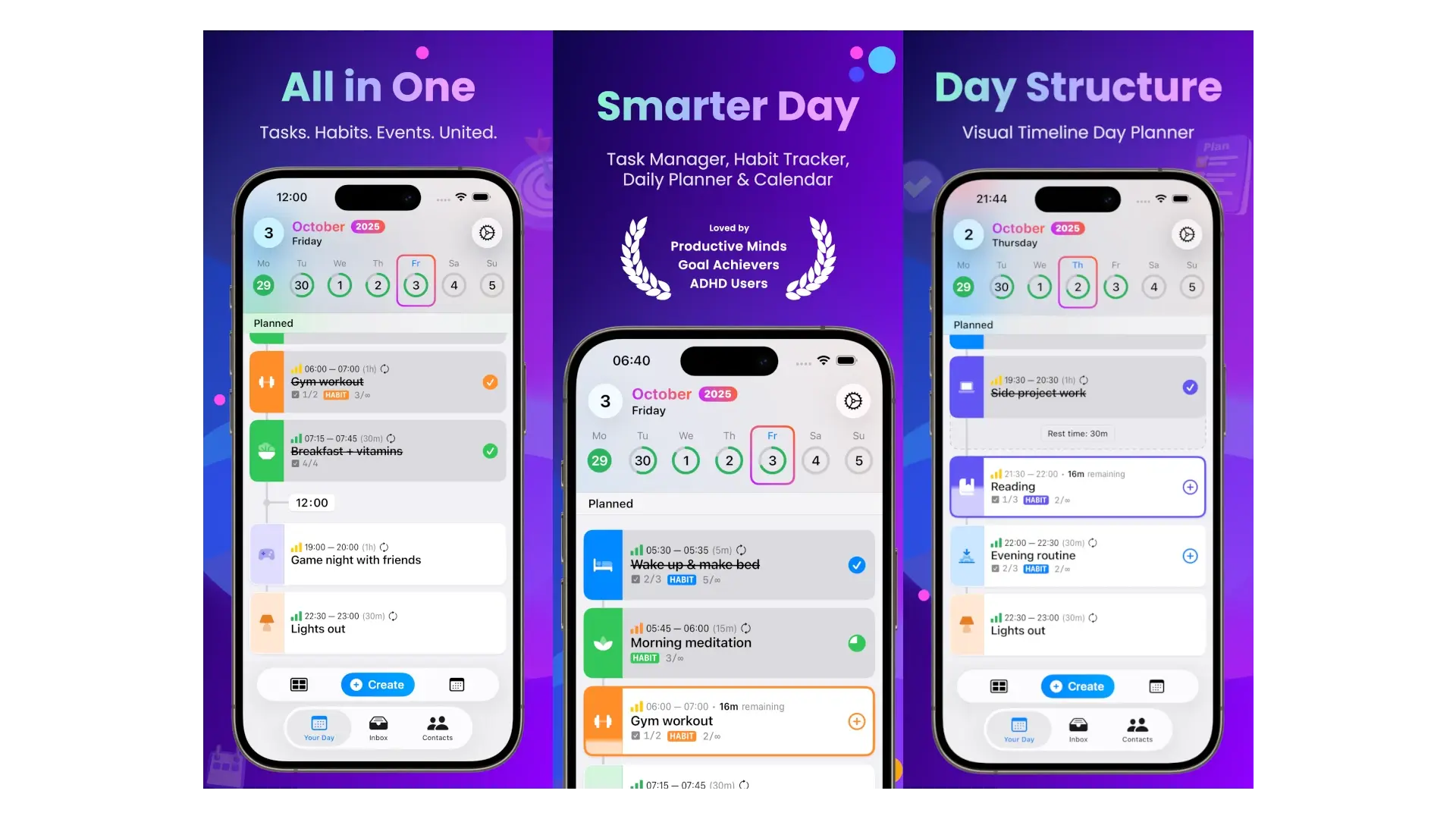
If you’re ready to operationalize these strategies, the productivity app at Smarter.Day can help you implement time blocking, task prioritization, and automated workflows in one place. It’s a practical way to turn today’s insights into tomorrow’s results—without adding complexity.
You May Also Like
These Related Stories
Time Optimization Tactics for High-Impact Productivity
Time Optimization Tactics for High-Impact Productivity
No Comments Yet
Let us know what you think