
10 Proven Productivity Tactics for Peak Performance

10 Proven Productivity Tactics for Peak Performance
We’ve all had those days where the to-do list grows faster than our energy. Notifications ping, priorities blur, and deep work never quite happens. If you’ve felt stuck in that loop, you’re not alone. The modern workplace is designed for distraction, not sustained performance. Here’s the catch: small, deliberate shifts in how we plan, focus, and recover can multiply output without multiplying hours. In this guide, we’ll unpack science-backed productivity strategies that beat overwhelm and help you reclaim momentum.
Our goal is simple: equip you with actionable methods you can apply today. You’ll learn time optimization techniques, habit systems, and workflow improvement tactics anchored in credible research—from Cal Newport’s Deep Work to studies on attention, energy, and motivation. Expect step-by-step methods, relatable examples, and practical tweaks that work in real life, not just on paper. Ready to sharpen your focus and get more done with less stress? Let’s dive in.
1) Time Boxing and Intentional Constraints
When time feels infinite, work expands to fill it. That’s Parkinson’s Law (C. Northcote Parkinson, 1955), and it’s why tasks balloon when your calendar is empty. Time boxing flips the script by assigning a fixed block to a specific task, a technique widely advocated by Cal Newport in Deep Work. The constraint forces clarity and speeds decision-making. You trade vague intentions for concrete time windows, which boosts commitment and reduces context switching. It’s not about working faster; it’s about creating containers that protect your attention.
Try this:
- Block 60–90 minutes for one high-impact task. Give it a name, not a category (e.g., “Outline Q1 strategy,” not “Planning”).
- Use soft and hard stops. A soft stop is your wrap-up alarm; a hard stop is the meeting that follows.
- Add a brief shutdown ritual (Newport) to summarize progress and define your next step.
Real-life example: Leah, a marketing manager, scheduled a 90-minute block to draft a product launch brief. With a hard stop before a team sync, she finished a clean version in one session. Without the boundary, the draft had previously sprawled across three days. The key was constraint by design, not more hours.
2) Habit Stacking and Tiny Starts
Big goals collapse without consistent actions. The fix? Tiny, reliable starts. BJ Fogg’s Tiny Habits and James Clear’s Atomic Habits show that small, sticky behaviors create compounding returns. Pairing a new habit with an existing trigger—called habit stacking—removes friction. Implementation intentions (Peter Gollwitzer, 1999) further strengthen follow-through by specifying when and where the habit will happen. Momentum beats motivation when your systems are clear and easy.
Try this:
- Use the formula: “After I [current routine], I will [new micro-habit].”
- Apply the two-minute rule (Clear): start so small it’s impossible to skip (e.g., write 50 words).
- Track streaks weekly, not daily, to reduce all-or-nothing thinking.
Real-life example: A grad student struggling to write her thesis stacked “Write 50 words” onto morning coffee. On busy days, she kept the tiny target; on good days, the 50 words became 500. By month’s end, she had three solid chapters. Tiny didn’t mean trivial; it meant automatic, which is what behavioral science says sustains progress.
3) Focus Sprints with Recovery
High performance isn’t a marathon; it’s intervals. Research from the DeskTime dataset popularized the 52/17 pattern—roughly 50 minutes of intense focus followed by 15–20 minutes of rest. Paired with Francesco Cirillo’s Pomodoro Technique, and the concept of ultradian rhythms (Ernest Rossi), you get a framework for cognitive performance that respects how the brain cycles energy. The goal is deliberate intensity and active recovery, not grinding until burnout.
Try this:
- Choose a sprint pattern: 50/10, 52/17, or one full 90-minute ultradian cycle.
- Use recovery activities that recharge: a short walk, light stretching, or box breathing.
- Start sprints with a one-line outcome: “By the end, I will have [specific result].”
Real-life example: A software developer did three 50/10 cycles each morning for complex debugging. The breaks—quick laps and hydration—reduced errors and boosted throughput. Over two weeks, bug tickets closed 30% faster. The technique worked because it matched brain energy patterns, validating what performance research has shown for decades.
4) Build a Distraction-Proof Environment
Distractions don’t just steal time; they shred attention. Gloria Mark (UC Irvine) found it can take over 20 minutes to regain full focus after an interruption. Sophie Leroy’s research on attention residue shows part of your mind stays stuck on the last task when you switch. The fix is to engineer your environment for single-tasking. When you reduce leakage, your brain returns to deep work faster, and your output improves without more effort.
Try this:
- Go single-tab for critical work; use full-screen apps to remove visual triggers.
- Set Do Not Disturb and batch notifications at set times.
- Employ site blockers (e.g., Cold Turkey, Freedom) during focus windows.
Real-life example: A copywriter cut her writing time per article from four hours to under three by adopting single-tab mode and scheduled Slack check-ins at :25 past the hour. By protecting cognitive continuity, she reclaimed almost five hours a week. That’s workflow improvement via subtraction, not heroics.
5) Prioritize with Clarity (Not Guesswork)
When everything is urgent, nothing is important. The Eisenhower Matrix helps you separate urgency from importance, while David Allen’s GTD clarifies next actions. For project-heavy roles, the RICE model (reach, impact, confidence, effort) popularized by Intercom gives quantifiable prioritization. The common thread is decision clarity—solving what to do before you try to do it, which saves hours of rework and indecision.
Try this:
- Set a daily Big 3: three outcomes that, if done, make the day a win.
- Run a 30-minute weekly review (Allen) to clean inboxes, plan, and renegotiate commitments.
- Use RICE for multi-stakeholder projects to align expectations transparently.
Real-life example: A product manager drowning in requests implemented a Monday RICE review. Features with low confidence or impact fell off the near-term roadmap. Her team shipped fewer items but delivered higher-impact releases, echoing prioritization principles seen in GTD and product strategy research.
6) Manage Cognitive Energy Like a Pro
Time is fixed; energy is not. Daniel Kahneman distinguishes between fast and slow thinking; the latter (deep analysis) burns fuel. Studies on decision fatigue (Danziger et al., 2011) show quality drops as choices pile up. Sleep research summarized by Matthew Walker links rest to memory consolidation, and John Ratey’s work in Spark connects exercise to BDNF, which supports learning and focus. Treat your brain like a battery and plan work around energy peaks.
Try this:
- Do your most demanding work at your chronotype peak (morning lark or night owl).
- Use protein-rich snacks and hydration to avoid mid-afternoon slumps.
- Add a 10–20 minute brisk walk before heavy cognitive blocks to prime attention.
Real-life example: During tax season, a CPA scheduled complex reconciliations between 9–11 a.m., moved email to 2 p.m., and added a 15-minute walk after lunch. Errors dropped, and review cycles shortened. The method was simple: align tasks with biological rhythms and protect the brain’s best hours.
7) Systemize with Templates and Automation
Let’s face it: repetition kills momentum. The McKinsey Global Institute estimates knowledge workers spend a large chunk of time on email and searching for information. Use automation and templates to compress low-value tasks and free bandwidth for high-impact work. No-code tools (e.g., Zapier), text expanders, and reusable SOPs reduce friction, stabilize quality, and enable faster onboarding.
Try this:
- Build a template library for proposals, briefs, and status updates. Version-control it.
- Create text snippets for common replies and update them quarterly.
- Automate repetitive workflows: calendar scheduling, file naming, and report generation.
Real-life example: A freelance designer packaged proposal, contract, and onboarding emails into templates and set up a Zap that created project folders automatically. Turnaround time shrank from days to hours, and client satisfaction rose. That’s time optimization by eliminating unnecessary choice and keystrokes.
8) Run Meetings Like a Costly Investment
Meetings are expensive by default. Steven Rogelberg’s research (The Surprising Science of Meetings) shows many meetings lack clarity and waste attention. The solution is intentional design: clear objectives, the right attendees, and outcomes captured. Borrow from the “two-pizza” idea—keep them small—and favor asynchronous updates when decisions aren’t needed live.
Try this:
- No agenda, no meeting. Define the decision owner and success metric upfront.
- Default to 25-minute or 50-minute slots to create time boundaries.
- Move status updates to async tools (docs, Loom, recorded walkthroughs).
Real-life example: A distributed team replaced two weekly status meetings with a Friday async update and a single 30-minute decision meeting. Meeting time dropped 40%, and projects moved faster because decisions had clear owners. Research-backed meeting hygiene is pure workflow improvement.
9) Build Learning Loops and Deliberate Practice
Skill growth fuels productivity. Anders Ericsson’s work on deliberate practice (Peak) shows improvement requires focused, feedback-rich reps just outside your comfort zone. Teresa Amabile’s Progress Principle highlights how visible wins drive motivation. The key is to formalize learning loops so each week gets sharper than the last.
Try this:
- Run a 15-minute After-Action Review: What intended? What happened? What will we change?
- Track one leading metric per skill (e.g., draft-to-publish time, sales call talk ratio).
- Use spaced repetition for critical knowledge to combat the forgetting curve.
Real-life example: A sales rep recorded two calls per week, tagged moments of friction, and practiced one micro-skill (e.g., objection handling) for seven days. Close rates improved within a month. Small, targeted loops drove consistent performance gains.
10) Practice Digital Minimalism and Mindful Tech
Modern tools help—or hurt—depending on how we use them. Cal Newport’s Digital Minimalism argues for aligning tech with your values and goals. Screen Time data from major platforms shows how easy it is to lose hours scrolling. The antidote is mindful defaults: limit optional technologies, design your phone to be boring, and create phone-free zones to protect attention.
Try this:
- Do a 30-day digital declutter: pause nonessential apps, reintroduce only those that serve clear purposes.
- Make your home screen utility-only; move social apps to folders or off your phone.
- Set focus modes tied to time blocks (work, deep focus, family).
Real-life example: A startup founder removed social apps from her phone and scheduled two 15-minute check windows on desktop. She regained about seven hours per week, which she invested in strategy and recovery. Minimal tech, maximum cognitive performance.
Conclusion
We’ve covered a full-stack approach to productivity: time boxing, tiny habits, focus sprints, environment design, prioritization, energy management, automation, meeting hygiene, learning loops, and digital minimalism. You don’t need all ten at once. Pick two, apply them for two weeks, and measure the impact. Small changes compound into sustained performance.
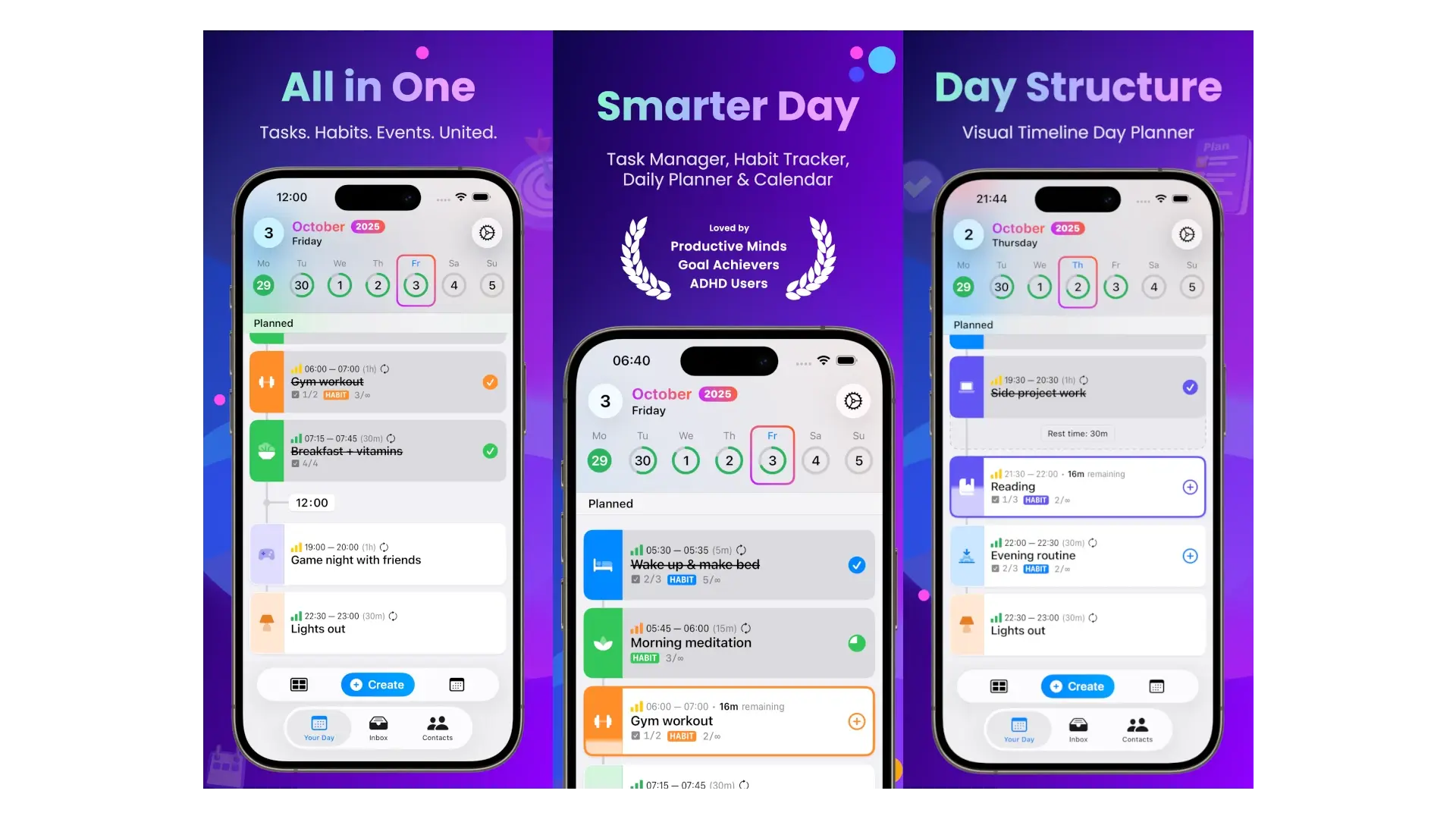
If you want a simple way to orchestrate these tactics—time blocks, habit tracking, and focused work sessions—consider a productivity app like the one at Smarter.Day. Used well, it becomes your command center for time optimization and workflow improvement, without the clutter.
You May Also Like
These Related Stories
10 Proven Productivity Tactics for Peak Performance
Peak Productivity: 12 Proven Strategies for 2025 Success
No Comments Yet
Let us know what you think