
12 Evidence-Based Strategies to Boost Productivity

12 Evidence-Based Strategies to Boost Productivity
It is universally acknowledged that everything is getting out of hand: your to-do list expands in size, the inbox is full, and your attention gets ping-ponged around different tabs. Procrastination is not the same as being lazy, but it usually is an indicator that the priorities are unclear or the task seems too overwhelming. However, the problem is that we can decrease our performance by competing for more. In this article, we will give you the means to simplify and avoid being overwhelmed with the help of actionable, research-backed methods that are the keys to achieving deep focus, enhancing cognitive performance, and developing a reliable workflow you can trust.
You will discover how to timebox your tasks in a way that they stop expanding, how to design Deep Work even in a noisy environment, and how to align your energy with the day's most important outcomes. We will mix hands-on techniques with authority sources—imagine Cal Newport, BJ Fogg, Teresa Amabile, and NASA—so that you can shift from being scattered to focused. If you have been looking for time optimization, workflow improvement, and routines that are stress-resistant and last long, you are exactly where you should be.
Outcome-Driven Prioritization: From OKRs to the 1-3-5 Rule
Base your focus on the end results, not the activities. Set up the OKRs (Objectives and Key Results) for the quarter, and then derive them into weekly goals. There are two methods: the first is the 1-3-5 Rule that you can use every morning—1 main task, 3 medium ones, and 5 small tasks—this way, the day’s form reflects your cognitive capacity. The second one is inversion: consider asking, “By ignoring this, what would I cause to break?” This makes it easy to eliminate nonessential work in a hurry. Peter Drucker's fundamental principle is: “If you can't measure it, you can't manage it,” and with OKRs, you get measurable focus while the 1-3-5 Rule arranges daily activities.
Take Lena as an example, a product designer who is tangled up with stakeholder requests. She aligned her weekly plan to just one Objective—reducing onboarding dropout—which she chose with three Key Results, then she directly mapped the daily 1-3-5 lists to those results. With this shift, she no longer had to run around in a panic as the daily lists showed her the way to what really counted. With more clarity, new workflow improvements presented themselves: fewer low-value tasks, a lot of visible progress, and much less context switching.
You can also avoid the problem of overcommitting by having maximums: no more than three priorities in a week, and no more than one “big rock” every day. Christina Wodtke's “Radical Focus” shows how OKRs flourish with short feedback loops. Preface this with daily “success criteria” that you write yourself: tell what “done” means before you start. This way, your decision-making will sharpen because your brain will see a goal to achieve, not a limitless field of tasks.
Timeboxing and Parkinson’s Law: Make Time Fit the Task
According to Parkinson's Law, tasks tend to use all the available time provided to them. The only solution to this is timeboxing—you need to place a fixed period on your calendar specifically for the task in question and, at the same time, stop working on it when the block ends. Two methods that can be adopted in practice are to set up 90-minute creation blocks for strategic tasks and run 25-minute Pomodoro sprints for quick interventions. You can also set and increment a timer to apply light pressure on yourself. The Pomodoro method, which is still useful, is Francesco Cirillo's invention that constrains the mind; consequently, people will direct their attention to focusing and will avoid such things as overthinking.
Jamal, who is a marketing head, had absorbed significant time increases on his campaign copy fine-tuning. He used two timeboxes: one for drafting (45 minutes) and the other for editing (30 minutes). He even managed to publish earlier without spending more time or sacrificing quality. He was energized by the afternoons when tasks did not overflow their timeframes. That is time optimization functioning.
To incorporate discipline, maintain a “parking lot” for ideas that come to you while you are performing a sprint and add a buffer block every day for the overflow. Write down the next steps to take at the end of every timebox so that you can re-enter seamlessly. Little by little, your brain will master the process: you will begin working fast, meet your deadlines, and escape the perfectionist cycles. You will be able to notice the progress of your throughput because the tasks will no longer take over your day as they used to.
Deep Work Sprints: Engineering Distraction-Free Focus
As Cal Newport describes it, “Deep work” is the ability to concentrate continuously for long periods of time; it is a rare and precious skill. Best practices include creating device-free Deep Work sprints (60–90 minutes) and applying website/app blockers during those windows. Multitasking has a cognitive cost; Stanford researchers found that multitaskers performed worse on tests of attention and task-switching. Findings from Gloria Mark indicate that after an interruption it takes about 23 minutes to regain focus—so protecting attention turns into good rewards.
Mara, a data analyst, arranged her Deep Work at 9–10:30 a.m., placing the phone in another room, pausing Slack, and blocking social and news sites. She turned ambient multitasking to undivided attention, which allowed her to catch up with complex SQL and modeling work in just half the time. With a clear “entry ritual” (tea, single tab, headset), she dropped into flow faster. Her cognitive performance rose because “focus begets focus.”
Set context cues—the same location, the same playlist, the same time—to train your mind. When distractions happen, apply the one-line note: write the exact next step, and then handle the interruption. This “breadcrumb” decreases reactivation time later. Deep Work is not about longer hours; it is about better-quality hours that compile as an output you can meaningfully see.
Energy Management and Ultradian Rhythms
Performance is largely reliant on biology and less on willpower. The findings of Anders Ericsson on the very best people in performance reveal that doing concentrated work in 90-minute periods complemented by breaks is an excellent method of maintaining high quality. Here are two examples that you can apply to your work: the first is to plan the cognitively heavy tasks that you will perform in your peak energy window (morning for many and afternoon for night owls) and the second one is to respect the ultradian breaks, which are 5–15 minutes of walking, drinking, or light exposure after every super-intensive work period. You are setting yourself up with the natural performance rhythms through this process.
Samantha, a senior engineer, moved code reviews and complex problem-solving to the period of 9–11 a.m. and transferred the admin to the low-energy slots. She introduced microbreaks—short walks and stretches—that lasted the time between cycles. In a fortnight, she had fewer bugs and was thinking more clearly as she reported. The NASA nap study is well known for its outcome that a 26-minute nap can benefit alertness and quite considerably improve performance; thus, power napping can be used as an actually effective productivity tool when our energy reserves go low.
In practice, you should run a 2-week energy audit: record your alertness each hour and the quality of output. After that, block the recurring deep blocks into your peak times. For your comfort, you can follow a very easy rule: “When energy is high, do hard things. When energy is low, do light things.” This simple act of rephrasing things saves you from the struggle against your willpower and provides you with a more balanced, humane, and sustainable pace of life.
Micro-Habits and Habit Stacking: Start Tiny, Grow Big
The reasons why habits are formed by prompts and not by motivation can be shown with BJ Fogg’s Tiny Habits framework and James Clear’s work “Atomic Habits,” which emphasize the fact that small wins facilitate an increase of self-concept and success. Two effective ways to do this are: apply the Two-Minute Rule (begin any task in two minutes or less) and habit stacking (tack a new act to the forming routine: “After I brew coffee, I plan my top three”). Minuscule changes act against the friction of competing habits and hence make consistency become the norm.
Priya, who was a customer success manager, had real difficulties in handling daily planning. She implemented a 90-second review into the coffee ritual: check the calendar, select the 1-3-5 priorities, and give the one-line intention for the day. In a month's time, she noticed that her morning anxiety was reduced and that her execution was more reliable. The mantra “Tiny is mighty” holds true since it leads to automaticity—your brain just does not negotiate anymore.
You can also include implementation intentions: if-then statements that predetermine the way you would respond to obstacles. For instance: “If my Deep Work is interrupted, then I’ll reschedule a 30-minute recovery block before 4 p.m.” Such micro-practices minimize cognitive load, avoid decision fatigue, and keep the momentum running. Over time, such minor practices will be your reliable operating system.
Reduce Cognitive Load: Decompose, Limit, and Visualize
When tasks are unspecific, your mind will be frozen. Instead of the ambivalence, task decomposition gives you the clarity. Writing a “Definition of Done” checklist for tricky tasks and applying Work-In-Progress (WIP) limits are two effective strategies for you to have only two active tasks at one time. Sweller's Cognitive Load Theory is a useful reminder that by getting rid of the extraneous load we can then perform better problem-solving.
Alex, a project manager who turned “Prepare client deck” into a 7-step checklist: outline, data pull, visuals, first draft, review, revise, finalize. He also enforced a team WIP limit of two tasks per person. Throughput increased and stress eased because progress was visible. Atul Gawande's “Checklist Manifesto” shows how simple lists improve outcomes in high-stakes environments; the same logic boosts knowledge work workflow improvement.
A Kanban board can help you see your progress: backlog, doing, done. Make each card small enough and name it the next physical action. In this way, you will defeat the “Zeigarnik effect” (the nagging of unordered tasks) by explicitly presenting the state of things and the next steps. Your mind will be free, and action will speed up.
Email and Chat Control: Async by Default
Communication overload only scatters a person's capacity to pay attention. Two of the most practical ways are switching to email/chat batching (check at specific times, such as 11 a.m. and 4 p.m.) and adding filters/templates to routine replies. Turn noncritical push notifications off; calendar and Deep Work blocks let your time be seen as blocked. Research by Gloria Mark shows that the more you are interrupted, the more stress you face and the slower your work is. Hence one should regard attention as a resource that is in short supply.
Diego, the sales lead, has transitioned from “always on” to two 30-minute communication blocks. He made templates for frequent questions and he also created filters for VIP clients. As a result, he was able to quickly respond only where it was necessary and, in the process, he encountered fewer reactive spirals. Within a week of the changes, he grew his time spent on pipeline development by 90 minutes—actual performance gains since there were fewer pings.
Set team norms: response-time expectations by channel, “quiet hours,” and a default to async updates for status. In addition to these examples, subject tags, which give clear indications of the email's purpose like [Decision], [FYI], or [Blocker], should be used. Not only will your team eliminate doubts, but your focus windows will also be untouched.
Decision Automation: Routines, Defaults, and Checklists
Lack of energy kills the momentum of getting things done. Two simple ways to make it happen are to set defaults for typical options and to employ precommitment as a way of locking in good behaviors. Settings such as a workout schedule, a weekly menu, or a pre-set clock for your phone could be defaults. Precommitment can be done by booking a public demo show date or putting a website blocker with a passcode that you don't know. The System 1/2 model created by Daniel Kahneman illustrates that one can retain their willpower for things that are more important given that there are fewer micro-decisions.
The CFO Anya had her mornings automated: the same breakfast, repeating the same review ritual, and sitting in the same deep block. Furthermore, she locked the finance update with a public Friday date, forcing the closure of the Thursday afternoon analyses. By eliminating friction and deciding only once, a person is able to free cognitive space for strategic questions. Automation is not just applicable to code; it also applies to cognitive clarity.
You can use this with checklists for recurring workflows such as monthly reporting, onboarding, or releases. Atul Gawande's study has found that checklists decrease mistakes and increase mental bandwidth. You will spend less time remembering and more time innovating, which is the essence of sustainable workflow optimization.
Meetings That Move Work Forward
Meetings ought to be a tool, not a tax. Two practical methods: create no-meeting blocks (e.g., daily 9–11 a.m.) and enforce agenda-first invites with outcomes and owners. Also, set the Two-Pizza Rule (no more than 2 pizzas) and finish with the ROAM log: Risks, Owners, Actions, and Milestones. Harvard Business Review consistently surveys the real cost of unproductive meetings; structure is the most effective medicine.
A non-profit organization slashed their weekly meeting time by 40% using async updates sent earlier and confining the live session to just decisions. Their Standups pivoted to self-serve check-ins, and the calendar gained visibility. The reward: they had more time to focus on significant, essential tasks and became less “calendar” tired.
To sustain the benefits, it is important to incorporate strict rules for meeting types: decision meetings (max 30 minutes), design reviews (pre-reads mandatory), and office hours (drop-in time to protect Deep Work). This way you will ensure that the meetings are turned into outcome engines rather than attention sinkholes.
Feedback Loops and Progress Tracking
The development of progress gives power to motivation. The Progress Principle, which was discovered through the research of Teresa Amabile, states that small wins generate big emotional benefits and continuous effort of work. There are two doable techniques: run a daily shutdown ritual (log accomplishments, capture open loops, define tomorrow’s top three) as well as a weekly review, which should be done to keep you aligned with OKRs. The weekly review was popularized by David Allen in GTD, as it clears mental clutter and reinforces the trust in your system.
Tasha, a UX researcher, started jotting down three wins each day and doing a review of her week every Friday. She would connect her wins to Key Results; thus, the momentum stayed aligned with goals. In just a month, not only did she feel calmer but also shipped more studies since she was able to see progress quickly. Visibility drives motivation, which drives output.
Record leading indicators (those that you control) together with the lagging outcome indicators: total pages written, the number of emails sent for outreach, or hours spent in Deep Work. This is a way to transform effort into lessons learned and lessons into a better strategy. Eventually, you’ll get a feedback-rich loop that compiles.
Environment Design: Friction for Distraction, Flow for Work
Your environment is either a trigger for focus or a distractor. Here are two pragmatic approaches: bring friction to time-wasters (uninstall social apps from your phone, log out after each session) and lessen friction for essential work (one-click access to your focus tools, single-purpose browser profile). The author suggests that the best method to bring about behavior changes is to arrange your environment in such a way that you have easy access to choices that are good for you and difficult alternatives to those that are bad for you: “Make the good choices easy and the bad choices hard.”
Elena, the remote developer, created a Build profile (without any bookmarks apart from the documentation, IDE, and tracker) and a Browse (personal) profile. Another thing she did was to keep her phone in another room during the sprint and make her task list within arm’s reach. What was the effect? A perfect flow state with fewer “quick checks” that turned into wasted hours.
Consider modes: a thinking desk for deep work, a meeting station for calls, and a planning corner for reviews. The fact that they are both physically distinct serves as a mental cue. Add cues—a lamp, a playlist, or a notebook—to signal intent. Your brain will automatically follow the pathway of least resistance you have meticulously designed.
Recovery, Sleep, and Stress Resilience
Being realistic: when one is tired, that person will choose more slowly. Two workable methods: guard consistent sleep (a regular bedtime, getting morning light, and sleeping in a dark, cool room) and implement stress resets during the day (box breathing, 5-minute walks, or a 10-minute nap). Matthew Walker, in his book “Why We Sleep,” points out that the quality of sleep affects learning, memory, and solving problems—the main factors in optimal cognitive performance.
Arjun, the startup head, established a ceiling on screen time and slotted a warning/alert for shutting down at 10 p.m. He included a 3 p.m. walking break and an occasional 20-minute nap on heavy workload days. He realized the benefits of cleaner thinking and greater regulation a few weeks after he introduced these changes. The NASA nap research indicates short naps are powerful, simple tools for the alertness boost; just see them as a strategic reset, not a pejorative waste of time.
Add a shutdown ritual phrase—“Work is parked. Recovery begins.”—to mark the boundaries as clearly as possible. You may use active recovery such as exercise, hydration, and no screen time. Sustainable productivity is in cycles that include the load and the unload, which then need to adapt. By maintaining the cycle, you will ensure that your best work is also preserved.
Conclusion
The real essence of productivity lies not in trying to fit more and more into each hour but in your focus, energy, and systems being in line, which results in your best work coming out inevitably. The methodologies from OKRs and timeboxing to Deep Work sprints and habit stacking work quite a bit in the ways they change aimless curiosity to a definite constructive system. Commence with the smallest step, keep track of development, and make alterations as you proceed.
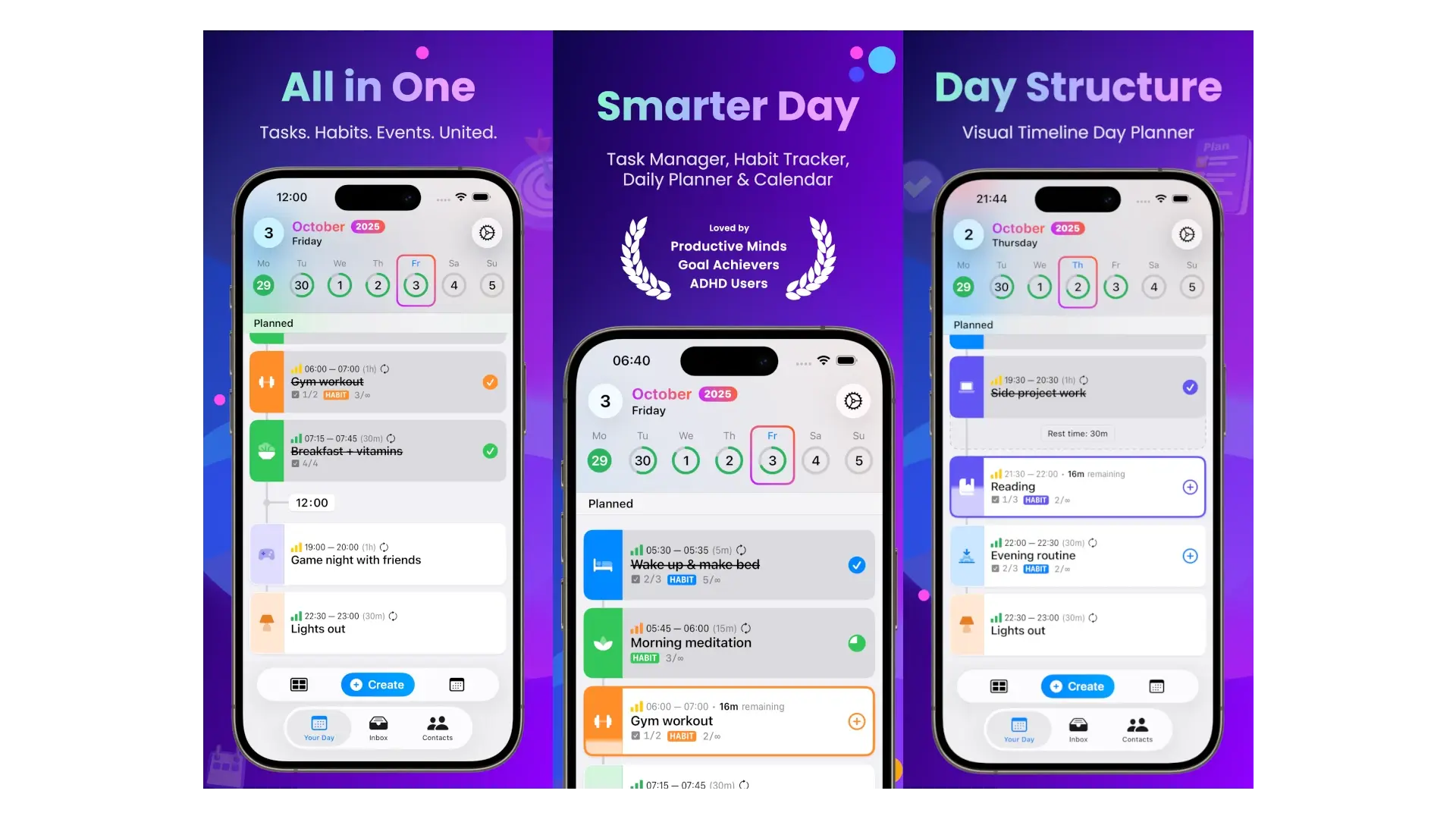
Should you be searching for a single site to schedule your priorities, plan your Deep Work, and reflect with concise feedback loops, then look into the productivity app at {URL}. It is a handy addition to the whole guide, assisting you in maintaining your performance and quality of the work, and also in clarifying your steps.
Is it time to shift from being busy to being effective? Visit {URL} to create your personal focus system and deliver on significant work every day.
You May Also Like
These Related Stories
Boost Focus with Science-Backed Productivity Methods
Boost Focus with Science-Backed Productivity Methods
No Comments Yet
Let us know what you think