
12 Evidence-Backed Ways to Supercharge Productivity

12 Evidence-Backed Ways to Supercharge Productivity
Introduction
Let’s face it—procrastination, endless tabs, and calendar overload make modern work feel like a maze. Have you ever noticed how a single ping derails an entire afternoon? You’re not alone. Studies show chronic context switching drains attention and motivation, creating an illusion of busyness without meaningful output. Here’s the catch: we don’t need more hours—we need better systems. In this guide, we’ll walk through actionable, evidence-based strategies to improve time optimization, deepen focus, and streamline your workflow.
We’ll blend research-backed methods with real-life examples you can copy today. You’ll learn how to prioritize with confidence, block time effectively, manage energy instead of just minutes, and automate the boring parts. Expect clear steps, practical tools, and expert insights to help you create a reliable productivity engine. Ready to move from overwhelm to momentum? Let’s build it—one small, strategic change at a time.
1) Prioritize What Matters With Decision Filters
When everything is important, nothing is. The Eisenhower Matrix, popularized by Stephen Covey, helps you distinguish urgent vs. important tasks so you stop firefighting and start leading. Complement it with the Ivy Lee Method: list six tasks, order by priority, and complete them sequentially the next day. Both curb decision fatigue and turn big goals into daily wins. As Gary Keller writes in The One Thing, focusing on the vital few is the fastest path to extraordinary results.
Practical methods:
- Use a daily top-three from your Eisenhower “Important, Not Urgent” quadrant.
- Apply Ivy Lee’s six and set WIP limits: never work on more than one deep task at a time.
- Add a quick effort vs. impact score (1–5 each) to pick the highest-leverage tasks fast.
Example: Ana, a product manager, triaged her backlog with the matrix and scheduled her Ivy Lee six each night. Within two weeks, she delivered a critical roadmap update early and cut after-hours work by 30%. She reported more control and fewer “urgent” surprises.
2) Time Blocking and Task Batching for Flow
Cal Newport’s Deep Work emphasizes protected, distraction-free blocks for cognitively demanding tasks. Pair this with task batching—grouping similar tasks like emails, approvals, or design reviews—to reduce switching costs. Remember Parkinson’s Law: “Work expands to fill the time available.” Constrain your blocks and add buffers to maintain speed without chaos. This structure improves consistency and predictability across your week.
Practical methods:
- Block two 90-minute deep work sessions for your highest-impact tasks; put admin in 30–45-minute batches.
- Schedule buffer time after deep work for quick recovery and light tasks.
- Use meeting-free mornings twice a week to protect your sharpest focus hours.
Example: Dev, a software engineer, reserved 8:30–11:30 a.m. for deep work and batched code reviews after lunch. After a month, cycle time dropped by 22% and bug rates fell. He said the simple rule “no meetings before noon” felt like a superpower.
3) Manage Energy Using Ultradian Rhythms
Productivity is not just time management—it’s energy management. Research by sleep pioneer Nathaniel Kleitman shows we operate in 90–120-minute ultradian cycles of peak and trough. Daniel Pink’s book When also finds most people perform their best analytic work in the morning peak. Align high-cognitive tasks with peaks and use troughs for admin and recovery. You’ll maintain sustained performance without burnout.
Practical methods:
- Perform an energy audit: track your hourly energy for a week; cluster deep tasks at peak times.
- Work in 90-minute sprints followed by 10–15-minute restorative breaks (movement, light, hydration).
- Use break types strategically: social micro-breaks for mood, quick walks for alertness, and screen-free pauses to reset.
Example: Priya, a sales lead, noticed her peak from 9–11 a.m. She scheduled proposals then and used 2:30 p.m. slumps for CRM updates. Quota attainment improved, and afternoon fatigue dropped. She credits “the right task at the right time” for consistent momentum.
4) Attention Management: Guardrails Against Distraction
According to researcher Gloria Mark (UC Irvine), interruptions can push recovery time to 20+ minutes, and frequent task switching increases stress and frustration. Attention is a limited resource—treat it like one. Build distraction guardrails so you can enter and maintain flow. “We don’t rise to the level of our goals; we fall to the level of our systems.”
Practical methods:
- Keep a distraction capture list beside you; write the thought down and keep working.
- Use website/app blockers during deep work and silence notifications by default.
- Implement the 3-swipe rule: if a task takes more than three app switches to start, simplify the path.
Example: Marco, a designer, set Focus mode on his phone, blocked social sites 9–12, and kept a jot list for ideas. His project lead noted faster iteration cycles and fewer context-switch errors. Marco said the capture list “turned noise into a queue.”
5) Habit Stacking and Tiny Wins
Behavior scientist BJ Fogg shows in Tiny Habits that small, easy actions, attached to existing routines, scale into reliable habits. James Clear’s Atomic Habits reinforces the power of habit stacking and environment design. Instead of willpower contests, change the default. Make the desired action obvious and frictionless, and celebrate small wins to reinforce identity.
Practical methods:
- Stack habits: “After I brew coffee, I open my daily plan and choose my top three.”
- Use temptation bundling: pair a desired habit (walk) with a treat (podcast).
- Put tools in sight: one-click doc templates, a pre-filled task list, and a dedicated focus playlist.
Example: Lina, a writer, stacked “open outline” after morning tea and allowed herself her favorite playlist only during drafting. Output rose from one to three solid articles weekly. The ritual made starting effortless and lowered anxiety.
6) Goals That Guide Your Week: OKRs and 12-Week Sprints
Goals only help if they translate into action. OKRs (Objectives and Key Results)—championed by John Doerr—make outcomes measurable and visible. Combine this with the 12-Week Year (Brian Moran) to create urgency and faster feedback loops. Shorter cycles reduce wishful thinking and increase focus on what actually moves the needle.
Practical methods:
- Write one quarterly Objective and 3–4 Key Results with numeric targets.
- Plan 12-week sprints with weekly scorecards and a 30-minute review every Friday.
- Use a lead vs. lag metric: lead for behaviors (outreach/day), lag for results (revenue).
Example: A boutique agency set “Increase qualified leads by 40% in 12 weeks” with KRs around outreach, landing page speed, and demos booked. Weekly reviews trimmed low-yield tactics. Pipeline volume grew 47%—close enough to validate the system.
7) Tame Email and Chat: Communication Hygiene
A University of British Columbia study (Kushlev & Dunn) found checking email less frequently reduces stress. Constant inbox grazing kills focus. Treat communications like work to be batched and bounded. Make it easy for others to help you with clear subjects, decision prompts, and default response windows. You’ll reduce back-and-forth and protect your best hours.
Practical methods:
- Set two to three email windows (e.g., 11:30 a.m., 4:30 p.m.); turn off push alerts.
- Use subject line templates: [Action Needed], [FYI], [Decision by DATE].
- Apply a two-minute triage: archive, delegate, schedule, or do.
Example: Rhea switched to two inbox checks and created canned responses for frequent asks. Team SLAs were posted in Slack. Within a month, she reclaimed 5+ hours weekly and reported less “notification anxiety.”
8) Make Meetings Worth the Cost
Meetings are expensive. Amazon’s two-pizza rule and Jeff Bezos’s silent memo reading aim to improve clarity and decisions. Research on “meeting recovery syndrome” shows poorly run meetings sap energy long after they end. If the outcome isn’t clear, cancel or convert to asynchronous updates. When meetings are necessary, design them like a product.
Practical methods:
- Require an agenda with outcomes and assign a decision owner.
- Timebox segments: 10 minutes context, 15 discussion, 5 decisions; end with a decision log.
- Protect no-meeting blocks for deep work, and use async docs for status updates.
Example: A product trio replaced their weekly status call with a shared doc and kept only decision meetings. Cycle times improved and stakeholders praised the clarity. “No agenda, no meeting” became a cultural norm.
9) Automate Repetitive Work With Tools and AI
McKinsey estimates that automation and AI could deliver significant productivity gains across knowledge work. The goal is workflow improvement, not novelty. Start with repetitive, rules-based tasks and expand to AI-assisted drafting and analysis. Free your brain for judgment and creativity—the work only humans can do.
Practical methods:
- Build no-code automations (e.g., form → spreadsheet → Slack notification → task).
- Use text expanders for common replies and snippets.
- Let AI create first drafts, summaries, or action lists, then edit for accuracy and tone.
Example: Omar automated client intake: a form triggered a CRM entry, welcome email, and task creation. With AI drafting proposals from a template, he cut admin by 6 hours per week and shortened proposal turnaround to 24 hours.
10) Review, Reflect, and Iterate
Progress fuels motivation. Harvard’s Teresa Amabile calls it the Progress Principle—even small wins boost engagement. A weekly review consolidates learning, celebrates wins, and resets priorities. Add a shutdown ritual (per Cal Newport) to transition from work to life, reducing stress and improving next-day readiness. Reflection turns experience into systems.
Practical methods:
- Run a Friday 30: wins, blockers, priorities; update your next week’s top three.
- Keep a daily 3-bullet log: one win, one learning, one improvement.
- Use a simple dashboard (lead/lag metrics) to guide decisions, not just record them.
Example: Jo, an operations lead, ended each day with “win/learning/next step” and did a Friday review. Within a quarter, their team’s on-time delivery rose to 96%. Jo said the ritual “made improvement inevitable.”
Conclusion
We’ve covered a practical toolkit: prioritization filters, time blocking, energy-aligned work, habit stacking, and automation—all anchored by reviews that keep you honest. The real shift happens when you apply two or three methods consistently and let them compound. That’s where performance and well-being finally align.
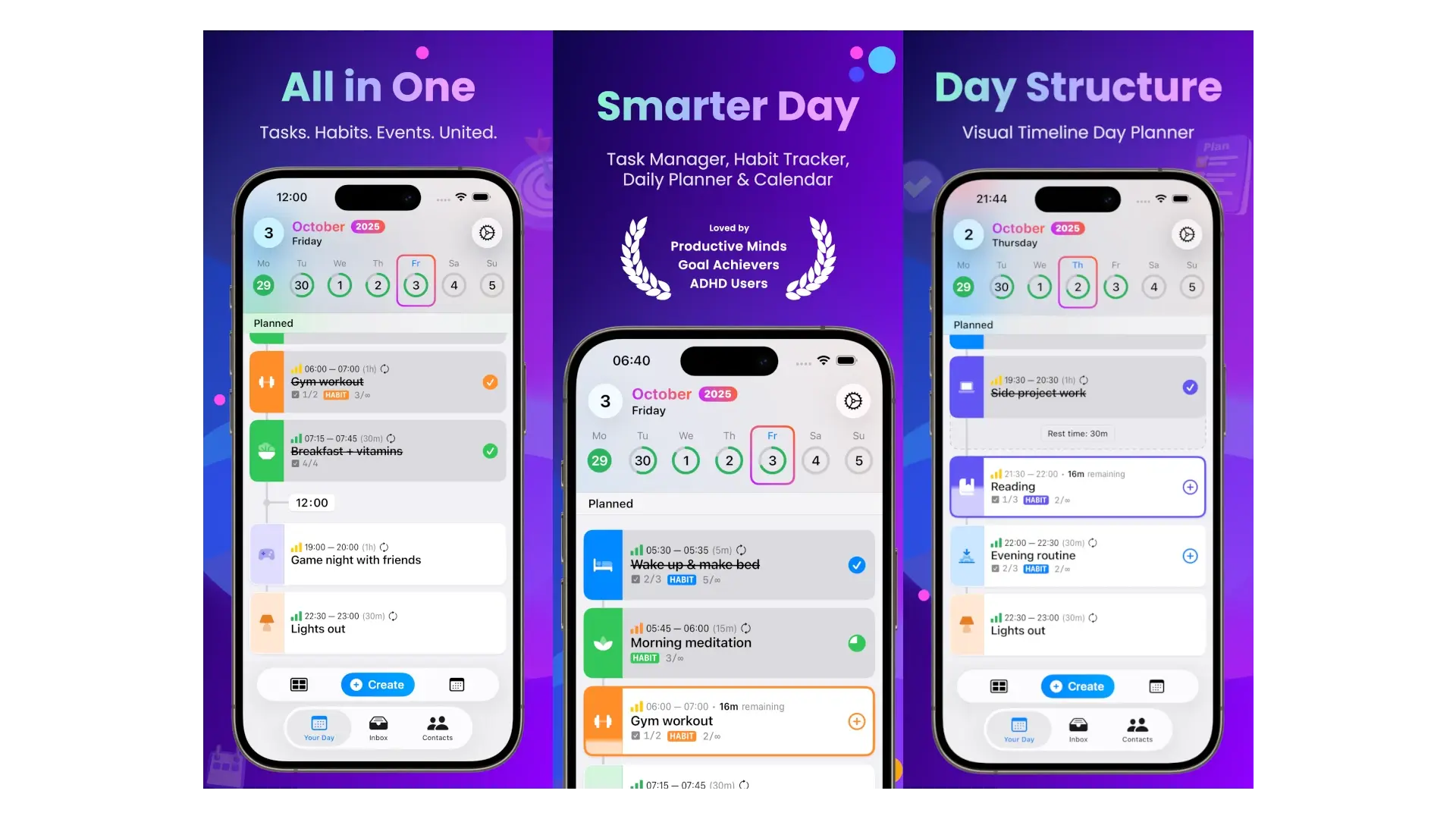
If you want a single place to plan, block time, automate admin, and reflect without juggling apps, try the productivity app at Smarter.Day. It can help operationalize the systems above with less friction and more reliability.
You May Also Like
These Related Stories
12 Evidence-Backed Ways to Supercharge Productivity
Advanced Time Management: 10 Proven Productivity Wins
No Comments Yet
Let us know what you think