
12 Evidence-Based Ways to Boost Daily Productivity

12 Evidence-Based Ways to Boost Daily Productivity
We all know the feeling: the day starts with good intentions, then meetings multiply, emails pile up, and your to-do list metastasizes. By 3 p.m., your brain feels like a browser with 47 tabs open. Here’s the catch—productivity isn’t about cramming more into your schedule; it’s about time optimization and workflow improvement that help you do the right things at the right time. In this guide, you’ll discover evidence-based strategies that reduce overwhelm, tame procrastination, and boost focus without burning out.
Our goal is straightforward: give you actionable methods—not fluff—that you can apply today. You’ll learn how to structure your day, defend your attention, and leverage tools that upgrade performance. Each section blends practical tactics, real-world examples, and references to credible experts and studies. Ready to boost your focus and reclaim your time? Let’s dive in.
Time Blocking and Task Batching for Peak Efficiency
If your calendar is a patchwork of tiny commitments, time blocking can be a game changer. Reserve 60–120 minute blocks for deep work, and group similar tasks into task batches—emails together, design together, admin together—to reduce switching costs. A Stanford study by Ophir, Nass, and Wagner found heavy media multitaskers perform worse on attention tasks, reinforcing why batching similar work helps. For example, Priya, a marketing lead, moved from all-day pings to two email batches and two deep work blocks daily; her turnaround time improved and stress dropped.
Two practical methods: first, create theme days (e.g., Tuesday for planning, Thursday for content) to keep context stable. Second, protect focus blocks with a visible status like “Heads-Down” in Slack. Cal Newport, author of Deep Work, argues that long, uninterrupted stretches are essential for cognitively demanding tasks. “Clarity about what matters provides clarity about what does not.” Batching gives you that clarity and preserves energy for high-value work.
Try a weekly planning routine to allocate your blocks in advance. Start by listing priorities, estimate durations generously, and assign blocks. Leave buffer blocks for unexpected needs—because emergencies happen. When Priya added a daily 30-minute buffer, she stopped bleeding into evenings. Over time, these focus rituals become routine, and your calendar tells the story of a week designed for performance, not firefighting.
The Eisenhower Matrix and Ivy Lee Method in Tandem
The Eisenhower Matrix helps you sort tasks by urgency and importance, while the Ivy Lee Method forces decision clarity: write your top six tasks for tomorrow in order of importance, and tackle them one by one. Dwight Eisenhower’s framework prioritizes what matters most; Ivy Lee’s century-old technique (popularized in 1918) keeps your prioritization tight. For example, Omar, a sales manager, uses the Matrix on Fridays and chooses his top six Ivy Lee tasks nightly. He closes the quarter with fewer surprises and better follow-through.
Two methods to try today: first, designate a 15-minute “priority triage” each afternoon to keep the next day focused. Second, limit your daily must-do list to 3–6 items; James Clear notes constraints increase focus by forcing trade-offs. HBR research also shows that workers who proactively prioritize experience less stress and better outcomes than those who react to urgent tasks alone. “What is important is seldom urgent,” the Eisenhower adage reminds us.
Use a simple quadrant: Important-Urgent, Important-Not Urgent, Not Important-Urgent, Not Important-Not Urgent. Move anything non-important off your plate through delegation or deletion. Omar reduced his “Not Important-Urgent” load by assigning routine follow-ups to an assistant with a clear SLA. The result: more time for strategic relationships and less context chaos. Your calendar will breathe again.
Deep Work, Attention Residue, and Single-Tasking
Attention residue—the mental carryover from switching tasks—erodes focus. Sophie Leroy’s research shows that unfinished tasks leave a cognitive footprint that reduces performance on the next task. Solution: single-tasking in protected deep work blocks, with a clear shutdown ritual between tasks. For instance, Elena, a data scientist, writes a one-sentence “next step” before switching contexts; it empties her mind and speeds re-entry. Cal Newport’s Deep Work advocates for this kind of focus architecture.
Two methods: adopt the Pomodoro Technique (25/5 cycles) for lighter tasks and 90-minute “ultradian” cycles for heavier work. Also, remove micro-distractions: silence notifications, use website blockers, and keep one tab per task. A 2009 Stanford study shows multitasking hinders performance; single-tasking recovers cognitive bandwidth. “If you don’t produce, you won’t thrive,” Newport writes—so design your environment to produce.
Create a “start gate” and “stop gate” routine: a checklist to launch deep work (clear desk, notes open, blocker on) and a quick review at the end (capture next step, archive links). Elena reported a 30% faster model iteration cycle after using gates. When attention residue fades, the mind settles—and cognitive performance rises.
Align Work with Energy: Chronotypes and Ultradian Rhythms
Not all hours are equal. Aligning tasks with your chronotype (your biological timing) and the ultradian rhythm (90–120 minute cycles) can dramatically improve output. Daniel Pink’s book When summarizes research showing most people peak mid-morning, dip in the afternoon, and rebound later. Meanwhile, sleep researcher Nathaniel Kleitman highlighted ultradian cycles; world-class performers often practice in focused blocks with breaks (Anders Ericsson). Maya, a designer, shifted her creative sprints to 9–11 a.m. and admin to 2–3 p.m.; her quality and speed improved.
Two methods: map a week of your energy highs/lows, then slot work accordingly. Second, schedule recovery microbreaks every 90 minutes—walk, breathe, hydrate. A study by K. Anders Ericsson suggests elite performers rely on deliberate practice cycles with rest intervals. Don’t fear breaks; they amplify your time optimization by preserving cognitive fuel.
Protect sleep as your non-negotiable productivity tool. Aim for consistent bed and wake times; limit blue light and caffeine late. The American Academy of Sleep Medicine links sleep to executive function and memory. Maya’s change from late-night scrolling to a 10 p.m. cutoff added an extra hour of sleep, cutting rework the next day. Energy management isn’t fluff; it’s your operating system.
Tiny Habits that Scale: Two-Minute Rule and Habit Stacking
Big changes stick when they’re small. The Two-Minute Rule—if a task takes under two minutes, do it now—clears friction. Pair it with habit stacking (“After I brew coffee, I plan my day”) to build reliable routines. James Clear’s Atomic Habits explains why cue–routine pairings hardwire behavior. For example, Rafael, an engineer, stacked “Open IDE” after his daily standup; then used a two-minute “stub the function” action to beat inertia. The small start made big projects feel approachable.
Two methods: design “starter steps” that are absurdly easy (open the doc, write the title, list three bullets). Then, pre-commit to a minimum viable session—five minutes often becomes 45 once you begin. BJ Fogg’s Tiny Habits supports the idea that celebration and simplicity reinforce behavior. “Make it easy; make it obvious; make it satisfying.”
Keep a running “two-minute queue” for quick wins you can slot between larger work. Rafael clears his queue during buffer blocks, preventing clutter from hijacking deep work time. Over weeks, these micro-actions compound into noticeable workflow improvement. Small hinges swing big doors.
Email and Messaging: Reduce Digital Drag
Email and chat can eat your day. The McKinsey Global Institute found workers spend about 28% of their week on email. Adopt inbox batching (two to three windows daily) and the 3-2-1 rule: three canned responses, two folders (Action, Archive), one weekly cleanup. Use asynchronous communication for non-urgent topics to protect deep work. For example, Lila, a consultant, shifted status updates to a weekly memo; her team’s Slack traffic dropped by 40%.
Two methods: create templates for frequent replies, and use subject line protocols like [Action], [FYI], [Decision] to set expectations. Merlin Mann’s “Inbox Zero” isn’t about zero messages—it’s about decision speed. “Delete, delegate, defer, or do” in under 60 seconds. That clarity returns hours to your calendar.
Add friction to compulsive checking: turn off badges, set VIP filters, and park email on the second screen so it’s out of sight. Lila’s rule—no email before 10 a.m.—saved her first deep work block. Research on attention switching shows even brief checks disrupt flow; protect your cognitive edges and your output will follow.
Make Meetings Productive or Make Them Disappear
Meetings aren’t bad—bad meetings are. HBR’s “Stop the Meeting Madness” reports that executives spend nearly 23 hours a week in meetings, many of them low value. Institute meeting-free blocks (e.g., mornings Mon–Thu) and require an agenda with owner and desired outcome. If no outcome, no meeting. Jonah, a product lead, reduced weekly meetings from 18 to 11 by consolidating updates and using async briefs; his team shipped faster.
Two methods: adopt the two-pizza rule (keep groups small) and start with a written brief so thinking precedes talking. Jeff Bezos championed silent reading time; it raises the baseline quality of discussion. “No agenda, no attenda,” as the saying goes—guardrail your time.
Clarify roles with RACI (Responsible, Accountable, Consulted, Informed) and end with decisions, owners, and deadlines. Jonah’s 25-minute cap for routine syncs forced focus and cut tangents. A study in Organizational Dynamics shows that structured agendas and clear decision rights improve outcomes and satisfaction. Design meetings like sprints; keep them lean and purposeful.
Externalize Your Brain: GTD, Second Brain, and Zettelkasten
Your mind is for having ideas, not holding them. David Allen’s Getting Things Done (GTD) advocates a capture–clarify–organize system that empties your head and reduces stress. Pair it with Building a Second Brain (Tiago Forte) or Zettelkasten (Niklas Luhmann) to store notes and ideas you can actually reuse. Aisha, a researcher, moved references and insights into a connected notes system; drafting literature reviews became twice as fast.
Two methods: maintain a universal inbox (paper or digital) to capture everything, then process it daily. Also, link notes by concept, not just by folder, to surface serendipitous connections. Luhmann produced 70+ books using his slip-box approach; linking ideas multiplies their value.
Create clear buckets: Projects, Areas, Resources, Archive (the PARA method from Forte). Aisha’s weekly sweep sorts tasks into Projects and insights into Resources; when writing, she pulls a ready-made outline from linked notes. Cognitive load drops because the system remembers; you can think instead of juggle. That’s workflow optimization at its best.
Automate the Mundane: Templates, Shortcuts, and RPA
Automation isn’t just for coders. Start with text expanders for common phrases, keyboard shortcuts for navigation, and templates for reports or proposals. For repetitive digital steps, tools like Zapier or native workflow automations can handle handoffs. Deloitte’s Global RPA Survey reports significant time savings and accuracy gains from routine automation. Carlos, in operations, automated CSV imports and status emails; he reclaimed five hours weekly.
Two methods: run a time audit for one week and flag steps repeated 10+ times—prime candidates for automation. Then, centralize reusable assets: slide decks, checklists, and email scripts. The payoff compounds; each reuse increases time efficiency.
Pilot automations with low-risk processes first, measure outcomes, then scale. Carlos set a key metric—error rates—and saw a 70% reduction post-automation. Keep humans in the loop for exceptions and quality checks. As Andrew Ng says, “AI is the new electricity”—but even simple automation lights up your day.
Beat Procrastination: Commitment Devices and Implementation Intentions
Procrastination is often a design problem, not a character flaw. Piers Steel’s The Procrastination Equation synthesizes decades of research: we delay when tasks feel low-value, late-rewarded, or hard. Use commitment devices (public deadlines, deposit contracts on StickK) and implementation intentions (“If it’s 9 a.m., then I open the brief”) to reduce friction. Noor, a grad student, pledged $50 per missed writing session and used “if-then” cues; her weekly output doubled.
Two methods: shrink the task to a five-minute gateway and pair it with a visual progress tracker. Peter Gollwitzer’s work shows implementation intentions boost follow-through by pre-deciding actions. “When situation X arises, I will perform response Y”—simple and powerful.
Engineer immediate rewards: co-work with a friend, or allow your favorite playlist only during tough tasks. Behavioral economics teaches that immediate incentives beat delayed ones. Noor celebrated each 500-word milestone with a micro-reward; motivation snowballed. Build a system that makes the next right action the easiest one.
Review Rituals: Daily Shutdown and Weekly Planning
Without a review habit, priorities drift. Try a daily shutdown routine—capture open loops, set tomorrow’s top three, and close your apps. Cal Newport argues shutdown rituals reduce evening rumination and improve rest. Pair this with a weekly review to update projects, plan time blocks, and surface risks. Diego, an engineering manager, used a Sunday 45-minute review; his team sprints became smoother and on-time delivery improved.
Two methods: keep a Kanban board (To Do, Doing, Done) and schedule recurring review prompts. David Allen’s GTD Weekly Review checklist—get clear, get current, get creative—remains gold. “Your mind is for having ideas, not holding them,” Allen reminds us; reviews keep the system trustworthy.
Use a simple doc template for your weekly plan: wins, lessons, focus, risks, and commitments. Diego shares his with his team for alignment and accountability. Over time, these planning rituals reduce surprises and sharpen your prioritization instincts. The future gets less fuzzy when you look at it on purpose.
Protect the Asset: Sleep, Movement, and Mindfulness
Productivity is a health strategy in disguise. Prioritize sleep, regular movement, and mindfulness to sustain cognitive performance. John Ratey’s book Spark shows exercise boosts attention and learning via neurochemical changes. A 2014 JAMA Internal Medicine review found mindfulness meditation can improve anxiety and stress. Lara, a UX lead, added a midday walk and a five-minute breath practice; her afternoon crash faded.
Two methods: schedule “movement snacks” (3–5 minutes every hour) and a digital sunset 60 minutes before bed. The American Academy of Sleep Medicine links consistent sleep with better executive function and memory. Guard these inputs like VIP meetings.
Try a simple mindfulness routine: 4-7-8 breathing or a body scan to downshift. Use a standing meeting for low-stakes syncs to encourage light activity. Lara now blocks a protected break at 2 p.m. and returns sharper for design critiques. Protect the asset—your brain—and your output follows.
Conclusion
Let’s face it: productivity isn’t about doing more—it’s about doing what matters, with energy and focus, and letting systems carry the load. You’ve seen a playbook of science-backed habits: time blocking, deep work, prioritization frameworks, automation, and recovery. Start small, stack wins, and protect attention like it’s billable. Believe me, I understand the pull of busywork; these tactics help you escape it.
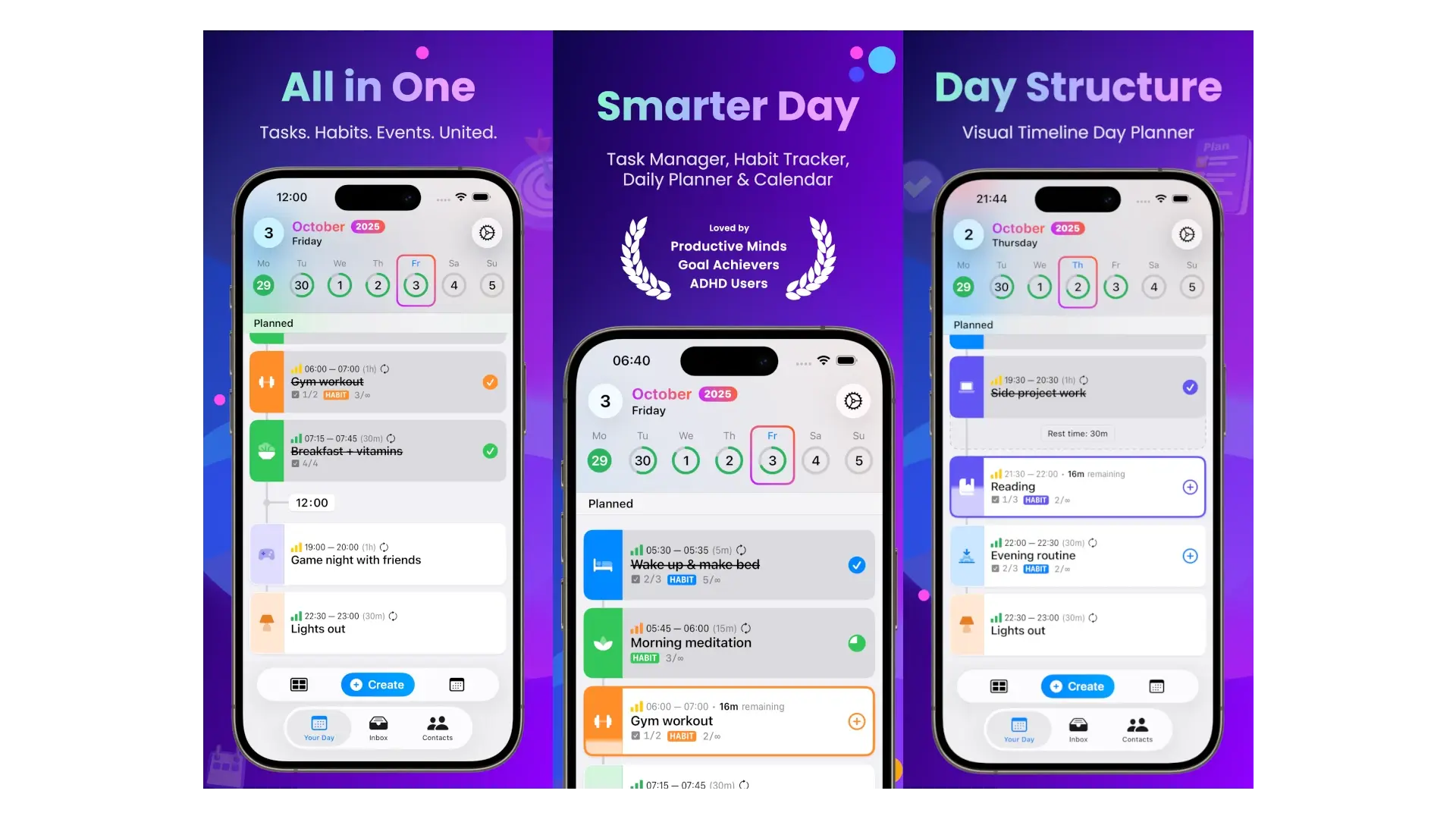
If you want a single place to plan, focus, and track habits, try the productivity app at Smarter.Day. It integrates many of the strategies we covered—so your routines are easier to start and harder to break.
You May Also Like
These Related Stories
12 Evidence-Based Ways to Boost Daily Productivity
12 Evidence-Backed Ways to Boost Daily Focus Fast
No Comments Yet
Let us know what you think