
Deep Work Days: Science-Backed Focus Strategies That Work

Deep Work Days: Science-Backed Focus Strategies That Work
Have you ever noticed how a “quick check” of email turns into an entire lost hour? Or how your best ideas arrive when you’re away from your screen? Here’s the catch: our brains aren’t built for the constant pings and context shifts that define modern work. If you’ve felt overwhelmed, stuck in procrastination, or frustrated by shallow progress, you’re not alone. Today, we’ll map out a practical, science-backed path to performance, time optimization, and workflow improvement—without relying on sheer willpower.
In this guide, we’ll move from theory to repeatable action. You’ll learn specific methods to protect attention, manage energy, use cognitive triggers, and install feedback loops that keep momentum. We’ll blend the best of deep work principles, behavioral science, and tech habits that really stick. Expect clear steps, relatable examples, and tools you can apply today. Let’s reclaim your focus and make the important work actually happen.
Audit Attention and Define Your Focus Baseline
Before optimizing, measure. Start with a one-week attention audit: note when you feel focused, distracted, and energized, along with the tasks you were doing. Use simple tags like “email,” “creation,” and “admin.” Pair that with a passive tracker (e.g., RescueTime) to estimate deep vs. shallow work. Two practical methods: 1) schedule a 10-minute daily focus log review, and 2) set a “focus score” for each day (0–10) to track trends. As Dr. Adam Gazzaley and Larry Rosen write in The Distracted Mind, “Our brains are limited-capacity systems,” so capacity management beats brute force.
Example: Mia, a product manager, logged one week and discovered her best cognitive performance landed between 9:30–11:30 a.m. She shifted her hardest tasks there and moved Slack checks to 1:00 and 4:30 p.m. The result? A consistent two-hour deep work win most days. Cal Newport’s Deep Work reinforces this approach: define time for depth explicitly, then defend it. The data doesn’t need to be perfect—just enough to inform experiments and eliminate guesswork.
To go deeper, visualize your baseline. Create a simple three-column sheet: high-focus windows, low-focus windows, and triggers (sleep, meetings, exercise). You’ll quickly see patterns. Then make one micro-change per week, such as reducing morning meetings or blocking the first hour for priority work. “What you measure improves,” Peter Drucker famously advised; the audit turns gut feelings into decisions you can test.
Time-Block with Ultradian Rhythms
Our bodies run on ultradian rhythms—90–120 minute cycles of high energy followed by 15–20 minutes of recovery, identified by sleep researcher Nathaniel Kleitman. Two methods harness this: 1) plan one or two 90-minute deep work blocks daily, and 2) insert a deliberate 15-minute recovery ritual (stretching, hydration, a short walk). Protect those blocks in your calendar as “Do Not Book.” Cal Newport calls it “time-blocking,” and it’s a cornerstone of time optimization because it reduces decision fatigue.
Example: Arjun, a software engineer, reserved 9–10:30 a.m. and 2–3:30 p.m. for uninterrupted coding. He set Slack to auto-responder and used a desk light as a visual “do not disturb” cue. After two weeks, his bug resolution rate increased by 28%. “If you don’t produce, you won’t thrive—no matter how skilled or talented you are,” Newport notes. The productivity gain came from predictable depth, not heroic sprints.
When others pressure your blocks, don’t apologize—negotiate. Offer specific alternatives: “I’m heads-down 9–10:30. Can we talk at 11?” Consider this your hard landscape—the non-negotiable structure that safeguards priority work. Over time, teammates learn your rhythms and schedule around them. The goal isn’t rigidity; it’s goal-aligned flexibility that respects human energy cycles.
Pomodoro 2.0: Find Your Work/Break Ratio
The classic Pomodoro (25 minutes work, 5 minutes break) is useful, but one size rarely fits all. Two methods: 1) run a week-long tempo test—try 25/5, 40/10, 52/17, and 90/15 and record perceived focus; 2) add a micro-reflection at each break: “What’s the next smallest step?” The DeskTime study popularized the 52/17 ratio, and Francesco Cirillo’s The Pomodoro Technique shows why short cycles reduce internal resistance and maintain momentum.
Example: Tasha, a writer, found 40/10 worked best for drafting, while 25/5 fit editing. She made a simple rule: “Draft in 40/10 until 1, edit 25/5 after lunch.” “Short bursts make starting trivial,” Cirillo emphasizes. When you pair intervals with a single, visible task, task initiation friction plummets and your output becomes more consistent.
Add break hygiene: leave the screen, hydrate, do a 60-second mobility stretch, or stare at a distant object to relax your eyes. Avoid doom-scrolling; keep breaks restorative. If you routinely overrun, use a kitchen timer across the room to stand up physically to stop it. Your perfect ratio is the one you’ll actually use, daily, with minimal willpower.
Batch Tasks and Kill Context Switching
Context switching taxes the brain. Studies by Rubinstein, Meyer, and Evans show switching costs can sap 20–40% of productive time. Two methods reduce the toll: 1) batch similar tasks (emails twice daily, approvals at 4 p.m., admin on Friday), and 2) create “themed hours” (e.g., 10–11 a.m. outreach, 3–4 p.m. review). Ophir et al. (Stanford) found heavy media multitaskers perform worse on attention tasks; sequential focus is a competitive advantage.
Example: Diego, a consultant, moved client email to 11:30 a.m. and 4:30 p.m. He stopped peeking at the inbox before his deep block. Within a week, he noticed fewer “where did my day go?” moments. “Multitasking is a myth,” as many cognitive scientists argue; what we’re doing is rapid task-switching, which degrades workflow improvement and learning.
Make batching visible with mode labels on your calendar: Create, Decide, Support. During Create, tools like Slack are closed; during Support, they’re open. Add a 5-minute buffer between modes to reset context (close tabs, clear desk, jot next steps). You’ll feel the mental noise drop and your throughput rise.
Lower Cognitive Load with External Brains
When working memory overloads, errors spike. Cognitive Load Theory (John Sweller) suggests offloading information to external systems. Two methods: 1) keep a single capture tool (notes app or paper) to dump ideas and to-dos instantly, and 2) use pre-flight checklists for repeatable tasks (publishing, deploys, handoffs). David Allen’s Getting Things Done popularized the idea: “Your mind is for having ideas, not holding them.”
Example: Priya, a designer, created a 12-step handoff checklist: assets, naming, accessibility notes, specs. Handoffs went from chaotic to consistent—fewer Slack pings, faster approvals. By externalizing the process, she freed mental space for creative decisions. “Checklists protect against the limits of attention,” Atul Gawande writes in The Checklist Manifesto.
Level up with templates: email templates for frequent replies, document templates for briefs, and agenda templates for weekly meetings. The brain relaxes when structure is predictable. Reduced load equals better performance, because attention is spent on solving problems, not remembering steps.
Use Implementation Intentions and WOOP
Plans work better when they’re specific. Two methods: 1) implementation intentions (“If it’s 9 a.m., then I open the proposal and write 200 words”) and 2) WOOP (Wish, Outcome, Obstacle, Plan) by Gabriele Oettingen. Peter Gollwitzer’s research shows “if–then” plans can dramatically increase follow-through because they pre-decide actions in context.
Example: Ren, a grad student, used WOOP for thesis progress: Wish: finish Chapter 2; Outcome: relief and momentum; Obstacle: checking forums; Plan: “If I feel the urge, then I set a 10-minute timer and write a paragraph.” “Mental contrasting plus implementation intentions yields robust behavior change,” Oettingen’s research finds.
Write your top three daily if–then scripts on a sticky note near your keyboard. Couple them with a tiny “starter step” (open doc, outline three bullets) to reduce activation energy. These scripts automate initiation and keep you moving when mood dips or distractions surge.
Manage Energy, Not Just Time
Time is fixed; energy fluctuates. Two methods: 1) protect sleep (consistent schedule, cool dark room, screens off an hour before bed), and 2) schedule active breaks (5-minute walks every hour, a 20-minute daylight break at lunch). Jim Loehr and Tony Schwartz’s The Power of Full Engagement argues energy management sustains high performance. Harvard sleep expert Charles Czeisler links sleep debt to impaired cognition and slower reaction times.
Example: Lina, a sales lead, moved prospecting calls to her personal energy peak (10–noon), cut caffeine after 2 p.m., and took a 15-minute walk at 3:30. Within two weeks, close rates improved as her afternoon slump faded. “Moderate arousal improves performance,” says the Yerkes–Dodson law; too little or too much stress hurts quality.
Add nutrition and light hacks: protein-forward breakfasts for stable focus, hydration reminders, and morning outdoor light to anchor circadian rhythms. Small energy habits compound, and your focus capacity becomes more reliable across the week.
Engineer a Distraction-Proof Environment
Your environment should make the right thing easy. Two methods: 1) deploy digital blockers (website/app limits, full-screen mode, focus timers), and 2) practice notification triage (turn off non-essential alerts, batch the rest). BJ Fogg’s behavior model highlights that reducing friction beats motivation. Ward, Duke, Gneezy, and Bos (2017) found that a smartphone’s mere presence can reduce available cognitive capacity.
Example: Omar set his phone to grayscale, removed social apps, and placed the device in another room during deep work. “Out of sight, out of mind” worked—the itch to check faded. He also set a “focus profile” on his computer that only allowed essential tools. Result: 90-minute blocks without mental tugging.
Create physical cues: a single-task desk setup (one screen, clean surface, headphones), a door sign during deep blocks, or a dedicated workspace if remote. These signals teach your brain, “Here, we focus.” The less friction you face, the more consistent your execution.
Run Meetings and Communication on Purpose
Meetings are tools, not default. Two methods: 1) adopt async-first communication (clear updates in project tools, recorded walkthroughs) and 2) require tight agendas with owners and decisions. Jeff Bezos’ “two-pizza rule” and HBR case studies highlight that smaller, agenda-driven gatherings outperform sprawling status meetings.
Example: A marketing team switched to Monday async updates and carved out no-meeting mornings Tue–Thu. They kept a 25-minute cap for most meetings and enforced a “one tap-out per meeting” rule if the purpose drifted. “If the meeting has no decision to make, it’s not a meeting,” became the mantra.
Install a meeting cost reminder: list attendee count x duration to show the real price. Default to cancellation if the same outcome can be achieved asynchronously. Communication should accelerate workflow improvement, not clog it. Fewer, better conversations yield faster progress and calmer calendars.
Trigger Flow with Clear Goals and Feedback
Flow emerges when challenge meets skill and feedback is immediate. Two methods: 1) define three outcome-based targets for your deep block (e.g., “ship draft paragraph A–C”), and 2) raise difficulty slightly each session (time limit, fewer tabs, stricter scope). Mihaly Csikszentmihalyi’s research shows clarity and balanced challenge are core flow triggers.
Example: Noor, a developer, set a rule: one unit test greenlit every 30 minutes. That instant feedback kept her immersed. “The best moments usually occur when a person’s body or mind is stretched to its limits,” Csikszentmihalyi noted. She also used a simple scoreboard: boxes to tick as tests passed.
Add friction reducers before the block: open only needed files, list the first two actions, silence alerts. After the block, log what worked and one tweak for next time. These small calibrations steadily increase your performance ceiling.
Beat Procrastination with Micro-Commitments
Procrastination isn’t laziness—it’s emotion management. Two methods: 1) the five-minute rule (work for five minutes; you may stop afterward), and 2) temptation bundling (pair an indulgence—like a favorite playlist—with a tough task). Piers Steel’s The Procrastination Equation and Katy Milkman’s research show that reducing aversion and increasing immediate reward break inertia.
Example: Eli dreaded expense reports. He promised himself a latte and his favorite playlist only during that task. He also set a five-minute timer. Usually, momentum carried him through the entire session. “Action precedes motivation more often than the other way around,” behavioral scientists remind us.
Name the next tiny step out loud: “Open the spreadsheet.” Reward completion, not perfection. Over time, a string of micro-wins becomes identity: “I’m someone who starts.” That identity shift is rocket fuel for habit formation and sustained execution.
Build Weekly Reviews and Rapid Feedback Loops
Consistency beats intensity. Two methods: 1) a Friday review (wins, bottlenecks, next week’s top three), and 2) a quick after-action review after major tasks: What did we expect? What happened? What will we change? W. Edwards Deming’s PDCA cycle and K. Anders Ericsson’s deliberate practice both emphasize structured feedback for improvement.
Example: Jia, a team lead, added a 30-minute Friday slot to finalize next week’s deep blocks, prune tasks, and set one process experiment (e.g., batch approvals). Within a month, spillover work shrank and predictability rose. “Without data, you’re just another person with an opinion,” Deming said.
Track a few leading indicators: deep hours logged, start time consistency, context switches, and energy rating. Review monthly to refine your system. The loop turns guesswork into continuous improvement, keeping your focus strategy alive and adaptive.
Optimize Your Tool Stack for Speed and Clarity
Tools should reduce friction. Two methods: 1) master keyboard shortcuts and command palettes in your core apps (docs, code, notes), and 2) create templates and automations for recurring work (e.g., Zapier/Make for handoffs). McKinsey once estimated knowledge workers spend up to 20% of time searching for information—clarity and speed pay compounding dividends.
Example: Sara, an ops manager, set up a request form that auto-created tasks with checklists and owners. She learned five shortcuts in her project tool and cut navigation time by half. “Automation is to your workflow what compound interest is to savings,” she joked—and it stuck.
Create a single source of truth for projects and a clean naming convention for files. The brain relaxes when retrieval is instant. That’s true workflow improvement: less hunting, more doing, fewer errors.
Make Nature, Light, and Micro-Restorations Non-Negotiable
Attention is replenished, not forced. Two methods: 1) schedule a daily micro-nature break (5–15 minutes outdoors or by a window with sky view), and 2) practice visual rest (20–20–20 rule: every 20 minutes, look 20 feet away for 20 seconds). Berman, Jonides, and Kaplan found that exposure to natural environments improves directed attention.
Example: Tom added a 12:30 p.m. sky-view walk and moved his desk toward natural light. Afternoon headaches vanished, and he felt more present in his 2 p.m. block. “Soft fascination” in nature restores our capacity to focus, attention researchers note.
If outdoors isn’t possible, use nature soundscapes, a plant on your desk, or a short corridor walk. Combine with breath resets (four-count inhale, six-count exhale). Small restorations keep your cognitive performance steady through long days.
Conclusion
You don’t need a perfect system to do the best work of your week—just a few high-leverage habits applied consistently. Measure your attention, block depth by your rhythms, cut context switching, and manage energy like the precious resource it is. Then add flow triggers, micro-commitments, and weekly reviews to keep improving. The compound effect is real.
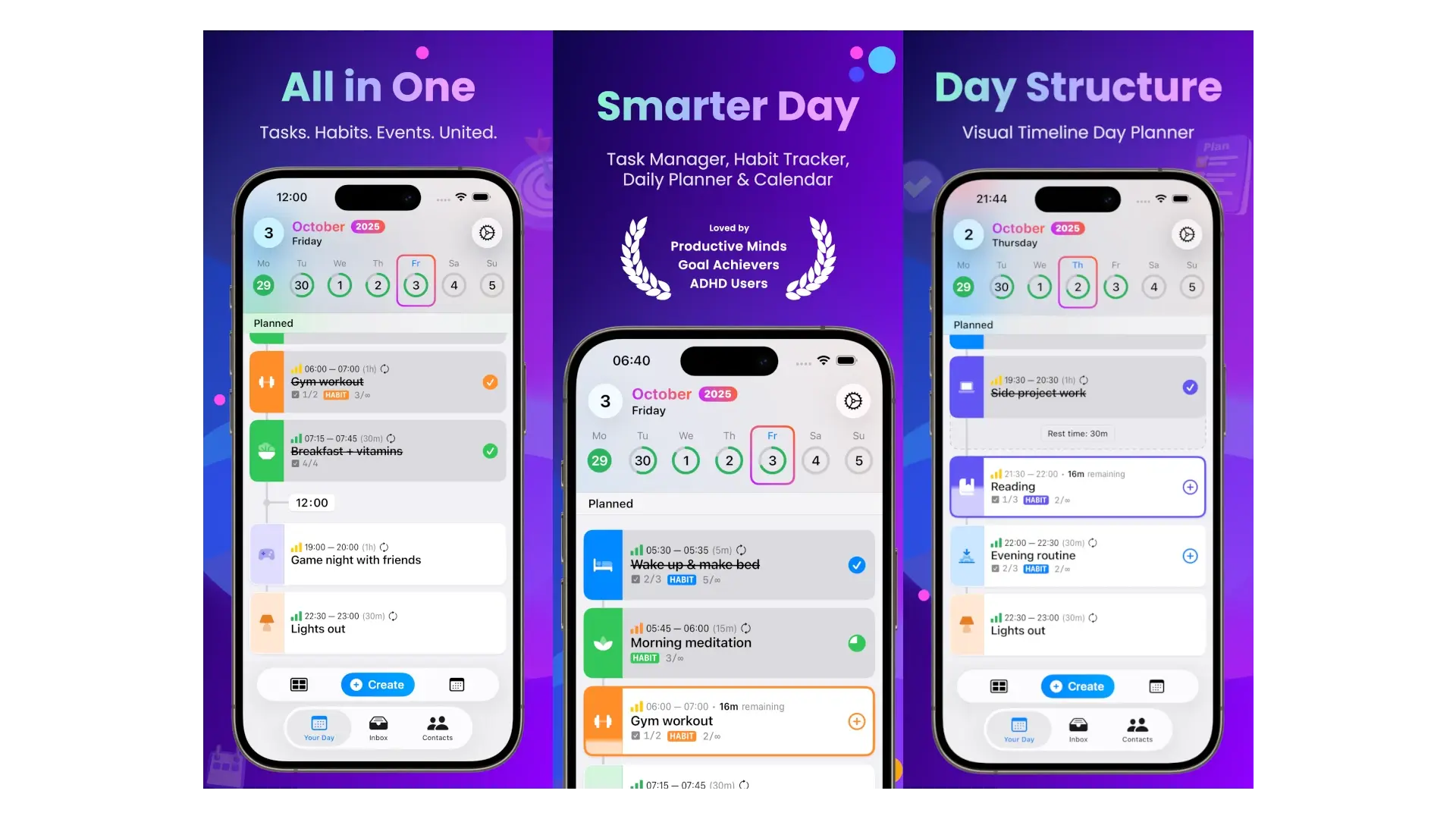
If you want a streamlined way to time-block, track deep hours, and build rituals without friction, try the productivity app at Smarter.Day. It’s designed to support focus, energy management, and feedback loops so you can execute what matters—and feel good doing it.
You May Also Like
These Related Stories
Deep Work Days: Science-Backed Focus Strategies That Work
Master Deep Work: A Practical Guide to Peak Focus at Work
No Comments Yet
Let us know what you think