

12 Proven Tactics to Maximize Focus and Productivity

Style: Conversational and evidence-driven
Category: Focus & Cognitive Performance
Title: 12 Proven Tactics to Maximize Focus and Productivity
Description: Discover research-backed methods to sharpen focus, beat procrastination, and optimize time with practical workflows you can apply today.
H1: 12 Proven Tactics to Maximize Focus and Productivity
Introduction
Let’s face it: in an always-on world, it’s easy to feel busy yet strangely unproductive. Notifications nag. Meetings multiply. Your to-do list grows faster than your energy. Have you ever noticed how even small distractions derail an entire morning? Here’s the catch—productivity isn’t about squeezing more into your day; it’s about time optimization, focus, and a better workflow. In this guide, we’ll show you how to reduce overwhelm and reclaim clarity using proven methods grounded in research and real-world practice.
This post delivers actionable strategies you can start today. From Deep Work sprints and intelligent prioritization to energy management and automation, you’ll get a practical playbook for everyday performance. We’ll blend the best of behavioral science, cognitive psychology, and workflow improvement for results you can feel. Whether you’re a manager, maker, or student, these tactics are built to help you consistently do your best work—without burning out.
H2: Start with Outcomes, Not Tasks
We begin with outcome-first planning—define what success looks like before you plan tasks. Choose 1–3 weekly outcomes that are specific and measurable. Then support them with WOOP (Wish, Outcome, Obstacle, Plan), a method from psychologist Gabriele Oettingen’s research that converts goals into executable steps by anticipating barriers. This single shift aligns your daily work with high-value results, shrinking busywork. As John Doerr notes in Measure What Matters, OKRs (Objectives and Key Results) give clarity and focus that compound over time.
Here are two practical methods to try:
- Draft weekly outcomes linked to key results (e.g., “Publish client case study with two quotes and one data point”).
- Use WOOP to explicitly plan around obstacles (e.g., “If the client delays quotes, I’ll schedule a 15-minute backup interview.”)
When Sarah, a marketing manager, switched from a bloated task list to three outcome-driven targets each week, she cut her workload by 20% while shipping more. The reason? Clarity reduces decision friction and makes prioritization obvious.
H2: Prioritize by Impact Using Clear Scores
Before you start, filter tasks by importance and impact. The Eisenhower Matrix helps you separate urgent from important: do first, schedule, delegate, or delete. Complement it with a lightweight RICE scoring model (Reach, Impact, Confidence, Effort) adapted from Intercom. Score tasks quickly to see what’s worth your time. When you combine these, you get speed and rigor—perfect for everyday time management.
Two methods:
- Run a five-minute Eisenhower triage to eliminate or delegate low-value tasks.
- Apply a simple RICE score (1–5 scale) to your top contenders; prioritize highest “Impact/Effort” items.
Tom, a freelance designer, used this combo to choose between three proposals and two portfolio updates. He prioritized the proposal with the highest RICE score and scheduled portfolio updates in the “important but not urgent” quadrant. Result: more revenue with less thrash. As Dwight Eisenhower put it, “What is important is seldom urgent, and what is urgent is seldom important.”
H2: Design Your Calendar With Timeboxing
Timeboxing turns intentions into protected focus. Assign tasks to specific blocks on your calendar with built-in buffers for transitions and interruptions. Add day theming (e.g., Monday strategy, Tuesday deep work, Wednesday meetings) to reduce context switching. Cal Newport’s time-block planning reinforces that forward scheduling beats reactive task lists for sustained performance and control.
Two methods:
- Create 90–120-minute deep work blocks for cognitively demanding tasks and 30–45-minute blocks for admin.
- Insert 10–15-minute buffers after meetings to capture notes and plan next actions, preventing spillover.
Lina, a software engineer, shifted to a themed week: mornings reserved for code, afternoons for code reviews and meetings. She enforced a shutdown ritual at 5:30 p.m. to review and reset. Parkinson’s Law says work expands to fill the time available; timeboxing ensures work shrinks to fit intentional boundaries instead.
H2: Build Focus Sprints That Respect Your Brain
Your brain loves rhythm. Alternate Deep Work sessions with strategic breaks to prevent cognitive fatigue. Try a 90-minute Deep Work sprint (Cal Newport) or the 52/17 rhythm identified by DeskTime’s analysis of top performers. Both respect ultradian cycles, keeping focus high and stress low. The key is consistency and a clear cue: start time, scope, and end time.
Two methods:
- Choose a sprint structure (25/5, 50/10, or 52/17) and set a visible timer; protect the entire sprint from interruptions.
- Predefine what “done” means for the sprint (e.g., draft section A, fix ticket #341, or outline slides 4–8).
Raj, a developer, ran three 50-minute sprints to finish a tricky feature. He took standing breaks and returned with fresher logic. Result: fewer bugs and faster throughput. Quote to remember: “Work deeply,” writes Newport, “and you’ll become hard to replace.”
H2: Cut Context Switching to Reclaim Hours
Context switching kills throughput. Research by Gloria Mark (UC Irvine) shows it can take about 23 minutes and 15 seconds to refocus after an interruption. The American Psychological Association has also highlighted how multitasking can reduce productivity by up to 40%. The antidote is single-tasking and communication batching—you compress shallow tasks and protect concentration.
Two methods:
- Batch email/Slack into two or three scheduled windows; disable push notifications during focus blocks.
- Use a “parking lot” notepad to capture stray thoughts without abandoning your main task.
Ana, a customer success lead, moved emails to 11:30 a.m. and 4:30 p.m. only. She told her team to call for true emergencies. Within a week, she reported a calmer mind and cleaner execution on complex cases, proving that fewer switches equal better workflow improvement and faster outcomes.
H2: Engineer an Environment That Supports Attention
Your environment should do half the work. Reduce friction to start and friction to distract. This is stimulus control: set a clean desktop, keep only the tools you need visible, and use website blockers during focus blocks. BJ Fogg’s behavior model shows behavior happens when motivation, ability, and prompts align; shaping your space turns willpower into system design.
Two methods:
- Pre-open only required tabs and pin your workspace; everything else stays closed.
- Create a “focus playlist” or ambient sound that signals deep work; pair it with a physical cue (e.g., desk lamp on).
Ben, a copywriter, used Freedom to block social sites and built a “writing mode” scene: lamp on, noise-canceling headphones, one document open. Cal Newport’s Digital Minimalism supports this: fewer inputs, more output. Result? Ben shipped first drafts 30% faster because his environment made distraction inconvenient.
H2: Manage Energy with Rhythms, Not Just Time
Optimize around energy cycles. Daniel Pink’s book When highlights daily peaks, troughs, and rebounds. Most people do analytic work in the morning peak and creative or integrative work later. Pair that with ultradian breaks (about every 90 minutes) to prevent fatigue. Sleep is non-negotiable—Matthew Walker’s research shows how quality sleep lifts memory, attention, and decision-making.
Two methods:
- Schedule your hardest task during your personal peak; move routine tasks to your trough.
- Use smart caffeine: 60–90 minutes after waking, small doses before deep work, none after mid-afternoon.
Mia, a product manager, shifted roadmap strategy to 9:30 a.m. and handled admin at 3:00 p.m. She also took a 10-minute walk between blocks. The switch improved her cognitive performance in debates and reduced afternoon fog. Remember: manage energy to manage output.
H2: Make Habits Stick with Small Wins
Consistency beats intensity. Use habit stacking (James Clear, Atomic Habits) by attaching a new behavior to an existing routine. Then apply temptation bundling (Katy Milkman, How to Change) to pair a must-do task with a want-to activity. These tools reduce friction and build automaticity—the path from effortful to effortless.
Two methods:
- After brewing coffee, start a 25-minute planning sprint—same cue, same length daily.
- Only listen to your favorite podcast while doing inbox triage or household chores.
Leo, a grad student, stacked “open notes and write one paragraph” after logging into Zoom. He set a hard stop and tracked streaks. Within weeks, the habit felt automatic. The principle is simple: make good behaviors easy and rewarding, and they’ll grow without constant motivation.
H2: Turn Procrastination into Momentum
Procrastination often masks fear or ambiguity. Shrink the task until it feels safe, then act. The 5-minute rule (work on it for five minutes) lowers resistance. Pair it with implementation intentions—“If it’s 2 p.m., then I open the brief and outline three bullets”—from Peter Gollwitzer’s research. Piers Steel (The Procrastination Equation) emphasizes that clarity and immediacy increase follow-through.
Two methods:
- Define the “minimum viable start” (open doc, write the title, list three points).
- Set an “If-Then” trigger: If the clock hits 2 p.m., then I start the five-minute timer.
Priya, an accountant, dreaded a messy reconciliation. She began with five minutes to label transactions. That tiny win snowballed into 40 minutes of flow. Takeaway: action precedes motivation, not the other way around. Start small to start soon.
H2: Review, Reflect, and Iterate Weekly
Weekly reviews make your system anti-fragile. Borrow from David Allen’s Getting Things Done: capture loose ends, clarify next actions, and clean your lists. Add a 15-minute retrospective: What worked? What didn’t? What will I change? Teresa Amabile’s research (The Progress Principle) shows that visible progress is a powerful motivator, even in small increments.
Two methods:
- Every Friday, review outcomes vs. intentions and plan three priorities for next week.
- Use a daily shutdown ritual to log wins, blockers, and the first step for tomorrow.
Ava, a product designer, wrote a two-line daily log: one win, one fix. In a month she saw patterns (meetings stacked too tightly) and made changes. Her stress dropped while output rose. Reflection turns data into direction.
H2: Automate the Busywork and Standardize Quality
Automation creates leverage. Start with SOPs (standard operating procedures) and checklists to reduce errors and decision fatigue—Atul Gawande’s The Checklist Manifesto shows how checklists elevate reliability in complex work. Then automate recurring steps using tools like Zapier or built-in features in your task manager. Layer in text expansion and keyboard shortcuts to reduce keystrokes for routine replies.
Two methods:
- Build a checklist for your recurring workflows (e.g., publish blog post: draft → edit → SEO → QA → publish → distribute).
- Automate handoffs: when you move a task to “Done,” trigger a Slack note, create a calendar event, or archive assets.
Diego, an AE, standardized his follow-up emails with templates and text expansion. He cut admin time by 40% and redeployed hours to discovery calls. That’s the magic: less friction, more focus, and higher performance with the same effort.
Conclusion
We’ve covered a complete system: outcome-first planning, impact-based prioritization, timeboxing, focus sprints, environment design, energy management, habit stacking, anti-procrastination tactics, reviews, and automation. Use two or three methods to start, then layer more each week. The goal isn’t perfection; it’s consistent, compounding progress that makes your best work easier, not harder.
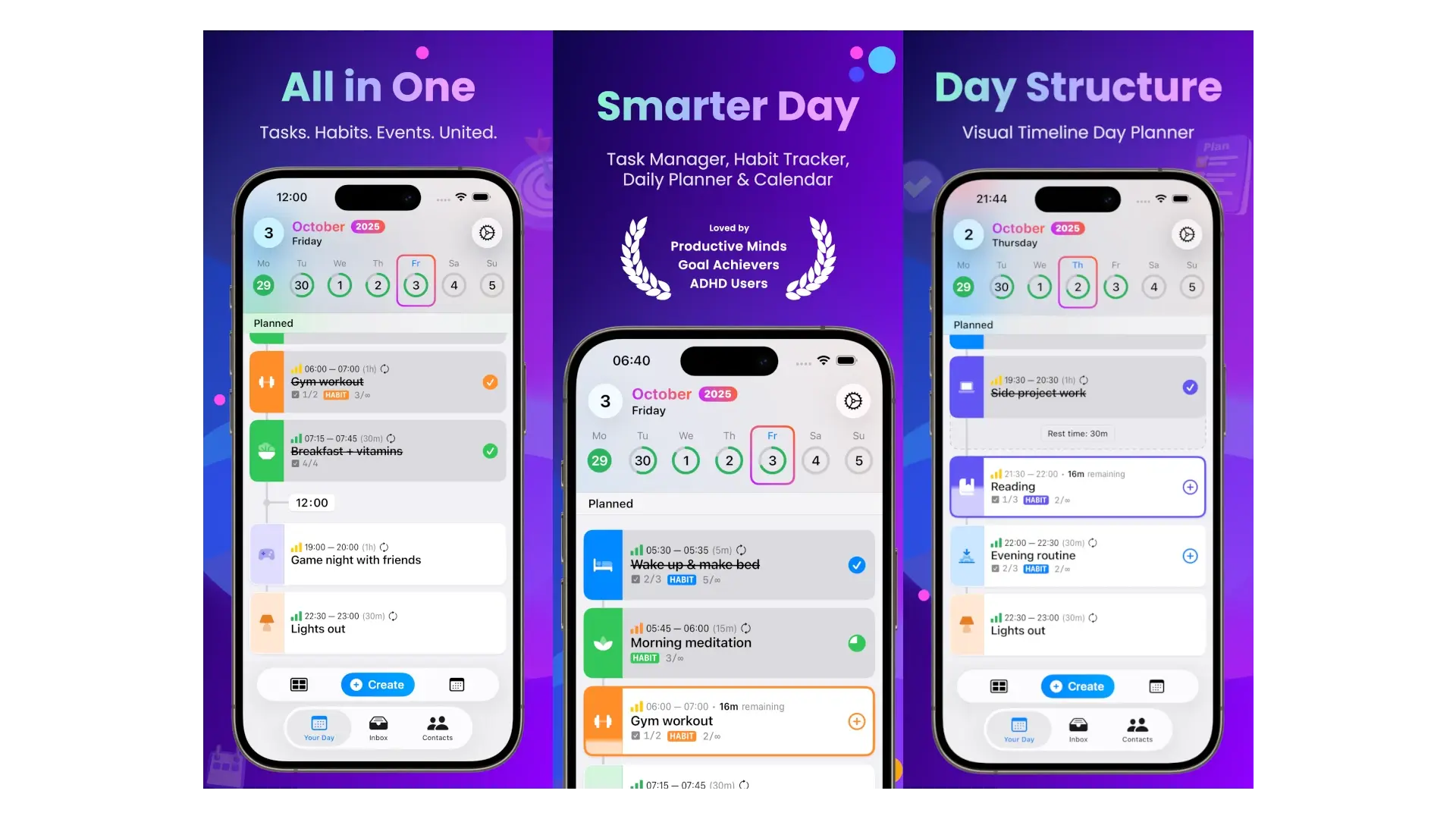
If you want a tool that brings this playbook to life, try the productivity app at Smarter.Day. It supports focused blocks, batching, reviews, and automation-friendly workflows—so you can move from theory to daily momentum, fast.
You May Also Like
These Related Stories
Peak Productivity: 12 Proven Strategies That Work Now
Peak Productivity: 12 Proven Strategies That Work Now
No Comments Yet
Let us know what you think