

Peak Productivity: 12 Proven Strategies That Work Now

Peak Productivity: 12 Science-Backed Strategies You Can Use Today
We’ve all had those days: your to-do list grows faster than you can type, Slack doesn’t stop pinging, and “deep work” feels like a myth. Procrastination creeps in, and the hours vanish. Here’s the catch—most productivity problems aren’t about effort; they’re about design. In this guide, we’ll show you how to design your day for time optimization, workflow improvement, and sustainable performance. No fluff. Just field-tested strategies.
You’ll learn exactly how to protect your attention, schedule high-impact work, and move faster without burning out. Each section delivers concrete methods, real-life examples, and insight from credible research—so you can stop guessing and start implementing. Ready to trade busy for effective? Let’s go.
Design Your Day with Time Blocking and Task Batching
If your calendar runs you, it’s time to flip it. Use time blocking to assign fixed windows to specific work, and task batching to group similar tasks like emails, content creation, or analysis. Aim for 60–120-minute blocks for focused work and 15–30-minute blocks for administrative tasks. Add buffer blocks between them to absorb overflow and reduce context switching. As Cal Newport notes in “Deep Work,” sustained focus increases output quality and speed—this is your engine for consistent results.
Here’s a practical setup:
- Block mornings for deep work on your top priorities.
- Batch admin, email, and approvals after lunch.
- Reserve late afternoons for collaboration and reviews.
A marketing lead I coached built three daily batches—campaign planning, stakeholder updates, analytics—and cut rework by 30% in two weeks.
Parkinson’s Law says “work expands to fill the time available.” Set shorter, realistic time boxes to speed decisions and delivery. Research on context switching by Gloria Mark shows it can take more than 20 minutes to regain full focus after an interruption. By batching similar tasks and limiting switches, you reclaim precious mental bandwidth and dramatically improve throughput.
The Two-List Method: Priorities and a Parking Lot
When everything is a priority, nothing is. Split your planning into two lists: your Critical Few and a Parking Lot. Start by identifying your 3 Most Important Tasks (MITs)—the non-negotiables that move goals forward. Everything else goes to the Parking Lot for later triage. This mirrors the simplicity of the Ivy Lee Method, famously used by Charles Schwab, and aligns with Gary Keller’s “The ONE Thing,” which urges focusing on the single most impactful task.
Two practical moves:
- Convert each MIT into a first-step verb (“Draft intro,” “Outline slides,” “Call supplier”).
- Promote only after finishing an MIT or at a scheduled review time.
A product manager I coached stopped juggling 12 “priorities” and focused on three. Launch issues dropped, and cycle time improved by 22% in a quarter.
To avoid list bloat, apply the 25/5 rule popularized in stories about Warren Buffett: identify your top five and avoid the rest until you finish them. Whether apocryphal or not, the principle works. James Clear, author of “Atomic Habits,” reinforces this idea: define the lead metric behavior that unlocks results, and make that your daily non-negotiable.
Master Deep Work and Attention Hygiene
To achieve cognitive performance, you need attention hygiene—habits that protect focus. Try a focus ritual before deep work: silence notifications, clear your desk, and set a single-tab browser window. Set a timer for 90 minutes and treat it like a flight—no leaving the seat unless it’s an emergency. Cal Newport’s deep work protocols can double output on complex tasks.
Two methods to adopt now:
- Use site blockers for social and news during work blocks.
- Implement a “Do Not Disturb” status with team norms for urgent vs. non-urgent messages.
A software engineer on a distributed team did exactly this and cut bug fix time by one-third in a month.
Gloria Mark’s research on interruptions shows knowledge workers switch screens every few minutes and need significant time to recover. The takeaway: create attention guardrails. “What gets your attention, gets your life.” Keep a “distraction capture” note nearby—jot impulses down and return to work. It drains their power without derailing your sprint.
Pomodoro Sprints Without the Training Wheels
The Pomodoro Technique—25 minutes on, 5 off—works, but you’re not limited to 25. Start there, then graduate to 45/10 or 60/10 sprints for deeper concentration. The goal is to reach a flow-state cadence that matches task complexity. For cognitively heavy tasks, aim for two back-to-back sprints before a longer break. Francesco Cirillo, who created Pomodoro, emphasizes the power of rhythm; Mihaly Csikszentmihalyi’s “Flow” explains why it feels so productive.
Two practical upgrades:
- Use a “warm-up task”: 3 minutes to outline the next steps before you sprint.
- Add “carryover notes” in the last 2 minutes so you restart instantly next time.
A grad student writing a thesis shifted from stop-start marathons to 50/10 sprints and produced consistent 800-word sessions without burnout.
If 25 minutes is too short, that’s normal. You’re building focus stamina. Keep sprints predictable, not punishing. “Make Time” by Knapp and Zeratsky suggests protecting a daily highlight with a clear start and end. It’s not just time management—it’s attention management.
Align Work with Energy: Circadian and Ultradian Rhythms
You don’t need more hours; you need better energy allocation. Identify your peak alertness window and schedule your most demanding tasks there. Many people peak mid-morning, dip early afternoon, and recover late day. Harness ultradian rhythms—90-minute cycles of natural alertness—by working hard for one cycle, then taking a 10–15-minute recovery break. Sleep researcher Nathaniel Kleitman first described these patterns.
Two methods:
- Slot deep work in your top energy window and automation/admin in your trough.
- Use a 15-minute reset: hydrate, light stretch, daylight exposure between cycles.
A UX designer shifted ideation to mornings and production tasks to afternoons; creative throughput rose noticeably within a week.
Matthew Walker’s “Why We Sleep” shows sleep loss impairs attention, memory, and decision-making. Short power naps (10–20 minutes) can restore alertness without grogginess; sleep scientist Sara Mednick’s work confirms benefits for learning and performance. Protect sleep like a project deadline—because your brain is the project.
Reduce Cognitive Load with an External Brain
Your mind is for having ideas, not holding them. Build an external brain to lower cognitive load: a capture system, a clear task board, and dependable checklists. David Allen’s Getting Things Done (GTD) popularized the “capture, clarify, organize, reflect, engage” loop. Add Cognitive Load Theory (John Sweller) and you’ll see why offloading memory frees processing power for problem-solving.
Two quick wins:
- Centralize tasks in one kanban board with “Next,” “In Progress,” and “Done.”
- Create checklists for recurring workflows (publishing, onboarding, reporting).
An event planner I coached moved 47 recurring steps into checklists and slashed errors to near zero. Atul Gawande’s “The Checklist Manifesto” shows how such lists save lives in medicine; they can certainly save your projects.
Use context-based tags like “@Desk,” “@Phone,” or “@Shallow” to match tasks to the right energy and location. Weekly, run a 10-minute review: clear inboxes, update statuses, and select the next week’s MITs. This keeps your system trustworthy—and your mind calm.
Make Fewer Decisions: Defaults, If–Then Plans, and Pre-Commitment
Decision fatigue is real enough to matter, even if debates continue about its mechanisms. The solution is elegant: use defaults and if–then plans. Psychologist Peter Gollwitzer’s research on implementation intentions shows that “If it’s 9 a.m., then I start the report” dramatically increases follow-through. Layer on pre-commitments—like scheduling tools or blocking apps—to reduce negotiation with yourself.
Two practical moves:
- Build morning and shutdown routines as defaults so the day starts and ends on rails.
- Use if–then triggers: “If I open my laptop, then I write for 10 minutes before email.”
A founder I worked with chose three default breakfasts, two work uniforms, and a fixed writing block. Cognitive bandwidth freed up for strategy.
Thaler and Sunstein’s “Nudge” explains how choice architecture shapes behavior. Remove friction for the right actions (open notes at startup) and add friction to the wrong ones (log out of social apps). The goal: fewer, better decisions—and more progress.
Reinvent Email and Meetings with Asynchronous Habits
Email and meetings steal focus because they blur urgency with noise. Create asynchronous norms so information flows without constant interruptions. Start by scheduling two email windows per day (late morning and late afternoon) and turning off new-mail alerts. For meetings, require written agendas, clear outcomes, and default 25- or 50-minute slots to protect buffer time.
Two methods that work:
- Replace status meetings with a shared async update template (what’s done, next, blocked).
- Add no-meeting blocks—two mornings per week for deep work.
An ops team I advised shifted 40% of recurring meetings to async docs; cycle times improved and stress dropped.
Harvard Business Review consistently reports on the costs of meeting overload and the benefits of agenda discipline. Gloria Mark’s interruption research reinforces the value of focus-preserving communication. Try a “response SLA” for non-urgent messages (e.g., 24 hours). It creates clarity and protects workflow improvement.
Automate the Repetitive: Templates, Text Expanders, and Workflows
If you do it twice, template it. If you do it ten times, automate it. Create canned responses, proposal templates, and brand-approved slide decks. Use text expanders for common phrases and URLs. Then connect tools with automation—think Zapier or native integrations—to trigger actions across apps. The objective is compound time savings that silently scale with your work.
Two quick automations:
- Auto-file receipts from email to a finance folder and Slack a weekly summary.
- Convert form submissions into tasks with owners, due dates, and checklists pre-filled.
A sales rep templated follow-ups and used snippets to personalize at speed, doubling outreach without longer hours.
A McKinsey Global Institute report estimates that up to 30% of tasks in many jobs are automatable. That doesn’t replace judgment; it protects it. Use automation for busywork and save your brain for strategy, creativity, and relationships.
The Courage to Say No: Essentialism and Focus Filters
Let’s face it: you can’t do it all. Essentialism by Greg McKeown teaches that saying “no” to the trivial many frees you to say “yes” to the vital few. Pair this with “The ONE Thing” by Gary Keller and Jay Papasan, and you get a powerful filter: if it doesn’t serve your main objective, it’s a distraction—however shiny.
Two practical scripts:
- “Yes, but later”: “I’d love to contribute. Given current priorities, I can start next quarter.”
- “Trade-offs”: “Happy to take this on. Which current project should I deprioritize?”
An analyst I coached used these scripts to decline three low-impact committees, then led a high-impact retention project that saved six figures.
Create a Not-To-Do List—banned activities during focus time (ad hoc status updates, open-ended brainstorming, reactive Slack browsing). As Derek Sivers puts it, “If it’s not a ‘Hell yeah,’ it’s a no.” Guard your attention like prime real estate—because it is.
Measure What Matters: OKRs, Feedback Loops, and Reviews
You improve what you measure—if you measure the right things. Use OKRs (Objectives and Key Results) to align work with outcomes. John Doerr’s “Measure What Matters” shows how clear, ambitious goals paired with measurable results accelerate progress. Then build feedback loops: weekly reviews, dashboard check-ins, and short retrospectives to refine your process.
Two methods:
- Weekly review: assess progress on OKRs, set next week’s MITs, and prune your Parking Lot.
- Use lead measures (behaviors) not just lag measures (results): “Daily outreach” beats “Monthly revenue.”
A startup team I advised ran 30-minute Friday retrospectives and shaved two weeks off their release cycle in a quarter.
Teresa Amabile’s “Progress Principle” finds that small wins boost motivation. Track visible progress—a burned-down backlog, a streak counter, or a completed milestone. Motivation follows momentum, not the other way around.
Microbreaks, Movement, and Recovery That Fuels Output
Pushing harder isn’t the same as producing more. Recovery is a performance strategy, not a reward. Take microbreaks (2–5 minutes) every hour to stretch, breathe, or get sunlight. Try walking meetings for discussion-heavy calls; Stanford researchers Oppezzo and Schwartz found walking boosts creativity. Maintain a shutdown ritual to release work thoughts and reset.
Two practical resets:
- 60-second box breathing (4-4-4-4 counts) between meetings to lower stress.
- Movement snacks: 10 squats, a short walk, or neck mobility to refresh posture and focus.
A support lead who adopted 5-minute breaks every 55 minutes reported fewer mistakes and steadier energy throughout the day.
Research by Sabine Sonnentag shows that psychological detachment from work during off-hours improves well-being and next-day performance. Use the Yerkes–Dodson law as a compass: optimal performance happens at moderate arousal, not chronic strain. Build sustainable intensity—you’ll last longer and deliver better.
Advanced Planning: Weekly Architecture and Daily Flex
Great days begin on weekly planning day. On Friday or Sunday, map your key outcomes, place your deep work blocks, and pre-commit to no-meeting mornings. Then, each day, make a 1-page plan: top 3 MITs, secondary tasks, and a flexible buffer. This hybrid of fixed architecture with daily adaptiveness balances structure and reality.
Two field-tested steps:
- Plan the week by outcomes, not tasks. Then attach tasks to each outcome.
- Use a two-pass morning: first pass to start the hardest task, second pass to triage messages.
A consultant I coached placed proposals Tuesday morning, delivery reviews Wednesday afternoon, and prospecting Thursday. Consistency compounded into a record quarter.
Chris Bailey’s “The Productivity Project” highlights the value of intentional time use and reflection. Keep your plan visible, and revisit mid-day to adjust. Your schedule is a living document—optimize it as new information arrives.
Skill Up Faster: Deliberate Practice and Tight Feedback
High performers optimize not just time, but learning velocity. Adopt deliberate practice—target specific weaknesses with focused drills. Anders Ericsson’s “Peak” shows that structured practice with immediate feedback accelerates skill growth. Pair it with tight feedback loops—from mentors, analytics, or user tests—to course-correct quickly.
Two methods:
- Build skill sprints: 30–60 minutes, three times weekly, on one sub-skill (e.g., data storytelling).
- Use post-mortems: after each deliverable, note what worked, what to change, and one experiment for next time.
A data analyst dedicated 45 minutes thrice weekly to visualization techniques and, within two months, reduced explain-time in stakeholder meetings by half.
Scott Young’s “Ultralearning” reinforces aggressive, strategic learning with real-world projects. Keep the loop clear: practice → feedback → adjustment → repeat. The faster you learn, the faster you ship—and the better your results.
Conclusion
You don’t need a new personality to be productive—just a better system. From time blocking and deep work to automation, OKRs, and recovery, these strategies shift you from reactive to intentional. Choose two methods to implement this week, then layer in others as habits solidify. Small, consistent changes drive outsize workflow improvement and sustained performance.
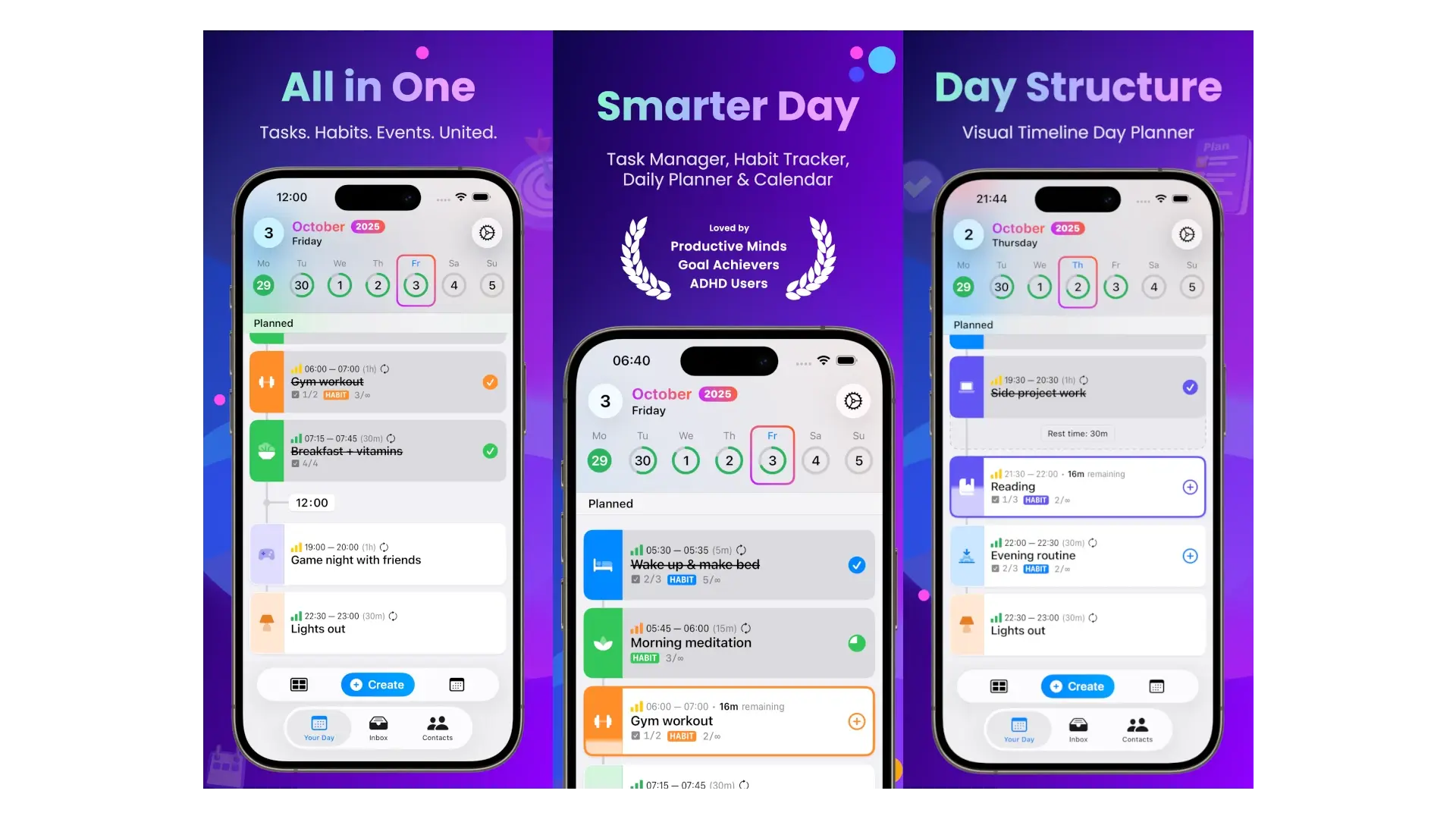
If you want a head start, try a productivity app that bundles capture, planning, focus timers, and reviews. We recommend exploring Smarter.Day—it aligns with these practices and simplifies the daily discipline required to execute them consistently.
You May Also Like
These Related Stories
Peak Productivity: 12 Proven Strategies That Work Now
Peak Productivity: 12 Proven Strategies That Work Now
No Comments Yet
Let us know what you think