

13 Proven Time Management Strategies for Busy Minds

13 Proven Time Management Strategies for Busy Minds
Have you ever stared at your calendar and felt your brain switch into survival mode? Between Slack pings, recurring meetings, and an endless to-do list, it’s easy to end the day wondering where your time went. Here’s the catch: productivity isn’t about squeezing more into your schedule—it’s about choosing better. In this guide, we’ll demystify proven methods that reduce overwhelm, fight procrastination, and sharpen focus so you can achieve more with less stress and real workflow improvement.
Our intent is crystal clear: give you actionable, science-backed strategies to reclaim your attention and optimize your time. We’ll share practical tactics you can use today, from time blocking and priority scoring to focus sprints and energy management. You’ll see relatable examples, references to credible studies and books, and step-by-step techniques that convert busy days into calm, productive flow. Ready to transform how you work? Let’s begin.
Build Outcome-Based Time Blocks That Protect Your Focus
Most schedules crumble because they list activities, not outcomes. Start with outcome-based time blocking: assign 60–120-minute blocks to one high-impact outcome, not a vague task list. Pair this with anchor events—fixed meetings or deadlines—to create stable guardrails. Cal Newport popularized this approach in Deep Work, noting that “high-quality work equals time spent multiplied by intensity.” By aligning blocks with measurable outcomes, you filter distractions and elevate performance.
Two methods help: a weekly plan every Friday for the next week, and a daily recalibration each morning. David Allen’s GTD weekly review complements time blocking by ensuring your commitments are clear. For instance, a product marketer splits Tuesday morning into “Write homepage draft” and “Review competitor analysis,” not just “Marketing tasks.” That clarity enables deep concentration and time optimization.
Example: Nora, a senior designer, was drowning in ad hoc requests. She created three morning deep-work blocks weekly for concept exploration and moved all feedback sessions to afternoons. In four weeks, her concept quality improved, and revisions dropped 30%. She attributed the shift to protecting cognitive bandwidth—consistent with Newport’s premise that depth amplifies value.
Prioritize with the Eisenhower Matrix and Value Scoring
Not all tasks deserve equal attention. The Eisenhower Matrix separates the urgent from the important: do first, schedule, delegate, or delete. Add value scoring—a 1–5 scale for impact and effort—to rank tasks quickly. As Dwight Eisenhower said, “What is important is seldom urgent and what is urgent is seldom important.” Combining urgency/importance with numeric impact helps you avoid the trap of busywork.
Use two methods: a 10-minute daily triage to place tasks in the matrix, and impact-first sequencing using your value scores. Harvard Business Review frequently highlights that high performers minimize low-leverage tasks to preserve attention for strategic work. For example, a startup founder placed investor outreach (high-impact, not urgent) in “Schedule” and automated routine invoices (low-impact) in “Delegate/Delete,” freeing hours weekly.
Consider Luis, a team lead. He rated tasks by expected revenue impact and customer risk. High-impact bugs jumped to “Do First.” Internal status updates landed in “Delegate,” supported by a lightweight dashboard. Within a sprint, cycle time improved, and he reduced weekend work—proof that smarter prioritization drives workflow improvement.
Defeat Procrastination with the 10-Minute Rule and Temptation Bundling
Procrastination thrives on ambiguity and fear. Enter the 10-minute rule: commit to work for just ten minutes, no pressure to continue. This shrinks the psychological barrier to starting—a principle supported by Piers Steel’s The Procrastination Equation. Pair it with temptation bundling (Katy Milkman): combine a desirable activity with a challenging task—listen to a favorite playlist only when writing, for example.
Two practical moves: define a minimum viable start (open the doc, outline three bullet points), and add a visible countdown timer to make progress tangible. After ten minutes, momentum makes continuing easier—a nod to the Zeigarnik effect, which suggests unfinished tasks linger in memory, nudging us forward. “Starting small beats waiting for perfect motivation” becomes a daily mantra.
Example: Priya, an analyst, delayed monthly reports. She bundled a special coffee with the reporting block and used a 10-minute “just start” commitment. The first week, she completed reports 1.5 days earlier. Over time, she swapped dread for a reliable routine—evidence that friction reduction beats willpower in boosting performance.
Pomodoro 2.0: Focus Sprints with Attention-Residue Resets
Classic Pomodoro uses 25-minute work sprints with short breaks, a system introduced by Francesco Cirillo. Upgrade it with attention-residue resets: avoid context switching during breaks; instead, do micro-recoveries like stretching, a short walk, or box breathing. Research by Sophie Leroy on “attention residue” shows that jumping tasks leaves a cognitive trace that degrades performance when you return.
Try two variants: the 40/10 cadence for complex tasks and the 90/15 ultradian sprint when energy is high. Use a single-tasking app and turn notifications off during each sprint. One quote to remember: “Multitasking is merely the opportunity to mess up more than one thing at a time.” That line, popular in productivity circles, underscores the cost of fragmentation.
Take Jordan, a software engineer. He shifted from ad hoc hacking to 40-minute code sprints, 10-minute breaks, and post-lunch 90-minute architecture blocks. Within a month, he cut defect rates and reported fewer late-night fixes. The combination of time-boxing and clean transitions minimized cognitive load and accelerated deep problem-solving.
Align Work with Your Energy: Ultradian Rhythms and Chronotypes
We don’t have equal energy all day. Work with ultradian rhythms—90–120-minute cycles of natural alertness—by scheduling demanding tasks during peaks and administrative or creative recovery during dips. Sleep researcher Nathaniel Kleitman documented these cycles, and Daniel Pink’s book When explores how timing affects performance. Aligning tasks with chronotype (morning lark, night owl) boosts consistency.
Use two methods: a personal energy audit for one week, rating each hour’s focus 1–5, and chronotype-aware scheduling—book deep work during peak scores, shallow work during low scores. Implement a quick pre-block ritual (water, stretch, no inbox) to prime your brain. The goal isn’t more hours; it’s higher-quality hours.
Example: Mei, a content strategist and night owl, stopped forcing 8 a.m. creativity. She moved ideation to late morning and editing to post-lunch when energy dipped. She also took a 10-minute outdoor break between blocks. Result: higher draft acceptance rates and fewer rewrites. That’s time optimization powered by biology, not brute force.
Slash Meeting Overload with Async-First and a 3-Bucket Rule
Meetings multiply because decisions lack clarity. Adopt async-first communication—use docs, short videos, or project boards—before scheduling time. Microsoft’s 2023 Work Trend Index shows meeting time keeps rising while attention declines. Implement a 3-bucket rule: Decision (sync), Status (async), Collaboration (sync with a clear agenda). Kill default 60-minute slots; cap at 25 or 45 minutes.
Two methods: a pre-read memo sent 24 hours ahead (inspired by Amazon’s memos) and a meeting hygiene checklist: purpose, owner, decision needed, success criteria. Shopify’s “meeting reset” famously removed thousands of recurring events to reclaim bandwidth. You can do a mini version by pruning low-value calendar repeats every quarter.
Example: Arman’s team replaced weekly status meetings with a Friday async update using a shared template. Decision meetings remained, but shorter with pre-reads. Within six weeks, total meeting time dropped 28%, and cycle times improved. The message is clear: design your information flow to protect deep attention.
Make Single-Tasking Your Default: Deep Work and Device Fences
Our brains don’t truly multitask; they switch and pay a toll. The American Psychological Association notes that task switching can cost up to 40% of productive time. Practice single-tasking via device fences: work on one screen, one app, one intent. Cal Newport’s Deep Work argues that rare, distraction-free concentration produces rare value.
Two methods: create a focus mode with app blockers and do-not-disturb, and use task statements (“For 30 minutes, I will refactor the auth module”). Add a capture pad nearby to park stray thoughts without opening new tabs. Clifford Nass’s Stanford research found heavy media multitaskers perform worse on tests of attention and memory—a warning for all of us.
Example: Talia, a lawyer, stopped leaving email open. She ran two 45-minute drafting blocks each morning with devices in airplane mode. She captured non-urgent ideas on paper, then batched them later. Her turnaround times improved, and errors dropped. Single-tasking felt radical at first, then liberating.
Reduce Cognitive Load with Checklists, SOPs, and Templates
When stakes are high, checklists shine. Atul Gawande’s The Checklist Manifesto shows how checklists reduce errors in complex environments. In knowledge work, pair SOPs (standard operating procedures) with templates to streamline recurring tasks—client onboarding, code reviews, publishing workflows. This offloads memory and produces consistent results.
Two techniques: build a “definition of done” for each recurring task and store template libraries (emails, briefs, PRDs) in your workspace. Use a short preflight checklist before publishing or shipping. NASA and aviation industries prove that even experts benefit from structured prompts, especially under time pressure.
Example: A marketing team created a launch checklist—brief, legal review, UTM links, QA, and rollback plan. They cut launch errors to near zero and shaved a day off each release. Less firefighting, more progress. That’s workflow improvement you can trust.
Control Inbox and Notifications with Batching and VIP Filters
Email and chat drain focus through constant micro-interruptions. Gloria Mark’s research on interruptions shows it can take over 20 minutes to regain full focus after a disruption. Fight back with batch processing—check messages 2–3 times daily—and VIP filters so only critical alerts break through. Turn off badges; use scheduled sends to avoid nighttime ping-pong.
Two methods: set inbox hours on your calendar and use rules/labels (Finance, Clients, Internal) to triage quickly. For chat, adopt status norms: when “Heads down,” respond at the top of the hour. Share your norms teamwide to reset expectations. You’ll feel the cognitive relief immediately.
Example: Diego, a customer success manager, moved to 11:30 a.m. and 4:30 p.m. email batches with a VIP filter for escalations. Within two weeks, he finished core tasks by 5 p.m. and stopped context switching every six minutes. The result: fewer mistakes, calmer days, better performance.
Automate Repetitive Work with No-Code Tools and Shortcuts
Automation is time’s best friend. Identify repetitive, rules-based tasks and use no-code automation (e.g., Zapier, Make) to move data, create tasks, or send updates. McKinsey estimates that about 60% of occupations have at least 30% of activities that could be automated. Layer text expanders and keyboard shortcuts to speed up routine writing and navigation.
Two methods: run a recurring automation audit—list tasks done 5+ times a week—and create one automation per week. Then build a snippet library for common responses and templates. Keep a “maintenance Monday” slot to fix broken zaps before they derail you. Small automations compound into major time optimization.
Example: Lila, a recruiter, automated moving form submissions into her ATS and sending candidates a personalized confirmation. She added text snippets for common emails. Result: she reclaimed five hours weekly and responded faster, improving candidate experience without extra effort.
Measure What Matters: Weekly Reviews, OKRs, and Progress Principles
Without feedback, you drift. Anchor your system with a weekly review: clear inboxes, scan calendars, update projects, and choose next week’s top three outcomes. Pair with OKRs (Objectives and Key Results) to keep goals measurable and aligned. John Doerr’s Measure What Matters illustrates how OKRs focus effort and reveal trade-offs.
Two methods: track lead measures (inputs you control, like hours in deep work) alongside lag measures (outputs, like shipped features). Teresa Amabile’s “progress principle” shows that recognizing small wins boosts motivation. Capture wins in a simple log to reinforce momentum. This habit fights the illusion of stagnation.
Example: Omar, a sales leader, reviewed his pipeline every Friday, identified two key levers, and set one experiment per week. Over a quarter, close rates ticked up, but more importantly, his team felt consistent progress. That clarity reduces anxiety and drives steady performance improvement.
Design Your Environment: Friction Down, Focus Up
Environment beats willpower. Create contextual cues that make good habits easy and distractions hard. Set up a clutter-free desk, keep noise-canceling headphones within reach, and make your calendar reflect reality. James Clear’s Atomic Habits underscores the power of environment design and habit stacking—attach a new habit to an existing one.
Two methods: build a focus launchpad—water bottle, task list, blocker apps—ready every morning, and establish shutdown rituals to signal the workday’s end. A simple “Plan tomorrow, tidy desk, close laptop” routine preserves evening recovery. Recovery is performance fuel, not a luxury.
Example: Hana, a project manager, moved her phone charger outside the office and placed a notepad by her keyboard. She stacked “start with 10 minutes of planning” onto her coffee routine. Distractions fell; her sense of control rose. Small environment tweaks created outsized gains in attention and time optimization.
Collaborate Smarter: Clear Hand-offs and Shared Definitions of Done
Teams leak time at hand-offs. Create shared definitions of done (DoD) for each workflow stage and use RACI (Responsible, Accountable, Consulted, Informed) to clarify ownership. When everyone knows what “done” means, rework shrinks. HBR articles on collaboration overload suggest clarity reduces unnecessary touchpoints and meetings.
Two methods: add handoff checklists to project boards and set SLA windows (e.g., reviews within 24 hours). Use comment-only windows to batch feedback instead of eternal threads. This replaces ambiguity with cadence and accountability.
Example: A product trio (PM, designer, engineer) agreed that “ready for dev” means “final copy, accessibility checked, edge states included.” Cycle times shortened, and production bugs dropped. Clear standards equal faster flow and better quality.
Put Boundaries on Work: Rest, Recovery, and Sustainable Pace
Let’s face it: you can’t sprint forever. Stanford’s John Pencavel found that productivity drops sharply beyond 50–55 hours per week. Protect recovery with hard stops and active breaks—walks, micro-stretches, or short social time. As athletes periodize training, we should periodize cognitive load—push weeks balanced by lighter weeks.
Two methods: schedule a daily shutdown and a weekly sabbath block with zero work inputs. Track your sleep opportunity (time in bed) to ensure you get enough restorative sleep; it’s the foundation of cognitive performance. You’ll think clearer, decide faster, and make fewer mistakes.
Example: Connor, a founder, instituted a 6:30 p.m. hard stop and no-Sunday rule. He communicated boundaries to his team and clients. Burnout symptoms receded, creativity returned, and the business didn’t implode. Boundaries create the conditions for excellence.
Conclusion
Productivity isn’t about cramming; it’s about crafting days that respect your brain and your goals. By aligning time blocks with outcomes, prioritizing with intent, protecting attention, and designing for energy, you convert chaos into calm, reliable output. Layer in automation, clear collaboration norms, and regular reviews, and you’ll feel momentum compound week after week.
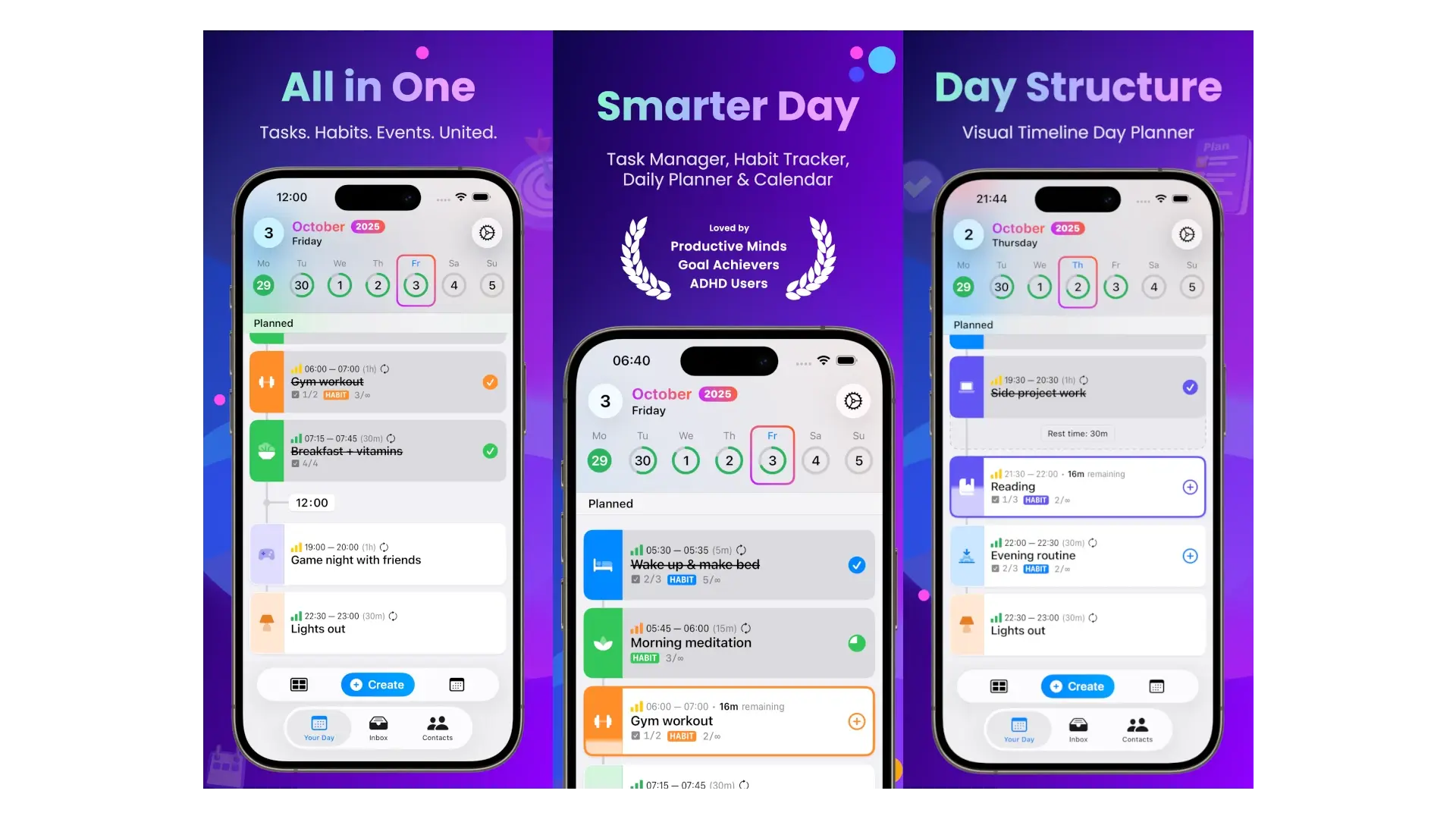
If you want a single place to plan, focus, and review without the noise, try the productivity app at Smarter.Day. It supports time blocking, batching, and reviews—so you can execute these strategies without juggling five tools.
You May Also Like
These Related Stories
13 Proven Time Management Strategies for Busy Minds
13 Proven Time Management Strategies for Busy Minds
No Comments Yet
Let us know what you think