

Master Your Time: 12 Proven Ways to Work Smarter Daily

Master Your Time: 12 Proven Ways to Work Smarter Daily
We all know the feeling: your to-do list explodes, pings multiply, and priorities blur. You promised yourself today would be different—yet procrastination sneaks in, and focus slips. Here’s the catch: productivity isn’t a personality trait; it’s a system. With the right time management strategies, prioritization frameworks, and focus tactics, you can reduce overwhelm and reclaim control. This guide distills research-backed methods for time optimization and workflow improvement so you can get more of the right work done—without burning out.
Our goal is simple: give you actionable, step-by-step techniques that you can implement immediately. You’ll learn how to plan your day around peak energy, protect deep work, prioritize effectively, and iterate using smart metrics. We’ll weave in real-life examples, credible studies, and proven books to help you improve cognitive performance and build sustainable routines. Ready to upgrade how you work and live? Let’s dive in.
1) Map Your Energy with Time Blocking
Most calendars treat every hour the same, but your brain doesn’t. Start by running a one-week energy audit: note your alertness each hour and the tasks you tackled. Then use time blocking to assign deep-focus work to your peaks and admin to your dips. Daniel Pink’s book “When” and chronobiology research by Till Roenneberg suggest aligning high-cognitive tasks with your chronotype (lark, owl, or third bird) improves performance. This simple shift boosts focus and reduces the willpower needed to start.
Method two: create a template week. Pre-place recurring blocks (deep work, collaboration, admin, learning) in your calendar so your plan supports your priorities by default. A real-life example: a UX designer discovered 9–11 a.m. was her sharpest window. She reserved it for design sprints, moved meetings after lunch, and cut average revision cycles by 30% within a month.
To make it stick, add guardrails: turn on “Focus” modes during deep blocks, set meeting-free mornings, and batch Slack and email checks. Keep a buffer block daily for overflow. Over time, refine your map using quick notes: Which block felt effortless? Which task dragged? This iterative loop compounds.
2) Prioritize with the Eisenhower Matrix and RICE
Not everything matters equally. Use the Eisenhower Matrix to sort tasks by urgent/important. Prioritize “Important, Not Urgent” (Quadrant II) work—strategy, prep, relationship-building—made popular through Stephen Covey’s “The 7 Habits of Highly Effective People.” Pair it with a daily “Top 3” to focus your limited attention on high-impact outcomes. This reduces reactive firefighting and supports long-term goals.
When you manage larger backlogs, use RICE scoring (Reach, Impact, Confidence, Effort), popularized by Intercom for product roadmapping. Score initiatives and compute a priority ranking. Example: a product manager weighed three features. A low-effort, medium-impact fix outranked a flashy, high-effort feature, accelerating customer satisfaction faster. The team gained momentum and avoided scope creep.
Practical methods to implement:
- Block 10 minutes each morning to label tasks by quadrant.
- Score project candidates with RICE monthly and re-check “Confidence” as new data arrives.
- Keep a “Not Now” list to avoid cognitive clutter while honoring future opportunities.
These systems elevate your decision quality while keeping the workload realistic.
3) Build Distraction-Proof Deep Work Sessions
If you want meaningful output, protect Deep Work. Cal Newport’s “Deep Work” argues that sustained, distraction-free focus is a superpower in a noisy world. Start with two daily 60–90-minute deep sessions. Silence notifications, use a blocker like Freedom or Cold Turkey, and work in full-screen mode. Research by Gloria Mark (“Attention Span,” 2023) shows average screen focus fragments in under a minute—so engineering your environment matters.
Add a pre-commitment ritual: set a specific goal (e.g., “draft outline + two sections”), clear your desk, and place only needed tools within reach. A marketer I coached used a “focus card” on her keyboard listing the session’s target. She doubled content throughput in six weeks and reported less end-of-day fatigue.
Two more methods boost results:
- Use a “distraction capture” pad to jot intrusive thoughts without switching.
- End each session with a 2-minute summary and next action, creating momentum for the next block.
With practice, your brain learns the cue and falls into flow faster.
4) Batch Tasks to Cut Context Switching
Every time you switch tasks, your brain pays a toll. Classic research by Rubinstein, Meyer, and Evans (2001) shows context switching drains time and increases errors. Gerald Weinberg’s heuristic suggests each concurrent project can cost around 20% efficiency. The fix: task batching. Group similar tasks—email, approvals, analytics—into windows so you leverage the same cognitive setup.
Method two: limit daily “processing windows.” For example, check email at 11:30 and 4:30, not constantly. A CFO I worked with grouped invoice approvals, budget reviews, and vendor responses. She shaved 90 minutes off her day, and more importantly, reclaimed morning focus for financial modeling.
To implement:
- Create “lanes” in your calendar: communications, operations, creative, and strategy.
- Keep separate browser profiles for each lane to avoid tab chaos.
- Use templates (email snippets, approval checklists) to speed repeated work.
Over a month, you’ll see tangible workflow improvement and steadier attention.
5) Use Pomodoro, Ultradian Breaks, and 52/17
The Pomodoro Technique (Francesco Cirillo) uses 25-minute focus sprints with 5-minute breaks. It’s great for starting hard tasks and maintaining momentum. But here’s the nuance: different bodies need different rhythms. Nathaniel Kleitman’s research on ultradian cycles suggests 90-minute focus waves followed by 15–20-minute breaks can match natural energy patterns. Test both and track output and fatigue.
Another option: the DeskTime/Draugiem Group analysis that popularized the 52/17 pattern—roughly 52 minutes on, 17 off—correlated with high productivity in real work settings. An engineer alternated two 52/17 blocks before lunch. Result: fewer afternoon crashes and consistent code quality.
Practical methods:
- Choose your cadence (25/5, 52/17, or 90/20) and stick to it for a week.
- During breaks, avoid screens—walk, stretch, hydrate.
- Every fourth short break, take a longer one to reset your attention.
Your goal is sustained performance, not heroics.
6) Capture, Clarify, and Organize: GTD + Second Brain
When your mind holds tasks, it can’t think clearly. David Allen’s GTD (Getting Things Done) starts with capture: funnel ideas, tasks, and open loops into a trusted inbox. Next, clarify: decide the next action, the context, and whether it’s a project. Finally, organize: sort by lists (“Calls,” “Errands,” “Deep Work”) and calendars. The result is less anxiety and smoother execution.
Pair GTD with Tiago Forte’s Second Brain and PARA (Projects, Areas, Resources, Archives). Store notes, references, and templates by project to retrieve them in seconds. A consultant built a proposal library and cut drafting time by 40%. More importantly, she stopped reinventing the wheel under pressure.
Practical methods:
- Keep one capture point on each device.
- Clarify daily for 10 minutes; review weekly for 45 minutes.
- Use templates for recurring tasks (meeting agendas, briefs, SOPs).
This system turns chaos into a reliable workflow.
7) Plan Weekly Sprints and Daily Wins
Borrow from agile: run a weekly sprint. On Friday or Monday, pick 3–5 outcome-based goals, time-box them on your calendar, and identify dependencies early. Teresa Amabile’s “Progress Principle” shows that visible progress, even small, fuels motivation. Ending the week with clear wins builds momentum and reduces weekend worry.
Daily, commit to the Big 3: three must-do tasks aligned to your sprint. A high school teacher used this to balance lesson planning, grading, and parent emails. By time-boxing the Big 3 before noon and batching emails later, she left school on time three days a week for the first time in years.
Practical methods:
- Use a sprint board with columns: Planned, In Progress, Done.
- Hold a 10-minute stand-up with yourself or a buddy each morning.
- Conduct a Friday retrospective: what to start, stop, continue.
This simple cadence sharpens planning and priority clarity.
8) Design Habits with Tiny Steps and Intentions
Big changes fail when they rely on willpower. James Clear’s “Atomic Habits” and BJ Fogg’s “Tiny Habits” show that tiny actions stacked onto existing routines drive sustainable behavior. Try habit stacking: “After I brew coffee, I’ll write one sentence.” Once the cue fires, the action becomes automatic and expands naturally.
Add implementation intentions (Peter Gollwitzer): “If it’s 8:30 a.m., then I open my editor and draft for 25 minutes.” This reduces ambiguity and increases follow-through. A writer used these techniques and went from sporadic bursts to 500 words before 9:30 a.m., five days a week—without the drama.
Two more methods:
- Design your environment (open your doc, lay out shoes, pre-load playlists) to make the desired action the path of least resistance.
- Use “temptation bundling” (e.g., only listen to a favorite podcast while walking).
Small steps, big compounding returns.
9) Backcast Projects and Protect the Critical Path
Start with the end in mind, then plan backward—this is backcasting (John B. Robinson). Define “done,” set a realistic ship date, and identify critical path tasks that must happen in sequence (PMI, Critical Path Method). Add buffers to resist Parkinson’s Law (work expands to fill the time) and the student syndrome (late starts). Reverse milestones help you spot risks sooner.
Practical method: build a one-page plan with milestones, owners, and risks. A marketing team launched a product webinar series by backcasting from a fixed date: assets, landing page, email drip, rehearsal. They placed a 2-day buffer before legal review. Result: on-time launch with fewer last-minute scrambles.
Another method: apply “Critical Chain” thinking (Eliyahu Goldratt). Protect your bottlenecks and limit work-in-progress to prevent overload. Weekly check-ins ensure dependencies are cleared before they become blockers. Clarity beats chaos every time.
10) Tame Email and Chat with Asynchronous Rules
Email and chat can devour your day. McKinsey once estimated knowledge workers spend about 28% of the week on email; that’s a giant lever. Implement asynchronous norms: set 2–3 windows for communication and default to a 24-hour response SLA for non-urgent messages. Use the 4Ds triage: Delete, Delegate, Defer, Do. Nir Eyal’s “Indistractable” argues that managing internal triggers also reduces reactive checking.
A startup team adopted office-wide “Focus Hours” from 9–11 a.m. and moved quick questions to a shared doc reviewed at 11:30. Within two weeks, meeting count dropped by 20% and cycle time improved. People felt less “on-call,” more in control.
Practical methods:
- VIP filters for key clients and emergencies.
- Agenda-first meeting invites; decline if there’s no clear outcome.
- Use threads and emojis to reduce noisy back-and-forth.
Your attention is a finite resource—treat it like one.
11) Boost Cognitive Performance with Sleep, Movement, Fuel
You can’t out-hustle physiology. Prioritize 7–9 hours of sleep; Matthew Walker’s “Why We Sleep” outlines how sleep consolidates memory and supports cognitive performance. Keep a consistent sleep window and dim screens an hour before bed. Add movement: even short walks improve executive function (see John Ratey’s “Spark” on exercise and the brain).
Fuel matters too. Opt for low-glycemic meals to avoid energy crashes; steady glucose supports attention. A financial analyst began taking 10-minute movement breaks, switched to a protein-rich lunch, and stopped late-night email. Afternoon errors dropped, and deep work felt “lighter.”
Two more methods:
- Light exposure: get 5–10 minutes of morning daylight to anchor circadian rhythms.
- Micro-recovery: 60-second box breathing between meetings to reset the nervous system.
Treat your body like a high-performance engine.
12) Measure, Limit WIP, and Iterate Your System
“What gets measured gets managed,” said Peter Drucker. Start with a time audit using a simple log or a tool like RescueTime to see where your hours really go. Then set WIP limits (work-in-progress) inspired by Kanban (David J. Anderson). Little’s Law shows throughput increases when you reduce items in progress—focus increases, cycle times shrink.
A design agency limited each designer to two active projects. They tracked cycle time and on-time delivery weekly. After one month, deadlines improved by 25%, and rework decreased. The team reported less stress and more creative headroom.
Practical methods:
- Pick 3 metrics: deep hours, completed outcomes, and cycle time.
- Run a weekly retrospective: what worked, what didn’t, what to try next.
- Change one variable per week; avoid overhauls that mask signal.
Continuous improvement beats occasional overhauls.
Conclusion
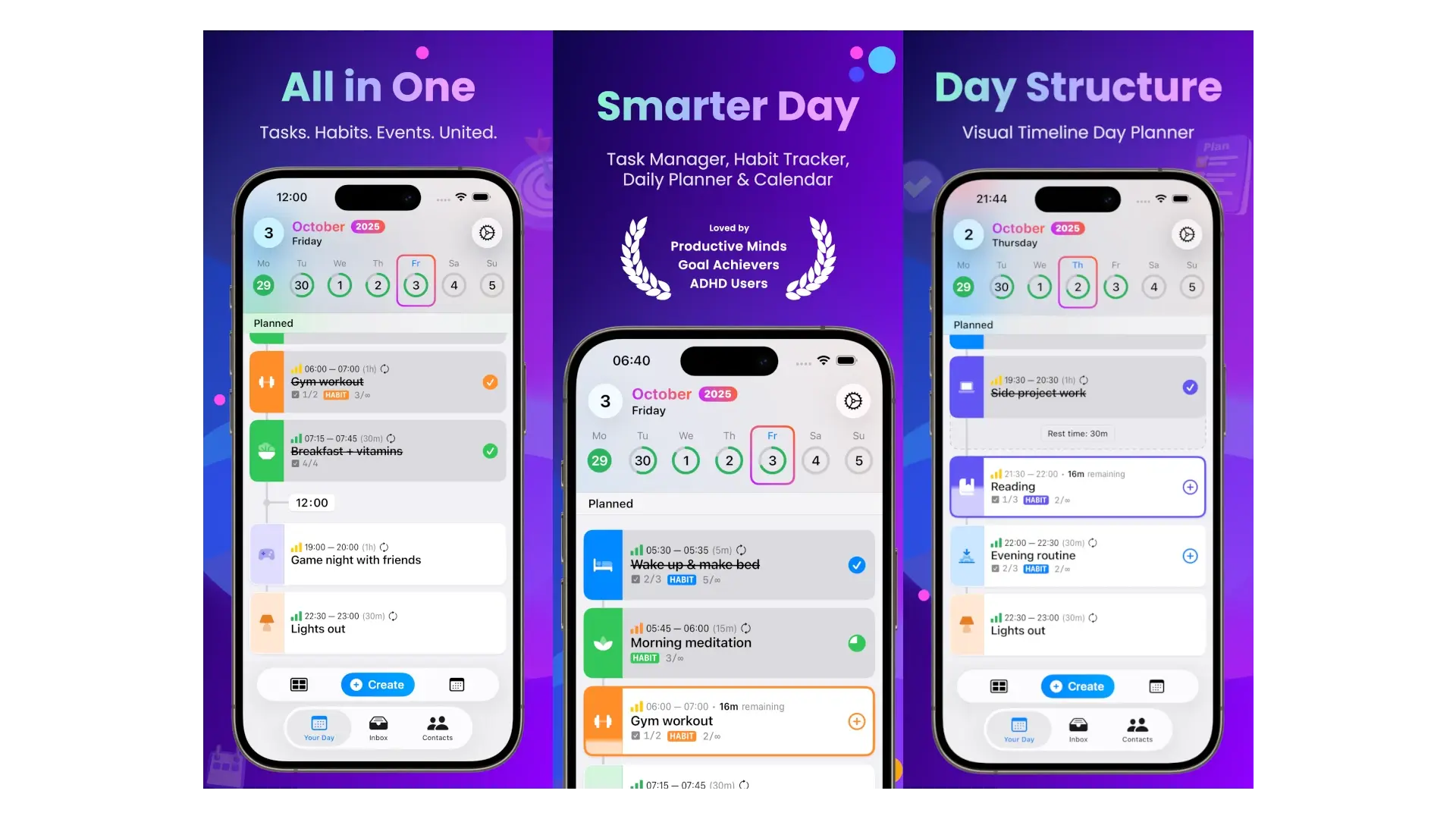
You don’t need more hours—you need better systems. By aligning work with your energy, protecting deep focus, prioritizing with intention, and iterating with smart metrics, you’ll compound gains week after week. Start small, test, and refine until your day runs on rails. And when you’re ready to streamline these habits with one reliable toolkit, try the productivity app at Smarter.Day. It brings time blocking, prioritization, and review rhythms into one simple workflow, so you can execute more and stress less.
Your time is your edge. Design it on purpose, and the results will follow.
You May Also Like
These Related Stories
Master Your Time: 12 Proven Ways to Work Smarter Daily
Master Your Time: 12 Proven Ways to Work Smarter Daily
No Comments Yet
Let us know what you think