
10 Proven Time Management Strategies That Actually Work

10 Proven Time Management Strategies That Actually Work
Most of us have had times that vanish into Slack pings, email threads, and “fast” meetings. You start with zeal, then end up multitasking everywhere, and then ask yourself why you didn't notice the time. Here is the paradox: productivity is not about fitting many more tasks into your day, but about time optimization that enhances your workflow and eliminates friction. In this handbook, we make it straightforward and present solutions based on research findings so that you can handle anxiety better, overcome procrastination, and perform your most valuable work regularly.
Our aim is very clear: show you how to make better decisions about your attention, which are your priorities, and where you are focusing your energy. You will acquire tactical moves—such as time blocking, prioritization, deep work, and automation—and you will learn how to weave them into a practice that you can actually maintain. We will combine insights from top experts and authors with personally engaging stories to help you improve your performance while avoiding burnout. Are you prepared to work smart, not just harder?
Start With a Time Audit: Measure Before You Optimize
You can't improve your time management if you don't even know where your time is spent. You should start with a time audit: for one week, note down your activities in categories such as deep work, meetings, email, and admin. Use tools or a basic spreadsheet and index tasks with energy levels. Gloria Mark's research at UC Irvine shows that interruptions often prolong the time needed to complete tasks, and a baseline helps you identify where attention leaks. Two ways to start: first, record every task in 15-minute increments; second, color-code your calendar retroactively to see patterns.
The next step is to determine your Time ROI. Figure out your high-impact tasks (for instance, client proposals, design, and strategy) and low-value tasks (for example, formatting documents and redundant check-ins). A simple rule to adopt: Which activities produce results you are proud of? Which ones can be removed, automated, or delegated? Peter Drucker, the great businessman and author, remarked, "What gets measured, gets managed." By looking at your exact calendar, you will be able to avoid guesswork and see workflow patterns more clearly.
For instance, a marketing manager recorded her week and realized that 9 scheduled hours in status meetings had no impact on outcomes at all. Two live meetings were switched to asynchronous updates, reclaiming 6 hours for campaign testing. The result was a 23% increase in ad performance in just two weeks, which proves that a simple measurement can unlock time management innovation.
Time Blocking and the Maker’s Schedule
Once you have identified where time goes, time blocking becomes a tool for managing it. Schedule 90–120-minute deep work sessions for difficult tasks, and shorter bursts for email and admin. Cal Newport, in his book Deep Work, proposes that concentrating on a task without distractions can become a "superpower" in our hyperconnected world. Method 1: Create a weekly template with recurring deep work blocks. Method 2: Set buffer blocks after intense sessions to prevent context switching from ruining your momentum.
Guard your "maker hours." Paul Graham's "Maker's Schedule, Manager's Schedule" makes clear that meetings disrupt creators. Group meetings into afternoons or just one day of the week, so you have unbroken time for building, writing, or coding. Consider including "No-Meeting Mornings" for two days a week. This creates a constant rhythm where creative output is not routinely interrupted by reactive requests.
For instance: A product designer adroitly switched the usual stand-ups and stakeholder calls to late afternoons. As a result, she designed two versions and shipped them three weeks ahead of schedule. The team then decided to implement "maker mornings" in their routine, which improved sprint velocity by 18%. By plugging work into high-energy periods, she turned previously random efforts into consistent performance gains.
Prioritize with the Eisenhower Matrix and the Pareto Principle
Not all work is equal. The Eisenhower Matrix is a simple way to arrange tasks into four parts: urgent/important, not urgent/important, urgent/not important, and not urgent/not important. It was Stephen Covey who brought this framework into popularity, and it is still a very efficient tool for prioritization. Method 1: Schedule the “not urgent but important” tasks first, such as strategy, planning, and learning. Method 2: Aggressively delegate or erase tasks that are urgent but not important.
Join it with the Pareto Principle (80/20 rule) from the economist Vilfredo Pareto. Find out the 20% of work that is responsible for the 80% of results—then focus on these actions. Make a minimal list of “Critical 20” and distribute your deep work time blocks exclusively there. This way, you will be working toward maximum impact, instead of just being busy.
Example: A freelance worker reviewed her client workload and noticed that two clients brought most revenues but got the least attention due to smaller accounts' urgency. She utilized the matrix by reallocating time and, as a result, witnessed a growth of 27% in her monthly income. The change wasn’t about working more hours—it was time optimization that relied on leverage.
Reduce Context Switching with Single-Task Sprints
Multitasking may be presumed as a method to enhance efficiency, yet research by the American Psychological Association reveals that the task-switching phenomenon may lead to productivity losses of up to 40%. In order to be more productive, apply the practice of single-task sprints. For instance, the Pomodoro Technique designed by Francesco Cirillo can be used (25 minutes on, 5 minutes off) to create brief, concentrated intervals. Another suggestion is to combine related tasks—reply to emails one or two times a day, process tickets together, and write content in themed blocks.
Initiate sprint rituals. Before a sprint, close unnecessary tabs, mute notifications, and establish a definitive "win condition" (like drafting two sections, processing 15 emails). Record progress in a log. This technique creates mental clarity and continuous forward movement. Over time, your brain will speed up the transition to a focusing state, thus enhancing cognitive performance.
A practical example: a support lead batched customer replies into a couple of 45-minute slots and kept a 90-minute block just for documentation. Ticket resolution time rose 15% and escalations decreased. He attributed the changes to fewer interruptions and a clearer focus, aligning with Gloria Mark’s study that fewer shifts improve performance and lower stress levels.
Build Keystone Habits and Routines You Can Sustain
Developing habits is an effective way to reduce decision fatigue and make consistency effortless. James Clear in his Atomic Habits and BJ Fogg in his Tiny Habits insist on the need for small, reliable actions. Method 1: Habit stacking—pair a new habit with an old one (“After I open my laptop, I review my top 3 tasks”). Method 2: Implementation intentions from Peter Gollwitzer (“If it’s 8:30 a.m., then I start my deep work block”), which create clear cues for action.
Design routines according to triggers and rewards. To start the day on a focused note, your triggers may be coffee + playlist + do-not-disturb, and the reward is a 10-minute walk. Keep habits visible with checklists or a desk card. As BJ Fogg points out, making the behavior tiny and consistent beats occasional intensity. The goal is to pre-script your ideal days.
Example: A sales representative created a pre-call routine: reviewing notes, rehearsing two objections, and calling. Her conversion rate rose by 12% after two weeks of this new habit. The habit was not complicated—it was consistent. Through building keystone habits, she improved workflow and outcomes without adding more hours of work.
Design Your Environment for Frictionless Focus
The environment is your constant ally. Automatically decrease cognitive load so your brain can focus. John Sweller's Cognitive Load Theory holds that distractions overburden working memory. Method 1: Make a distraction-free desktop—one screen per task, minimalist dock, email closed while working deeply. Method 2: Use physical cues: a standing sign, noise-canceling headphones, or a desk light that signals “focus mode” to others.
Embrace digital minimalism. Cal Newport advocates for limiting optional technologies that do not significantly aid your goals. Check your apps and notifications; remove non-essential alerts. Block access to your personal kryptonite apps during intense work periods. Reducing inputs will improve your ability to focus and diminish the allure of switching contexts.
Example: A project manager wiped social media icons from her first screen and kept only three work apps visible. She also put her phone in grayscale during work blocks. She reported checking the phone less often and, as a consequence, delivered two roadmaps earlier than planned. One simple change in the environment led to compound benefits in performance.
Optimize Energy and Cognitive Performance, Not Just Time
Poor energy management is the main reason time management fails. Matthew Walker, author of Why We Sleep, shows that the quality of your sleep determines how memory, attention, and decision-making improve. Method 1: Protect a consistent sleep window and finish caffeine 8–10 hours before bedtime. Method 2: Work with your ultradian rhythms—take a 5–10 minute break every 90 minutes to reset attention and maintain cognitive performance.
Plan tasks requiring high cognitive ability during the times you naturally feel most awake. Several people have peak time mid-morning; some have it in the afternoon or evening. The research of Anders Ericsson on deliberate practice shows that intense work for a short period is more effective than working for a long time with an unfocused mind. Schedule deep work when your energy is highest and save administrative tasks for energy dips. Movement or short outside breaks are another option.
Example: A data analyst moved analysis to 10 a.m. and emails to 2 p.m. Moreover, he took a 10-minute walk after each deep work block. Within a month, error rates were lower and review cycles shorter. He didn't have to shift tools; instead, he connected time with biology. That is the best time optimization.
Automate and Template Repetitive Work
Automation acts as a multiplier. According to McKinsey research, nearly a third of company work could be done with present technologies. Method 1: Automate repetitive tasks by using tools such as email filters, calendar rules, text expanders, and integration platforms. Method 2: Create templates for recurring projects—proposal decks, sprint checklists, onboarding docs—to eliminate reinvention and reduce cognitive load.
Checklists are a good way to maintain consistency. Atul Gawande's The Checklist Manifesto argues that using standard lists can cut down errors and create mental room. Make a "starter kit" for your most frequent workflows. Continue to stay in business by maintaining a library of SOPs (standard operating procedures) so that your team can execute without your ongoing input.
A real example: An ops lead created a supplier onboarding checklist and triggered emails. Cycle time dropped from 12 days to 7, and escalations were cut in half. The magic was not heroics; it was workflow improvement by restructuring processes and smart automation.
Plan Weekly with Objectives and Daily with Constraints
Schedule the week, not only the day. The GTD method of David Allen stresses the necessity of a weekly review. This is to clear your mind, update projects, and choose next actions. Method 1: Set weekly Objectives using OKRs inspired by John Doerr and define measurable results. Method 2: Cap daily work with constraints—“Top 3” outcomes and a hard stop to avoid scope creep, leveraging Parkinson’s Law (“work expands to fill the time available”).
Your planning cycle might appear like this:
- Fridays: Review, capture, and prioritize for next week
- Mondays: Confirm weekly objectives and time blocks
- Daily: Select Top 3, schedule deep work, batch communication
Example: A startup founder set two weekly objectives, including shipping a pricing test and recruiting two advisors. Each day, she chose a Top 3 task that connected to those goals. This resulted in better output, but most importantly, stress levels decreased. The clear constraints prevented her from becoming reactive and helped her focus on what was really important.
Communicate to Protect Focus: Asynchronous by Default
The MS Work Trend Index found that employees spend considerable time covering digital communication, often at the expense of focused work. These changes can allow you to work more efficiently and reduce the stress of communication. Method 1: Use asynchronous communication for status updates, brainstorms, and documentation—shared docs and recorded walkthroughs. Method 2: Set quiet hours and reply norms so people will not feel bad for not responding on time.
Make a team charter that specifies when you will meet and when you will write. Jason Fried from Basecamp recommends a “calm company” routine: fewer meetings, written decisions, and fixed schedules. Hence focus is on long-term attention and better performance rather than constant pinging of adrenaline. Asynchronous defaults are the sword that guards deep work at the organizational level.
Example: A remote team moved weekly status meetings to an async doc with a 24-hour comment window. They kept one live sync for blockers. Over a quarter, they recovered 5 hours per person per week and increased on-time delivery. Less talk, more throughput—a simple workflow improvement with outsized results.
Execute with Single-Source Systems and Clear Next Actions
Tools scattered all over the place lead to a diversion in focus. Shift tasks 100% to a single source of truth—a task manager or project tool everyone simply trusts. Method 1: Codify the project as a sequence of clear action steps (“Draft outline,” “Email Sandra,” “QA version 1”). Method 2: Affix tasks directly to resources (docs, briefs, specs) so you don't lose context and momentum.
Diminish friction with standard naming and tagging. Task names should start with verbs, due dates should be added, and tasks should be linked to outcomes. The Zeigarnik effect indicates that when tasks are not finished, they occupy the mind in a negative way; capturing and clarifying them will reduce anxiety and boost focus. David Allen's statement about "what's the very next physical action?" is still the classic productivity tool.
Exemplary: The content team centralized requests on a single board and eliminated tasks from chats. Their briefs and drafts were attached to the cards, and “Next Actions” were specified. Their throughput increased, and far fewer tasks slipped through the net. Clarity trumped chaos, and without recruiting new staff, their time management improved as well.
Build Recovery and Reflection Into the System
Renewal is the essence of high performance. Researcher Teresa Amabile shows that small accomplishments and visible progress pave the way for motivation (The Progress Principle). Method 1: Two-minute shutdown—at the end of each day, write down your wins, list the blockers, and decide upon the top three tasks for the next day. Method 2: Plan active recovery—strolls, light workouts, and social breaks—to reset your mind and creativity.
Weekly reflection serves as a strategy for change: What produced overwhelmingly more? Where did time dissolve? What are your plans for next week? The concept of flow described by Mihaly Csikszentmihalyi is the state of mind found by setting clear goals and getting immediate feedback. A feedback loop is four times more effective than simply doing the experience, turning it into a compounding skill.
Example: A software engineer put a daily “wins and lessons” card on her board. She discovered that if she started the day with code reviews before deep work, it slowed her day. Consequently, she rearranged them, guarded her mornings, and shipped products with less pressure. Reflection turned individual stories into real-time optimization techniques.
Conclusion
Admit it—there is no single shortcut that transforms everything overnight. However, when you put together time audits, time blocking, priority frameworks, single-task sprints, and automation, you create self-sufficient machinery that enhances your performance week by week. Start small: safeguard one deep work block, choose a Top 3 for tomorrow, and batch your communication.
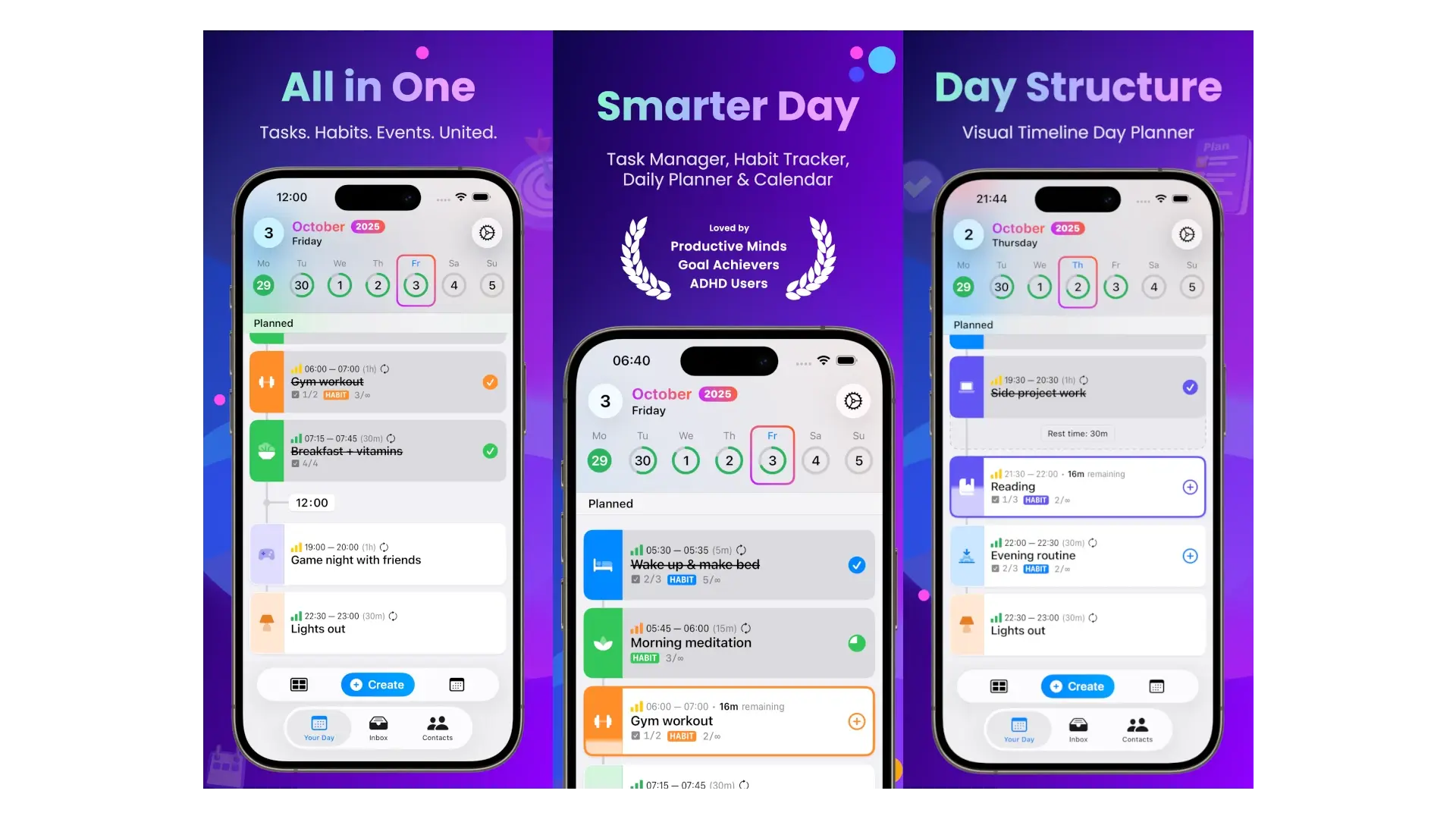
If you want these strategies all in one place—track habits, plan weekly, run deep work timers, and manage tasks—use the productivity app at Smarter.Day. The app is the best way to avoid friction, secure focus, and get your optimal outcome.
CTA: Are you set to organize your schedule and get genuinely productive work done? Find out Smarter.Day and integrate these solutions into your daily routine.
You May Also Like
These Related Stories
Time Management That Works: 12 Evidence-Based Tactics
Time Management That Works: 12 Evidence-Based Tactics
No Comments Yet
Let us know what you think