
Advanced Time Management for Peak Productivity Today

Time Management Mastery: Advanced Strategies for Peak Productivity
Have you ever opened your laptop, vowing to be different today, yet still felt dragged into the sea of notifications, emails, and urgent-but-irrelevant tasks? Modern work resembles a nonstop attention tax, no matter how we try to express it. The reassuring thing is that more hours won’t help; you need time management tools and concentration techniques that work in accordance with your brain’s modes. In this blog, we are going to discuss the best evidence-based techniques to use your time efficiently, protect your attention, and streamline your workflow.
We are not going to just throw out some common tips; we will give you practical methods that you can implement right away—energy-respecting time blocking, prioritization frameworks that help you cut down your to-do list, and cognitive tactics that will help you do deep work. You are going to create a long-term, sophisticated playbook for performance, time optimization, and workflow improvement without worries, thanks to real examples, reliable sources, and handy tools.
Design Your Day with Time Blocking and Energy Mapping
The first stage of our program is to adjust your tasks to your ultradian rhythms—natural 90–120-minute energy cycles described by sleep researcher Nathaniel Kleitman. The first method to achieve that program is to make a simple energy audit for a week and rate hours 1–5 on the alertness scale; then cluster the highest-priority tasks that you need to do during the two daily peaks. The second method is to set 90-minute deep work blocks with a recovery break. Cal Newport, in his book “Deep Work,” argues that maintaining focus can be done much better with scheduled time blocks compared to interruption-free environments.
In real life, Maya, a product manager, moved specs and architecture reviews into a block of time from 9:30 to 11:00 a.m., and she moved status pings to late afternoon. In just two weeks, she cut rework by 30% since the decisions she made at that time were much more solid. She arranged her admin work for 3:30–4:30 p.m.—which she was sure would be easily done. The outcome: less context switching, more time optimization.
Creating a boundary is another step to consider: if the task goes beyond 90 minutes, divide it into sub-goals with clear “done” criteria. That will make your attention more concentrated and will also increase momentum. As Newport argues, “Clarity of task plus constraints breeds focus.” Place a timer in a visible position and lock your calendar to secure that block; treat it like a meeting with your future self.
Prioritize the Right Work: Eisenhower Matrix Meets Pareto
Speed and progress are often confused. Two methods help: the Eisenhower Matrix and the Pareto Principle (80/20). First, sort tasks into four quadrants according to urgency and importance; schedule the “Important/Not Urgent” items immediately or they’ll be crowded out. Second, identify the 20% of tasks that will bring about 80% of the outcomes. Greg McKeown, in “Essentialism,” calls this pursuit of the vital few the only path to meaningful progress.
Luis, who runs a small agency, applied the matrix on Monday mornings. He discovered that client strategy (non-urgent, important) got pushed aside by email fire drills. He locked two 90-minute strategy sessions weekly and assigned urgent/low-value items. In four weeks, new retainers rose 25% due to the time finally given to high-leverage work. A quote to remember: “If you have more than three priorities, you don’t have any.” —Jim Collins.
To make the filter better, try The ONE Thing question from Gary Keller: “What’s the one thing I can do such that doing it will make everything else easier or unnecessary?” The answer, of course, becomes your daily keystone task. Pair it with a yes/no checklist that protects resources from drift.
Turn Procrastination into Motion with Micro-Starts
Stalling is not a defect of personality but a design error. Two strategies work well. First, apply implementation intentions (Peter Gollwitzer): “If it’s 8:30 a.m., then I open the brief and write 50 words.” The if–then formula removes decision friction. Second, use the 5‑Minute Rule: commit to just five minutes; once you start, the Zeigarnik effect (unfinished tasks nag memory) will enhance your persistence. Piers Steel, in his book “The Procrastination Equation,” demonstrates that cutting delay and increasing expectancy results in rapid action.
Real example: Anika, a graduate student, loathed literature reviews. She used a 5‑minute timer to quote three, and then she continued naturally for 40 minutes. After a fortnight, she finished the chapter she had hesitated for months to write. Also, try temptation bundling (Katherine Milkman): associate a preferred activity (favorite playlist) exclusively with the task you resist. It is about reframing the initiation.
Make it practical: organize a frictionless first step the night before. For example, open the files, bullet the outline, and put the books on your desk. “You don’t rise to the level of your goals; you fall to the level of your systems.” —James Clear, “Atomic Habits.” Your safety net is the system.
Control Email and Chat Before They Control You
McKinsey found that workers spend 28% of the workweek on email. To manage this, batch email and chat to two and three times per day, respectively. Method two is the use of David Allen’s Two‑Minute Rule: sort tasks based on how much time they will take; do first the things that will take no more than two minutes (and put them in a Done list); otherwise, move them to a folder or a task manager that has an action and the next deadline. Thus, you keep your mind clear and thereby focus.
A real example illustrates this: Priya, a sales lead, established email hours at 11:30 a.m. and 4:30 p.m., and turned off desktop notifications. She introduced templates for standard replies and a “triage in 10” routine: delete, delegate, defer, or do. During the first month, she recovered 5+ hours weekly, improved replies, and stopped after‑hours work. Her team copied these practices, leading to shorter meetings due to clearer thread discussions.
Additionally, add two protective measures: batch newsletter reading into a weekly learning slot and route notifications via VIP filters so only high-priority senders break through. You’ll experience immediate workflow improvement by reducing random pings that fragment attention.
Single-Tasking Wins: Reduce Switching Costs and Close Tabs
The American Psychological Association states that task switching can reduce up to 40% of productive time; a Stanford study (Ophir, Nass, Wagner) also points out that media multitaskers perform worse on attention tasks. The first method is to use a single‑task protocol: one tab for each task, one device mode (e.g., Do Not Disturb), and a timer. The second method is to create distraction fences using site blockers and a “Parked Ideas” note to capture off‑topic ideas without chasing them.
A real example is Theo, a software engineer, who shut 17 tabs, kept only the story ticket and IDE open, and used a 60‑minute timer. He parked his curiosities—like wondering about Stack Overflow rabbit holes—on a scratchpad. Velocity improved by 18% over two sprints because his context load got smaller. “Focus is a muscle—train it deliberately.” The cognitive lift from fewer toggles is immediate.
For escalations, establish response SLAs (for example, check chat at :25 and :55). This makes single‑tasking socially acceptable and predictable for your team, thereby promoting deep cognitive performance time.
Make Meetings Work: Shorter, Sharper, Fewer
The problem with meetings is not the meetings themselves but the poorly designed ones. Method one: set no‑meeting zones (e.g., 9:00–12:00) to protect deep work. Method two: require A.P.A.—which stands for Agenda, Purpose, and Action owner—before allowing anyone to be added to the invitation. The Microsoft Human Factors Lab found that short breaks between meetings help retain interest and elevate mood; schedule 5‑minute buffers by default to avoid cognitive pileups.
Real example: a fintech ops team reduced recurring meetings from 14 to 8, enforced 30‑minute defaults, and adopted a decision log. In six weeks, they achieved a 22% reduction in average cycle time without anyone missing context. Harvard Business Review authors (Leslie Perlow et al.) demonstrate that the introduction of measures such as “quiet time” and structured communication can produce significant enhancements in satisfaction and productivity.
Use this rhythm: Mondays for planning, Wednesdays for problem-solving, Fridays for retrospective and recognition. Keep invites low; “If you’re not making decisions or providing data, you don’t need to be there.”
Visualize Work: Kanban and WIP Limits for Flow
Visibility is a significant factor that propels knowledge work. One way to do this is to create a Kanban board (To Do, In Progress, Review, Done), which is an excellent way to identify problems. A second method is to set WIP limits (work in progress) to prevent overload—finish one before you start another. The Kanban method, introduced by David J. Anderson, is based on Lean and the Toyota Production System (Taiichi Ohno): reducing inventory increases speed by decreasing idle time and context switching.
An actual example of this was a marketing team that fixed WIP to two items per person and added a Definition of Done checklist (asset links, approver named, due date). As a result, campaign lead times dropped by 27%, and handoffs were cleaner. The phrase that reminds me of this is “Stop starting, start finishing.” By guarding the flow, you bring in workflow improvement without additional personnel.
Furnish your board: bring in additional tags (blocked), an aging indicator, and a weekly throughput review. After some time, you will understand actual capacity and be able to forecast delivery with far less stress.
Boost Cognitive Performance: Breaks, Pomodoro, and Light
Consider directing attention as a sprint, not a marathon. Program one: make use of Pomodoro (25/5) or a 52/17 pattern in cycling effort and recovery; both protect against overtaxed attention. The Pomodoro Technique by Francesco Cirillo remains effective because it limits work, creates urgency, and normalizes breaks. Program two: do not forget biology—use morning light exposure to anchor circadian clocks and improve alertness, then protect sleep. According to Matthew Walker’s “Why We Sleep,” memory, creativity, and performance are driven by the quality of sleep.
Real example: Noor, a designer, worked for 3 × 52/17 cycles before lunch with an afternoon 90‑minute block. She introduced a caffeine‑nap, which includes drinking coffee and a 15‑minute nap to boost afternoon mood. Jha et al. (2010) have shown that mindfulness practice enhances working memory and attention; Noor applied a 4‑minute breathing reset between cycles. Fast results: quicker creative loops and fewer late edits.
To keep it simple, you can stack micro‑breaks with movement and water. Build a break menu: walk, stretch, breathe. You can easily prevent “doom scrolling” by putting your phone in another room during work sprints.
Align Effort with Outcomes: OKRs and Weekly Reviews
Busy doesn’t mean productive. Instead of busy, method one: set OKRs—Objectives and Key Results—so weekly tasks map to measurable outcomes. John Doerr’s “Measure What Matters” shows the importance of clear metrics in achieving speed and execution. Method two: hold a weekly review—what has moved, what has stalled, what needs to be changed. Teresa Amabile’s “Progress Principle” suggests that small wins are a significant source of motivation; if you track them, you will gain more momentum.
Actual case: a nonprofit organization dedicated to social work aimed to “Increase donor retention.” The key results included: elevating the 90‑day retention rate from 54% to 64%, reducing response time to 24 hours, and sending two personalized updates monthly. The Friday reviews helped the team exclude a low‑yielding event and double down on onboarding sequences; this caused the KR metrics to go up weekly. The easy‑to‑grasp ideas cut fruitless tasks and ensured maximum time optimization.
Stay simple: three OKRs every three months, and one keystone result for each person at a time. Combine the review with calendar cutting so tasks are aligned with goals instead of being habit‑driven.
Automate the Repetitive: Templates, Snippets, and No-Code
Automation is not a luxury; it is leverage. The first method is to create SOPs and templates for work that recurs often, such as proposals, briefs, meeting notes, and onboarding checklists, which keeps you from starting from scratch. The other approach is to generate no‑code automation (e.g., Zapier or native integrations) for data movement, trigger reminders, and task generation. According to McKinsey, the automation of certain parts of activities in different roles with present technology is possible, thus leaving humans to do more valuable jobs.
Darren, a real‑life example, is a recruiter who made outreach templates as well as a zap for the follow‑up task that would be created 72 hours after any candidate reply. In addition, he used text expanders for FAQs. The result was a 35% faster cycle and fewer dropped threads. A strict rule: automate the boring, humanize the important—use the time you save to build stronger relationships and make better decisions.
Get started with a small step: select one repetitive process to work on this week, develop its SOP, then automate one of its steps. The ball starts rolling.
Make Habits Stick: Stacking and Environment Design
Habits are the key to continuous productivity. The first approach is habit stacking (James Clear), which is pairing a new behavior with an existing one: “After I make coffee, I plan my top three.” The second method is environment design (BJ Fogg), in which the desired action becomes the easy action by putting the book on your keyboard, blocking distracting sites, and laying out running shoes. According to Fogg’s behavior model, three elements—motivation, ability, and prompt—must come together; small changes in the environment increase ability by reducing friction.
For instance, Chen wanted to do deep work daily. He stacked “start timer, noise‑cancelling on, phone in drawer” after opening his laptop. He placed a sticky note with his ONE Thing on the monitor. After 21 days, the sequence felt automatic. “You do not rise to the level of your goals; you fall to the level of your systems.” The system is the habit scaffold that keeps you consistent.
Additional commitment devices are constructing co‑working sessions or publishing a weekly deliverable. Even if your future self is tempted to go back to old ways, the structure helps you stick to your path.
Protect the Asset: Sleep, Recovery, and Boundaries
Output that is sustainable requires recovery. Method one: prioritize 7–9 hours of sleep; Walker’s research connects sleep with memory consolidation, decision quality, and creativity. Method two: use active recovery—light movement, nature, and detachment from work. Organizational psychologist Sabine Sonnentag’s studies show that psychological detachment after work predicts better next-day performance and well‑being.
Real example: A founder added a hard stop at 6:30 p.m., took 20‑minute evening walks, and stopped blue‑light exposure an hour before bed. She woke earlier, maintained a consistent routine, and found deep work easier by 8:30 a.m. Her team followed with weekly no‑after‑hours guidelines. The payoff: better morale and fewer “urgent” late‑night mistakes.
Set boundaries: decide in advance your off hours, protect them with calendar blocks, and inform collaborators. Recovery isn’t indulgence; it’s a performance strategy.
Conclusion
You don’t need a miracle morning to achieve peak productivity—you need a practical stack of systems that respect your attention, energy, and goals. We covered time blocking, prioritization, procrastination fixes, communication control, focus protocols, meetings, Kanban, cognitive performance routines, OKRs, automation, habits, and recovery. Choose one method per section and implement it this week.
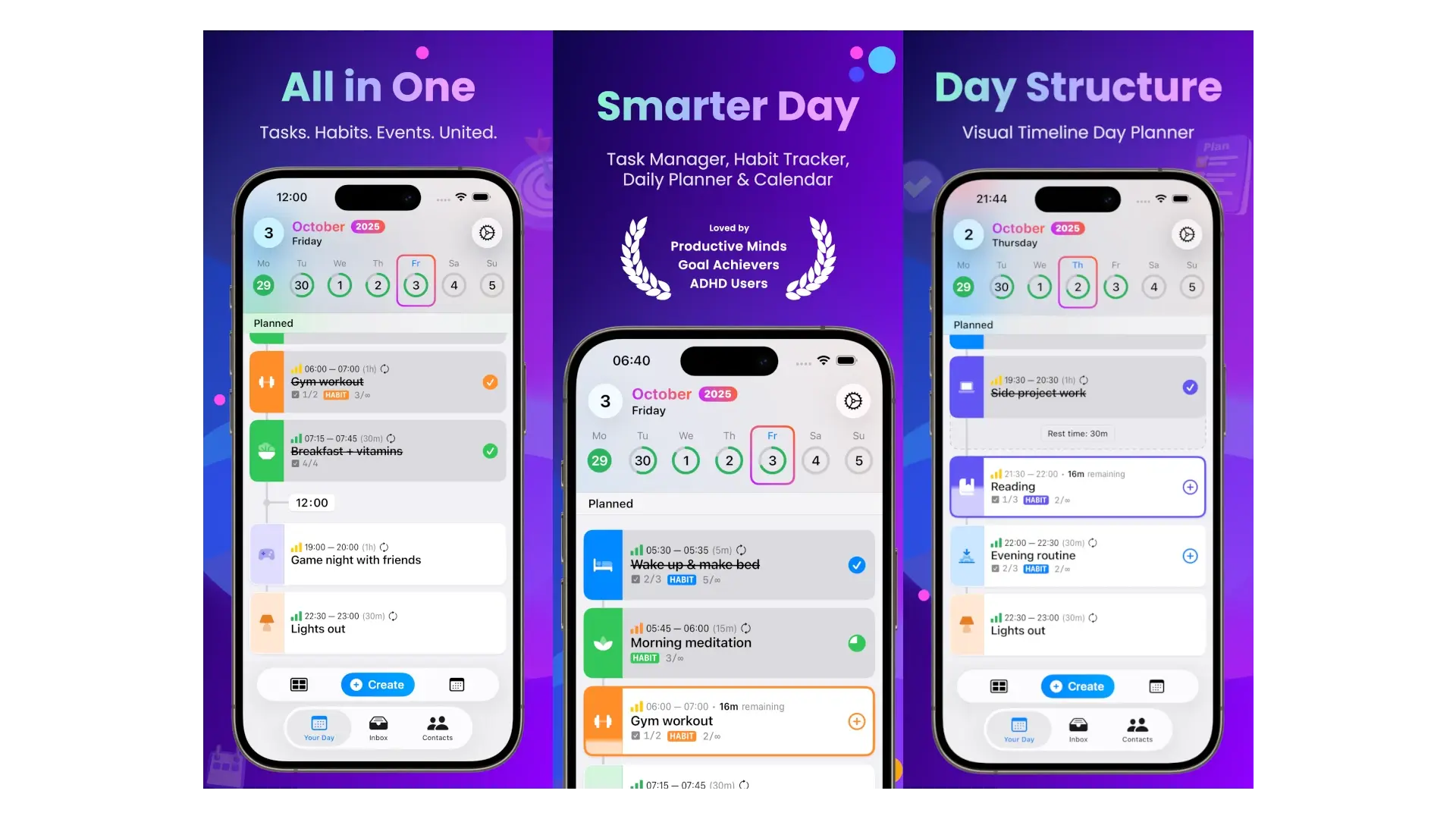
To make change easier, pair these strategies with a simple tool you’ll actually use. The productivity app at Smarter.Day helps you time‑block, prioritize, and review in one place—so your plans finally become momentum. Try one deep work block with it today and see the difference.
You May Also Like
These Related Stories
Master Time Optimization: 12 Proven Productivity Tactics
Advanced Time Management: 12 Proven Productivity Tactics
No Comments Yet
Let us know what you think