
Deep Focus Tactics to Cut Distraction and Boost Output

Deep Focus Tactics to Cut Distraction and Boost Output
Introduction
Have you ever noticed that a “quick check” of email turns into 45 minutes—and your best work window evaporates? Distraction creeps in, deadlines compress, and stress spikes. Here’s the catch: we’re not short on talent; we’re short on time optimization and systems that safeguard focus. In this guide, we’ll break down practical methods to tame chaos, limit context switching, and build a better workflow so your performance improves without longer hours.
Our goal is simple: deliver a toolkit you can use today. Across the sections below, you’ll find research-backed strategies—like time blocking, habit stacking, asynchronous collaboration, and cognitive load management—paired with relatable examples. We’ll mix proven frameworks from Cal Newport, Teresa Amabile, Atul Gawande, Tiago Forte, and others so you can experiment, adapt, and lock in deep work. Ready to reclaim your attention and your calendar?
Build a Focus-First Schedule with Time Blocking and Energy Mapping
A powerful day starts with time blocking—deliberately assigning hours to specific tasks—and energy mapping, which schedules work to match your biological prime time. Start by identifying your chronotype (morning lark, night owl, or in-between). Then place deep work in your peak hours and meetings in valleys. Author Dan Pink’s “When” highlights how timing shapes performance, while Cal Newport’s “Deep Work” argues for long, uninterrupted blocks as a competitive advantage.
Two practical methods: schedule a daily 90–120-minute block reserved for one high-impact deliverable, and protect it with a calendar label like “Do Not Schedule.” Add a 15-minute pre-focus routine—closing tabs, prepping materials, and defining a single outcome. Sara, a product manager, shifted strategy work to 9–11 a.m. and moved standups to the afternoon; her planning velocity doubled within a sprint.
For maintenance, conduct a quick energy audit each Friday. Note when focus felt easy versus forced. Adjust next week’s blocks accordingly and create “buffer blocks” for admin. This prevents drift and keeps your system adaptive. Calibrate by week, not by day—you’ll smooth volatility and reduce guilt when life intervenes. Over time, you’ll see a measurable boost in output and fewer “busy but not productive” hours.
Tame Digital Distraction and Context Switching
We lose enormous time to context switching—shifting tasks forces the brain to reload rules and data. Gloria Mark’s research at UC Irvine shows it can take 20+ minutes to refocus after an interruption. Two methods help: set notification fences (kill push alerts, batch-check messaging apps at set times) and single-task in full screen (one app, one goal). Pair both with a tight “start script”: define the first keystrokes you’ll make when the focus window opens.
Real-life example: Devin, a software engineer, moved Slack checks to three 10-minute windows and used macOS Focus Filters to hide workspaces during coding. Result? Fewer pings, clearer mental space, and tickets closed 30% faster. He also set a browser profile just for work repositories—no social tabs allowed. Small frictions prevent big derailments.
For teams, establish communication SLAs and channel norms (e.g., email within 24 hours, chat within 4 hours, emergencies via phone). Cal Newport’s “A World Without Email” underscores how unscheduled messaging wrecks cognition. You’re not being unresponsive; you’re being intentional. Try a weekly review of your digital hygiene: time in communication apps, recurring offenders, and one automation to add next week.
Prioritize with the Eisenhower Matrix and Impact/Effort Scoring
When everything feels urgent, nothing truly important gets done. Use the Eisenhower Matrix: categorize tasks by Urgent/Important to decide whether to do, schedule, delegate, or drop. Pair it with Impact/Effort scoring: rank tasks on expected value versus cost. Stephen Covey’s work popularized urgency/importance, while Greg McKeown’s “Essentialism” reminds us to “separate the trivial many from the vital few.”
Two practical methods: run a 10-minute Priority Sweep every morning—list your tasks, tag them (U/I, U/NI, NU/I, NU/NI), then pick one “vital item” for deep work. Then apply a quick 1–5 Impact/Effort score to competing tasks and choose the highest ratio. Example: A founder debated between a landing page polish and a customer interview. The matrix and scoring quickly favored the interview—real insight over cosmetic tweaks.
To make this stick, create kill criteria—if a task scores low on impact twice, eliminate it or delegate. Do a weekly “Task Pruning” ritual to prevent backlog bloat. Covey’s emphasis on Quadrant II (important, not urgent) is essential: that’s where strategy, learning, and relationship-building live. Protect those blocks even when urgent pings shout for attention.
Sprint Smarter: Pomodoro Meets Ultradian Rhythm
Classic Pomodoro uses 25-minute sprints with short breaks. Useful—but many of us hit deeper flow in 75–90-minute cycles aligned with ultradian rhythms (Nathaniel Kleitman). Try a hybrid: run 50/10 or 90/20 cycles for cognitively heavy work, and 25/5 for admin. Neuroscience educator Andrew Huberman also recommends non-sleep deep rest (NSDR) or eye rest during breaks to reset.
Two practical methods: define your “A-Block” (one 90-minute session) for your hardest problem, then a “B-Block” (50 minutes) for related tasks. During breaks, move, hydrate, or step outside—no doomscrolling. A data analyst tested 90/20 for modeling and found error rates dropped while throughput rose 25%. For lighter tasks, she used 25/5 to avoid over-engineering simple work.
Add a break checklist to boost recovery: stand, breathe for 60 seconds, look at distant objects, and log one insight from the last block. Over time, you’ll notice patterns in when focus peaks. Calibrate your cycles weekly and treat timers as guardrails, not shackles. As Cal Newport notes, “Structure begets freedom” when the schedule serves your best cognitive windows.
Stack Tiny Habits with Implementation Intentions
Sustainable focus is mostly habit. Combine habit stacking (pair a new behavior with an existing routine) with implementation intentions (“If it’s 8:30 a.m., then I open the brief and start section one”). BJ Fogg’s Tiny Habits and Peter Gollwitzer’s research show that pre-deciding the “if-then” raises follow-through dramatically. James Clear’s “Atomic Habits” adds the principle of making habits obvious, attractive, easy, and satisfying.
Two practical methods: create a launch ritual (coffee → headset on → open task doc → write one sentence). Then use environment design: clear your desk the night before, leave only the next task’s materials. Example: Priya, a copywriter, stacked “brew tea” with “open outline,” and added an if-then rule: “If I hesitate, I write a bad first sentence.” Drafts started faster and got better by iteration.
To reinforce, add a success cue—tick a wall calendar or track streaks in your app. Keep the initial version so small it’s laughable (write 50 words, not 500). As Clear notes, “You do not rise to the level of your goals; you fall to the level of your systems.” Build the smallest system that triggers action daily, then scale.
Offload the Brain: Checklists, SOPs, and Templates
Your brain is for solving problems, not storing steps. Use checklists, standard operating procedures (SOPs), and templates to reduce cognitive load. Atul Gawande’s “The Checklist Manifesto” shows how structured steps prevent errors in complex environments. In knowledge work, this translates into faster onboarding, fewer mistakes, and consistent quality.
Two methods: write a Definition of Done (DoD) for recurring tasks—what “finished” means in 5–7 bullet points. Then build a template library: email responses, meeting agendas, research briefs. Real-life example: A marketing lead created a launch checklist covering legal review, analytics tags, QA, and postmortems. Launch defects fell to near zero, and cycles shortened by a week.
Embed checklists into tools you already use: task subtasks, doc templates, or kanban cards. Review SOPs monthly and prune steps that don’t add value. The payoff is mental clarity. Less “Did I forget something?” means more energy for creative work. As Gawande notes, checklists aren’t about dumbing down—they’re about reliability under pressure.
Work Async by Default to Protect Deep Work
Meetings are expensive. Shift to asynchronous collaboration for status updates, ideas, and decisions. Cal Newport argues in “A World Without Email” that unstructured communication fragments attention. Two methods: use loom-style screen recordings or concise docs for updates, and maintain a decision log with context, options, and final calls. This creates a searchable, low-interruption knowledge base.
Real-life example: A remote design team replaced three weekly status meetings with a shared doc and annotated videos. They kept one weekly sync for blockers only. Within a month, they reclaimed six hours per person and reported higher workflow performance due to fewer interruptions and more thoughtful feedback.
Set clear async norms:
- Response windows (e.g., 24 hours)
- Preferred channels by topic
- Templates for proposals and decisions
This reduces ambiguity and anxiety. Add a monthly meeting audit—cancel, shorten, or convert to async. You’ll still meet—but for creativity, alignment, and relationships, not status theater.
Visualize Work with Personal Kanban and WIP Limits
A simple board clarifies everything. Personal Kanban (To Do → Doing → Done) plus work-in-progress (WIP) limits exposes bottlenecks and stops overload. Jim Benson and Tonianne DeMaria stress the value of visualizing work and limiting tasks in progress. When you see the queue, you feel the consequence of starting too much.
Two methods: cap the “Doing” column at two or three; you cannot start a new task until one finishes. Then add swimlanes for categories (Deep Work, Admin, Meetings) to keep attention honest. A developer adopted a WIP limit of two; cycle time dropped, and “half-done chaos” vanished. He also added a Done column with a weekly tally to celebrate progress.
Review your board daily, and do a blocked task protocol: if a card stalls for 24 hours, write the blocker and next ask. This habit accelerates unblocking. David J. Anderson’s Kanban principles apply here: manage flow, evolve policies, and make process explicit. It’s a simple system with outsized effects on workflow improvement.
Manage Cognitive Load with External Brains and Summaries
Your working memory is tiny. Reduce cognitive load by externalizing ideas and compressing notes. Cognitive Load Theory (John Sweller) shows that reducing extraneous load improves learning and performance. Two methods: maintain a capture inbox (notes app or paper) for every thought, and use progressive summarization (Tiago Forte) to distill notes in layers—bold key lines, then highlights, then a short summary.
Real-life example: A consultant built a “Second Brain” with PARA (Projects, Areas, Resources, Archives). During proposals, she pulled prior insights in minutes instead of hours. This freed time for strategic thinking—and creativity soared. She also added a “Today” note with three outcomes bolded at the top for quick orientation.
H3: Practical Drill
- Capture everything for one week—no sorting, just offload.
- On Friday, organize into Projects and Areas.
- Summarize one key note per day next week in three sentences.
Over time, your “external brain” turns into a competitive edge—better recall, faster synthesis, and less mental clutter.
Review Weekly: The Progress Principle in Action
Consistency beats intensity. Teresa Amabile and Steven Kramer’s “The Progress Principle” found that small wins drive motivation. Pair that with David Allen’s Weekly Review (GTD) to regain clarity. Two methods: run a Friday Reset—clear inboxes, close loops, and choose three priorities for next week. Then do a micro-retrospective: What worked? What drained energy? What one tweak will improve next week?
A sales lead struggled with reactive weeks. After adopting a 60-minute Friday Review, she started each Monday with a tight plan, pre-drafted emails, and scheduled focus blocks. Her pipeline moved steadily, and stress dropped. She also logged “wins of the week” to track momentum—great for morale and performance reviews.
Add a Done list alongside your To-Do list. Seeing output combats the Zeigarnik effect’s open-loop stress. Keep reviews light but consistent—skip fancy dashboards if they slow you down. The goal is clarity, not ceremony. A reliable review ritual becomes your compass in fast-moving work.
Protect Energy: Sleep, Movement, and Microbreaks
You can’t out-hustle biology. Prioritize sleep, light movement, and microbreaks to protect focus. Matthew Walker’s “Why We Sleep” highlights how sleep consolidates memory and decision quality. Two methods: anchor a consistent sleep window (even on weekends) and adopt a walk-first break—five minutes outdoors per hour of deep work. Even low-intensity activity boosts blood flow and creativity.
Real-life example: A founder set a hard stop at 10:30 p.m., reduced late-night screens, and added morning daylight exposure. Within two weeks, she reported fewer afternoon crashes and sharper problem-solving. She paired this with a standing desk for short bursts to combat sedentary fatigue.
Add hydration and snack rules: water bottle within arm’s reach; protein- and fiber-rich snacks; caffeine front-loaded before noon to avoid sleep disruption. The American Psychological Association links chronic stress to performance dips—small recovery habits buffer burnout. Treat energy as a budget: invest wisely and watch focus compound.
Decision Speed with Defaults and Pre-Commitments
Decision fatigue kills momentum. Use defaults and pre-commitments to move faster. Richard Thaler and Cass Sunstein’s “Nudge” shows that choice architecture shapes behavior. Two methods: set default choices (tools, templates, meeting lengths) and create if-then rules for recurring decisions (e.g., “If a meeting lacks an agenda 24 hours prior, it’s rescheduled to async.”)
Consider a real-life example: A team made 25 minutes the default meeting length and required agendas in a shared doc. Their calendar density dropped, and decision velocity rose. Individually, a designer pre-committed to “ship draft v0 by noon,” sharing an early version to trigger feedback loops. Faster cycles, fewer bottlenecks.
Add commitment devices: calendar invites for deep work, website blockers during A-Blocks, and public accountability (post your week’s three outcomes to your team). Daniel Kahneman reminds us that System 2 is lazy—make the smart choice the easy choice. Defaults reduce friction so your best intentions actually happen.
Write to Think: Clarity Through Pre-Briefs and Post-Morts
Thinking improves when you write. Use pre-briefs to clarify goals and post-mortems to extract lessons. Two methods: before major work, draft a one-page pre-brief—problem, stakes, hypotheses, constraints, definition of done. After delivery, run a blameless post-mortem—what surprised us, what worked, what we’ll change. This accelerates learning and reduces repeat mistakes.
Real-life example: A data team started pre-briefs for models. They caught ambiguous metrics early and prevented rework. Their post-mortems fed a “playbook” that shortened future projects. HBR frequently notes that learning organizations outperform by capturing and using knowledge—not just finishing tasks.
To keep it efficient, timebox both documents to 15–20 minutes. Store them in a shared folder with tags for easy retrieval. Over time, your knowledge capital grows, and your startup brain—whether you’re a solo professional or a team—stays sharp and scalable.
Automate the Mundane: Rules, Shortcuts, and AI Assistants
Free your brain by automating repeatable tasks. Two methods: set up automation rules (filters, labels, and routing in email; recurring tasks in your PM tool) and create text snippets/shortcuts for frequent replies. Add lightweight AI assistance for drafting, summarizing, and data cleanup—always with human review for quality and ethics.
Real-life example: A recruiter automated resume intake with labels, used text expanders for common responses, and had AI summarize long profiles into bullet points. The result? Hours saved weekly, more time for high-value conversations, and quicker workflow improvement across the pipeline.
Keep automation transparent and reversible. Review rules monthly to avoid unintended consequences. As McKinsey research suggests, knowledge workers can reclaim significant time with well-designed automation. The goal isn’t to remove judgment—it’s to preserve it for the work that truly needs your mind.
Conclusion
Deep focus isn’t a personality trait; it’s a system. By protecting deep work windows, taming context switches, stacking tiny habits, and continuously reviewing your process, you’ll boost performance without burning out. Start with one method—time blocking, WIP limits, or a Friday Review—then layer others as wins accumulate. That’s how sustainable productivity sticks.
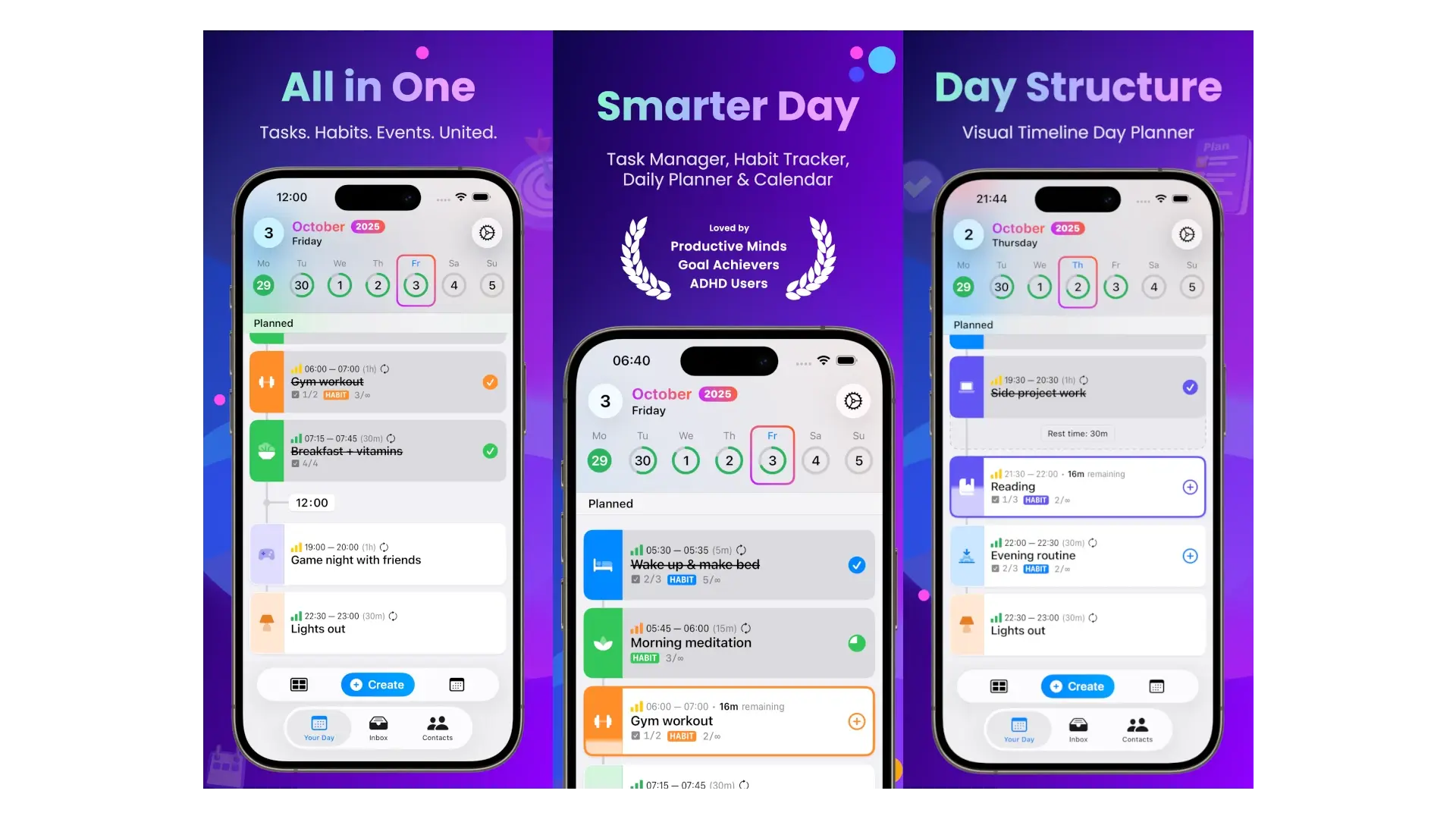
To streamline adoption, try the productivity app at Smarter.Day. It’s a practical hub for blocking time, tracking focus, capturing tasks, and reviewing progress—so you spend less effort organizing and more time doing.
Call to Action (CTA)
Ready to work with less stress and more flow? Explore the tools and templates at Smarter.Day and turn today’s ideas into tomorrow’s output.
You May Also Like
These Related Stories
Deep Focus Tactics to Cut Distraction and Boost Output
Deep Work Days: Science-Backed Focus Strategies That Work
No Comments Yet
Let us know what you think