


You sit down to work, open three apps, scan a packed calendar, and still ask the same question: what should I do first?
That moment is the real problem. Not laziness. Not lack of ambition. It’s decision fatigue.
If you want to know how to organize your day, the goal is not to squeeze in more tasks. It’s to remove friction so the next right action is obvious. A well-organized day gives you clarity, protects your attention, and helps you finish meaningful work without feeling scattered by noon.
For busy professionals, founders, marketers, developers, and project leads, the best daily system is rarely complicated. It’s structured enough to guide you and flexible enough to survive real life.
How to organize your day starts with one decision
Most people lose time before the day even begins. They carry around too many open loops, too many low-value tasks, and too many places where work lives. When everything feels equally urgent, nothing gets proper focus.
A better approach is to make one decision first: what kind of day is this?
Some days are execution days. You need long focus blocks and minimal context switching. Some are coordination days filled with meetings, approvals, and follow-ups. Others are recovery days where your energy is lower and the win is handling essentials without falling behind.
That one decision shapes everything else. It tells you how aggressive to be with your schedule, how many priorities to set, and how much margin to leave. If you skip this step, you’ll build an ideal plan for a day you’re not actually having.
Build your day around priorities, not possibilities
The fastest way to feel overwhelmed is to treat your full task list as today’s plan. It isn’t. It’s inventory.
Your day needs a smaller, sharper set of commitments. Start by separating tasks into three groups: what must happen today, what should happen if time allows, and what can wait. This is where prioritization frameworks earn their place. The Eisenhower Matrix is especially useful because it forces you to distinguish between urgency and importance instead of reacting to the loudest item.
A common mistake is filling the day with quick wins because they feel productive. Answering five messages and renaming a folder can create motion, but motion is not progress. If your most important work keeps getting pushed to tomorrow, your day is organized around convenience, not outcomes.
Try this instead. Give yourself one primary task, two secondary tasks, and a short list of admin items. That structure is realistic for most knowledge workers. If your job is meeting-heavy, your primary task may be smaller. If you have deep work time, it can be more ambitious. It depends on your actual schedule and your energy, not your best-case fantasy.
Put time on the calendar or it usually won’t happen
A task list tells you what matters. A schedule tells you when it will happen.
This is where many daily plans break down. People identify priorities, then leave them floating in an open-ended list. By mid-morning, inboxes, pings, and meetings take over. The work that mattered most never got a protected slot.
Time blocking fixes that. Assign your important work to specific windows in your day. Not every minute needs a label, but the work that requires focus should have a clear start time.
For example, you might reserve 9:00 to 10:30 for strategy work, 11:00 to 12:00 for team communication, 1:30 to 3:00 for execution, and 4:00 to 4:30 for planning and cleanup. That structure reduces switching costs and keeps the day from turning into one long reactive blur.
Be honest when you block time. Most people underestimate setup time, interruptions, and mental recovery between tasks. A calendar packed wall-to-wall looks efficient, but it usually creates slippage and stress. Leave space. White space is not wasted time. It’s what keeps the plan usable.
Create one trusted system for tasks, habits, and events
If your tasks are in one app, your meetings in another, your habits on paper, and your reminders in your head, your day will always feel heavier than it needs to.
Organizing your day gets easier when everything lives in one trusted system. You want a single place to capture ideas, review commitments, track habits, and see your schedule. That reduces clutter and cuts the constant question of where to look next.
This matters more than people think. Fragmented systems create hidden work. You waste energy checking multiple tools, rewriting tasks, and mentally reconnecting what belongs together. A unified daily view gives you control because it makes trade-offs visible. You can see what fits, what conflicts, and what deserves attention now.
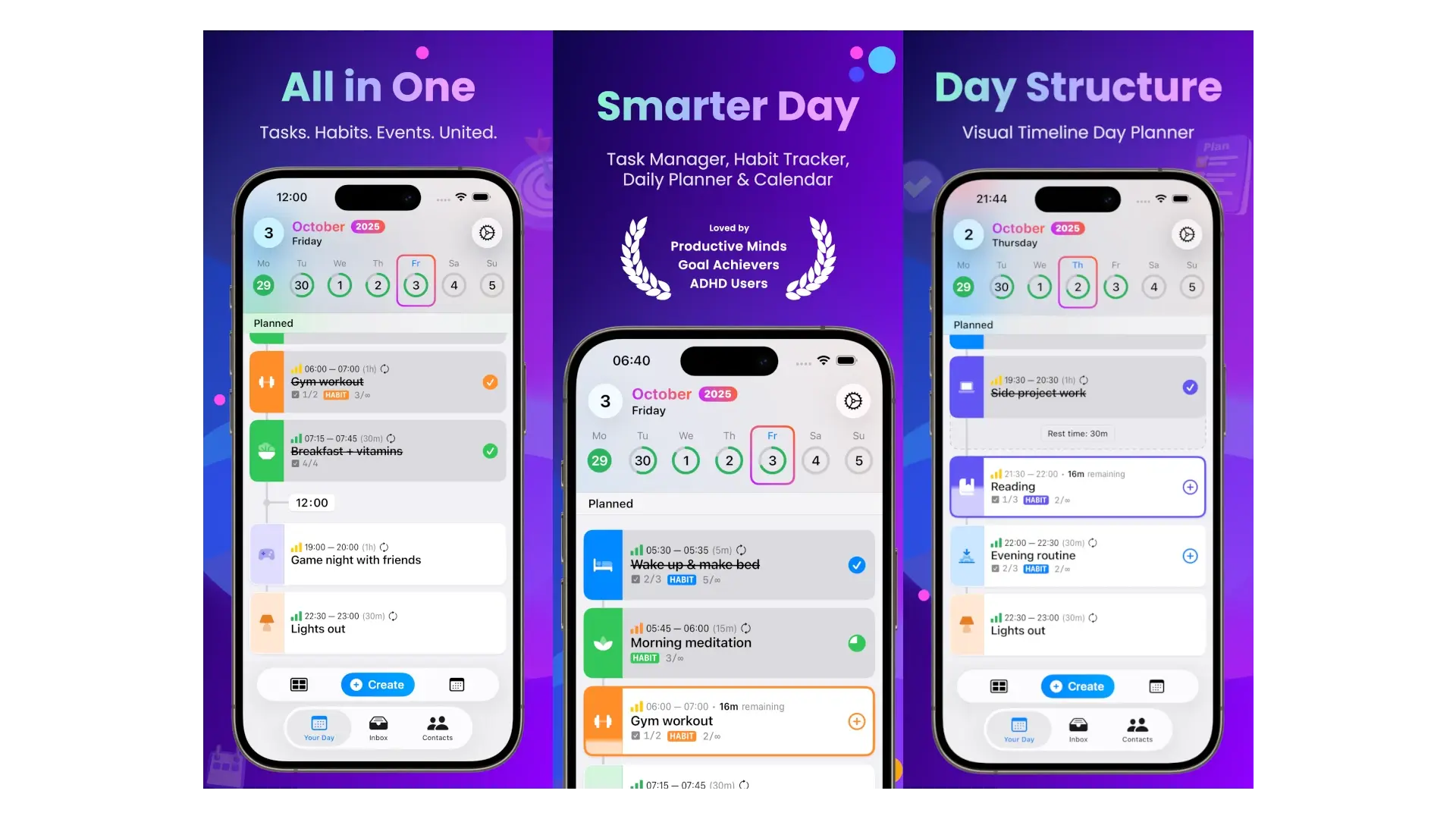
That’s why many high-performing professionals move toward an all-in-one planning setup. A tool like Smarter.Day brings tasks, habits, events, prioritization, and structured scheduling into one visual workflow, which makes it easier to act quickly instead of spending half your morning organizing the act of organizing.
Design your morning for momentum, not perfection
A strong day usually starts before your first task. It starts with a short planning ritual.
This does not need to be a 45-minute productivity ceremony. In fact, that can become another form of procrastination. Five to ten minutes is enough for most people.
Review your calendar. Confirm your top priorities. Check for deadlines, dependencies, and meetings that need prep. Then decide what your first focused block will be.
The key is to begin with intention, not reaction. If you open email or Slack before setting your plan, you’re giving other people first claim on your attention. Sometimes that’s necessary, especially in collaborative roles. But if it happens by default every day, your priorities will always come second.
If mornings are chaotic because of commuting, kids, or variable start times, plan the night before. The best system is the one you can repeat consistently.
Protect focus by reducing transitions
Most lost productivity doesn’t come from one big failure. It comes from tiny leaks: checking messages every six minutes, switching between unrelated tasks, and restarting work after every interruption.
If you want a more organized day, reduce transitions.
Group similar work together. Handle messages in batches. Keep admin tasks in a single block instead of sprinkling them across the day. Use subtasks for complex projects so the next action is visible without requiring a fresh round of thinking.
This is also where habit design helps. If you always start your deep work block with the same cue - coffee, headphones, timer, document open - your brain learns the pattern. You spend less effort getting started.
Methods like Pomodoro can help if you struggle with initiation or attention drift. Short, timed focus sessions create urgency and make bigger tasks feel less intimidating. Still, they’re not universal. Some people do better with 25-minute sprints, while others need 60 to 90 minutes to get into real cognitive work. Test both. Productivity is personal, even when the principles are consistent.
Expect disruptions and plan for recovery
A perfectly organized day that collapses after one surprise meeting is not organized. It’s fragile.
Real days change. Priorities shift. Clients respond late. A bug appears. A child gets sick. Your system needs recovery rules.
One helpful rule is this: if the day gets disrupted, protect the primary task first. Before you reshuffle everything else, ask whether the most important outcome can still happen. If yes, rebuild around it. If no, make a conscious trade-off and move it with intention instead of letting it quietly disappear.
Another useful rule is to keep a short reset block late in the day. Fifteen to twenty minutes is enough to process loose notes, reschedule unfinished tasks, and prepare tomorrow. That small habit prevents backlog from multiplying overnight.
Measure success the right way
An organized day is not a day where every box gets checked. That standard sounds disciplined, but it often rewards poor planning.
A successful day is one where the right work moved forward, your obligations stayed visible, and you didn’t spend the whole day deciding what to do next. Some days that means completing a major project milestone. Other days it means showing up to key meetings, handling urgent issues, and keeping your routine intact.
Track patterns, not just wins. Notice which tasks repeatedly slide, which times of day produce your best focus, and which habits support consistency. The more you understand your own working rhythm, the easier it becomes to build days that feel calm and effective instead of crowded and reactive.
The best daily system is not the most elaborate one. It’s the one that makes your priorities clear, your schedule realistic, and your next step obvious. Start there, and your day stops running you.
You May Also Like
These Related Stories
Deep Focus Tactics to Cut Distraction and Boost Output

How to Capture Tasks Quickly and Stay Clear

No Comments Yet
Let us know what you think