
Timeboxing to Deep Work: A Practical Productivity Playbook

Style: Conversational and evidence-driven
Category: Time Management & Prioritization
Title: Timeboxing to Deep Work: A Practical Productivity Playbook
Description: Boost focus with proven methods: timeboxing, prioritization, deep work sprints, automation, and weekly reviews. Optimize your workflow today.
H1: From Timeboxing to Deep Work: A Practical Productivity Playbook
Introduction
Let’s face it: modern work can feel like juggling flaming torches on a moving treadmill. Notifications pop, meetings multiply, and your to-do list grows faster than you can cross items off. The result? Overwhelm, procrastination, and scattered attention. Here’s the catch—productivity isn’t about squeezing more in; it’s about doing the right things well. In this guide, we’ll tackle common productivity traps and share battle-tested approaches for time optimization, focus, and workflow improvement that actually stick.
You’ll get practical, zero-fluff strategies: timeboxing, deep work sprints, habit stacking, automation, and weekly reviews—all backed by research and real stories. We’ll balance the “how” with the “why,” so you can adapt methods to your context. If you’ve ever thought, “I’m busy but not productive,” this playbook is for you. Ready to swap frantic activity for meaningful progress? Let’s dive in.
H2: Timeboxing and Calendar Blocking That Stick
Calendar blocking turns intention into commitment. Start by assigning fixed timeboxes for your most important work, then add buffer blocks to absorb overflows and interruptions. This counters Parkinson’s Law—work expanding to fill the time available—by giving tasks a clear boundary. An HBR perspective encourages planning your priorities before the day claims them. To get rolling, timebox one “deep work” block in the morning and one “admin” block in the afternoon; it’s simple and powerful.
Try the 90-15 rhythm: a 90-minute focus block followed by a 15-minute reset for notes, water, and a quick walk. Another method is the 25-5 Pomodoro cycle for tasks that resist starting. A product manager I coached protected a daily 2-hour research block and used a 30-minute “spillover” buffer after. Within two weeks, they reported a calmer pace and a finished brief that had been stalled for months. Small guardrails, big returns.
Make your plan visible. Use a traffic-light calendar: green for deep work, yellow for collaboration, red for personal commitments. If possible, set your status to “Focus Time” during green blocks—big organizations like Google popularized this. Keep blocks realistic: aim for 60–120 minutes, not an all-day marathon. “What gets scheduled gets done,” as the planner’s mantra goes. The goal isn’t rigidity; it’s clarity. Let your calendar narrate your priorities.
H2: The 3-2-1 Prioritization Framework
When everything is urgent, nothing is. The 3-2-1 framework brings sanity: choose 3 MITs (Most Important Tasks), 2 supporting tasks, and 1 quick win/admin item each day. This approach blends the Eisenhower Matrix—urgent vs. important—with practical constraints. As Stephen Covey taught, focusing on “Quadrant 2” (important but not urgent) compounds long-term results. Start your day writing your 3-2-1 on a sticky note or in your task app.
Combine it with the “Rule of Three” from J.D. Meier’s “Getting Results the Agile Way”—three outcomes for the day, week, and month. Add a “no list” of tempting but low-impact tasks you’ll avoid. A marketing lead I worked with picked three outcomes: finalize the campaign angle, review the top-of-funnel metrics, and meet with the content partner. Two support tasks were slides and messaging tweaks; the quick win was inbox zero for the campaign folder. Progress felt crisp instead of chaotic.
For prioritization at scale, consider Essentialism (Greg McKeown) to continually ask, “What’s the one thing that truly matters right now?” If you get stuck, write everything you could do, then ask, “If I could only do one today, which moves the needle?” This single filter clarifies the fog. Review your 3-2-1 midday; adjust without guilt. Plans are guides, not handcuffs. The aim is deliberate action, not perfect prediction.
H2: Deep Work Sprints and Attention Management
Cal Newport defines deep work as cognitively demanding tasks performed in a state of distraction-free concentration. Schedule deep work sprints—one or two per day—when your energy peaks. During these blocks, silence notifications, close chat apps, and put your phone in another room. Try 60–90 minutes per sprint with a clear objective, like “Draft sections 2–3” instead of “Work on report.” Clarity creates momentum. As Newport notes in Deep Work, “The ability to perform deep work is becoming increasingly rare and valuable.”
Use attention shields: full-screen mode, site blockers (e.g., Freedom or Cold Turkey), and “Do Not Disturb” on your devices. Pair that with a single-session objective: one problem, one document, one result. An engineer I coached used a “Headphones = heads-down” signal and a desk sign during sprints; colleagues adapted quickly. The result? The bug backlog shrank and satisfaction rose because progress was now visible and consistent.
Build a pre-sprint ritual: a 2-minute breathing exercise, a quick scan of your outline, and a timer start. End with a shutdown routine—capture next steps, file notes, and celebrate a tiny win. These cues reduce friction and protect your mental context. As a reminder, perfection isn’t required; presence is. One hour of relentless focus beats three hours of fractured attention. Deep work is a muscle—train it daily.
H2: Reduce Cognitive Load and Kill Context Switching
Our brains pay a steep tax for context switching. Gloria Mark’s research at UC Irvine shows it can take over 20 minutes to fully resume after an interruption. A Stanford study (Ophir, Nass, Wagner) found heavy media multitaskers perform worse on attention-switching tasks. The fix? Batch similar tasks and guard your focus with ruthless kindness. Keep your high-cognitive tasks together, and place logistics or communication in separate clusters.
Try single-thread mornings for your most demanding work, then collaboration afternoons for meetings and messages. Another method: task grouping (write all briefs together, process all invoices together) to leverage momentum and reduce setup costs. A designer I know ran “creative-only before 11 a.m.” days and saved hours weekly by avoiding tool/context changes. The output quality improved because their working memory stayed on one channel.
Make work visible with a Kanban board and WIP limits. Seeing tasks in “To Do, Doing, Done” reduces cognitive clutter and highlights bottlenecks—core principles from Lean and the Toyota Production System. Limit your “Doing” column to 2–3 items. It’s a constraint that liberates attention. Remember, cognitive load isn’t just a feeling; it’s a capacity. Protect it like you would a scarce budget.
H2: Habit Stacking and Keystone Habits
If you’ve ever struggled to “just be more disciplined,” you’re not alone. Habits remove willpower from the equation. Use habit stacking: “After I [current habit], I will [new habit],” from BJ Fogg’s Tiny Habits and James Clear’s Atomic Habits. Pair a morning coffee with a 3-minute plan, or a calendar open with picking your MITs. Small anchors compound. Charles Duhigg calls these keystone habits because they trigger positive spillovers.
Two methods to start: the 2-minute rule (begin tasks in a version that takes two minutes) and environment design (lay your tools out the night before). A consultant I advised set a notebook on their keyboard at day’s end with tomorrow’s three outcomes. In the morning, the first thing they saw was intent. Sounds simple. It works. “You do not rise to the level of your goals; you fall to the level of your systems,” writes Clear.
Build feedback loops to make habits sticky: track streaks, celebrate micro-wins, and review pitfalls without shame. If a habit slips, shrink it. Missed two days? Restart at one minute. Research shows that consistency beats intensity for long-term adherence. Combine habit stacking with your 3-2-1 plan, and you’ll create a daily operating system that runs even on low-motivation days.
H2: Manage Energy with Ultradian Rhythms
Productivity isn’t just time management—it’s energy management. Nathaniel Kleitman’s research on ultradian rhythms suggests humans work in 90–120-minute cycles. Plan high-cognitive tasks during your peak cycle, then take genuine breaks. Stand up, hydrate, get light movement, or step outside for sunlight. These aren’t indulgences—they’re fuel. Protect your mornings if you’re a lark; reserve late-day focus if you’re a night owl.
Experiment with sprint-to-rest ratios. While Pomodoro’s 25-5 is popular, many knowledge workers thrive on a 52-17 cadence (a pattern observed in DeskTime’s analysis of top performers). Test different intervals and measure perceived exertion and output quality. A data analyst I worked with shifted complex SQL work to 9–11 a.m., walking five minutes every hour. Their error rates dropped, and review cycles shortened. It wasn’t more time; it was better-timed time.
Supporting habits matter: sleep, nutrition, hydration, and light. Matthew Walker’s “Why We Sleep” underscores consistent wake times and a wind-down routine. Consider caffeine timing (avoid late-day spikes) and protein-forward meals for stable energy. Track how different practices affect your cognitive performance. Energy is the foundation; strategy sits on top.
H2: Systems Over Goals: OKRs and Weekly Reviews
Goals are destinations; systems are vehicles. Use OKRs (Objectives and Key Results) to align outcomes and measurable proof, as John Doerr explains in “Measure What Matters.” Example: Objective—“Launch our onboarding flow with delight.” Key Results—“Reduce drop-off to 15%, ship v1 by March 15, achieve NPS 45+.” Tie weekly tasks to KRs so your to-do list tracks progress, not just activity.
Run a weekly review à la David Allen’s GTD: capture loose ends, clarify next actions, and plan the week. Use a checklist. I like a simple flow: calendar lookback/forward, inbox sweep, Kanban tidy, and choose next week’s Big 3 outcomes. A startup ops lead who adopted this saw fewer surprises and a smoother handoff between urgent and important. “Your mind is for having ideas, not holding them,” Allen reminds us.
Add retrospectives: What worked? What didn’t? What will we try next? Teresa Amabile’s “Progress Principle” shows that visible progress fuels motivation. Celebrate micro-wins and kill zombie projects. The quiet power move is pruning. Systems create repeatability; reviews create learning. Together, they compound.
H2: Automation, Templates, and AI as Your Copilot
Free your brain from repetitive drudgery. Start with email templates and text expanders for frequent replies. Build SOPs and document templates for proposals, briefs, and onboarding. Next, automate with tools like Zapier or native integrations: when a form is submitted, create a task, send a Slack message, and file the document. McKinsey estimates that about 30% of activities in most jobs can be automated—your time savings are real.
Turn recurring work into checklists. Pilots and surgeons use them for a reason: fewer errors, smoother flow. A startup founder I coach templatized investor updates and automated metrics ingestion; reports now take 30 minutes, not three hours. Think “create once, run many.” The front-loaded effort repays you daily. Less variability, more capacity.
Use AI for drafting, summarizing, and brainstorming. An MIT/BCG study found that generative AI boosted performance on certain knowledge tasks, especially for less experienced workers. Keep a human-in-the-loop for accuracy and tone. Pair AI with your judgment: ask for outlines, counterarguments, or simplifications. The aim isn’t to outsource thinking—it’s to accelerate it.
H2: Email, Meetings, and Communication Hygiene
Email and meetings aren’t evil; unchecked, they’re attention magnets. Apply a triage protocol twice daily: 1) delete/ archive, 2) delegate, 3) do if under two minutes, 4) schedule. Cal Newport’s “A World Without Email” argues that the hyperactive hive mind kills deep work; batching and clear policies restore focus. Turn off push notifications; pull messages on your schedule.
Make meetings default 25 or 50 minutes to add breathing space. Require an agenda, owner, and decision. If no decision is needed, consider async updates. The Microsoft Work Trend Index reports that many knowledge workers spend most of their week communicating; being intentional here gives back hours. One team I advised cut their weekly status meeting by half by adopting written updates and a decision log. More outcomes, less overhead.
Lean into asynchronous workflows: threaded discussions, recorded demos, and clear deadlines. Establish channel etiquette—what goes to chat vs. email vs. docs. A small vocabulary shift helps: “What decision are we making?” and “Who is the DRI (Directly Responsible Individual)?” Clarity de-stresses collaboration and protects your focus.
H2: Task Batching, Templates, and Standard Workflows
Batching reduces setup time and mental friction. Create theme days (e.g., Tuesday = content, Thursday = analysis) to group work with similar tools and mindsets. Within a day, use power hours to plow through administrative tasks: invoices, scheduling, approvals. This structure combats decision fatigue and strengthens your workflow rhythm. As Peter Drucker reminds us, “Efficiency is doing things right; effectiveness is doing the right things.”
Build standard workflows for repeatable projects: ideation, draft, review, finalize. Attach templates and checklists to each stage so you never start from scratch. A content team I worked with shaved days off turnarounds by formalizing their pipeline and using a shared Kanban board with WIP limits and definition-of-done. Quality rose because variability shrank.
For solo operators, even simple folder structures and naming conventions reduce search time and errors. Name files with date_version_topic, and keep assets together. Invest once; save time forever. This is workflow improvement at its most practical: less thinking about where, more thinking about what.
H2: Reflection, Metrics, and Personal KPIs
“What gets measured gets managed,” Drucker famously said. Run a time audit for one week using a tool like RescueTime or Toggl to see where your attention truly goes. Define personal KPIs that matter: weekly focus hours, number of deep work blocks, meeting load, sleep average, and one well-being metric. Review trends, not single days. Numbers don’t judge; they inform.
Create a personal dashboard: a simple doc with your KPIs, top priorities, and the experiments you’re running this week. Try A/B tests: 90-minute vs. 60-minute sprints, morning vs. afternoon creative work, or two vs. three meeting days. A product designer I coached tracked “focus hours” and “revisions per deliverable”; by reducing mid-task Slack checks, revisions dropped and satisfaction rose. Progress became visible and repeatable.
Sustainable productivity includes well-being. The WHO recognizes burnout as an occupational phenomenon; prevention beats recovery. Add metrics like “walks taken,” “no-meeting blocks kept,” or “end-of-day shutdowns completed.” Kristin Neff’s research on self-compassion shows kinder self-talk improves resilience and motivation. Measure what matters to both output and you.
Conclusion
Productivity is a practice, not a personality trait. By combining timeboxing, prioritization, deep work, energy management, and automation, you create a personal operating system that turns chaotic days into deliberate progress. Start small: one protected focus block, one weekly review, one automation. Iterate weekly. The compounding effect is real.
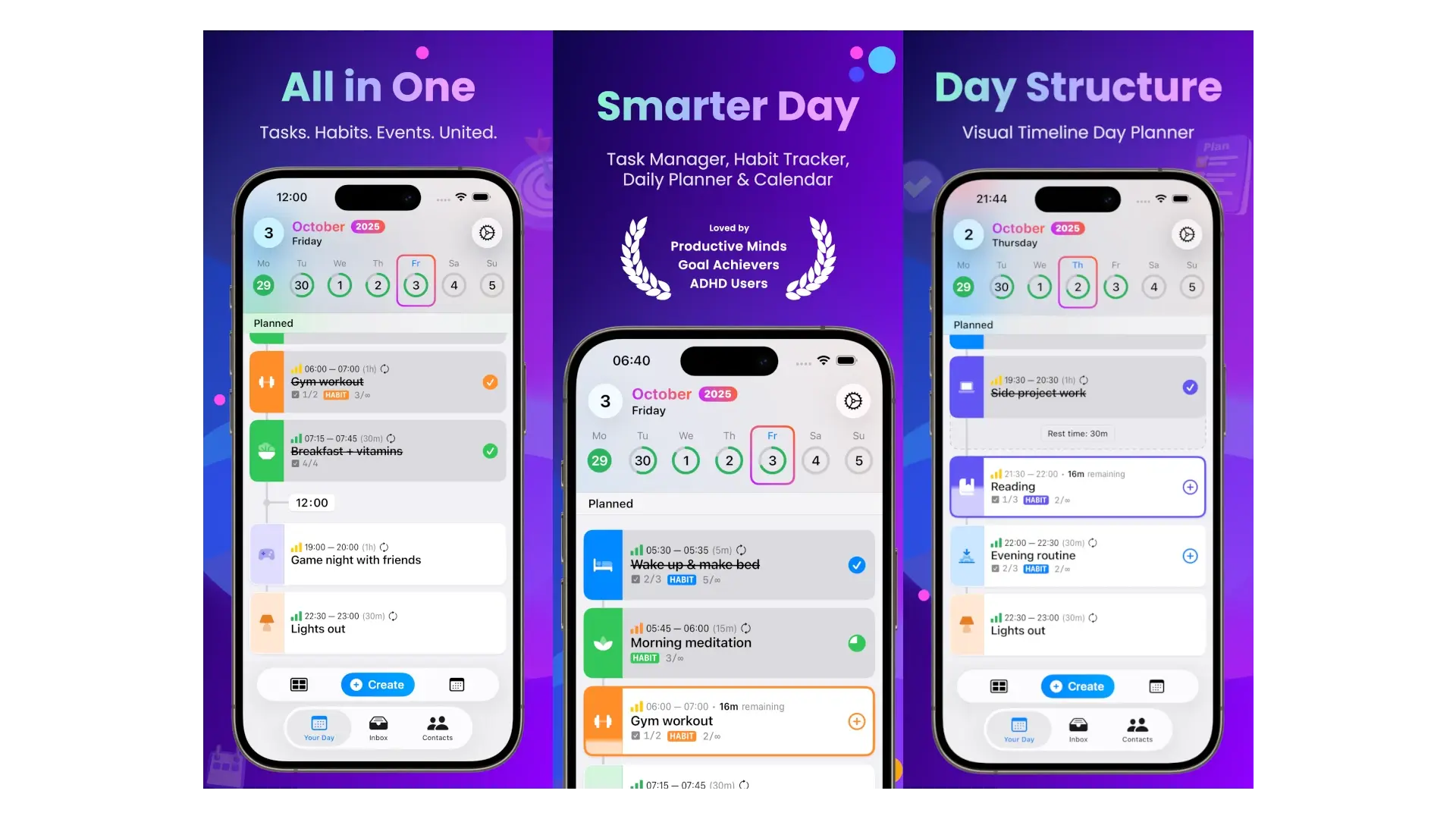
If you want an all-in-one way to plan, track, and optimize your focus, explore the productivity app at Smarter.Day. It brings together calendar blocking, task prioritization, templates, and review cadences so you can execute with clarity and calm—without duct-taping five tools.
You May Also Like
These Related Stories
Timeboxing to Deep Work: A Practical Productivity Playbook
Timeboxing to Deep Work: A Practical Productivity Playbook
No Comments Yet
Let us know what you think