

You do not lose momentum because you are lazy. You lose it because the moment you sit down to plan, your brain meets too many choices at once. Which task matters most? What belongs today versus later? Where did that note go? If you want to know how to reduce planning friction, start there - not with more motivation, but with fewer decisions between intention and action.
Planning friction is the hidden drag inside your day. It shows up when your task list is scattered, your calendar lives in a separate mental lane, your habits are tracked somewhere else, and every work session begins with ten minutes of sorting instead of doing. For busy professionals, founders, developers, marketers, and anyone managing a full plate, that drag compounds fast. For ADHD users especially, even small points of friction can break focus before real work starts.
The fix is not a more complicated productivity system. It is a system that removes hesitation.
What planning friction actually looks like
Most people think planning friction means they are bad at time management. Usually, that is not true. The real issue is that their workflow asks for too much setup.
You open three apps to understand your day. Your priorities are buried in a long list. Tasks have no next step, so each one requires fresh thinking. Your schedule is technically full, but it is not clear what deserves deep focus and what can wait. That is friction.
This matters because planning is not neutral. Every extra click, every unclear priority, and every decision you postpone creates cognitive load. Evidence-based productivity methods consistently point in the same direction: the more mental energy you spend organizing work, the less you have for executing it.
If your current approach makes planning feel heavy, the answer is not to try harder. It is to make planning lighter.
How to reduce planning friction without lowering standards
Reducing friction does not mean becoming less ambitious or less organized. It means building a better path between knowing what matters and starting it.
The first shift is centralization. A unified planning environment beats a stack of disconnected tools almost every time. When tasks, habits, events, notes, and priorities live in separate places, your brain has to stitch the day together manually. That is wasted effort. Strong productivity systems reduce that stitching work by showing the full picture in one place.
The second shift is visible prioritization. Many people keep lists, but lists alone do not create clarity. A task list with twenty items is just a record of obligations unless it also shows what is urgent, what is important, and what can wait. This is where daily task prioritization strategies matter. A prioritization layer, especially one based on a time management prioritization framework for entrepreneurs with multiple commitments, cuts down the pause before action.
The third shift is reducing planning depth for routine decisions. Not every task deserves a full planning session. Some decisions should be made once and reused. Recurring habits, repeated workflows, standard meeting prep, and common admin work should already have a place, a pattern, or a trigger. This is one reason productive systems outperform ad hoc planning. They preserve energy for work that actually needs judgment.
Build a day view that answers three questions
If your plan does not quickly answer what matters, what fits, and what comes next, it will create friction no matter how pretty it looks.
A useful day view should answer three questions within seconds. What are the top priorities today? What time constraints shape the day? What is the next actionable step when you finish the current task?
That sounds simple, but it is a major upgrade from the way many people plan. Instead of maintaining a giant list and hoping motivation fills in the gaps, you create a narrow field of focus. This is smarter time in practice. You are not trying to manage everything at once. You are making the next move obvious.
For many users, the sweet spot is a daily plan with a small set of high-priority tasks, calendar visibility, and built-in cues for habits or routines. That structure supports proven productivity because it lowers the startup cost of work.
Use prioritization to remove hesitation
One of the biggest sources of planning friction is false urgency. Everything feels important, so nothing feels clear.
A prioritization framework solves that problem by forcing separation. The Eisenhower Matrix remains one of the best time management methods proven to reduce decision fatigue because it distinguishes urgency from importance. That matters when your day includes client work, messages, admin tasks, strategic projects, and personal commitments all competing for attention.
There is a trade-off, though. Prioritization frameworks help only if they stay lightweight. If categorizing tasks becomes a project of its own, you have added friction instead of removing it. The goal is fast sorting, not perfect labeling.
That is why many effective daily task management systems methods 2025 2026 are moving toward guided prioritization, quick drag-and-drop planning, and AI support for ranking work. Used well, those features shorten the gap between capture and action. Used poorly, they become another layer to maintain. It depends on whether the system helps you decide faster or simply gives you more settings to manage.
Shrink the distance between capture and clarity
A lot of planning friction starts before planning even begins. Ideas, requests, and reminders arrive all day long, and if there is no fast capture path, they get stored mentally. Mental storage is expensive.
Inbox capture is one of the leading systems for identifying productivity blockers because it reveals where work is getting stuck. If your brain is carrying loose tasks, your planning session will feel harder than it should. A quick capture method clears the mental clutter first, then lets you sort later.
This is where micro actions help. If a task enters your system, define the smallest next move immediately when possible. Not "launch campaign" but "review ad draft." Not "fix onboarding" but "list top three drop-off points." Clear tasks create faster starts. Vague tasks create avoidance.
That principle lines up with evidence-based productivity tips from behavior science: action starts more easily when the first step is concrete, visible, and low resistance.
Reduce tool switching to protect focus
You can have a solid plan and still lose momentum if execution requires too much navigation.
Every switch between calendar, task manager, notes app, habit tracker, chat tool, and personal reminders creates a small attention tax. One switch is nothing. Twenty switches is a fragmented day. This is why systems productivity matters more than isolated features. The best setup is not the one with the most tools. It is the one with the least friction between planning and doing.
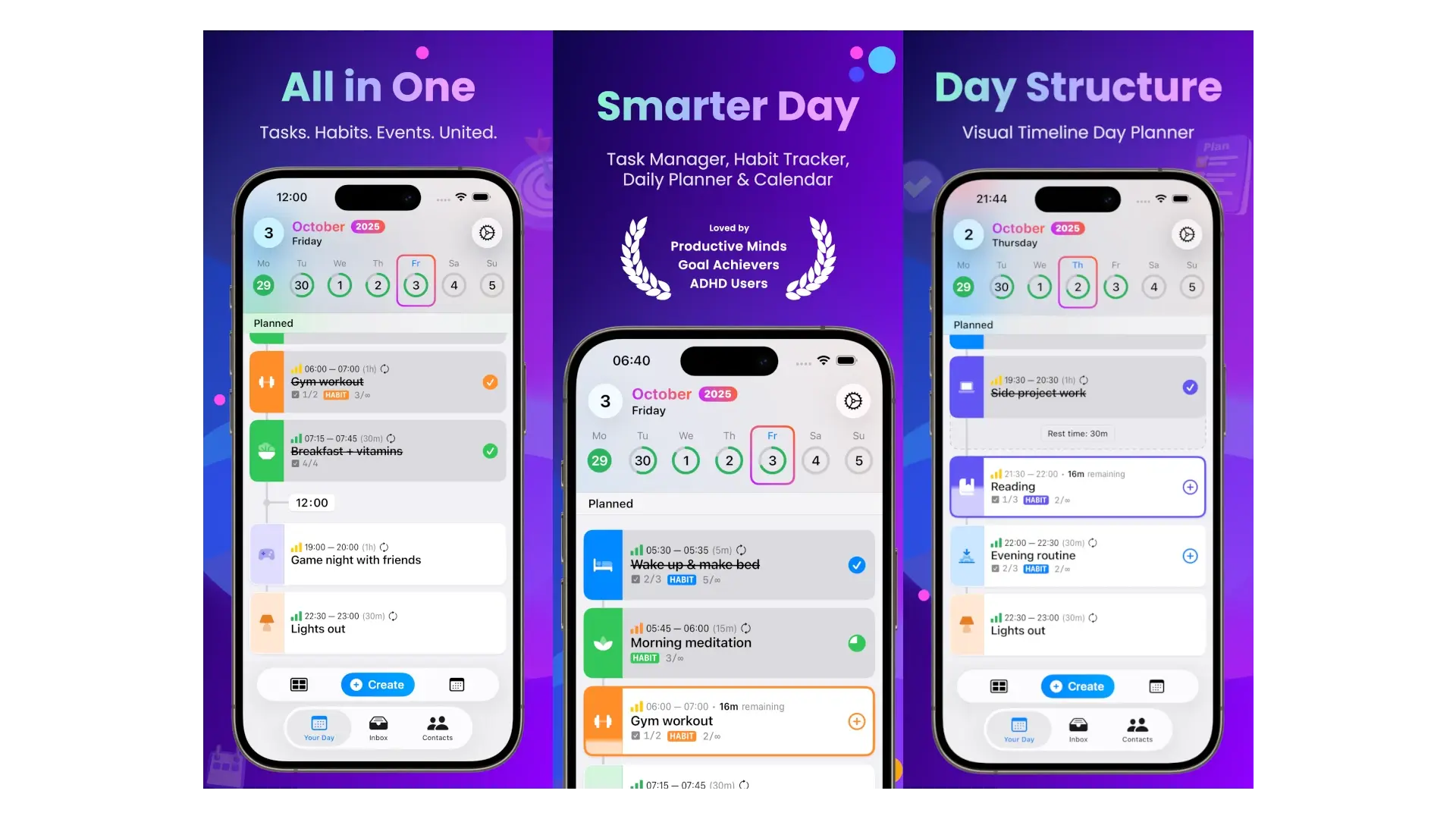
For many professionals, a unified app structure creates immediate gains in time optimization. Tasks can be scheduled where they are seen, habits can support the day instead of competing with it, and priorities stay visible during execution. Smarter.Day is built around that idea: one visual system that helps you stay in control, cut clutter, and move from planning to action faster.
Make routines do more of the work
If every day starts from zero, planning will always feel heavier than it needs to.
Templates, recurring tasks, and built-in habit cues are not boring. They are force multipliers. They reduce the number of fresh decisions your brain has to make before noon. This is especially useful for people balancing deep work with recurring responsibilities, and for ADHD users who benefit from strong visual structure and predictable startup sequences.
Still, routine has limits. Over-structuring your day can backfire if your work is highly reactive or creative. The goal is not to script every hour. It is to automate the repeatable parts so you can stay flexible where flexibility matters.
That is the practical meaning of time optimization. It is not squeezing every minute for output. It is designing a day that wastes less attention.
The best planning system feels lighter, not stricter
A good system should make you feel clear before it makes you feel disciplined. That distinction matters.
When people abandon planning tools, it is often because the tool asks them to become a full-time manager of their own process. Too many fields, too many categories, too many cleanup tasks. The system becomes another obligation. Proven time management strategies work when they reduce drag, not when they add ceremony.
If you are reevaluating your setup, ask a simple question: does this help me start faster? If the answer is no, that is your bottleneck. The best productivity systems are not the most impressive on paper. They are the ones you trust at 8:12 a.m. when your day is already moving and you need clarity now.
Planning should feel like a launch sequence, not a negotiation. Strip away the extra decisions, make priorities visible, and give every task a clear next step. When your system is built for speed and focus, momentum stops feeling fragile and starts feeling repeatable.
You May Also Like
These Related Stories
Boost Focus Fast: 12 Proven Productivity Tactics Today
12 Evidence-Backed Ways to Boost Daily Focus Fast
No Comments Yet
Let us know what you think