

7 Productivity Trends for Professionals Worth Using

A packed calendar can make a professional feel productive while the work that actually moves a project, business, or career forward keeps getting pushed to tomorrow. That is why the most useful productivity trends for professionals are not about squeezing more activity into every hour. They are about seeing what matters, protecting attention, and building a system that makes the next right action easier to choose.
The trend underneath every other trend is simple: people are moving away from disconnected tools and reactive work. They want clarity without spending half the morning creating it. For entrepreneurs juggling clients, managers balancing teams, and professionals with ADHD or high-context roles, the goal is not a perfect schedule. It is a productive system that works when the day gets messy.
1. Fewer tools, stronger productivity systems
The era of collecting a new app for every problem is losing its appeal. A separate calendar, task list, habit tracker, notes app, and project board can create more administrative work than momentum. Every switch forces your brain to reorient, and every duplicate reminder creates another decision.
The leading shift is toward unified productivity systems: one place to capture tasks, organize events, see habits, and make daily priorities visible. This is not an argument for using one tool at all costs. Specialized software still makes sense for deep project planning, design, or engineering work. But your personal operating system should give you one reliable answer to a basic question: what needs my attention now?
A unified view also supports smarter time. When appointments, deadlines, recurring routines, and personal commitments sit together, you can plan against reality rather than against an imaginary empty day. That is the practical meaning of time optimization: using your available time intentionally, not simply filling it.
2. Daily task prioritization is replacing endless to-do lists
Long lists feel responsible, but they rarely create action. They put a strategic proposal, a two-minute reply, a grocery reminder, and a vague idea in the same visual space. Then the easiest item wins.
Professionals are adopting daily task prioritization strategies that separate urgency from importance. The Eisenhower Matrix remains useful because it creates a clear distinction between work that deserves immediate focus, work that should be scheduled, work that can be delegated, and work that does not need to be done at all.
The key is to use the framework before your day becomes reactive. During planning, identify one to three high-impact outcomes and give them a place on the schedule. A priority without time is often just a good intention. A deadline without a defined next step is often a source of stress.
AI-based priority scoring is becoming part of this process, particularly for people managing a high volume of commitments. It can surface due dates, task importance, estimated effort, and project context faster than manual sorting. Still, use it as decision support, not an authority. An algorithm can flag a task as urgent; only you can judge whether it deserves your best hour.
3. Focus is being scheduled, not hoped for
Constant availability has a cost. A few quick messages can fracture a 90-minute block of demanding work into fragments that never add up to meaningful progress. The professionals who protect focus are not necessarily working longer. They are more deliberate about when they are reachable and when they are producing.
This trend is visible in time blocking, meeting-free windows, and shorter communication cycles. Instead of responding to every incoming request, people are assigning messages a defined place in the day. They are also breaking substantial work into smaller milestones so a project does not remain an intimidating, undefined task.
Evidence-based productivity techniques often emphasize the same principle: attention is limited, and task switching has a real cost. The best time management methods proven in real work settings tend to reduce unnecessary switching, clarify the next action, and create feedback on progress. You do not need an elaborate routine. You need protected blocks that match the type of work in front of you.
For example, use your clearest mental window for analysis, writing, strategy, or code. Save administrative tasks, status updates, and simple approvals for lower-energy periods. That is time optimization strategy in practice, not a rigid productivity rule.
4. Habit tracking is joining task management
Tasks move projects forward. Habits keep the person doing the work healthy, prepared, and consistent. Professionals increasingly recognize that planning cannot be separated from the behaviors that support follow-through: a morning review, focused work sessions, movement, medication, inbox processing, or a realistic shutdown routine.
A habit tracker works best when it is connected to the day rather than hidden in a separate app. Seeing a habit alongside meetings and tasks turns it from an abstract goal into a commitment with a visible place. This matters especially for people who struggle with time blindness, task initiation, or remembering what comes next.
Keep habits small enough to survive pressure. “Review priorities for five minutes” is more actionable than “be organized.” “Open the proposal and write the first three lines” can beat “finish proposal.” These micro actions lower the activation energy that fuels procrastination. Once started, the work is usually less difficult than the avoidance story around it.
5. Planning is becoming more visual and more flexible
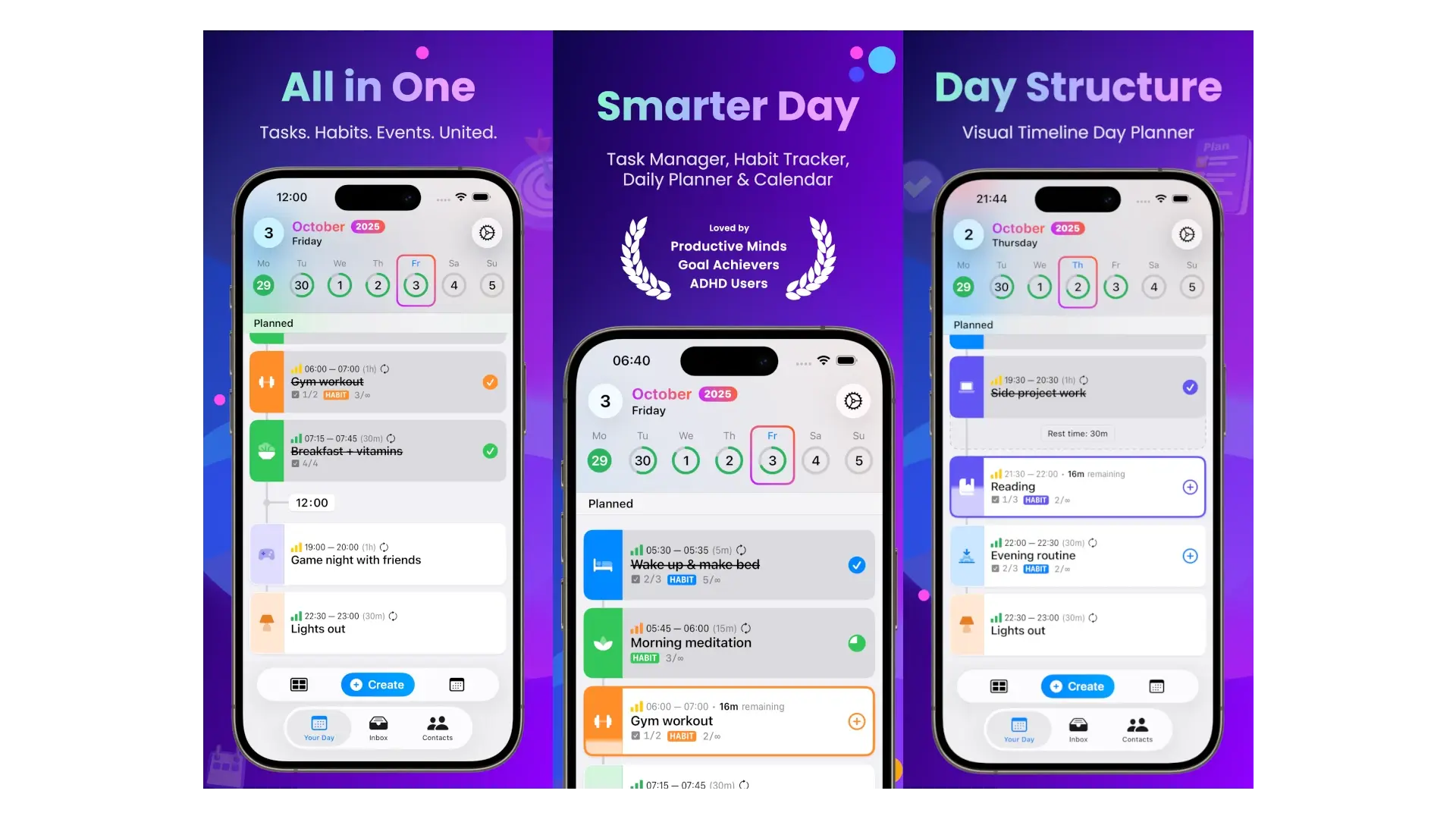
A calendar-only approach can hide the difference between a meeting and meaningful work. A list-only approach can hide the fact that your day has no capacity left. Visual day planning brings both realities together, which makes it easier to spot overload before it becomes a late-night emergency.
Drag-and-drop planning is particularly effective because it keeps prioritization tangible. Move a task, and you immediately see what it displaces. Add a subtask, and a large commitment becomes a sequence you can begin. Reschedule a nonessential item, and you preserve room for the priority that cannot slip.
Flexibility matters as much as structure. A plan should guide the day, not punish you for having one unexpected call or a low-energy afternoon. Build buffers between demanding commitments. Leave some tasks unscheduled but visible. When your plan changes, revise it quickly rather than abandoning it.
6. Meeting time optimization is becoming a leadership skill
Meetings are one of the biggest productivity blockers because they consume more than their listed duration. They require preparation, transition time, follow-up, and attention recovery. The most effective teams are responding by treating meeting time as a resource that deserves the same scrutiny as budget.
Before accepting or scheduling a meeting, establish the decision it must produce. If the purpose is information sharing, an update may be enough. If the purpose is collaboration, set an agenda with a clear owner and a defined outcome. End with assigned next actions, not a vague agreement that someone will follow up.
This does not mean eliminating every conversation. Complex decisions, conflict resolution, mentoring, and creative collaboration benefit from live discussion. The better standard is not “fewer meetings” by itself. It is fewer meetings without a clear reason, and better meetings when people truly need to think together.
7. Productivity is becoming more personal, not more performative
Time management research 2025 2026 discussions continue to point professionals toward a more realistic truth: the ideal workflow depends on your role, energy, environment, and responsibilities. A sales leader, freelance designer, developer, and parent managing a demanding job should not expect the same routine to work.
That is good news. Proven productivity does not require copying someone else’s 5 a.m. ritual or color-coded calendar. It requires observing where your attention leaks, where work stalls, and which commitments consistently produce results. Use that information to build systems productivity around your actual life.
Start with a short daily reset. Capture incoming work before it disappears into memory. Review deadlines and calendar events. Choose your highest-value actions. Then give them a realistic place in the day. Smarter.Day is built around that kind of visible, structured planning, helping you connect tasks, habits, priorities, and schedules without adding more clutter.
The best trend to adopt is the one that reduces friction tomorrow morning. Build a system that makes your priorities obvious, your next action small, and your progress visible. When the day gets noisy, that clarity gives you something far more valuable than a fuller schedule: control.
You May Also Like
These Related Stories
12 Proven Productivity Strategies for Busy Professionals
12 Proven Productivity Strategies for Busy Professionals
No Comments Yet
Let us know what you think