

If your day feels busy but oddly slippery, the problem might not be motivation. It might be tool mismatch. The task manager vs habit tracker question matters because these tools solve different problems, and using the wrong one creates friction fast.
A lot of ambitious people try to run everything through one lens. They put recurring routines into a task list and wonder why it feels nagging. Or they track one-off project work like a habit and lose urgency. The result is familiar - clutter, skipped priorities, and that low-grade stress that comes from never feeling fully caught up.
For professionals, founders, developers, marketers, and ADHD users juggling real complexity, this distinction is more than semantics. It shapes how you plan, how you focus, and whether your productivity system actually supports action.
Task manager vs habit tracker: the core difference
A task manager is built for completion. A habit tracker is built for repetition.
That sounds simple, but it changes everything. Tasks have an endpoint. Finish the client proposal, book the dentist appointment, review Q2 campaign performance, send the follow-up email. Once done, they leave the system.
Habits work differently. They are not about finishing forever. They are about showing up again. Drink water, write for 20 minutes, stretch after lunch, review priorities before 9 a.m. The value comes from consistency over time, not checking a box once.
When you place habits inside a standard task list, they often compete with urgent work and get buried. When you place high-stakes tasks inside a habit tracker, they can look optional, as if missing them today is no big deal because there is always tomorrow. That mismatch weakens daily task prioritization strategies and makes even strong systems productivity harder to sustain.
What a task manager does best
A task manager gives shape to work that needs decisions, scheduling, and prioritization. It helps you answer three questions quickly: What matters now? What can wait? What should not be on my plate at all?
This is where proven productivity starts to feel practical instead of theoretical. A strong task management tool lets you capture ideas fast, break projects into subtasks, sort by urgency and importance, and see your day clearly enough to act without second-guessing every move.
For people managing multiple commitments, this structure is essential. A product launch, team requests, invoice follow-ups, personal errands, and meeting prep do not all deserve equal attention. Good productivity systems create separation between noise and action. Great ones reduce decision fatigue so you can move with confidence.
Task managers are especially useful when work is variable. If your schedule changes often, if deadlines shift, or if you are coordinating with other people, you need a system designed for dynamic inputs. A habit tracker will not give you enough control there.
What a habit tracker does best
A habit tracker supports identity and consistency. Its job is to make repeated behavior visible.
That matters because routines are often where time optimization really begins. Not in heroic work sprints, but in small repeated actions that stabilize the day. Planning tomorrow before logging off. Clearing inbox clutter once a day. Reviewing top priorities in the morning. Taking medication. Going for a walk. Writing code before opening chat.
These behaviors are easy to skip because they rarely feel urgent in the moment. A habit tracker keeps them visible and measurable. It turns vague intentions into patterns you can actually see.
This is also where evidence-based productivity methods become useful. Behavioral research consistently points toward repetition, cue design, and friction reduction as drivers of follow-through. In plain terms, people repeat what is easy to see, easy to start, and satisfying to record. Habit tracking supports all three.
For ADHD users in particular, that visibility can be a major advantage. It reduces the mental load of remembering, lowers the chance that important routines disappear, and creates a cleaner feedback loop than relying on memory alone.
The real problem: most people need both
The task manager vs habit tracker debate gets framed as a choice, but for most busy adults, it is a coordination problem.
You need one system for commitments and another for routines, or one integrated system that handles both without forcing you to fake one as the other. That is the key distinction.
A task manager alone can turn daily routines into repetitive clutter. A habit tracker alone can leave serious project work underplanned. Together, they support both execution and consistency, which is what effective daily task management systems methods 2025 2026 are really aiming for.
Think about a normal Tuesday. You may need to finish a budget review, prep for a client call, reschedule a meeting, and submit feedback to your team. Those are tasks. You may also want to exercise, review your top three priorities, limit context switching, and do 15 minutes of focused reading. Those are habits. They coexist, but they should not be managed the same way.
How to decide what belongs where
A simple test helps. Ask: am I trying to complete this, or repeat it?
If the item has a clear finish line, it belongs in a task manager. If success means doing it consistently over time, it belongs in a habit tracker.
There are gray areas, and that is normal. "Write newsletter" is a task if it refers to this week’s issue. "Write for 30 minutes every weekday" is a habit. "Weekly planning" can be treated as a habit because it repeats, but if you want stronger accountability, it may also appear in your calendar or daily view.
The point is not perfect categorization. The point is reducing ambiguity. Ambiguity is where procrastination thrives.
This is why many productivity strategies for professionals now lean toward unified planning environments. The less time you spend bouncing between disconnected tools, the easier it becomes to stay in control. You do not need more apps. You need a cleaner system productivity model.
Where separate tools break down
Using one app for tasks and another for habits can work. But it often creates blind spots.
You complete habits without seeing how they fit into your actual workload. Or you overload your task list without accounting for the routines that keep you steady. That split may seem minor, yet it affects time optimization meaning in a very practical way. You are not just managing time. You are managing attention, energy, and behavioral follow-through.
Fragmentation is expensive. It creates duplicate planning, scattered notifications, and competing views of what the day is supposed to look like. For people already operating at full capacity, that extra friction is enough to derail good intentions.
An integrated setup is often stronger because it lets you see tasks, habits, events, and priorities in one place. That kind of visual clarity supports smarter time decisions. You can spot overload earlier, protect focus blocks, and avoid treating every obligation like it has the same weight.
What to look for in a combined system
If you want one app to handle both, the goal is not just feature breadth. It is behavioral fit.
Look for a system that lets you capture tasks quickly, prioritize them visually, and schedule them in context. Then make sure habits do not just exist as another checklist buried in the same pile. They should be trackable as repeated actions with clean visibility over time.
A strong combined system should also support prioritization frameworks. If you can sort work by urgency and importance, organize subtasks, and view your day in a structured layout, you reduce the cognitive drag that kills momentum. Add habit tracking to that same environment and you start to build productive systems that reflect how real days actually work.
This is one reason all-in-one tools are gaining ground among users who care about proven time management strategies. When your planning, routines, scheduling, and prioritization live together, execution gets faster. You spend less time maintaining the system and more time using it.
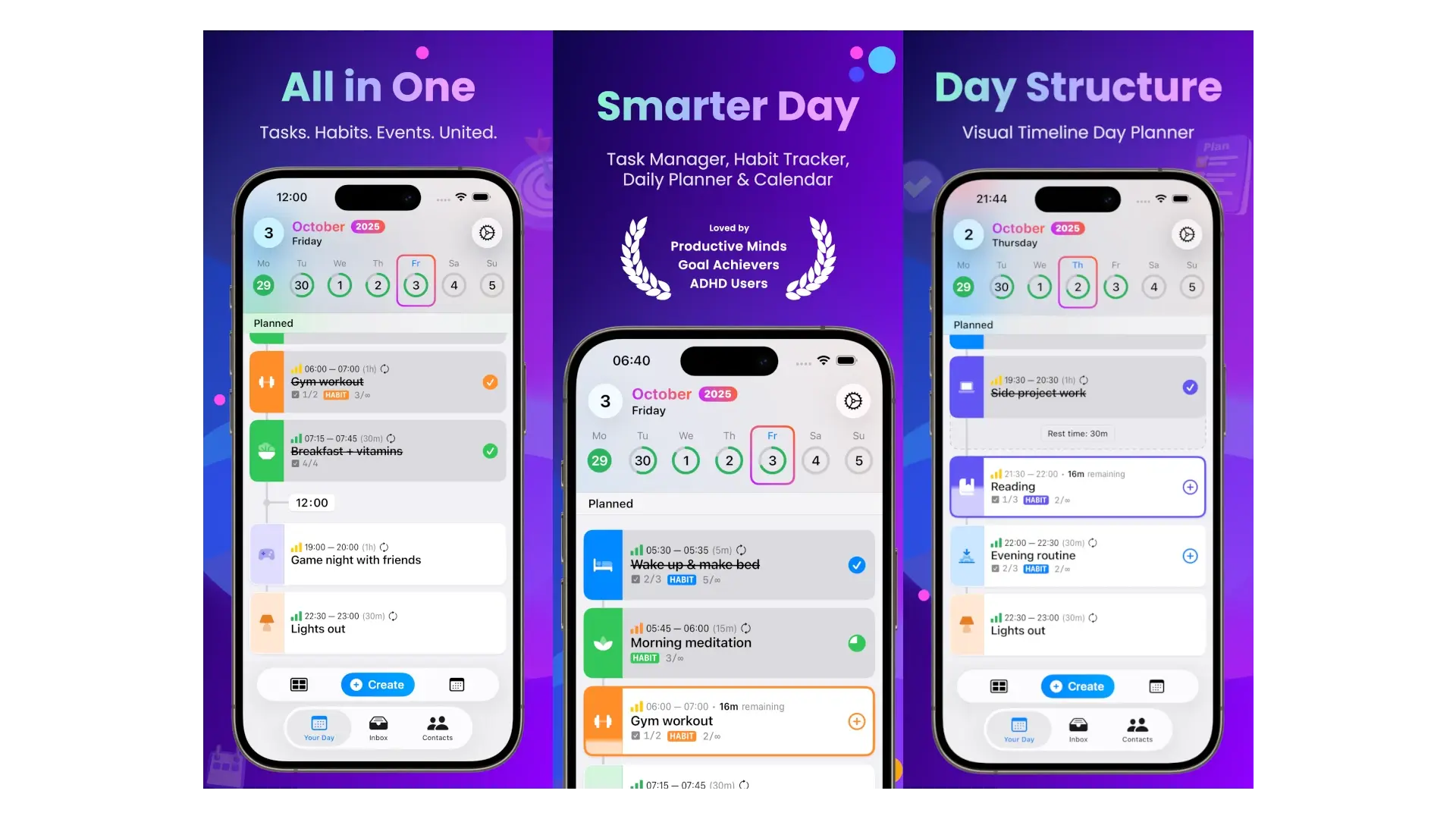
Smarter.Day is built around that idea - one visual workspace for tasks, habits, events, and priorities, designed to reduce clutter and help you act on what matters most.
Which one should you start with?
If your biggest problem is missed deadlines, mental clutter, and too many open loops, start with a task manager.
If your biggest problem is inconsistency, weak routines, and not following through on the basics, start with a habit tracker.
But if you are managing both chaos and inconsistency, which is common, start with the system that gives you the clearest daily view and lets you support both. That is usually the fastest route to control.
Productivity is not about squeezing more into every hour. It is about building a reliable operating system for your day. When you stop forcing tasks and habits into the same mold, planning gets cleaner, focus gets easier, and progress stops feeling accidental.
Choose the tool based on the behavior you want to drive. Then make it easy to use every day. The best system is not the one with the most features. It is the one that helps you see clearly, decide quickly, and keep going when the day gets messy.
You May Also Like
These Related Stories
Master Time Optimization: 12 Proven Productivity Tactics

How to Organize Recurring Tasks That Stick
No Comments Yet
Let us know what you think