

Time Mastery: Proven Systems to Prioritize and Focus

Time Mastery: Proven Systems to Prioritize and Focus
Introduction
Let’s face it: even the most motivated among us get derailed by overflowing inboxes, shifting priorities, and relentless pings. The result? We stay “busy” but not effective. Have you ever noticed how a day of scattered tasks leaves you exhausted yet oddly unaccomplished? Here’s the catch—productivity isn’t just about working harder; it’s about building systems that protect your time, sharpen your focus, and align your effort with outcomes that matter. In this guide, we’ll turn overwhelm into a manageable workflow you can trust.
Our goal is straightforward: give you actionable time optimization strategies you can deploy today. We’ll blend proven frameworks—like the Eisenhower Matrix, Deep Work, and Weekly Reviews—with modern tactics for automation, communication hygiene, and data-driven iteration. Expect practical steps, relatable examples, and references to trusted experts. By the end, you’ll have a repeatable approach to prioritization, focus, and workflow improvement that helps you do less, better.
Clarify Outcomes with the Rule of Three
The Rule of Three forces clarity. Each morning, define the three outcomes that, if completed, would make your day successful. Pair this with a weekly “Big Three” to keep daily actions aligned with bigger goals. J.D. Meier popularized this in “Getting Results the Agile Way,” and it’s echoed in Greg McKeown’s “Essentialism,” which urges us to do fewer things, better. Practical methods: write your daily three before opening email, and set a WIP limit—no more than three active tasks at once to curb multitasking.
Here’s a quick example. A product manager lists: finalize feature spec, review two customer interviews, and align the sprint backlog. She blocks time for each and ignores non-critical requests until these three are done. The result? Less context switching, more meaningful progress. As McKeown notes, “If you don’t prioritize your life, someone else will.” The Rule of Three is a friendly guardrail against scattered busyness.
Extend the system with a weekly checkpoint. On Fridays, compare your daily outcomes against the weekly three. What drifted? Why? Adjust the upcoming week. This micro-retrospective keeps your plan grounded in reality. Over time, you’ll notice better time management and more accurate estimates. You’ll also learn how long real work takes—critical for consistent performance.
The Priority Matrix: From Urgent to Impact
The Eisenhower Matrix separates the urgent from the important. Method one: categorize tasks into four quadrants (Urgent/Important, Important/Not Urgent, Urgent/Not Important, Not Urgent/Not Important). Method two: assign an impact score (1–5) to each task, then sort by importance before urgency. Stephen R. Covey popularized this in “The 7 Habits of Highly Effective People”—especially the focus on Q2 work: important but not urgent.
Example: A marketing lead sees “reply to vendor” (urgent, low impact) and “launch audience research” (not urgent, high impact). By scheduling the research first, she shapes strategy instead of chasing pings. “What is important is seldom urgent,” said President Eisenhower. The matrix isn’t just a grid; it’s a commitment to prioritization and impactful work.
To lock it in, build a routine: spend 10 minutes each morning sorting tasks into quadrants. Batch Q3 tasks (urgent, not important) into a short window or delegate them. Drop most Q4 tasks. The discipline is simple but transformative. Over weeks, your calendar shifts from reactive to proactive, and your stress drops as your workflow reflects what truly moves the needle.
Time Blocking and Energy Matching
Time blocking is a calendar-first method: schedule work in focused blocks rather than reacting to tasks as they arise. Method one: block 90–120 minutes for deep tasks; method two: protect “admin stacks” for shallow tasks. Combine this with energy matching—align work type to your chronotype. Research by Daniel H. Pink (“When”) and Nathaniel Kleitman on ultradian rhythms supports working in natural peaks for complex tasks and troughs for shallow ones.
A software engineer, for instance, schedules algorithm design from 9–11 a.m. (peak focus) and code reviews at 3 p.m. (lower energy). She stacks meetings mid-afternoon when creative horsepower is scarce. By respecting cognitive performance rhythms, she reduces friction and errors. The result is smoother output and fewer late-night sprints.
To start, audit your energy for a week—note when you feel sharp, average, or drained. Then, create recurring blocks that mirror this pattern and defend them like meetings. Add one rule: reschedule a block you must move within 24 hours. This prevents “calendar slippage.” Over time, time optimization becomes automatic because your schedule supports how your brain actually works.
The 2-Minute Rule and Micro-commitments
David Allen’s Getting Things Done gives us the 2-Minute Rule: if it takes less than two minutes, do it now. Method two: use micro-commitments—promise yourself to work on a task for 60 seconds to overcome starting friction. BJ Fogg’s “Tiny Habits” shows small, reliable actions create lasting momentum. Combine both to kill procrastination and build motion.
Real-life example: a writer avoids starting a long article. She commits to “open the doc and write one sentence.” Within five minutes, she’s rolling. The first action is the hardest—once started, the Zeigarnik effect (our memory’s pull to complete open tasks) nudges you forward. The 2-minute triage clears grit from your gears; micro-commitments ignite focus.
Practical routine: at the top of each hour, spend two minutes clearing tiny tasks. Then pick one important task and perform a micro-commitment to start. Track how often “just one minute” becomes 20. Over a week, you’ll notice faster task turnover and fewer nagging to-dos. Momentum compounds, and your workflow improvement becomes visible and repeatable.
Deep Work Sprints with Attention Management
Cal Newport’s “Deep Work” argues that undistracted concentration produces significantly better results. Method one: schedule deep work sprints (45–90 minutes) with a 5–15 minute break. Method two: practice attention management—disable notifications, use site blockers, and set a visible “focus status.” “Clarity about what matters provides clarity about what does not,” Newport reminds us.
Consider a financial analyst preparing a quarterly report. She plans three 60-minute sprints, closes Slack, and turns her phone face-down in another room. With a single-task checklist and a hard stop, she finishes the core analysis in one morning instead of a scattered day. The win isn’t just speed; it’s accuracy and confidence—hallmarks of high performance.
To sustain this, create a “focus environment”: noise-canceling headphones, minimal tabs, and a pre-focus ritual (review goals, start timer, silence devices). Use a 50/10 rhythm if you’re new to longer stretches. Over time, you’ll strengthen your “focus muscle,” spending more hours in flow and fewer in reactive mode.
Systems Over Goals: Build Reliable Routines
“Losers have goals; winners have systems,” writes Scott Adams. Goals clarify direction, but systems make progress reliable. Method one: use habit stacking—attach a new behavior to an existing one. Method two: redesign your environment to make desired actions easy and undesired ones harder. James Clear (“Atomic Habits”) outlines both strategies in practical detail.
Example: an entrepreneur wants consistent planning time. She stacks “open calendar and write daily three” immediately after making coffee. She also puts her notebook on the coffee machine each night—environment design that reduces friction. Within two weeks, planning is automatic, and her days start with intention, not anxiety.
Codify your routines with if–then rules: If it’s 8 a.m., then I plan my day. If I finish lunch, then I walk for 10 minutes. Small, predictable actions compound, smoothing your workflow and reducing decision fatigue. Systems don’t require motivation every morning; they run even when willpower dips.
Automate and Delegate with SOPs
Automation and delegation free your time for high-impact tasks. Method one: build SOPs (standard operating procedures) for repeatable work—checklists, templates, and step-by-step guides. Method two: automate with tooling (email filters, scheduling links, Zapier/Make for integrations). Tim Ferriss (“The 4-Hour Workweek”) and Peter Drucker’s principle of focusing on what only you can do both support this shift.
A customer success lead documents her onboarding SOP, including email templates and checklists. She delegates it to a team member and uses automation to trigger follow-ups. Onboarding time drops by 40%, and she reclaims hours for strategy. The lesson: document once, benefit many times.
Practical approach:
- Run a quick 80/20 analysis to find tasks that consume time but don’t require your strengths.
- Convert top candidates into SOPs.
- Automate handoffs (e.g., form submission → Slack notification → task creation).
You’ll reduce errors, speed delivery, and create a scalable workflow improvement engine.
Inbox Zero and Communication Hygiene
Email and chat can wreck focus if unmanaged. Method one: batch processing—handle messages 2–3 times daily, not constantly. Method two: use templates, filters, and channel norms (e.g., “DM only for urgent blockers; otherwise post in channel”). Merlin Mann coined “Inbox Zero,” and Gloria Mark (UC Irvine) found it takes over 20 minutes to refocus after an interruption—costly for deep work.
Consider a sales manager. She checks email at 11 a.m. and 4 p.m., uses canned replies for common questions, and filters newsletters to a “Read Later” label. Slack is set to “Notify on @mention only.” Within a week, she recovers hours and finishes proposals faster. Her stress drops because messages stop dictating her day.
Add a communication contract to your team: response-time expectations, meeting-free blocks, and async-first habits. Close loops with clear subject lines and “Next Step + Owner + Date” at the end of messages. You’ll protect focus, reduce back-and-forth, and strengthen team throughput.
Review Rituals: Weekly, Monthly, Quarterly
Without reflection, plans drift. Method one: a Weekly Review (from David Allen’s GTD) to clear inboxes, update projects, and set the next week’s Big Three. Method two: monthly and quarterly resets using OKRs (Objectives and Key Results). John Doerr’s “Measure What Matters” shows how OKRs align effort with outcomes.
A freelance designer spends Friday afternoons reviewing deliverables, checking invoices, and planning next week’s top three outcomes. Monthly, she reviews her pipeline metrics and refreshes her marketing OKRs. Quarterly, she assesses client mix and raises rates for high-touch work. The result is steady growth and less last-minute scrambling.
Keep it simple:
- Weekly: clear, calibrate, commit.
- Monthly: review metrics and projects; prune what no longer matters.
- Quarterly: refresh OKRs and capacity plan.
These rituals maintain time management hygiene and keep your execution tethered to strategy.
Strategic Saying No: Guardrails for Your Time
Every “yes” is a hidden “no” to something else. Method one: use decision filters—does this align with current OKRs or top priorities? Method two: offer positive alternatives (“I can’t this week, but here’s a resource” or “I can do A or B, which helps more?”). Greg McKeown’s “Essentialism” champions deliberate trade-offs to protect impact.
A product lead gets invited to three meetings that don’t require her expertise. She proposes a written update instead and attends just one critical decision meeting. She keeps a “Not Now” list to revisit ideas in the next planning cycle. By narrowing commitments, she multiplies outcomes on what matters most.
Script your responses in advance. Examples:
- “Thanks for asking—my plate is full with [priority]. Can we revisit after [date]?”
- “I’m not the best fit, but [Name] can help.”
Prewritten scripts make it easier to prioritize without friction or guilt and strengthen your boundaries.
Manage Meetings Like a Project
Meetings can be value engines—or time sinks. Method one: require a clear agenda with outcomes; cancel if missing. Method two: default to shorter durations (25 or 50 minutes) and end with “Decisions, Owners, Dates.” Research from Harvard Business Review highlights the heavy cost of poorly run meetings and the gains from clear structure and fewer attendees.
A nonprofit director shifted status meetings to async updates in a shared doc, keeping a 20-minute live slot for blockers only. Attendance dropped from 12 to 5, decisions sped up, and the team regained hours weekly. The principle: “Meeting time is product time—treat it with respect.”
Tactics to try:
- Adopt a rotating facilitator and timekeeper.
- Use a parking lot for off-topic items.
- Record decisions and next steps live.
Meetings should accelerate work, not replace it.
Data-Driven Productivity: Track, Iterate, Improve
“What gets measured gets managed,” attributed to Peter Drucker, applies to your personal workflow. Method one: time tracking for a week to identify leaks and calibrate estimates. Method two: run small experiments—change one variable (e.g., focus block length) and compare results. Teresa Amabile’s “The Progress Principle” shows that noticing small wins boosts motivation and output.
Example: a consultant logs time and discovers 6+ hours/week lost to ad hoc Slack replies. She implements two message windows, adds status visibility, and recovers four hours weekly. She tracks deep work hours and sets a target: 12 hours/week. The data confirms improvement—not just a feeling.
Keep iteration light:
- Pick one metric (deep work hours, task completion rate, or context switches).
- Set a weekly target.
- Run a two-week experiment, review, then keep or tweak.
Data turns productivity tips into a reliable system you can improve over time.
Conclusion
You don’t need a bigger to-do list—you need better systems. By clarifying outcomes, prioritizing for impact, matching work to energy, protecting focus, and reviewing consistently, you’ll transform your days from reactive to purposeful. Start small: choose one approach—like the Rule of Three or time blocking—and layer on from there. Momentum and confidence follow structure.
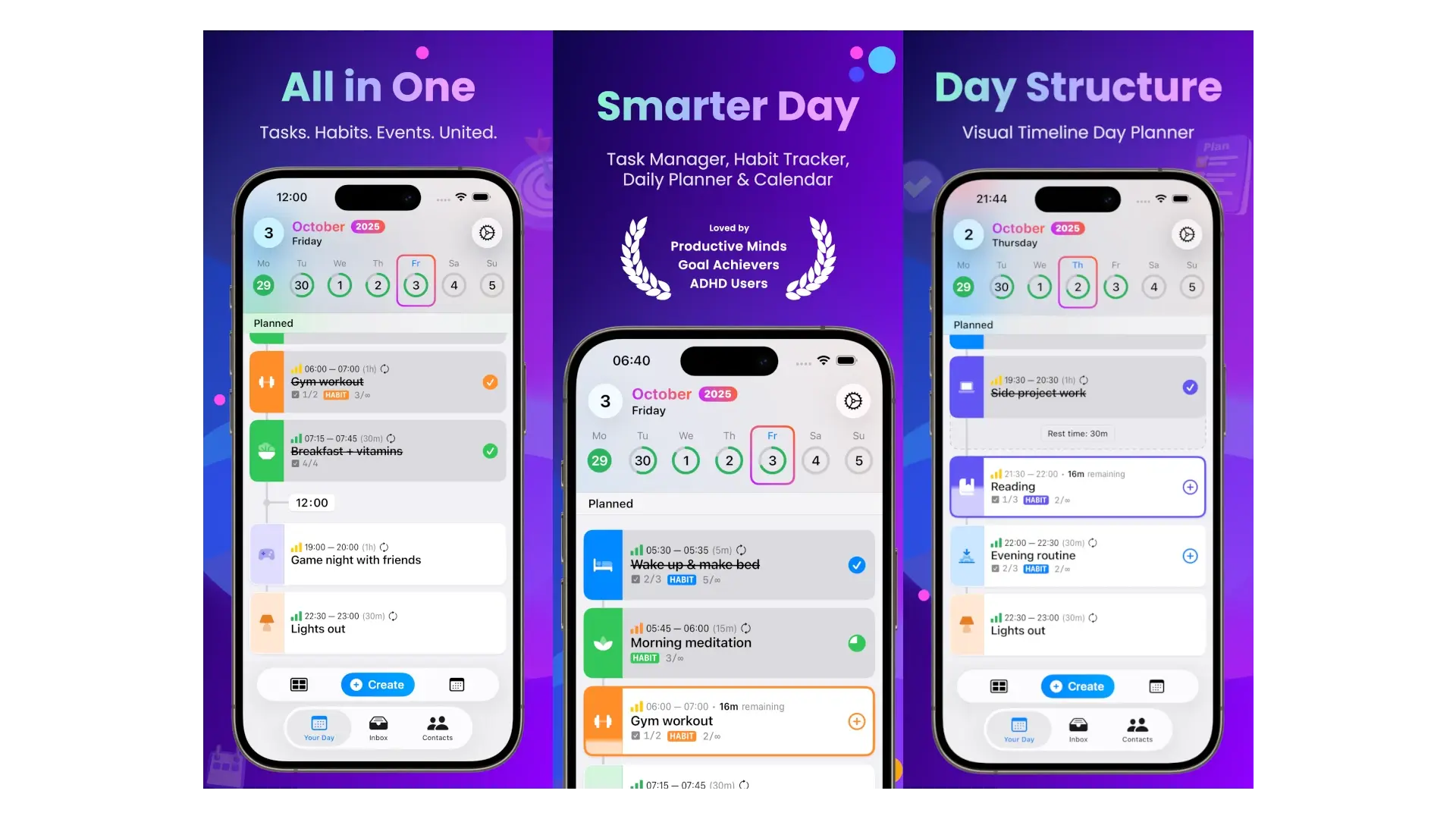
If you want a single place to plan your daily priorities, block time, and review progress, try the productivity app at Smarter.Day. It’s designed to support these exact methods so you spend less time organizing and more time executing.
You May Also Like
These Related Stories
Time Mastery: Proven Systems to Prioritize and Focus
Time Mastery: Proven Systems to Prioritize and Focus
No Comments Yet
Let us know what you think