

12 Proven Time Management Strategies That Actually Work

12 Proven Time Management Strategies That Actually Work
We all juggle competing priorities, endless notifications, and creeping procrastination. Here’s the catch: most of us rely on willpower instead of systems. That’s why days feel busy but not productive. In this guide, we’ll break down time optimization techniques that reduce friction, boost focus, and create repeatable workflow improvements. We’ll tackle real obstacles like context switching, meeting overload, and task overwhelm with proven methods you can apply immediately.
You’ll discover a playbook built from research-backed strategies, expert frameworks, and relatable examples. We’ll combine tools like time boxing, the Eisenhower Matrix, and deep work with energy management, automation, and meeting hygiene. By the end, you’ll have a practical set of tactics that fit your life—not just another aspirational routine. Ready to reclaim your schedule and improve performance without burning out? Let’s get to it.
Prioritize with the Eisenhower Matrix and Ivy Lee Method
Start by clarifying what truly matters. Use the Eisenhower Matrix to sort tasks into urgent vs. important quadrants, then schedule the “important, not urgent” work before it becomes a fire. Pair it with the Ivy Lee Method: write down the six most important tasks for tomorrow, order them by priority, and tackle them one at a time. These two methods work beautifully together to drive workflow improvement without the mental clutter of endless to-do lists.
For example, a marketing manager drowning in requests can spend five minutes each afternoon ranking the six next-day tasks. “Create campaign brief” and “review analytics” might outrank “answer Slack pings.” The matrix helps delegate or defer low-impact work, while Ivy Lee ensures a single-tasking rhythm. The result? Fewer reactive hours and more meaningful progress—even when urgent items pop up.
Dwight D. Eisenhower popularized the urgency-importance distinction, and productivity author James Clear has detailed how the Ivy Lee Method reduces decision fatigue by pre-committing to priorities. One tip: add a small buffer after task three to absorb inevitable surprises, so your plan bends without breaking. Keep your prioritized list visible—on paper or a digital widget—to anchor attention.
Time Boxing with Pomodoro and the 2-Minute Rule
When your day feels slippery, time boxing brings structure. Block specific time slots for high-impact tasks, then protect them like meetings. Layer in Pomodoro (25 minutes focused, 5-minute break) to build momentum, and use the 2-minute rule from GTD: if a task takes less than two minutes, do it now. These methods reduce procrastination by lowering activation energy and creating natural sprints.
Consider a software engineer with code reviews, deep feature work, and bug triage. They can time-box two morning Pomodoros for deep work and reserve a 30-minute block post-lunch for quick 2-minute items like approvals and short replies. Fast wins keep the inbox tame while Pomodoros push substantial work forward. The mix preserves energy and focus across different task types.
The Pomodoro Technique by Francesco Cirillo is widely used to boost attention and combat perfectionism. The 2-minute rule comes from David Allen’s “Getting Things Done,” which emphasizes frictionless capture and execution. To prevent over-scheduling, cap time-boxed blocks at 60–90 minutes and insert micro-breaks. If interruptions are common, add a “recovery buffer” after each deep block to regain rhythm.
Batch Tasks and Defeat Attention Residue
Jumping between tasks saps performance due to attention residue—part of your mind lingers on the last thing. Solve this by task batching: group similar activities like email, data entry, or design reviews into defined windows. Also adopt context-specific checklists that standardize recurring steps, minimizing mental load and errors. Together, batching and checklists turbocharge workflow improvement.
Picture a recruiter who checks applications, schedules interviews, and writes feedback. By batching application reviews for 45 minutes, then scheduling in a single 30-minute block, they avoid ping-ponging. A hiring checklist streamlines each step: confirm job code, template outreach, calendar logistics. This structure frees attention for candidate evaluation—the highest-value work.
Management scholars Meyer, Evans, and Rubinstein (2001) showed that task switching incurs time and accuracy costs. Organizational psychologist Sophie Leroy coined the term attention residue, explaining why “just a quick check” derails focus. Practical tweak: define 2–3 daily batch windows and communicate them (“I process emails at 11:30 and 4:30”). Batching reduces the urge to multitask and stabilizes cognitive performance.
Build Deep Work Blocks and Audit Distractions
We live in distraction machines. Carve out deep work blocks—90-minute windows for cognitively demanding tasks—where notifications are off and tabs are minimal. Run a distraction audit for a week: note every interruption and the trigger (notification, habit, person). Then apply targeted fixes like website blockers, notification summaries, or moving apps off your home screen to reclaim attention.
A product designer struggling to finish a complex prototype schedules two deep blocks weekly, 9:00–10:30 a.m. They mute Slack, enable a site blocker for social and news, and keep only Figma open. After tracking distractions, they notice a midday slump triggers scrolling. The fix? A short walk before lunch and a rule: news only after 4 p.m. Performance—and satisfaction—skyrockets.
Computer science professor Cal Newport popularized deep work, while Dr. Gloria Mark (UC Irvine) has shown that frequent digital interruptions reduce focus and can take over 20 minutes to fully recover. A simple rule helps: “One screen, one task.” If you must be reachable, give colleagues a clear window for responses. Protecting even two deep blocks a week yields outsized results.
Manage Energy with Ultradian Rhythms and Strategic Breaks
Time matters, but energy management often matters more. Work with ultradian rhythms—natural 90–120-minute cycles—by scheduling mentally intense work when your energy peaks and inserting brief recovery breaks. Use strategic naps or movement breaks to reset. Even a five-minute walk boosts mood and cognition; a 20–26 minute nap can significantly restore alertness without grogginess.
Imagine an analyst who’s sharpest from 9:30 to 11:30 a.m. They protect that window for complex modeling, then take a 10-minute break away from screens. Post-lunch, they schedule lighter tasks and a short movement break at 2:30 p.m. On heavy days, a 20-minute nap at 3:00 prevents the afternoon fade, keeping output high into late meetings without extra caffeine.
Sleep researcher Nathaniel Kleitman identified ultradian cycles, and NASA’s research with pilots found that a 26-minute nap improved performance by about 34% and alertness by 54%. Treat breaks as maintenance, not indulgence. Keep naps under 30 minutes, hydrate, and step into daylight. Track your peak periods for a week, then align priority work with those peaks for reliable performance gains.
Plan with GTD Capture and Weekly Reviews, Aligned by OKRs
Cluttered minds stall action. Use GTD capture to externalize tasks fast—email yourself ideas, drop notes in an inbox, or voice-capture on the go. Then run a weekly review to clarify, organize, and next-action everything. Align these micro-tasks with OKRs (Objectives and Key Results) so daily efforts ladder up to quarterly goals, keeping execution and strategy in sync.
A startup PM captures every request into one inbox during the week. Friday afternoons, they clarify: is it actionable, delegated, or someday/maybe? Then they map tasks to OKRs like “Improve onboarding activation from 35% to 50%.” This filters nice-to-have tasks and highlights high-leverage work, like an onboarding checklist test. Fewer random errands, more impact.
David Allen’s “Getting Things Done” provides the capture and review backbone that reduces anxiety and speeds decisions. Andy Grove and John Doerr championed OKRs to drive focus and transparency. Quick practice: tag tasks by Key Result (KR1, KR2, etc.). If a task doesn’t support a KR, question it. This keeps your time optimization tightly connected to measurable outcomes.
Shrink Scope with The ONE Thing and the 80/20 Rule
When everything feels important, it’s time to shrink the scope. Ask Gary Keller’s focusing question from “The ONE Thing”: “What’s the one thing I can do such that by doing it everything else will be easier or unnecessary?” Combine it with the Pareto Principle (80/20) to identify the few inputs driving most results. Cutting ambition into a laser beam beats spreading yourself thin.
A freelance designer overwhelmed by five client projects asks the focusing question and realizes updating a reusable template will speed three projects. They dedicate a morning to the template and save hours later. A quick 80/20 review of revenue vs. time reveals one client is high-friction, low-profit—prime for renegotiation or referral. Prioritization becomes obvious.
Economist Vilfredo Pareto observed the 80/20 distribution, later applied to productivity, while Gary Keller and Jay Papasan provide a reliable focusing lens. Practical methods: define a “Minimum Viable Outcome” for today’s top task and set a “stop rule” (e.g., deliver a v1 draft by 3 p.m.). Use bold checkpoints like “What’s my one thing right now?” to avoid scope creep and decision drift.
Automate, Template, and Use Text Expanders
Free your brain from repetitive tasks. First, automate routine workflows with tools that connect apps (e.g., automatically archive invoices, log calendar events, or save attachments to project folders). Second, build templates and text expanders for recurring emails, briefs, and reports. Third, master keyboard shortcuts to shave seconds that compound into hours across the week.
Take a customer success lead handling onboarding emails, FAQs, and renewals. They create templates for the top five responses, a text-expander snippet for personalized intros, and a workflow that sends signed contracts to a CRM and Slack channel. What used to take 90 minutes daily now takes 35—with fewer errors and greater consistency across the team.
The McKinsey Global Institute reports knowledge workers spend around 28% of their time on email. Automations, templates, and snippets attack that overhead directly. Start by documenting your top five recurring processes, template them, then automate the handoffs. Add a weekly “automation audit” to spot patterns. Every saved minute is compounding productivity you can reinvest in deep work.
Run Better Meetings with Agendas, Decision Logs, and Time Caps
Meetings expand to fill the time allotted—classic Parkinson’s Law. Counter this with three rules: 1) send a clear agenda with desired outcomes, 2) keep a decision log in the invite notes, and 3) set time caps (30 minutes default, 50 minutes max). Adopt the “two-pizza rule” for size limits and default to asynchronous updates when decisions aren’t needed.
An operations team moved weekly status updates to a shared doc reviewed asynchronously. The live meeting now focuses on two decisions and one blocker. They cap the session at 25 minutes, document decisions inline, and assign owners immediately. Result: fewer meetings, faster follow-through, and more time for real work—without sacrificing alignment.
Studies in the Harvard Business Review highlight how structured agendas and smaller meetings increase effectiveness and reduce burnout. Add these methods: start with the decision question (“Are we deciding A or B?”), timebox each agenda item, and reserve five minutes to confirm owners and deadlines. Protect your calendar with “no-meeting” focus blocks to maintain cognitive performance.
Fight Procrastination with Implementation Intentions and WOOP
We procrastinate when tasks feel vague or too big. Use implementation intentions—if-then plans—to script the exact next step: “If it’s 8:30 a.m., then I open the spec and write the outline.” Combine with WOOP (Wish, Outcome, Obstacle, Plan) to anticipate barriers and pre-plan responses. This removes ambiguity and builds automaticity.
A grad student dreading a thesis chapter tries: Wish: finish section 2. Outcome: clarity for advisor. Obstacle: checking messages. Plan: “If I reach for my phone, I put it in the drawer and write one more paragraph.” They also preopen the doc the night before and leave a note: “Start with method paragraph.” The friction drops, and they start faster.
Psychologist Peter Gollwitzer established implementation intentions as a powerful behavior change tool, and Gabriele Oettingen developed WOOP to turn wishes into action. Two practical add-ons: create “starter steps” so the bar to begin is tiny, and set realistic deadlines—near enough to motivate, far enough to be feasible. Small, well-defined moves beat grand, vague plans.
Calibrate Focus with Flow Triggers and Task Difficulty
Productivity spikes when you’re in flow—that sweet spot between boredom and anxiety. Achieve it by matching task difficulty to your skill, setting clear goals, and getting immediate feedback. Two methods help: break large tasks into challenge-sized chunks and use focus cues (noise-canceling headphones, a ritual playlist, or a consistent workspace) to prime your brain.
A developer refactors a legacy module by setting a 60-minute challenge: “Clean the authentication layer.” They track tests passing for quick feedback and keep a visible progress bar. With a ritual (tea, three deep breaths, playlist), they hit flow more often. Not every session is perfect, but consistency beats sporadic marathons.
Psychologist Mihaly Csikszentmihalyi introduced flow as a driver of peak experience and performance. To engineer it, define the next clear sub-goal, remove ambiguous steps, and seek immediate feedback (tests, checklists, or peer review). If stuck, adjust difficulty: easier for momentum, harder for engagement. Sustained performance thrives where clarity meets challenge.
Make Decisions Faster with Default Rules and Precommitments
Slow decisions drain time and willpower. Create default rules for recurring choices—like “email triage twice daily,” “meetings default to 25 minutes,” or “book flights on Tuesdays.” Pair with precommitments: schedule sprints with colleagues, lock in gym classes, or use site blockers during deep work. These constraints simplify your day and protect priorities.
A sales lead sets a default: proposals are sent within 24 hours. They precommit by blocking 4–5 p.m. after each discovery call for drafting. With a shared template and a rule that drafts must be sent for peer review by 5 p.m., turnaround time drops and win rates improve. Decisions feel lighter because the system does the heavy lifting.
Behavioral economics shows defaults shape behavior—people follow the path of least resistance. Productivity authors like Dan Ariely and Katy Milkman have documented how precommitments and nudges reduce friction. Practical step: list your top five recurring decisions and design a default for each. Add one precommitment that protects your most important work daily.
Close Your Day with a Shutdown Ritual and Next-Day Script
End strong to start strong tomorrow. Use a shutdown ritual: clear your inbox to a few actionable emails, update your task list, capture loose ideas, and write a next-day script with your top three tasks. Then physically step away—close the laptop, tidy your desk, and mark a line in your notebook. This signals closure and reduces overnight rumination.
A support team lead spends the last 15 minutes closing tickets, flagging two follow-ups, and scripting tomorrow’s priorities. They also add a note: “If the queue spikes, triage first, templates second.” The next morning, they begin immediately—no dithering—because the runway is already paved. Consistency compounds; stress declines.
Cal Newport advocates a “shutdown complete” habit to protect cognitive resources, and memory research shows unresolved tasks nag at us (the Zeigarnik effect). Your ritual doesn’t need to be long—5 to 10 minutes is enough. Include a gratitude line or a quick win log to sustain motivation. Tomorrow’s clarity begins with today’s deliberate finish.
Conclusion
We’ve covered a comprehensive toolkit for better time management, from prioritization and deep work to energy management, automation, and decision defaults. The common thread is simple: lighten cognitive load, protect focus, and align daily actions with meaningful outcomes. Start with one or two strategies, make them stick, then layer more. Results follow consistency.
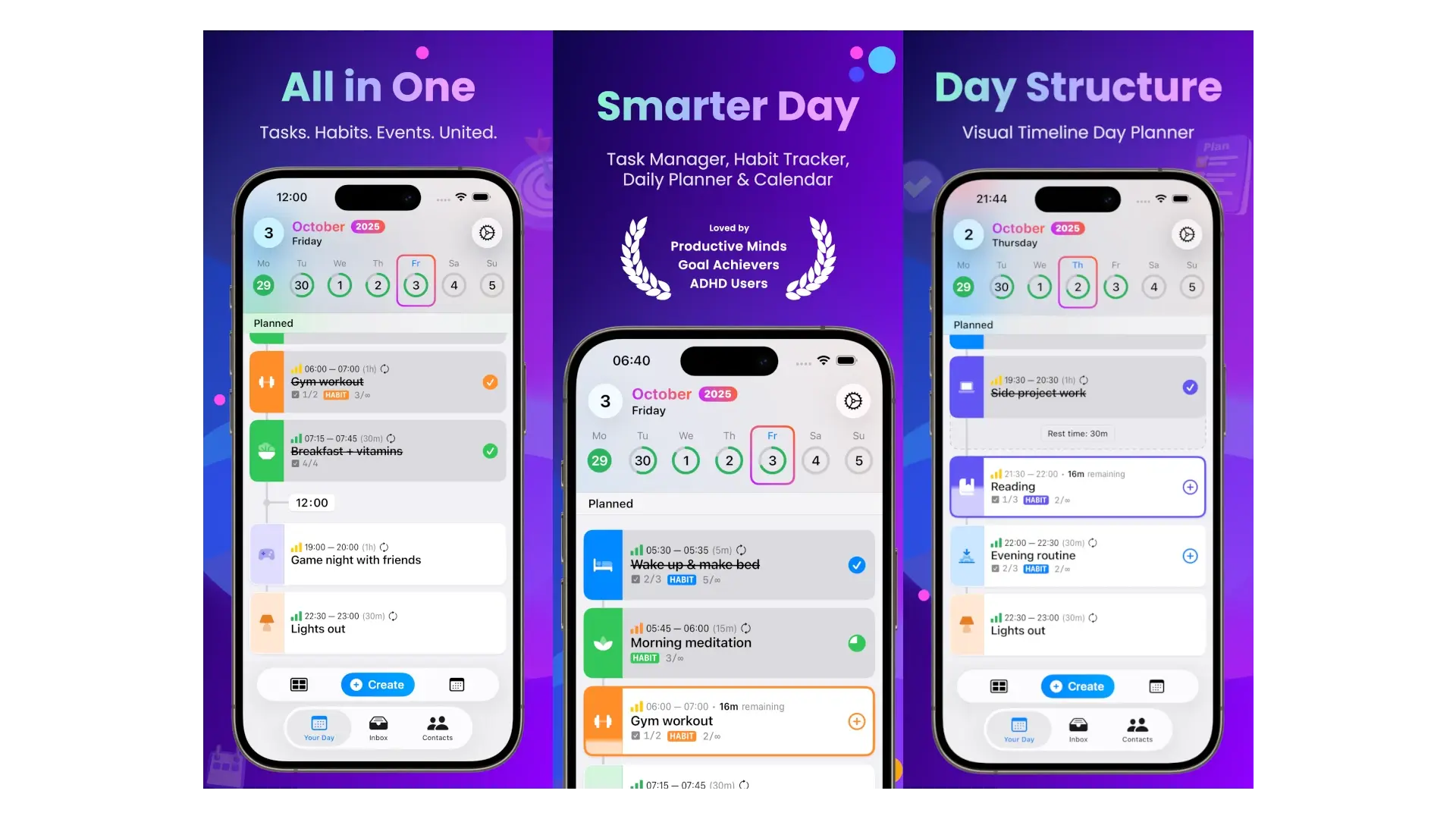
To make execution easier, pair these methods with a supportive tool. The productivity app at Smarter.Day helps you capture tasks, block focus time, and align goals without fuss. It’s a practical way to turn ideas into a repeatable system that fits your life and boosts performance.
You May Also Like
These Related Stories
12 Proven Time Management Strategies That Actually Work
12 Proven Time Management Strategies That Actually Work
No Comments Yet
Let us know what you think