

12 Proven Time Management Tactics That Actually Work

12 Proven Time Management Tactics That Actually Work
You understand that life can be unpredictable: just when you finally set to work, your planner starts buzzing, your mailbox overflows, and your concentration is nowhere to be found. The day has virtually left you because it was engrossed in meetings and little decisions. The irony is that productivity tips most of the time are either too general or too strict for effective implementation in real life. By reading this guide, you will discover practical, scientifically validated time management techniques that easily adapt to chaotic calendars and swapping priorities. We will confront procrastination, distraction, and decision fatigue with tactics that significantly increase attention, productivity, and workflow while you remain with zero burnout.
You will have a straightforward manual: what you should try, how to begin it, and when to make corrections. Each section presents you with at least two implementable approaches in addition to a down-to-earth example, rooted in the knowledge of famous figures like Cal Newport, Daniel Pink, and Atul Gawande. Whether you are a team leader or a multitasker, utilizing these tricks will bring back hours you lose due to stress and help you build your velocity. Are you ready to escape the harness of time by turning it into a productivity engine? Then let's go.
Map Your Energy, Then Time-Block Like a Pro
Most people consider time blocks merely as a matter of time management; however, high achievers see them as a matter of energy. Start with a one-week energy audit—keep a log of your most productive, sluggish, and creative times. Daniel Pink’s book “When” reveals that our chronotype dictates our most favorable performance periods. The first method to implement is to set your highest-value tasks at your cognitive peak (for most people this is late morning) and let dips take care of admin. The second method is to take the "anchor blocks" route—unmovable periods for deep work—then go with the flow as meetings change. This way, structure is blended with practical flexibility.
In a real-life situation, a UX designer found that her intellectual peak was from 9 to 11 a.m. The designer consequently established two 90-minute deep work blocks (the idea of Cal Newport) and deferred status updates to late afternoon. Astonishingly, within just two weeks, the need for revisions went down by 30% because the earlier version was on point. For a start, you can experiment with two 90-minute sessions a day and check for the output rather than the hours you spend on those sessions to see if it fits.
If your energy spikes at night, then you should go for it; sticking with it is way better than following convention. To aid the adoption of this approach, combine time-blocking with buffer zones. A 10-minute break between blocks can help prevent spillover and “cognitive carryover.” Furthermore, a short checklist is recommended: close tabs, breathe, preview the next block. Research by Sophie Leroy suggests that attention residue is critical; transitions are the areas to pay attention to; thus, clear boundaries safeguard your focus. Over time, you will discover a cadence: high-priority tasks first, co-schedule collaboration, trivial tasks in low-energy hours—a natural flow improvement that is not conscious but becomes second nature in time.
The Two-Minute Rule Meets Micro-Progress
Tiny beginnings conquer strong resistance. David Allen’s two-minute rule comes from the book “Getting Things Done” and states that if a task takes less than two minutes, you should just do it immediately. The first method: organize a "two-minute sweep" once in the morning and once in the afternoon to get rid of clutter—quick replies, approvals, calendar tweaks. The second method: apply micro-progress triggers: agree to spend just five minutes on a huge task. As soon as you are done, the rest of the work will be easier for you. The Zeigarnik effect—our tendency to remember incomplete tasks—will push you to go on, so you will not put it off any longer.
Visualize: a customer success manager is not delighted at all at the thought of writing a monthly report. She decides to make a "five-minute ignition" and has only to draft the header and the outline. In 15 minutes, she could be halfway through. These low-friction entry points decrease the area of avoidance. Combine it with a visible progress bar (even a checklist) for your brain to achieve the dopamine of micro-wins. The closer the finish line, the more you want to participate.
To diminish contextual confusion, you should add a decision checkpoint at the end of your sweeps: delegate, do, or schedule. You do it if the time taken is less than two minutes. If someone else can do it faster, delegate with a template. If it requires concentration, then schedule the task into your next energy-matched block. This way, your pipeline remains clean, and you get to do tasks at the right time management window—leading to the smoother execution of tasks.
Prioritize with the Eisenhower Matrix and ICE Scoring
Not all job tasks are the same. The Eisenhower matrix classifies tasks into Urgent/Not Urgent and Important/Not Important. Procedure one: every day, select three Important but Not Urgent tasks—these tasks are your growth drivers. Step two: for projects with many alternatives, utilize ICE scoring (Impact, Confidence, Ease) from growth teams to order what delivers the most value with the least amount of work. This combination puts order and strategy first.
A startup founder was in a state of feature bloat. The matrix was utilized in such a manner that she moved "urgent but low-value" tasks to a single late-day batch. Then she ICE-scored feature ideas; one got a high score on both impact and ease dimensions but had been an obvious miss. By shipping it early, they boosted trial conversions by 12% that week. The moral of the story: prioritization is a decision system, not a feeling. Write it down to eliminate any bias.
Back it up with studies: Stephen Covey popularized the value of quadrant two (Important/Not Urgent) in "The 7 Habits of Highly Effective People." Teams that invest there will have compounding returns. To make it more practical, review your matrix weekly and readjust ICE scores when new data comes out. You will transform from reactive firefighting to proactive time optimization—which is a mark of effective leaders.
Single-Task with Context Barriers and App Limits
Multitasking is a myth; we are just switching tasks, and that’s draining. The American Psychological Association found that productivity can be reduced by up to 40% due to task switching. The first method: set up context barriers—full-screen mode, a separate browser profile for your work, and a physical “focus card” on your desk with the current task. The second method: apply app limits: during deep work, block social feeds with Freedom, and mute notifications that are not essential. Context switching has to be reduced to avoid clogging cognitive throughput.
A software engineer realized that he switched between apps 300 times on a daily basis. He made use of “focus sprints” while he was allowed to use only one tab in the browser and batched messages into only two windows. What was the outcome? Bugs were fewer, and commits were faster. Sophie Leroy’s study on attention residue shows that just a quick look at chat may disturb your thinking. “I will just check” is not a neutral tax.
For it to be fun, build in escape valves: a 5-minute curiosity break after a 45–60 minute sprint, and a “parking lot” note to capture off-topic ideas without derailing work. This preserves creative sparks without sacrificing flow. Through a month, expect clearer mental bandwidth and a measurable performance and accuracy boost.
Pomodoro 2.0: Variable Sprints and Recovery Protocols
The traditional Pomodoro (25/5) is a fantastic tool for the first experiment, but unlike clothes, your brain is not one-size-fits-all. Experiment with variable sprints like 40/10 or the 52/17 rhythm popularized by the DeskTime study (Draugiem Group). According to the study, the best performers pair targeted attention with breaks. The second method: create recovery protocols—movement, hydration, or eye breaks (20-20-20 rule)—to reset your nervous system and keep your focus longer.
For example, a content marketer managing different campaigns switched to 45-minute sprints with 10-minute active breaks (walk, stretch, water) and a short reflection: What was advanced? What is next? The afternoon dip in her energy went down while she became more creative. The trick was not to work harder but to recover more efficiently. Quality is better than quantity concerning deep work.
Wrap it up with session goals: specify a single, distinct goal you want to achieve before beginning each sprint and mark it as done. This forms a rhythm of daily small victories that add up over time. Anders Ericsson's work on intentional practice shows that structured intensity, which is followed by rest, is the way to effective learning. Just like fixing your eye on a target goal, you should defend recovery on that path as well, and thus your workflow improvement will become resilient.
Email and Chat Hygiene You Can Actually Maintain
Email and chat can occupy your full day. As per the estimates by McKinsey, knowledge workers dedicate 28% of their time to email communication. The first method is to set communication windows—two or three scheduled windows—and in between them turn off push notifications. Another method is to build VIP filters and templates: route important messages to a priority inbox, and save replies for FAQs, introductions, and approvals to cut decision fatigue.
A manager at a product company was able to reduce the time spent on emails by 40% within a month. She made it into a rule: “no replies in the same hour unless really urgent,” set canned responses for common questions, and finally suggested shifting complicated threads to a 10-minute call with a visible agenda. The results were that the time taken for resolution was shorter and less exchange of messages took place. “Asynchronous by default, synchronous by design” was her saying.
Highlight your rules with clarity: publish your response SLA (e.g., “I check messages at 11 a.m. and 4 p.m.”) in your signature or on Slack status. Defining things makes life obviously easier—both for you and others. A study on time management shows that norms that are social by nature are more successful in establishing boundaries. When you are not rushing, just ask: can it be resolved using a shared doc, a short Loom video, or during the next scheduled sync? Choose the path that has the lowest interruption.
Automate Decisions with Checklists and If-Then Plans
Decision fatigue is something that is very real; you must remember that the brain is a limited resource. Method one: use checklists for routine processes (Atul Gawande’s “The Checklist Manifesto”)—morning startup, weekly review, pre-meeting prep. This prevents errors and frees mindshare. Method two: deploy implementation intentions (“If X happens, then I will do Y”), a concept from psychologist Peter Gollwitzer, to convert intentions into automatic actions.
A sales lead drew up a checklist for the end of the day: log deals, plan tomorrow's top three, clear desk, and shutdown. She also added an if-then rule saying: “If I get a new lead at 4 p.m., then I capture it in CRM and schedule a morning follow-up.” The result? Fewer dropped balls and easier mornings. Automation is not only a tech matter; it is the design of the brain.
To elevate, mix checklists with defaults: default meeting length 25 minutes, default document template, default naming convention. Defaults remove the decisions for the smallest choices that drain our willpower. After a few weeks, you will feel less scattered and more in control. The amazing result? You have more energy for the difficult thinking and the result-oriented solutions, which is where you make the biggest impact.
Meeting Minimalism: Fewer, Shorter, Sharper
Taking everything into consideration, it is a self-evident fact that scheduling too many meetings can cause calendar clutter. The first method is to adopt a "no agenda, no meeting" policy and make pre-reads necessary. The second method is to design shorter defaults—15-minute huddles and 25-minute decision blocks—with clear roles (RAPID or RACI) to streamline accountability. MIT Sloan's research has shown that meeting overload adversely affects productivity and morale; therefore, trimming the meetings can be the solution to restore focus.
A SaaS team that draws inspiration from Shopify's management style dedicated a month to the total abolition of all recurring meetings. They kept one 30-minute weekly planning meeting but replaced status updates with an asynchronous document. The outcome: eight meeting hours regained for each person, fewer interruptions, and speedier decisions. "We meet to decide, not to discuss" has become a cultural norm. Therefore, it stuck due to the improvement in outcomes.
Here are some steps for meeting hygiene:
- Send a one-page brief 24 hours in advance.
- Start with the decision to be made.
- End with owner, deadline, and next step.
These limits lead to clarity. The side effect? Your involvement in the decision-making process will pave the way for the team to work, not just to talk confidently. That is a measurable workflow improvement.
Kanban Flow and WIP Limits to Beat Overload
Overloading work is a consequence of our commencing too many tasks. The first method is to integrate Personal Kanban (Jim Benson & Tonianne DeMaria Barry)—visualize work in To Do, Doing, Done. The second method is: establish WIP limits (Work In Progress): limit “Doing” to 2–3 items so as to avoid bottlenecks. Queueing theory’s Little’s Law demonstrates that limiting WIP leads to reduced cycle time, which means faster delivery without any extra expense.
A data analyst maintained a simple board, tracked tasks, and capped WIP at two. Prior to this, she had six unfinished tasks and went through constant context switching. When WIP limits were introduced, her throughput increased, and the stress level decreased. Weekly review rituals—transfer of done tasks, reflection, rearranging priorities—enabled the system to remain truthful. The board was used to refer to a single source of truth for priorities.
Adding swimlanes for “Today,” “This Week,” and “Blocked” can show friction painfully. If items are stuck, consider: Do I need help? Is the scope unclear? Can I split it? These questions open pathways to the flow of work. Kanban is not only for programmers; it is a universal time management method. The loop of visual feedback is the one that makes procrastination real and progress truly fascinating.
Cognitive Performance: Sleep, Fuel, and Light
You can't just beat nature with your effort. First, you should protect sleep with a consistent bedtime, a cool dark room, and a wind-down routine. According to Matthew Walker's studies, even a slight sleep deficit can cause attention and memory problems. Second, you should manage the fuel and light intake—eat more proteins and fibers, time caffeine 60–90 minutes after waking, and get morning daylight to anchor your circadian rhythm and sharpen focus.
A remote engineer inserted a 10-minute morning light walk and moved his coffee to mid-morning. The afternoon crashes disappeared, and the coding reviews became quicker. He also used pink noise to cover the distractions and a hydration alarm. Little changes can result in big performance improvements. Consider it like rebooting your brain's operating system.
For break design, try NSDR (non-sleep deep rest) or a short breathing practice to reset between deep work blocks. Maintain a simplistic environment with cool temperature, task lighting, and a comfortable chair. When your body is in sync with your schedule, time optimization feels super easy. Productivity resembles less a struggle and more a rhythm.
Planning Backwards with Constraints and Buffers
In most cases, the handoff is the bottleneck. Method one: backward planning—start from the due date, map milestones in reverse, and assign realistic durations. Method two: add buffers—protect critical handoffs and allow 10–20% slack for unknowns. Project management studies indicate that buffer placement (not just size) determines reliability and stress levels.
Understand a marketing launch: the team, instead of a single deadline, defined content freeze, QA, and approvals backward from launch day. Each stage had a hard stop and a buffer. If a vendor shipped late, the buffer could absorb the shock. The team launched as scheduled. The team didn’t “move faster”; they planned smarter. The constraints helped them understand the situation better.
To stay on top of this, run a 10-minute weekly pre-mortem meeting: “If we fail to meet the date, what is the likely cause?” Then, take care of those risks in advance. Document the decisions, not just the tasks, so the context is not lost in chats. This will ensure you have a strong plan when you are faced with real situations—and you certainly will. The benefit of this is continuous workflow improvement with fewer emergency drills.
Frictionless Starts: Environment, Triggers, and the Next Action
Motivation is not good enough; friction is something you can control. Method one: Make the next action the only physical action in your environment to keep it simple—open the doc, load the dataset, lay out the gear. Method two: set behavioral triggers: same desk, same playlist, same warm-up task. James Clear’s habit research proposes that environmental cues have a stronger impact than willpower on one's consistency.
A writer concludes every day by typing, “Next: draft intro and bullet three points.” After the first day, the next morning there isn’t any guesswork involved—just start it. She also has a "focus token": when the candle is lit, she can't be reached. Rituals are symbols to your brain like: “This is time.” It means less hesitation and more of the doing. It is productivity you can sense.
When you get stuck, ask the classical GTD: What is the next physical action? Not “complete report,” but “get last month’s figures.” Small, tangible tasks give the illusion of progress. The next step is to combine them to create power. In the long run, the effect of the sum is impressive: fewer non-starters, increased efficiency, and a more peaceful mind.
Summary
We discussed a full toolbox: energy-based time-blocking, micro-progression, smart prioritizing, single-tasking, upgraded Pomodoros, clean communication, decision automation, meeting minimalism, Kanban flow, cognitive upgrades, resilient planning, and frictionless starts. You don't need to implement all 12 today. Choose two, run a two-week experiment, and measure results—then iterate. That is the way workflow improvement is done as a habit, not as a phase.
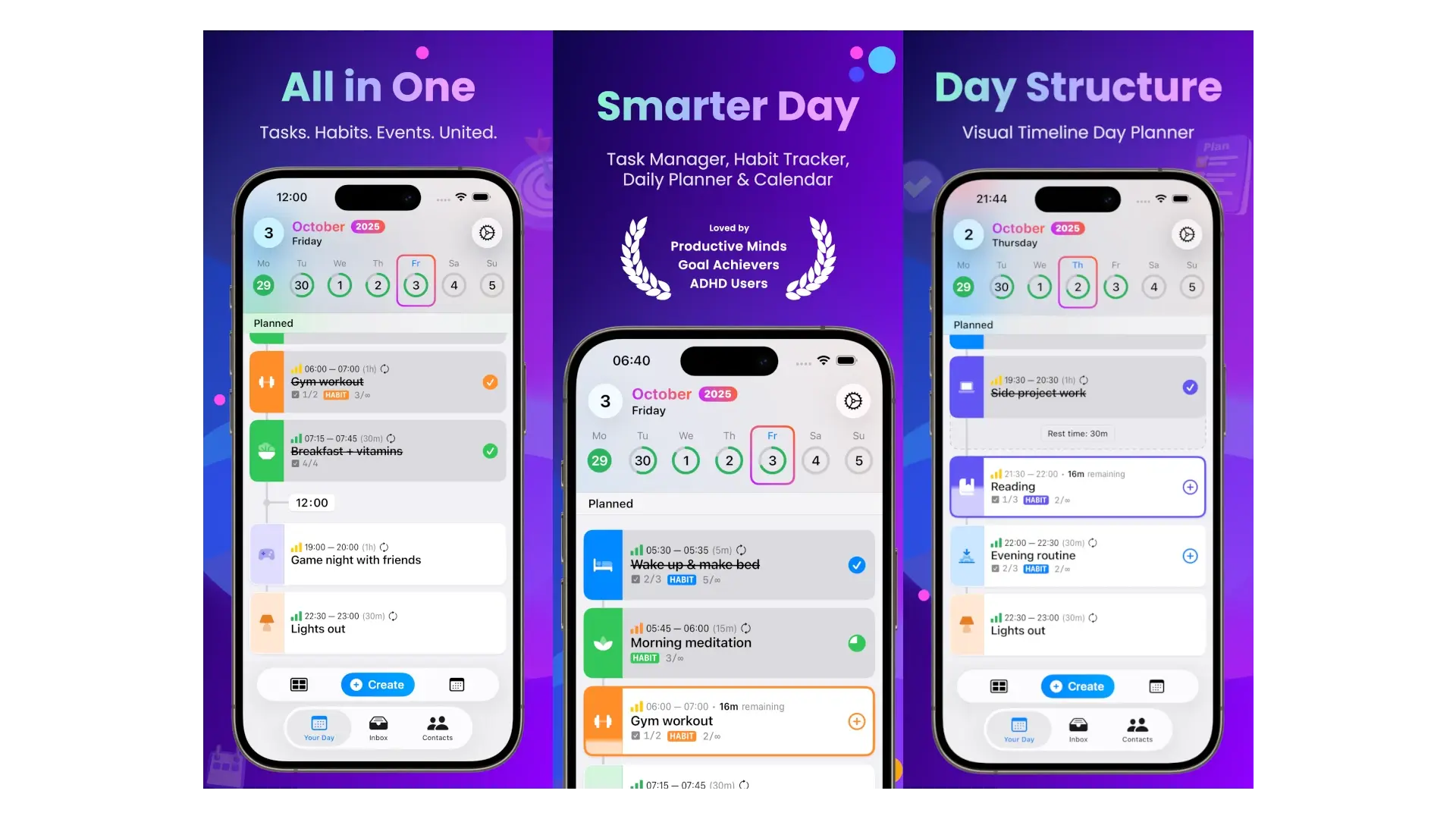
If you want one place to schedule deep work, track WIP, automate check-ins, and keep priorities visible, try the productivity app at Smarter.Day. It goes well with these methods—helping you plan, focus, and review without extra admin. Begin small and grow in productivity, and enjoy the cumulative effect of a well-ordered day.
You May Also Like
These Related Stories
Master Time Management: 12 Simple Strategies to Achieve More
How to Stop Procrastinating: 12 Proven Strategies for Success
No Comments Yet
Let us know what you think