

12 Proven Time Management Tactics for Peak Productivity

12 Proven Time Management Tactics for Peak Productivity
Introduction
Facing the reality, on the one hand, is a working day with a myriad of different aspects of not stopping the traffic signals: emails to read, pings to act on, and pressure to handle. Have you ever realized how your best ideas are beaten by distractions like meetings, context switching, and mental fatigue? The catch is that most of us do not have a time problem; we have a prioritization and focus issue. You obtain in this guide the actionable, expert-backed strategies that relieve perception, clarify your attention, and make your daily workflow better. If you dream of ending the day with a feeling of having achieved so much without burning out, then you've come to the right place.
Our goal is direct: to assist you in accomplishing less, but more efficiently. We will delve into time-blocking, deep work, WIP limits, and other habit-based techniques that are easier to follow than willpower alone. Each section contains valuable methods and practical examples based on the research done by Cal Newport, Teresa Amabile, Gloria Mark, and others. At the end of this article, you will be equipped with a toolbox that you can use to increase your performance, manage your time better, and achieve lasting results—without resorting to any temporary solutions that expire by Friday.
Design Your Day with Time-Boxing and Time Tracking
The concept of time-blocking, which was brought into light by Cal Newport, is such an effective tool that the mere act of scheduling your day is not only a protective layer to your focus but also a clear concentrator of your tasks (Deep Work, 2016). The best way to put that into practice is by associating time tracking to a plan vs. reality comparison. You will even see the hidden instances of your productivity. You will go against Parkinson's Law, stating that work will always expand to fill the available time. The study by RescueTime shows that most knowledge workers, in reality, spend less than three hours a day on concentration work due to distractions; therefore, structured time-blocks are the solution to help you regain them.
For instance: Software engineer Sarah schedules deep work blocks of 90 minutes for feature development, 30-minute blocks for code reviews, and three 15-minute administrative blocks, respectively. By tracking her time, she moved beyond the mundane overruns and added buffers, which resulted in a 20% decrease in her overtime by the end of the month.
Try this:
- Devise a daily time-blocking system with 15-minute buffers between blocks.
- For one week, track the actuals (either manual logging or an app). Based on accurate data, make adjustments to the block sizes and set “guardrails” for overruns.
Prioritize with the Eisenhower Matrix and Pareto Power
The framework devised by Dwight D. Eisenhower and widely acknowledged by Stephen Covey not just helps but also is the surest way to differentiate urgent things from important ones and thus eliminate low-value noise. It serves alongside the Pareto Principle of Vilfredo Pareto, which prescribes that about 80% of results stem from merely 20% effort. According to Gary Keller's The One Thing, which reiterates this principle, you should decide which task is responsible for making the remaining ones easier or even unnecessary. The three instruments together foster ruthless prioritization.
For instance, a marketing manager considers her “One Thing” as a webinar that will attract qualified leads. With the help of the Eisenhower Matrix, she kicks off the week by scheduling urgent-but-not-important tasks (content, email sequencing) early in the week and delegating social posts and deferring a redesign that is not critical.
Try this:
- Make it a habit to finish your day by identifying a single must-win outcome to accomplish the next day.
- Conduct a weekly review: compile a list of top outcomes, perform the 80/20 test, and prioritize “important but not urgent” work first.
Deep Work Sprints and Distraction Audits
Deep work is one of the Cal Newport notions that get across the idea that doing hard tasks would be more effective with the concentration that you do not the most. The study of Gloria Mark (at the University of California, Irvine) states that it is possible for a person to lose focus for over 20 minutes to an interruption, so cutting back on context switching is obligatory (Attention Span, 2023). Begin with one-hour or 90-minute deep work sprints and conduct a distraction audit to find out triggers.
For instance: A content strategist or an individual curates data of the tasks, including each of the interruptions that have snatched her focus from one week, and comes to an end with her most problematic items being chat notifications and calendar pop-ups. She turns off alerts that are not urgent, sets a status that says "heads down," and replies twice a day in batch mode. Result: a 30% increase in publish-ready drafts weekly.
Implement this:
- Schedule two periods of deep work daily, then arrange around meetings.
- Conduct a distraction audit: list triggers, install blockers, and batch notifications into set check-in windows.
Match Tasks to Your Biology: Chronotypes and Ultradian Rhythms
Your chronotype influences your brain's peak timings. Daniel Pink (When) and chronobiologist Till Roenneberg demonstrate that people's performance becomes better when they do the tasks corresponding to biological timing. Add ultradian rhythms—natural 90-minute cycles (Ernest Rossi)—and you can adjust your sprints and breaks to your energy waves for achieving better cognitive performance.
For example: An analyst who believed she had "morning problems" finds out that her attention peak is 10:30 a.m.–12 p.m. She arranges her modeling at that time, moves her email to 2 p.m., and takes a 10-minute outdoor break after each intense working period. With this, she sits more accurately, and the afternoon slumps do not stop her anymore.
Try this:
- Monitor your energy levels throughout the day for one week; allocate high-focus work to your peak times.
- Use 90-minute cycles, then take recovery breaks: doing movement, hydration, and exposure to sunlight beat scrolling every time.
Turn Intent into Action: Implementation Intentions and WOOP
The intent remains a thought only unless it is time/space/manner specified. Peter Gollwitzer, a psychologist, has implementation intentions, which are assertions that generally increase the continuation of the actions. Gabriele Oettingen, on the other hand, sees the method of WOOP (Wish, Outcome, Obstacle, Plan), which adds the contraction of the mind, thus giving a chance to foresee hurdles and pre-plan ways to solve them. Aside from that, they turn hope into consistent practice.
Sample: The project manager takes advantage of WOOP for a report: Wish—delivery by Friday; Outcome—executive clarity; Obstacle—client fire drills; Plan—If a fire drill arises, then I will stop for a while and come back to the report at 3 p.m. for 60 minutes. She thanks to that success, even though there have been issues during the midweek.
Here is your assignment:
- Set three triggers in the form of “If X, then Y” about the task which is a priority for you (e.g., “If it’s 9 a.m., then I start the proposal draft.”).
- Complete a five-minute WOOP: determine the most probable obstacle and come up with a specific plan to overcome it.
Limit Work-in-Progress with Personal Kanban
Multitasking is not really the concept that it is usually thought to be; rather, the switching between two tasks is what takes the time and hampers the quality of performance (Rubinstein, Meyer, Evans, 2001). Personal Kanban—“Visualize work, limit WIP”—is the secret to keeping your pipeline flowing (Jim Benson & Tonianne DeMaria Barry). Queueing theory (Little’s Law) will confirm that: the less you have work-in-progress, the quicker your cycle time could be. Transformational management based on the Kanban method of David J. Anderson now applies to personal projects much better than the original did.
Take the illustration of a product designer who has decided to cap WIP at 3. Her board: Backlog, Doing (max 3), Review, Done. By limiting the number of things she started, she managed to reduce the average time spent on tasks from 6 days to 3 without working extra hours.
Here’s a good one to try:
- Construct a straightforward board (physical or digital). Assign a WIP limit of 2–3 for “Doing.”
- Only pull new work when you have finished a particular task. Instead of hanging out, set a 15-minute "unstick" timer or decrease the task size.
Defeat Procrastination with Micro-Starts and Bundling
Ambiguity and aversion act as the fuel for procrastination. Piers Steel’s book on The Procrastination Equation reveals that dystiprimie and subjectivity have the same bias or direction. You can utilize the two-minute rule (David Allen) to make a decision and start on little-duty immediately, while you can use micro-starts to knock off strewn-outoad on big ones. You can also include temptation bundling (Katy Milkman) to boost the level of compliance by pairing a fun activity with an extra hard task that must be done.
A literature graduate student can pair literature review with a favorite playlist and start with a "just 5 minutes" skim. The micro-start, by its very nature, reduces friction; when she is in movement, she continues for 45 minutes, during which she notes key quotes that are included in the literature without seeing the process as hard.
Put it to the test:
- For intimidating jobs, figure out the least amount of tangible actions achievable in 5 minutes.
- Stack a painful task with a reward (podcast + admin cleanup) and limit the reward only to that singular work block.
Make Learning Stick: Spaced Repetition and Smart Notes
Most of the new knowledge that we gain is quickly forgotten without structured review as demonstrated by the Ebbinghaus forgetting curve, which reflects a rapid forgetting curve. The spaced repetition schedule sets the review just before you’re going to forget such material, and in the words of Sönke Ahrens, a book titled How to Take Smart Notes, the use of the Zettelkasten—small, linked ideas that compound understanding (inspired by Niklas Luhmann)—thus becoming the best teaching/learning method. This combination is a truly transformative power, which turns variable knowledge into permanent, findable knowledge.
For instance, a programmer preparing for a licensing examination takes atomic notes covering the essential points, which he/she then uses to create spaced-repetition flashcards. He/she spends 10 minutes daily for the revision, drawing connections between his/her notes and the real projects he/she's working on. The exam day becomes much more familiar to her than ever because she has practiced the retrieval, not just rereading the text.
Here is an example: is it really possible to understand all these things without converting highlights into atomic notes (one idea per note with a clear title)?
- Schedule new spaced reviews (1, 3, 7, 14 days). Use tags and backlinks. Ideas should connect and resurface.
Control Communication: Email Triage and Async Norms
In the book "A World Without Email," Cal Newport explicates that the hyperactive hive mind—the ceaseless interaction between parties—acts like a cancer to deep work. The results of the research conducted depict that a person checking email frequently tends not only to be less happy but also to have less focus (for further information visit the research section in Harvard Business Review). The async norms are a solution, alongside noticing which messages are of the same issue and using an email triage system like the 4Ds: Delete, Delegate, Defer, Do.
Illustration: A sales lead arranges two email periods (10:30 a.m. and 3:30 p.m.), switches off notifications, and types out commonly used replies by templates. She uses the subject line tags of [Action], [Info], or [Waiting] that permit her to decrease proofreading messages by 40% and increase the clarity of the responses.
Try this:
- Set aside 2–3 email blocks a day; no other time keep the inbox closed.
- Use templates and rules. Apply the 4Ds in 60 seconds per message to avoid decision fatigue.
Run Lean Meetings with Clear Decisions
In his article on Harvard Business Review, Urrutia shows that unnecessary meetings are time robbers and morale destroyers; thus many teams, by simply reducing them, get back a day a week. Employ the no-meeting blocks, demand agendas and pre-reads, and wrap up with definite owners and deadlines. Use decision frameworks such as RAPID (Bain) or DACI to steer clear from indistinct accountability and rework.
For example: A startup CTO requires pre-reads 24 hours in advance and conducts 25-minute status meetings, 50 minutes for decisive meetings. Every meeting concludes with one line of decision log and a single owner. The team ships features faster because decisions are made first time correctly.
Engineer Your Environment for Focus
Environment wins over willpower. According to BJ Fogg's Behavior Model, a behavior happens as the convergence of motivation, ability, and prompt—therefore, you need to change your environment to focus on frictionless. As found by Kostadin Kushlev and his coauthors, continuous notifications lead to the depletion of attention and negatively affect health. Create a single-tasking setup by batching notifications and automating repetitive clicks.
For instance: A financial analyst designs different desktops for "focus" and "comms." The Focus desktop is equipped with just the necessary apps; the Comms desktop holds Slack/email. She deploys text expanders for standard replies and enables Do Not Disturb scheduling during her deep work. The outcome: a cleaner attention span and a faster throughput.
Do this:
- Non-urgent notifications should be disabled and scheduled summaries should be used.
- For the avoidance of micro-friction and the protection of momentum, use text expanders, keyboard shortcuts, and window management.
Build Momentum: The Progress Principle and Habit Loops
The Progress Principle of Teresa Amabile and Steven Kramer makes it clear that minor visible successes have the effects of strong motivators. In addition, the effects of habit stacking and identity-based habits (James Clear, Atomic Habits) add to turning daily happiness into a habit. If you can see the progress, your motivation will follow; if the habits are trivial, consistency will endure even on the busiest of days.
Example: A teacher selects a daily highlight (Jake Knapp & John Zeratsky, Make Time) and logs three wins at day’s end. She stacks “plan tomorrow” after closing her gradebook. Over weeks, small improvements compound into smoother mornings and less Sunday stress.
Try this:
- Define a daily highlight and track a streak—even 15 minutes counts.
- End-of-day "progress review": list three wins, one improvement, and schedule the next highlight.
Conclusion
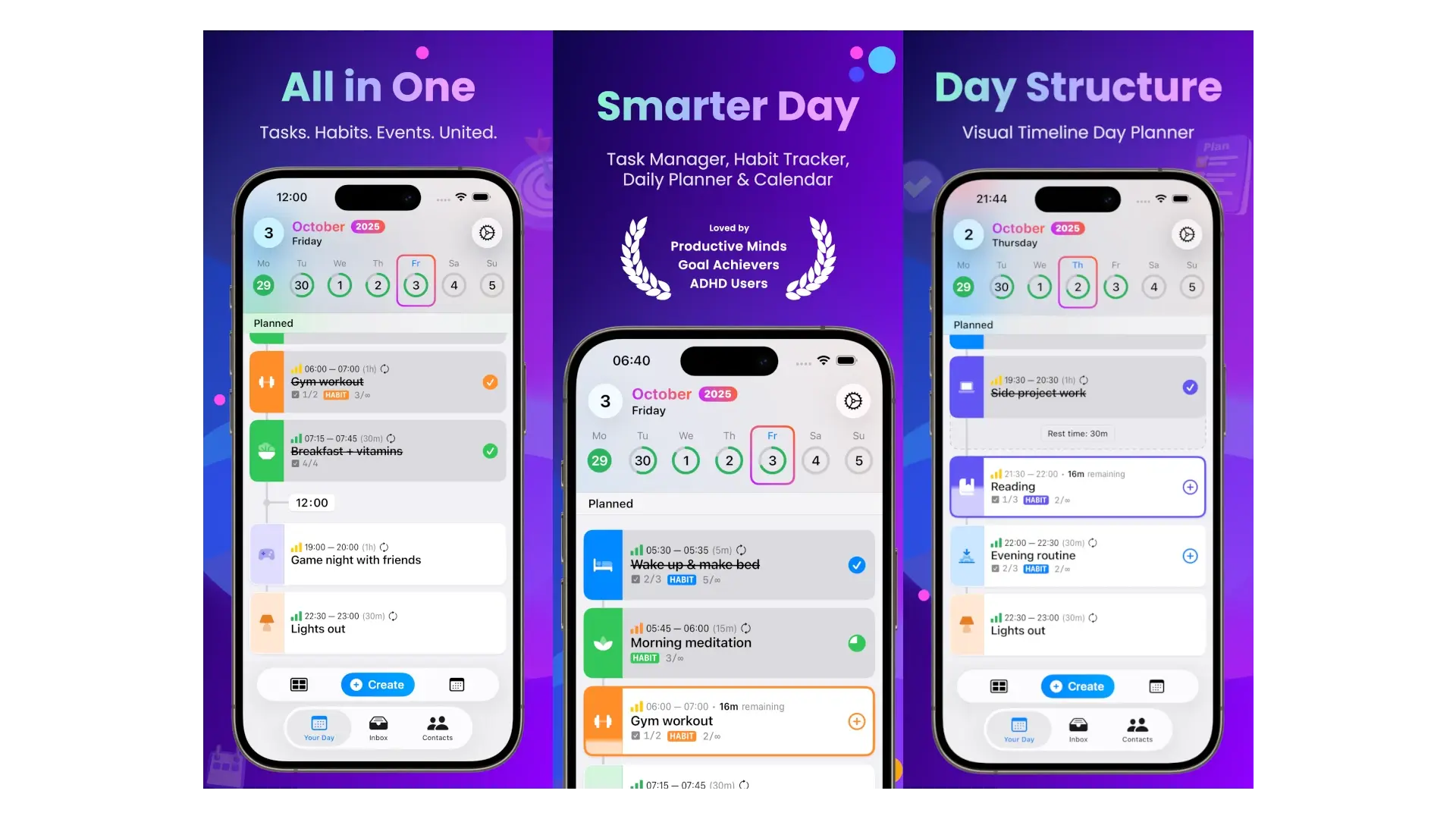
Productivity is not about shadowing more activities on your calendar; it is rather about clarity, focus, and deliberate practice. The above-mentioned methods are the answers to reclaiming attention and turning intention into results, which include tools like time-boxing, WIP limits, deep work, and habit loops. If you are looking for a very efficient, yet simple, way of coordinating scheduling, blocking distractions, and capturing tasks in one place, the productivity app at Smarter.Day can streamline your workflow without adding complexity. Utilize it with the above-mentioned tactics, and see the difference in energy and output.
Are you ready to create sustainable momentum? Start this week by committing to one or two techniques, then integrate more as they become habits. For a practical productivity boost, check out the tools at Smarter.Day, and make focus your default, not a lucky accident.
You May Also Like
These Related Stories
Advanced Productivity Playbook: Time Focus Results
Master Time Optimization: 12 Proven Productivity Tactics
No Comments Yet
Let us know what you think