
Master Your Focus: Proven Techniques to Work Smarter

Master Your Focus: Science-Backed Ways to Work Smarter
Do you find it difficult to concentrate on your work despite sitting down in front of the computer? Notifications start coming in, new tabs open automatically, and your to-do list looks more like white noise instead of a plan. You're not the only one having the problem. The researcher Gloria Mark states that knowledge workers switch tabs every few minutes, which in turn decreases cognitive performance and causes stress. The good news here is, you can turn that around. This blueprint compresses science-backed focus strategies into handy steps that you can implement today to better time optimization and workflow improvement.
Our aim is straightforward: aid you in working with your brain rather than against it. We will talk about deep work routines, attention training, and smart tech that makes your work easy and simple, plus tactics for energy management and context-switching control. Each method presents unambiguous actions and easy-to-understand examples that are based on studies from leading experts such as Cal Newport, Sophie Leroy, and Nathaniel Kleitman. If your interest lies in finding a way to come back to focus and make sustained productivity such a natural ability for you, then you're in the right place.
Design a Distraction-Proof Environment
The easiest and fastest method to increase concentration is to strip down your environment from the friction points. First things to prioritize are visual simplicity and noise control. Hide the non-essential desktop icons and only keep the active document on the screen. You can add noise-masking like brown noise or a fan—according to studies on open-plan offices (e.g., Hongisto et al.), even low-level chatter can lead to decreased knowledge work efficiency. Another technique is friction blocking: for example, you can use website blockers (e.g., Cold Turkey) and also set your phone on Do Not Disturb with an allowlist.
Here’s a relatable example: Maya, a product manager, used to work in a crowded coffee shop. By switching to a corner with a lot of space, using over-ear headphones, and by blocking social sites from 9–12, she managed to increase two “real” hours a day to four. Cal Newport, the author of Deep Work, claims that building a distraction-minimized environment is not a luxury but a necessary condition for deep work.
Fast Installation Checklist
- Reduce visual clutter: single-tab rule during deep work.
- Mask noise: brown noise playlist; door sign for “heads-down hours.”
- Block digital distractions: app blockers, notification allowlists.
Time Blocking and Task Batching for Deep Work
In case your day feels chaotic, time blocking is a roadmap. Designate specific time for focused tasks, admin, meetings, and breaks individually. You can also mix it with task batching—which is one of the best ways to minimize distractions. By no means should you switch your mind between different tasks (emails, reporting, calls), and this has been proven to create attention residue leading to poor performance. Adopt a scheme of color-coded blocks and limit meetings to preset windows for the purpose of conserving your best cognitive hours.
Two down-to-earth methods: introduce a daily 90-minute “Deep Work” block and a 30-minute “Admin Batch.” Then, apply a shutdown routine to arrange tomorrow’s tasks as Newport advises. A practical illustration: Jordan, a leader in sales, shifted all follow-ups to a single 45-minute block post-lunch and got back his mornings for proposals—a decision that raised close rates and slashed email time by 38%.
The central idea of the quote: “What gets scheduled gets done.” This statement, which was made famous by Cal Newport, is a lot more than just a phrase; it represents a focus system that synchronizes time with priorities for the purpose of long-term workflow improvement.
The 90–20 Rhythm: Ultradian Cycles for Energy
Your brain is not a robot. You are not a machine! It functions based on ultradian rhythms: increasing focus for about 90 minutes, and then going through a 15–20 minute recovery phase. These cycles were brought to light by Nathaniel Kleitman’s investigations. The first method requires you to work in 90-minute deep focus sprints, then step aside from the screen for 15–20 minutes. The second method involves recovery rituals (hydration, movement, daylight) that you schedule to restore the mental batteries for the next cycle.
Let's take a look at Ravi, who is a UX designer and had a habit of working even when he was tired. The 90–20 scheme, with a 5-minute stretch, a glass of water, and 10 minutes of light exposure, did the trick for him. His afternoon slump vanished. The reason behind the performance increase was him respecting his brain's natural oscillations instead of battling against them.
How to Apply Today
- Choose the time of your day when you are the most energetic and do the most work at that hour.
- Set a timer for 90 minutes, then do not use the screen for 15–20 minutes.
- Observe the signals of tiredness; change cycle length if necessary.
Cognitive Offloading: Build a Second Brain
Your working memory has limits. Cognitive offloading—the practice of transferring thoughts, responsibilities, and references to outside-the-brain systems—will enable you to think more deeply. First method: keep everything that comes to your mind in one place, including a single capture inbox (for instance, notes app or notebook). The second method: arrange notes according to a lightweight taxonomy (e.g., PARA from Tiago Forte’s Building a Second Brain: Projects, Areas, Resources, Archives) for instant retrieval.
Illustration: Lina, an engineer, formerly had specs, meeting notes, and ideas on many sticky notes, but after using an inbox and sorting into Projects and Resources in a weekly file, she managed to stop “holding it all in her head,” thereby getting rid of her anxiety and improving her task execution speed. Studies conducted in cognitive psychology revealed that externalizing memory helps problem solvers by lessening the cognitive burden.
Keep It Simple
- Have a single capture point.
- Hold a 30-minute sort session every week.
- Create project pages that have the next actions clearly labeled in bold.
Strategic Breaks: Movement, Micro-Naps, and Light
Breaks are a risk-free way to raise your energy and mood levels. Sipona et al. (2019) found that microbreaks of 1–3 minutes every 30–60 minutes work to increase and maintain your vigor and reduce fatigue without lowering your output. Method two: sunlight and exercise—a fast walk and sunlight reset your alertness through circadian pathways (Cajochen's research on light and alertness). When the situation gets overwhelming, a short 10–20-minute nap can make things better by improving learning and reaction time (Mednick's nap research).
Example: Priya, an analyst, added a 2-minute stretch every 45 minutes and a 10-minute outdoor walk mid-morning. She reported fewer headaches and more consistent afternoon focus. The key isn’t a longer break, but the right kind of break at the right time to maximize time optimization.
Break Formula
- Every 45–60 minutes: 2-minute movement.
- Midday: 10-minute daylight walk.
- Emergency fatigue: 15-minute nap, caffeine optional.
Attention Training: Mindfulness Meets Metacognition
Mindfulness is not only a term popular among people, but it is also a practice to enhance one’s attention. First method: spend 8 to 10 minutes a day practicing the mindfulness of breathing. Through meta-analyses, it is revealed that mindfulness has a positive impact on the control of attention and also helps one to decrease mind-wandering. Second method: metacognitive check-ins—asking oneself “What am I doing? What matters now?” every hour. Ethan Kross and others have shown how distanced self-talk (“What’s the next best step?”) can be used to reduce the occurrence of rumination and to redirect the mind.
For instance, Omar, the founder, began his day by breathing for the first 10 minutes. He also created a recurring hourly prompt: “Return to your one thing.” After three weeks, he managed to switch tabs less and start tasks quicker. Besides this, one can also use implementation intentions (Gollwitzer): “If I open a new tab, I will go back to my document.” Such a practice is just a tiny rule that protects one from a cognitive performance drop.
Quote: “You don't attain the height of your target; instead, you minimize it to the level of your system.” James Clear's observation points to the fact that daily attention systems are more effective than willpower.
Reduce Context Switching with Kanban and WIP Limits
Kanban is not only a tool for developers; it is a visual workflow for everyone. Establish columns—Backlog, Doing, Done—and limit WIP (Work In Progress) to ensure that one has to complete existing tasks before taking new ones. The first method: do not stack a number of items in Doing beyond 1–3. The second method: batch interrupts—note them in Backlog, review later—to avoid attention residue (Leroy). You will be able to complete more in a shorter time with less pressure.
Example: Ella, a marketer, set her 3-item WIP limit. When a Slack ping needed her attention, she moved it to Backlog and got back to it in her next review. Throughput increased, and the problem of the late-night spillover was resolved. Kanban and time boxing work together to transform the overwhelm into workflow improvement as they identify bottlenecks and visualize progress.
Quick Start
- Create a 3-column board.
- WIP limit: 2 tasks max in Doing.
- Plan 3 daily review points: start, midday, shutdown.
Decision Hygiene: Defaults, Checklists, and If–Then Plans
Decision fatigue is detrimental to focus. Fight it with choice architecture. The first method is to use defaults—predetermine your morning routine, deep work start time, and menu. Behavioral scientists like Todd Rogers indicate that defaults are a way to drive consistent actions. Method two: checklists—Atul Gawande’s research proves that basic checklists can significantly diminish errors made in pressure conditions. Include implementation intentions (Gollwitzer): "If it’s 9 a.m., then I start Block A."
Take for example Nina, a project lead, who has set a default "Laptop open, blocker on, headphones in" at 8:45 a.m. and also created a pre-flight checklist: calendar, task board, top 3 priorities in bold. She saved 20 minutes of her daily startup time with this method. The advantage is evident: the reduction of micro-decisions leads to an increase in mental bandwidth to focus on the important work.
Assemble Your Decision Hygiene Kit
- Default start/stop times.
- 7-step morning checklist.
- If–then rules for common derailers.
Nutrition and Hydration for Brain Performance
The naked truth is that the brain is a biological organ just like the others. So, you should feed it for a long-lasting, good performance. The first method: maintain hydration; results of studies (for instance Ganio et al., 2011) reveal that merely 1–2% dehydration diminishes attention and working memory. You should keep a water bottle at your desk and drink frequently. Method two: opt for low-glycemic meals (protein + fiber + healthy fats) that will help you avoid post-lunch crashes; instead of eating heavy, high-sugar meals that spike and crash glucose, eat light, low-gly sourced foods.
A vivid example is Darius. He switched his pastry and soda for Greek yogurt, nuts, and berries at 10:30 a.m., paired with water breaks at the top of each hour. The brain fog lifted in the afternoon. Combine nutrition with caffeine timing—avoiding coffee for 60–90 minutes after waking can result in a smooth energy level without overdependence, as it was talked about by sleep experts.
Brain Fuel Essentials
- Water within reach; hourly sips.
- Protein-forward snacks; balanced lunches.
- Caffeine late morning; cut by midafternoon.
Tech That Boosts Focus: Automation and AI Assistants
Instead of letting distraction manage you, technology can also serve you and help you focus. You can do it in two different methods. The first one is: automate daily tasks (for example, calendar scheduling, file backups, or recurring invoices) with the help of tools like Zapier or native integrations. Automation helps you to use your brain more for high-impact work. Another way is to use AI assistants like meeting summaries, first drafts, or action items but set guardrails: template prompts and checklist reviews to maintain quality.
Real example: Keiko, an operations manager, automated daily reporting and used AI to draft status summaries. She reclaimed 5 hours a week to reinvest for process benefit. Research on automation bias reminds us that humans must dominate the process—using AI to promote, not eliminate, cognition. Overall: quick delivery, improved time optimization.
Technology Smart Regulations
- Automate routine, low-variance tasks.
- Drafts made by AI; always check.
- Batch notifications; disable badges.
Email and Slack Discipline: Protocols That Protect Focus
Communication tools are not only indispensable, but they also have risks. The first method to use is to establish communication windows (e.g., from 11:30 to 12:00, and from 4:00 to 4:30) and to mute the rest. Gloria Mark's study found that frequent interruptions not only cause attentional difficulties but also increase the level of stress. The second method is to write clear messages with bold first lines (for instance, "Action needed by EOD," "FYI only") thus reducing the exchange of messages and hastening decisions.
Think of Ben, the tech lead who introduced a team protocol: "No Slack during deep work blocks; urgent items = call." He added to that email triage, which means star, schedule, or delete emails within two minutes. Consequently, there were fewer pings and more throughput. The general rule: manage your inputs to manage your outputs.
Protocol Checklist
- Designate response windows.
- Use subject-line tags: [ACTION], [INFO].
- Emergencies escalate via call, not chat.
The Two-List System: Priorities vs. Possibilities
Doing everything at once leads to loss of interest and focus. One such technique for focus was made popular by Warren Buffett: ascertain your Top 5 priorities and do not get caught up in anything else till they are done. Method one: keep two lists, one being the Focus List (3–5 items at max) and the other being the Parking Lot (other interesting tasks you want to do). Method two: exercise the known weekly reviews to shift tasks from Parking Lot to Focus List according to the capability of handling them.
Illustration: Sara, a former content strategist, used to multitask 12 "priorities." After she got the Two-List System on board, 8 were transferred to Parking Lot and the other 4 were successfully completed in two days. The suggestion from Daniel Kahneman of go slow for big bets; be aware that not all tasks deserve the same amount of attention. This system emphasizes strategic neglect so your most valuable work receives the most valuable energy.
Make It Work
- Daily: Focus List of 3 items, no exceptions.
- Weekly: Go through the Parking Lot for promotion.
- Say no with a later option: "Parking it for Friday review."
Reflect, Refine, Repeat: Feedback Loops for Focus
Continued performance results from iteration. Method one: run a basic end-of-day review—What went well? What disturbed me? What will I do differently tomorrow? Method two: keep track of a single metric for 2 weeks: “time spent in deep work,” “projects finished,” or “context switches avoided.” The method of Anders Ericsson’s deliberate practice points out that the improvement is driven by feedback and adjustment.
Real instance: Tom, a data scientist, kept his record of deep work hours for 14 days and after that found out that he is best focused from 8:30 to 11:00. He moved the meetings around and got 6 extra high-quality hours on a weekly basis. The lesson learned: reflection acts as a converter of experience into performance gains. Marginal changes compounded into striking workflow improvement over time.
Basic Cycle
- Daily: 3-question check-in.
- Weekly: analyze metrics; change one variable.
- Monthly: eliminate one tactic, try a new one.
Conclusion
An all-encompassing system for focus, time optimization, and cognitive performance has been introduced: the creation of an ideal work environment, time blocking, ultradian rhythms, cognitive offloading, smart breaks, attention training, WIP limits, decision hygiene, brain-friendly fuel, and assistive tech. This week just do two of the methods you learned and then do one new method each week after that. Small, consistent improvements are preferable to massive, short-term improvements.
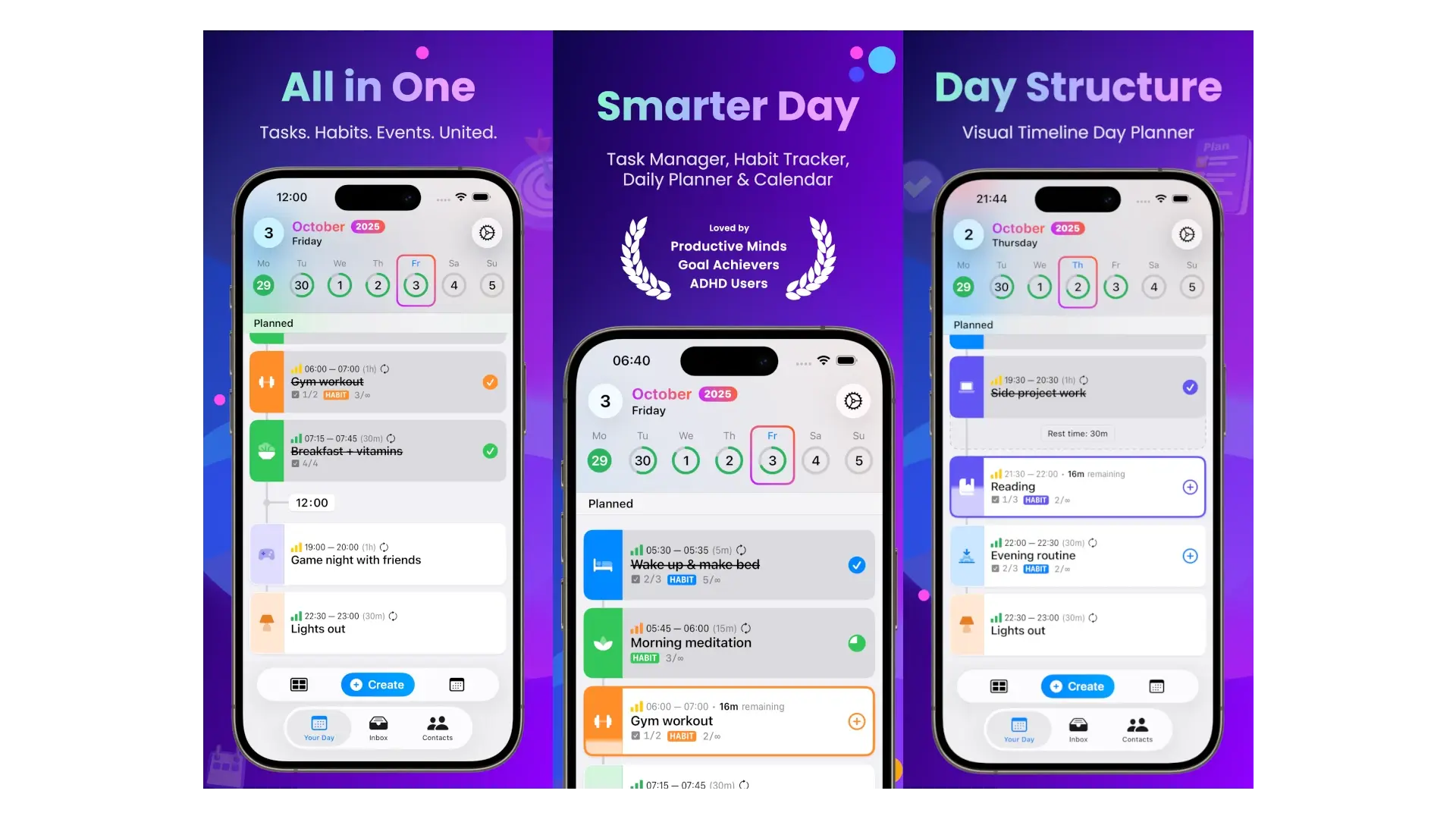
For a comprehensive hub that will both capture tasks, block time, and add smart reminders to protect your deep work, consider the productivity app at Smarter.Day. The routines described here can be simplified with the app without adding any complexity or noise.
You May Also Like
These Related Stories
12 Proven Ways to Boost Focus and Productivity Today
12 Proven Ways to Boost Focus and Productivity Today
No Comments Yet
Let us know what you think